

Activity CZ 140
How to Start a Yarn Wholesale Business in Dubai
Yarn is an industrial input, not a shop item. The buyer is a mill with a schedule and a count to hit, so the wholesale skill is breaking a mill's container into a knitter's lot.
ConsultZone licensing desk
- Activity code
- CZ 140
- Category
- Trading
- Reviewed
- Read
- 7 min
Listen instead
45 seconds
An audio summary of this guide.
Topic summary
How to Start a Yarn Wholesale Business in Dubai
A mill does not ask what colour the yarn is. It asks for the count.
Everything else about this trade follows from that one sentence. The person at the other end of a yarn order is running machines to a schedule, and the yarn is a raw material with a specification that either feeds those machines or stops them. He will name a count — how fine the yarn is spun — a fibre or a blend, a twist, whether it is single or plied, whether it was combed or carded, whether it is greige or already dyed, and what package it must arrive on. Then he will ask how much of it exists in one lot. Colour is somewhere near the end of that conversation, and often is not part of it at all.
This is the point in the textile chain furthest upstream that is still a trade rather than a factory. The pages beside it deal in cloth and in finished garments, where the buyer has a season and a shop. Here the buyer has a production plan.
CZ 140 — Wholesale Of Yarn
The stockist's real product is the small lot
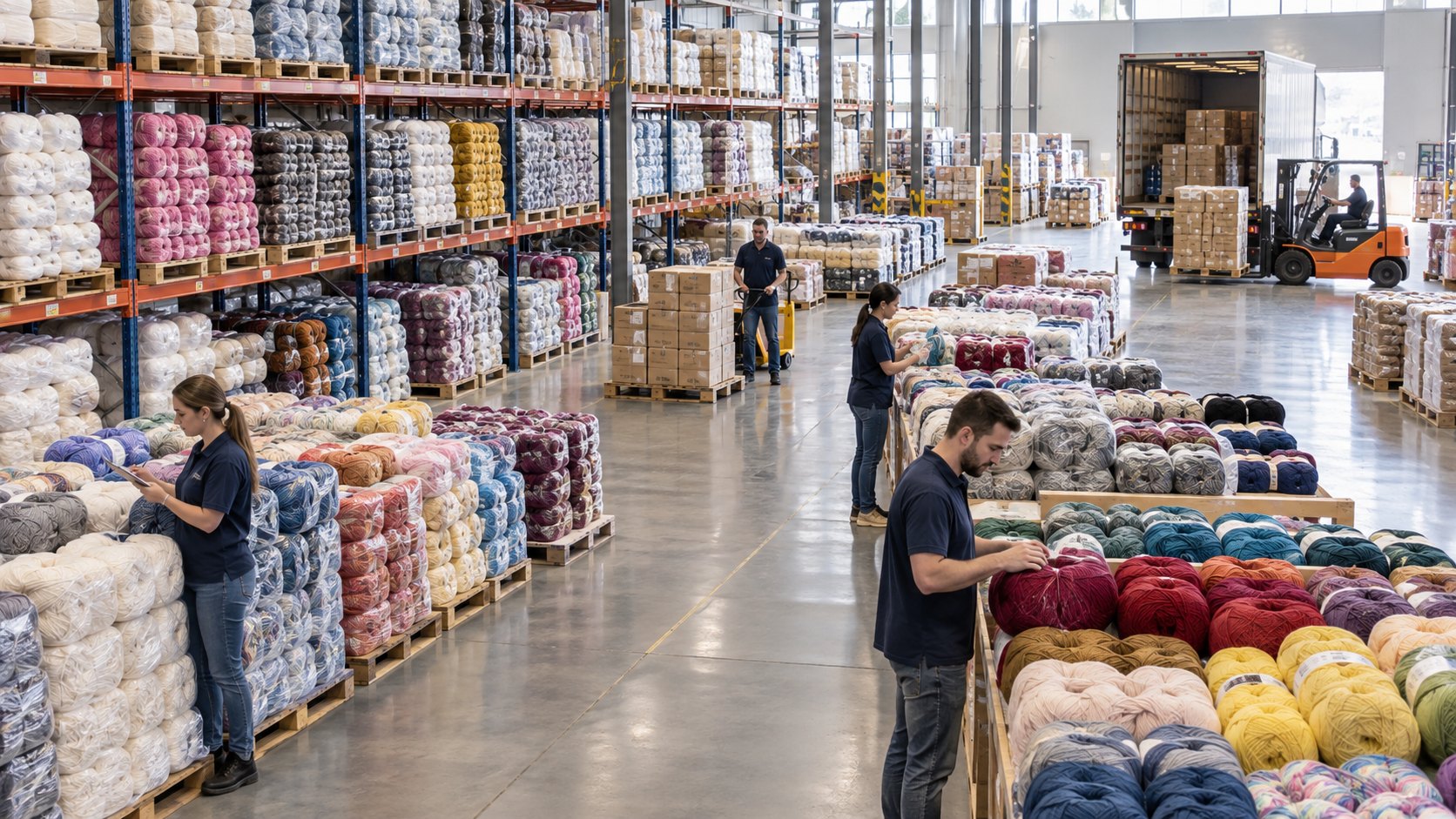
Spinning mills are built for volume and price their output accordingly: container quantities, and a minimum order quantity per shade and per count because a dye vessel and a spinning frame are both expensive to change over. A knitting unit finishing a run needs a few hundred kilos in a single matching lot, next week. Those two facts do not meet, and the gap between them is the entire commercial reason a yarn wholesaler exists.
So the business is not really buying and selling yarn. It is holding depth in a limited number of counts and fibres, and being able to answer a mill's question — is there enough of this in one lot — on the telephone. Dubai does that job for a wide region rather than for its own factories alone, because the port and the customs system are built to take cargo in and send it onward, and because a buyer in a neighbouring market can inspect and collect without a container commitment.¹
Weight is the unit, and weight is not stable
Yarn is bought and sold by weight, and yarn takes up and gives off moisture with the air around it. A bale that is heavy in a humid loading bay is lighter in an air-conditioned store, and the difference is not a rounding error on a truckload. Experienced buyers argue about conditions of storage and the point at which weight was taken; inexperienced ones discover the problem in a stock count.
Shade lots behave the same way. Two lots of the same dyed count from the same spinner are not interchangeable in a finished piece, so a lot has to be kept whole and sold whole, and a part-sold lot is a liability sitting on a rack. Discipline about lots is what separates a yarn stockist who makes money from one who slowly accumulates odd weights nobody wants.
Price is set somewhere else
Cotton is a globally traded commodity and polyester yarn tracks a petrochemical feedstock chain, which means the wholesaler works inside a spread he does not set and cannot argue with. The skill is in buying quality and quantity accurately, in timing a purchase against a customer's committed order rather than against a hunch, and in not holding a count that has gone out of fashion with the mills.
Sorted by who actually takes delivery, the orders in this trade collapse into three kinds of customer — and the weight falls heavily on one of them.
five kinds of order, three kinds of buyer
- Combed ring-spun cotton in one matching shade lotThe run is already scheduled and the shade has to hold across the whole piece
- Rotor-spun yarn in coarse counts, bought on price per kiloTerry, denim and heavy knit absorb small variation and buy on cost
A knitting or weaving mill
- Filament polyester and industrial thread on conesMachines are fed cone by cone and changed by colour, so it is many shades in small weights
- Metallic, fancy and textured yarn in short lengthsDecoration buys novelty in tiny quantities and pays for having it in stock
An embroidery or thread house
- Container lots bought to be moved on unopenedNothing enters a production line here, so the value added is holding and paperwork
A buyer outside the UAE
Read the concentration rather than the rows. Most of this trade ends at a mill, and that has two consequences. The customer is technically competent and will test what arrives, so a specification sheet counts for nothing against a laboratory result. And the customer is also captive in a useful way: a mill that has qualified a yarn on its machines does not change supplier lightly, which is why a single mill relationship can carry a young company for years.
The lines next door, and where each boundary falls
Four activities sit close enough to this one to be chosen by mistake.
CZ 141 — Wholesale Of Fabrics
The moment yarn becomes cloth it is a different line with a different customer. Fabric is sold on shade, width and weight to people who cut; yarn is sold on count and lot to people who knit or weave. The two pages are complementary rather than competing, and several operators eventually hold both lines because a weaver is a yarn customer and a cloth customer in the same week. They are still two activities, and the wording on the licence has to say so.
CZ 143 — Wholesale Of Haberdashery
Sewing thread is the honest overlap. Thread on a domestic reel sold to a tailor is a notion and belongs with needles and trims; industrial thread on a cone sold to a stitching unit behaves exactly like yarn. The test is the buyer, not the product — and where a range straddles the boundary it is worth having the activity wording confirmed in writing rather than assumed.
Spinning and texturising
Turning fibre into yarn is manufacturing. It needs an industrial licence, approved premises and the federal standards framework that goes with production, and it is a different undertaking with different capital needs.² A trader who intends to twist, texturise or dye is not buying the right line here.
Raw fibre
Cotton lint, tops and staple fibre before spinning are an agricultural commodity trade with its own controls, not a yarn line. The physical goods look related and the trade does not behave alike at all.
Who should take this licence
A stockist who already has a mill's order book
The strongest version of this business starts from a confirmed offtake and works backwards to a spinner. Mills buy repeatedly, in volume, on terms, and they tell you what to hold.
A mill buying its own raw material
Knitters and weavers tired of paying an intermediary take the line so they can import in their own name, hold the parcel themselves and control the lot. It changes the landed cost and the security of supply at the same time.
An agent or re-export operator
Companies whose value is movement rather than consumption. Here the choice between a mainland licence and a free zone one does real work: goods that never enter the local market are handled differently from goods sold to a factory on UAE soil, and that structural question is worth settling before premises are taken.
Where this is the wrong purchase. If the intention is to spin, dye or texturise, or to sell cloth, this is not the activity. It permits the trade in yarn and nothing beyond it.
What the licence costs to hold, what conditions attach to a specific fibre, and how a consignment is classified on arrival all depend on the emirate, the premises and the goods themselves. ConsultZone confirms them with the licensing authority against the real product list before anything is committed.
References
- Import and export clearance, customs codes and the treatment of restricted goods. Dubai Customs
- Industrial licensing, national standards and conformity for production and processing. Ministry of Industry and Advanced Technology
- The federal framework for trade and commercial activity in the UAE. UAE Government portal
Elsewhere in Trading
Activities that sit beside this one
Most licences carry more than one activity. Adding a neighbouring line at the application stage costs a fraction of amending the licence afterwards.
Begin with a clear conversation
Tell us what you intend to build.
A consultant will map the structure, jurisdiction, approvals and likely cost against what you actually described — not against a package.
