

Activity CZ 139
How to Start a Textiles, Clothing and Footwear Wholesale Business in Dubai
Textiles, clothing and footwear share one licence line and almost nothing else. Breadth wins the mixed order and costs depth in all three. The line suits an importer, not a specialist.
ConsultZone licensing desk
- Activity code
- CZ 139
- Category
- Trading
- Reviewed
- Read
- 7 min
Listen instead
56 seconds
An audio summary of this guide.
Topic summary
How to Start a Textiles, Clothing and Footwear Wholesale Business in Dubai
A container holding bolts of shirting, cartons of boxed garments and racks of shoes is carrying three businesses under one bill of lading. They share a licence line, a warehouse floor and a customs file, and almost nothing after that. Cloth is sold by the metre or by the kilo and has no size at all. A garment is sold across a size curve and loses value the week the season turns. A shoe is sold in pairs across a size run, and a run with the middle sizes gone is close to worthless however good the leather is.
That is the whole argument about this activity. It is the broad line in the textile family, and breadth is genuinely worth something — but it is worth a great deal to one kind of trader and very little to anyone else. The pages next door cover cloth, garments and shoes one at a time, and a reader who already knows which of the three is his real trade should be reading those instead. This one is for the trader whose advantage is assortment.
What one line across three families actually covers
Read as a trade rather than as a row on a spreadsheet, the line runs from cloth to the finished article.
Textiles are piece goods: woven and knitted cloth held as roll stock, greige or finished, plain or printed, plus made-up textile articles. Clothing is the finished garment — outerwear, shirting, knitwear, sportswear and work clothing, sold in packs and size curves. Footwear covers leather, textile, rubber and moulded shoes, sandals and boots, sold by the pair and boxed in size runs.
What the line plainly does not reach is more useful to know than what it does. The yarn the cloth was spun from is a line of its own, because its buyer is a factory working to a production plan rather than a shop working to a season. The needles, thread, zips and trims a workroom consumes sit under haberdashery. Fur articles, clothing accessories such as gloves, ties and braces, umbrellas and made-up household linen each carry their own line. A reader whose real trade is one of those is better served by the narrow page than by this one, and choosing this line because it sounds broader is the commonest classification mistake in the family.
Two further boundaries matter more than any of that. Making the goods is not trading them: weaving, knitting, dyeing, printing and cut-and-sew work are manufacturing, carried out under an industrial licence on approved premises, and the standards side of that is federal.¹ And a wholesale line is written for selling to the trade. Selling over a counter to the public is a retail activity and is licensed as one, so a business that means to do both wants the activity wording settled before the licence is cut rather than discovered afterwards.
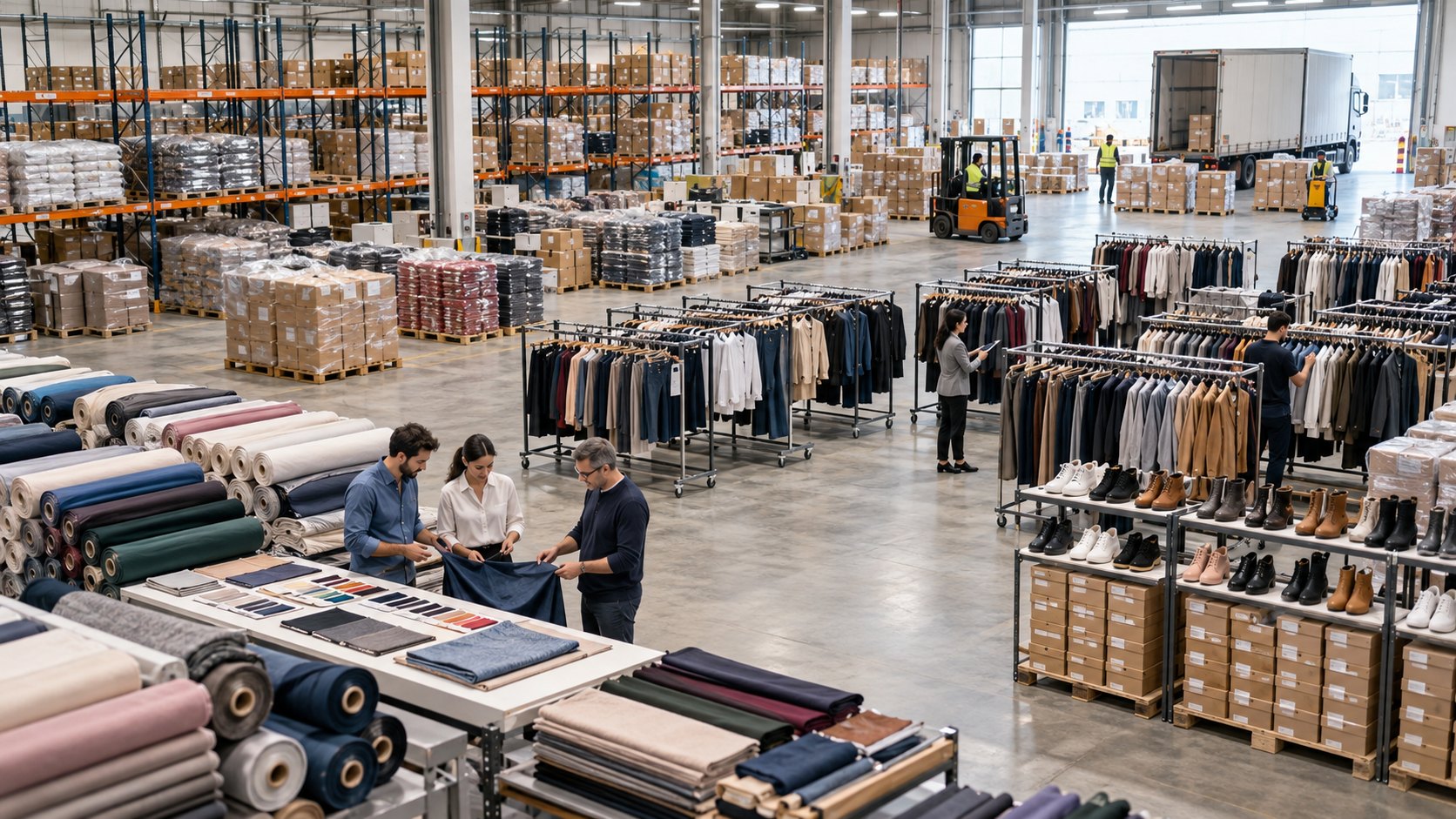
The buyers are four different trades, and only one of them wants all three
The cloth and garment streets of Bur Dubai and Deira exist for a reason that has nothing to do with rent: a buyer can cross a road and see forty suppliers in an afternoon. The independent retailer who shops there buys narrow and often, holds almost no stock himself, and pays for availability rather than for price. Serve him and you are running a stockholding business whose product is being open when he arrives.
The second buyer is the uniform and workwear account — a contracting company, a hotel group, a school supplier, a facilities firm. It buys one specification, in one colour, repeatedly, and it will happily buy cloth, garments and safety footwear on the same purchase order. This is the buyer the combined line is genuinely for, and it is the reason the line exists at all.
The third is the regional wholesale buyer who flies in, inspects, and takes a mixed container onward to a market outside the UAE. Assortment is the product there; slow-moving lines travel out alongside fast ones, and the skill is in making up a container that clears.
The fourth is the online seller buying small repeat lots: low value per order, high service expectation, and a returns rate that barely exists in the trade channels.
Each of those routes rewards something different and charges for it in a different currency, and no new entrant has the working capital to sit in all four at once.
five ways to trade the same licence line
What it givesWhat it costs
- Carrying cloth, garments and footwear togetherThe mixed order closes in one visit, and one buyer's trip pays for the dayThree seasons, three size logics, and stock money too thin to be deep in any of them
- Narrowing to one family and going deepDepth a buyer cannot find on the next street, and a price that holdsThe mixed order walks, and the whole year turns on one category's season
- Buying branded carry-over stockGoods that sell themselves, at a price the label already setProof of title down the chain, and no say in what the next parcel contains
- Putting your own label on plain goodsThe repeat order and the margin both stay with youThe labelling file, the fit complaints and the returns are yours alone
- Selling mixed containers to regional buyersVolume that clears the slow lines along with the fast onesTerms argued in somebody else's market, and no second chance on a size run
The marked row is the one to read twice. Breadth is a service, and a service has to be paid for out of a margin that breadth itself compresses — three families means three times the stock-keeping units, three buying seasons and three ways to be left holding goods. The operators who make the wide line work are almost always the ones with a contract account behind them, because a uniform order absorbs assortment without asking for fashion.
The conditions sit on the goods, not on the company
Nothing on a trade licence tells a reader whether a particular consignment may be sold here, and that gap is where money is lost in this trade.
Consumer textiles, garments and footwear fall inside the federal standards and conformity framework, which sets what a product must comply with and how that compliance is demonstrated before the goods reach a buyer.¹ The requirement most often missed is labelling. Fibre composition and care instructions in Arabic belong on the article itself, which makes them a print decision taken at the factory — not something that can be corrected on a pallet after arrival.
Clearance is a customs matter, and the classification of the specific article decides how it is treated.² Two things reliably go wrong. The first is an assortment or a size run described loosely on an invoice, which turns a routine clearance into a query and a day into a week. The second is intellectual property. Apparel and footwear are among the most widely copied consumer goods there are, protected marks are enforced at the border, and a wholesaler who cannot show where a branded parcel came from is the one holding it when it is detained.³
Where this is the wrong purchase. If the plan is to manufacture, to open a shop to the public, or to trade one of the three families seriously and the other two as an afterthought, this is not the line to take.
What the licence costs to hold, which approvals attach to a specific article, and how a given consignment is cleared all depend on the emirate, the premises and the actual product list. ConsultZone confirms those against the chosen jurisdiction and the real range before anything is committed.
References
- National standards, conformity assessment and product labelling for consumer goods — what a textile, garment or footwear article must comply with, and the industrial licensing line that separates making from trading. Ministry of Industry and Advanced Technology
- Import and export clearance, customs codes, and restricted and prohibited goods. Dubai Customs
- The federal framework for trade, consumer protection and intellectual property rights. UAE Government portal
Elsewhere in Trading
Activities that sit beside this one
Most licences carry more than one activity. Adding a neighbouring line at the application stage costs a fraction of amending the licence afterwards.
Begin with a clear conversation
Tell us what you intend to build.
A consultant will map the structure, jurisdiction, approvals and likely cost against what you actually described — not against a package.
