
Activity CZ 144
How to Start a Clothing Wholesale Business in Dubai
Clothing wholesale commits money a season before it learns whether it was right. What a size curve actually buys, why sportswear behaves differently, and where the markdown goes.
ConsultZone licensing desk
- Activity code
- CZ 144
- Category
- Trading
- Reviewed
- Read
- 7 min
Listen instead
48 seconds
An audio summary of this guide.
Topic summary
How to Start a Clothing Wholesale Business in Dubai
The order for next season is placed while this season is still hanging unsold. That is the defining condition of clothing wholesale and there is no way to arrange the business out of it. Money goes out against a judgement about what people will want, months before anybody can check, and the stock that judgement buys loses value by the week rather than by the year. A carton of sewing thread is worth the same in March as it was in January. A carton of last season's jackets is not.
The second thing to understand is that the unit of purchase is not a garment. It is a size curve — a pack weighted towards the middle sizes, with fewer at each end. Buy the curve correctly and the range sells through. Buy it badly and the middle clears in weeks while the ends stand there, and a range a retailer cannot fill from is worth markedly less than the sum of its remaining pieces. Most of the losses in this trade are not bad styles. They are good styles in the wrong ratio.
Two calendars collide in this market, and reading them correctly is most of the buying skill. The wardrobe here is shaped by heat outdoors and cooled air indoors rather than by four temperate seasons, while suppliers ship to a northern calendar. Stock that arrives labelled as autumn is worn differently, at a different time, for different reasons. A buyer who understands that buys better ranges than one who takes the collection as it is offered.
The buyer is a retailer with a season to fill and a fixed budget to fill it with
Almost nobody in this line sells to the public. The customers are boutiques and independent shops, department store buyers, chain retailers, online sellers holding no stock of their own, souq and market traders, uniform and corporate account suppliers, and other wholesalers consolidating for regional markets. What they have in common is a budget fixed before the season opens and divided among suppliers, so a new supplier is not asking for an order — it is asking a buyer to take money away from somebody already on the list.
That is why this line rewards a point of view more than it rewards a large warehouse. A wholesaler who can say which three things will sell, and be right often enough, becomes part of a buyer's plan. One carrying whatever the factory had available competes on price alone, and price competition in a market this well supplied is a slow way out of business.
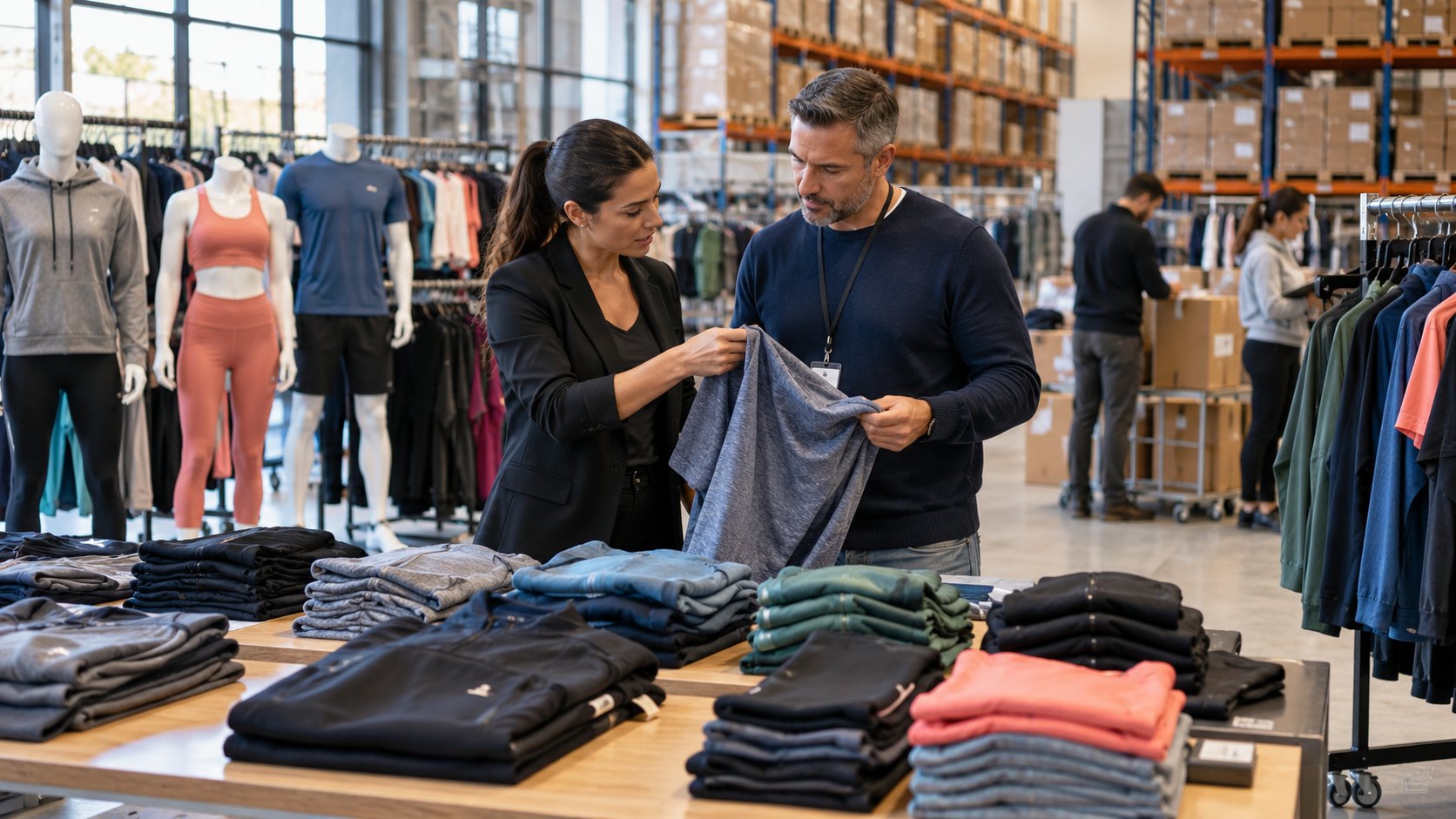
Sportswear, which the activity name calls out specifically, carries its own buyer and its own risks. Clubs, gyms, schools and sports retailers buy to a specification rather than to a look, they re-order as kit wears out, and they will ask a supplier to stand behind whatever the label claims about the fabric. Branded and licensed kit adds a further condition: the right to sell it comes from the owner of the mark, and a wholesaler who cannot show that its supply is authorised is holding an exposure rather than an asset. Goods bought outside the owner's own distribution are where this trade most often gets into trouble, and the trouble lands on whoever is holding the stock.
| Everyday clothing | Technical sportswear | Licensed and branded kit | |
|---|---|---|---|
| When the money goes out | A season before it sells | A season, plus a sampling round | On the terms agreed with the owner of the mark |
| What the buying unit is | A size curve weighted to the middle | A curve, plus a fit block per style | A specified article, ordered to a club or school list |
| What the label must survive | Fibre, care and origin | The performance claim as well | The owner's own approval of the article |
| What actually goes wrong | Broken sizes, cleared at a discount | A claim nobody can stand behind | Stock nobody is authorised to sell |
| How the business repeats | Next season, differently | By style, for as long as the fit holds | Annually, to the same list |
Read the marked row first. The three columns fail in three unrelated ways, which means they are three businesses sharing one activity line rather than one business with three product groups. A wholesaler good at clearing broken sizes is not thereby equipped to hold a licensing exposure.
CZ 144 — Wholesale Of Clothing, Including Sports Clothes
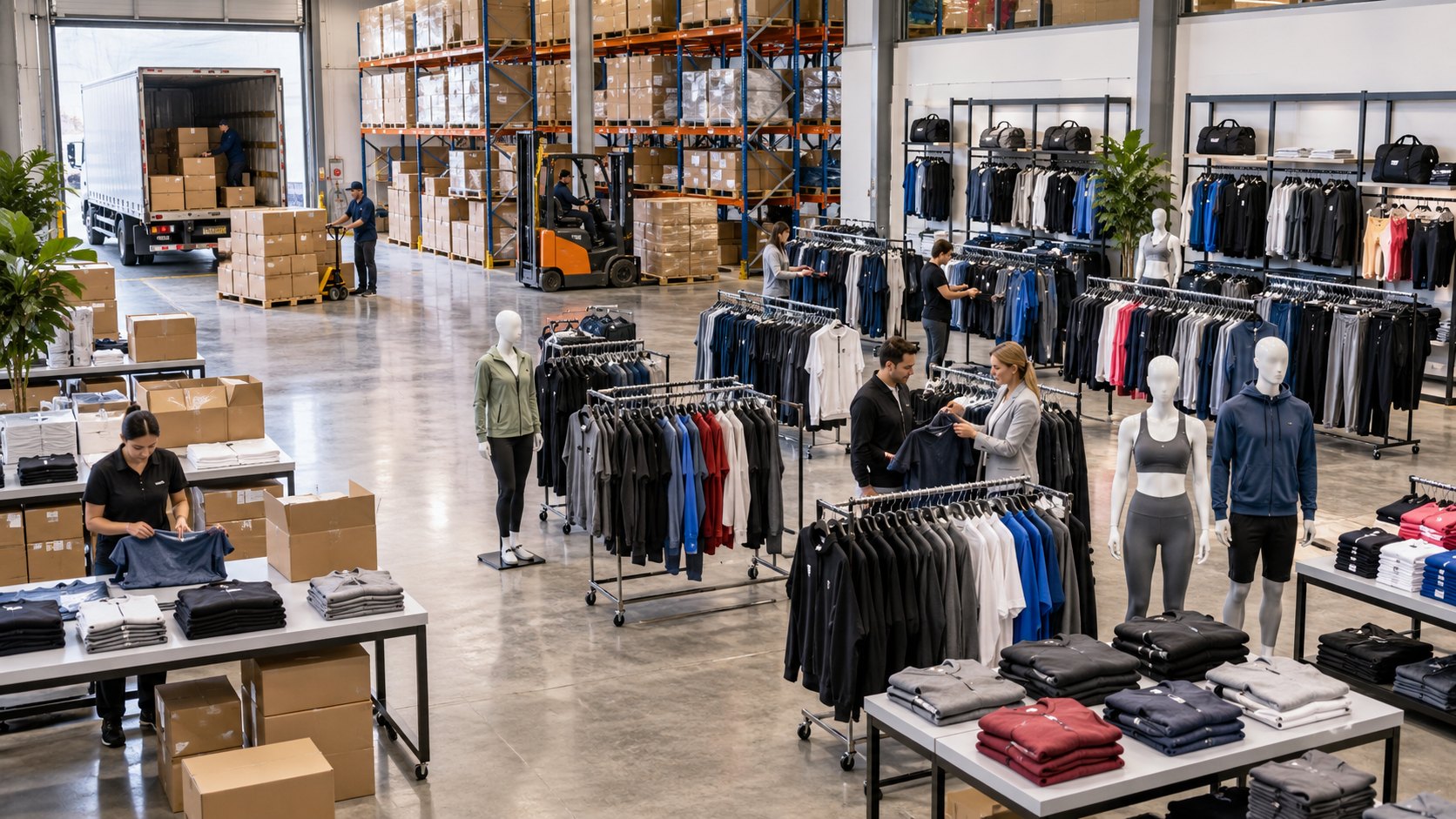
This line is the trade in finished garments bought for resale to other businesses. Outerwear, shirts, trousers and jeans, knitwear, dresses, abayas and kanduras bought ready-made, children's and infants' clothing, nightwear, underwear and hosiery, swimwear, and the sportswear and team kit named in the activity. The common feature is that every article was made to a size and a pattern before anybody knew who would wear it.
That is the whole boundary of the line and it does two useful pieces of work. It separates this activity from making the garments, and it separates it from cutting them to a named person, which is what the tailoring lines in this catalogue do. It also means the goods arrive finished, labelled and packed, so what matters at the border is the paperwork and what the label says, not the state of the article.
Around that sit the ordinary conditions. Garments sold on to consumers fall inside the national standards, conformity and Arabic labelling expectations for consumer goods, which are administered federally, and fibre content, care instructions, size and country of origin are the details a retailer will ask about before it takes delivery.¹ Imported stock clears through the emirate's customs authority, which is also where the code the company deals under comes from, and it is worth arranging before the first container is booked rather than while it is waiting.² Warehouse staff and sales people need work permits and contracts, with the wage payments behind them a continuing obligation.³ The unit and its storage are the municipality's ground, settled with the tenancy.⁴ Corporate tax applies as it does to any UAE business, and once takings pass the mandatory turnover threshold the company is inside the VAT system too.⁵ Which of these applies, and on what conditions, differs between the mainland and the free zones and between one emirate and the next, so it is confirmed for the specific case before a lease is signed.⁶
What this line does not carry
Several adjacent plans are close enough to be worth naming, because choosing the wrong one is discovered at the border rather than at the counter.
Making the garments is apparel manufacture, not trading, and cutting them to a customer's measurements is tailoring. Selling to the public from a shop or a website is retail, which is a separate activity even where the same stockroom serves both. Footwear is not here — it is CZ 146, and the reason is structural rather than administrative: shoes multiply every style by a full run of sizes, so the stock arithmetic is a different business. Accessories are CZ 145, where most articles have no size at all. The cloth is CZ 141, the yarn CZ 140 and the trims CZ 143. Fur articles are CZ 147 and household linen CZ 142. The combined umbrella covering textiles, clothing and footwear together is CZ 139, which is the line to look at when a business genuinely intends to hold all three rather than specialise.
One more boundary matters more than it looks. Protective clothing — high-visibility wear, flame-resistant or cut-resistant garments, anything sold to keep a worker safe rather than dressed — is personal protective equipment. It carries conformity obligations that ordinary clothing does not, it is classified that way before it is ordered rather than when it lands, and a business intending to supply it should say so while the activities are being chosen. The same physical garment can fall on either side of that line depending on what it is sold as, and that is exactly why it gets missed.
References
- Ministry of Industry and Advanced Technology — national standards, conformity marks and labelling expectations for clothing sold to consumers. Ministry of Industry and Advanced Technology
- Dubai Customs — import and export of finished garments, and the customs code the trading company deals under. Dubai Customs
- Ministry of Human Resources and Emiratisation — work permits, labour contracts and wage protection for warehouse and sales staff. Ministry of Human Resources and Emiratisation
- Dubai Municipality — premises suitability and storage conditions for a wholesale unit. Dubai Municipality
- Federal Tax Authority — VAT and corporate tax enrolment and filing. Federal Tax Authority
- UAE Government portal — the mainland and free zone licensing structure and general federal information. UAE Government portal
Elsewhere in Trading
Activities that sit beside this one
Most licences carry more than one activity. Adding a neighbouring line at the application stage costs a fraction of amending the licence afterwards.
Begin with a clear conversation
Tell us what you intend to build.
A consultant will map the structure, jurisdiction, approvals and likely cost against what you actually described — not against a package.
