

Activity CZ 142
How to Start a Household Linen Wholesale Business in Dubai
A hotel does not buy a towel; it buys the hundredth wash. Household linen wholesale is contract supply against a written specification and a replacement cycle, which is not the same trade as selling bedding.
ConsultZone licensing desk
- Activity code
- CZ 142
- Category
- Trading
- Reviewed
- Read
- 7 min
Listen instead
44 seconds
An audio summary of this guide.
Topic summary
How to Start a Household Linen Wholesale Business in Dubai
A hotel does not buy a towel. It buys the hundredth wash.
That is the sentence that separates this activity from the shops that sell the same-looking goods. A commercial laundry washes hot, uses chlorine, extracts at high speed and irons under pressure, and it does that to the same towel a hundred times and more. A towel that is thick and soft on delivery and thin, grey and hard-edged after one season has failed — and it failed on the specification, not on the price. The buyer knows this, which is why he writes the specification before he asks what it costs.
So the trade is contract supply. It looks like a consumer-goods wholesale line on a spreadsheet and behaves like an industrial one in practice: written specifications, sampling, tenders, invoices on terms, and orders that repeat on a cycle for as long as the house keeps its standard.
The margin is in the replacement order, not the first fill
Two facts about how a hotel holds linen decide the whole commercial shape of this business.
The first is par stock. A house does not hold one set of linen per bed; it holds several — one in use, one in the laundry, one on the shelf — so the opening order is a multiple of the room count rather than a shelf quantity. That makes the first fill large, visible and fought over, and it is frequently won on a thin margin precisely because everyone in the market can see it coming.
The second is the replacement cycle. Linen degrades in the laundry rather than on the bed, so a house replaces continuously as items fall out of standard, against the same specification it approved at the start. That repeat order is quiet, unadvertised, placed by a housekeeper rather than a purchasing committee, and it is where this business actually earns. A supplier who holds the approved specification in stock, in the same shade, and can deliver on a telephone call, keeps it for years. A supplier who cannot has to re-tender for it.
Two consequences follow. Working capital sits in stock held against an expected call-off rather than an issued order, which is heavier than it looks. And shade consistency across years matters as much as it does in the cloth trade, because a house cannot have two whites on one floor.
That is the hospitality route. There are two other ways to sell the same goods, and it is worth seeing them on the same rows.
one product, three ways to sell it, six rows
| Judged on | Hotel contract supply | Wholesale to retailers | Selling direct to the public |
|---|---|---|---|
| The specification is written by the buyer | Yes | No | No |
| The opening order is sized by the building | Yes | No | No |
| Repeat business arrives on a replacement cycle | Yes | Partly | No |
| Price is argued once, in a tender | Yes | Every season | Every day |
| Durability in an industrial laundry decides the re-order | Yes | Indirect | No |
| Stock has to hold one shade for years | Yes | No | No |
The column the drawing picks is not the easiest of the three — it is the one with the longest sales cycle and the most demanding buyer. It is chosen because it is the only one of the three where a single approved specification produces revenue without a fresh argument, and that is the difference between a trading business and a stall.
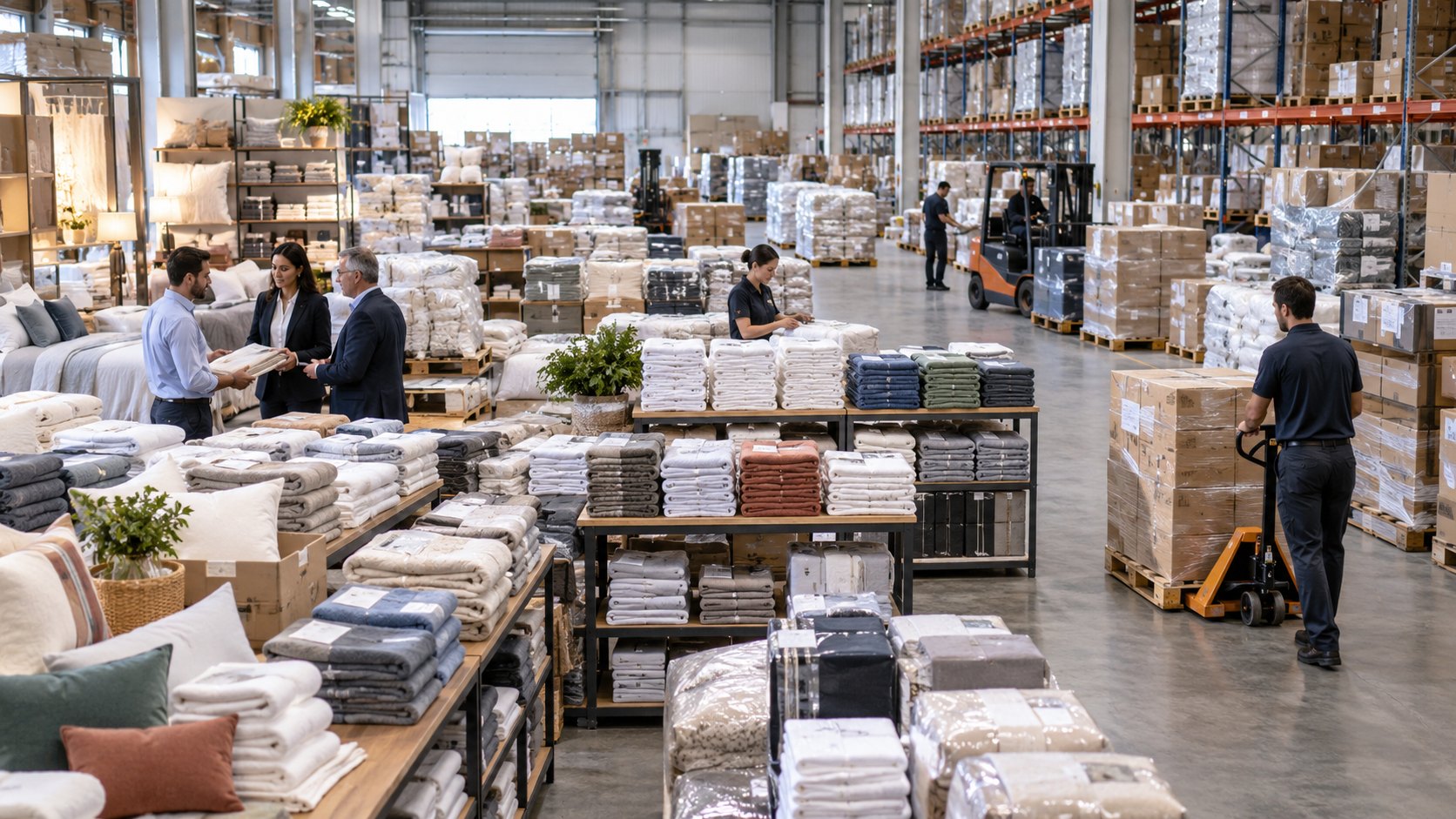
CZ 142 — Wholesale Of Household Linen Etc.
What the "etc." actually holds
Bed linen — sheets, duvet covers, pillowcases and protectors. Towelling in its full range, which is wider than people expect: bath sheets, bath towels, hand and face towels, bath mats, pool towels and beach towels, each with a different specification and a different theft rate. Table linen — cloths, napkins, runners and banqueting skirting. Bathrobes and slippers. Kitchen textiles such as aprons and tea towels. Made-up soft furnishings including cushion covers and ready-made curtains.
What it is not
The cloth these articles are made from is a separate line: fabric is sold by the metre to people who cut, and that page sits beside this one. Making the articles up — cutting, hemming, embroidering a monogram — is manufacturing under an industrial licence. Household furniture and household appliances each carry their own trade lines, and a mattress reads as furniture while the protector over it reads as linen. That last boundary is genuinely fine, and it is exactly the kind of thing worth settling with the licensing authority in writing before the activity wording is fixed rather than after a consignment has arrived.
The vocabulary a contract buyer uses
A hospitality specification is written in terms a retail buyer never uses: fibre and blend, the weight of towelling per square metre, thread or pick count for flat linen, the finished size after washing rather than before it, hem and stitch construction, colour fastness to chlorine and to industrial washing, and the number of laundry cycles the article is expected to survive. A supplier who cannot read that document cannot quote against it, and a supplier who quotes against it loosely is the one who loses the account in year two.
The conditions attach to the goods and to the unit
The goods. Household textiles are consumer products and sit inside the federal standards and conformity framework, which sets what an article must comply with and how compliance is shown.¹ Labelling is the part most often got wrong: fibre composition and care instructions, in Arabic, on the article itself — a factory decision, not something that can be put right on a pallet after arrival.
Clearance. Import is a customs matter and the classification of the specific made-up article decides how it is treated.² Assorted containers of mixed linen are a common source of clearance queries, because an invoice that describes a parcel loosely gives the classification nothing to work with.
The unit. Made-up textiles in volume are combustible and take a great deal of space for their value, so warehouse suitability sits with the municipality and how the stock may be stacked and protected sits with the fire-safety authority in the emirate concerned.³
Supplying a health facility. Hospital and clinic linen is bought by an operator whose own licence conditions govern what it may put into service, so the constraint arrives through the customer rather than through the supplier's trade licence. It is a question for the health authority and one to ask before tendering, not after winning.⁴
Tax. A contract supplier invoices on terms, which means the business meets the federal tax framework as a matter of course: once it crosses the enrolment threshold it must enrol for VAT and account for it, and corporate tax applies on its own terms. The thresholds and the filing mechanics belong to the Federal Tax Authority and should be read there rather than taken from a supplier's summary.⁵
Where this is the wrong purchase. If the plan is to cut and sew the linen, to embroider it as a service, or to open a bedding shop to the public, this is not the activity. It permits the trade in the finished article and nothing more.
What the licence costs to hold, which approvals a specific unit and a specific product range attract, and how a consignment is classified all depend on the emirate, the premises and the goods themselves. ConsultZone confirms those with the licensing authority for the actual case, and settles the mainland-or-free-zone question against where the linen is really going, before anything is committed.
References
- National standards, conformity assessment and labelling requirements for consumer textile articles. Ministry of Industry and Advanced Technology
- Import and export clearance, customs codes and the classification of made-up textile goods. Dubai Customs
- Premises suitability and municipal conditions on a warehouse unit in Dubai. Dubai Municipality
- Health facility licensing conditions that govern what a facility may accept into service. Dubai Health Authority
- VAT enrolment, corporate tax and filing obligations for a trading company. Federal Tax Authority
Elsewhere in Trading
Activities that sit beside this one
Most licences carry more than one activity. Adding a neighbouring line at the application stage costs a fraction of amending the licence afterwards.
Begin with a clear conversation
Tell us what you intend to build.
A consultant will map the structure, jurisdiction, approvals and likely cost against what you actually described — not against a package.
