

Activity CZ 143
How to Start a Haberdashery Wholesale Business in Dubai
Haberdashery wholesale is judged on whether the one item a workshop is missing today is on the shelf. Why breadth beats price, and what thousands of tiny lines do to a stockroom.
ConsultZone licensing desk
- Activity code
- CZ 143
- Category
- Trading
- Reviewed
- Read
- 8 min
Listen instead
55 seconds
An audio summary of this guide.
Topic summary
How to Start a Haberdashery Wholesale Business in Dubai
A tailoring workshop with eleven kanduras cut, pressed and waiting on the rail can be stopped for a day by one missing spool of thread in the right shade of off-white. The garments are finished work. The thread is worth almost nothing. That asymmetry is the whole commercial premise of haberdashery wholesale, and it is why this trade is won on availability and lost on the day a regular has to go somewhere else.
Haberdashery is everything that goes into a garment except the cloth, together with the things the workroom consumes while making it. Sewing and embroidery thread, hand and machine needles, pins, zips, buttons, studs, hooks and eyes, press fasteners, elastic, bias binding, tape, interlining, shoulder pads, braid and trimming, bobbins, shears, tailor's chalk and measuring tapes. Individually they are the cheapest things in the building. Collectively they decide whether a garment can be finished at all.
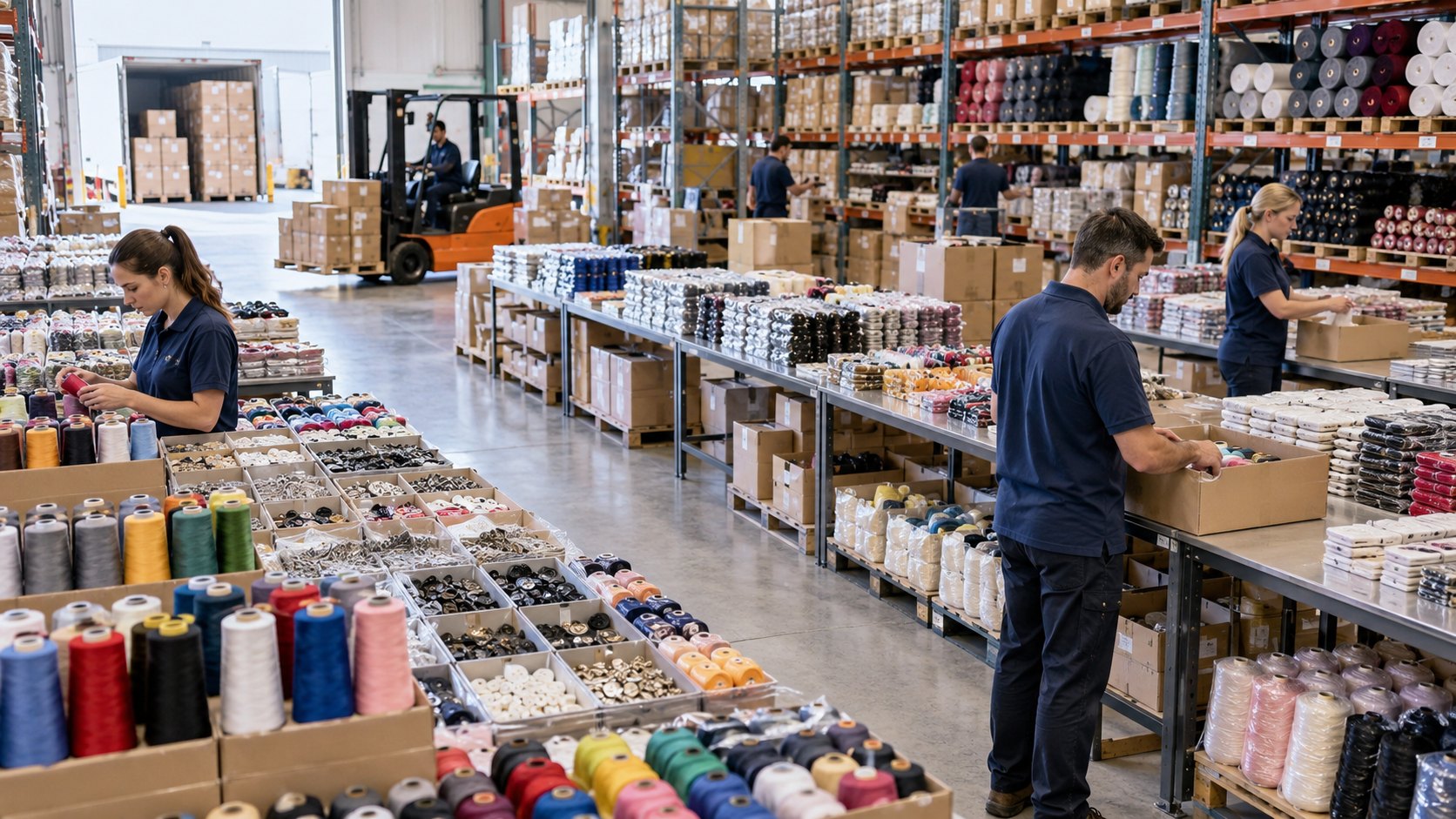
The figure that describes this business is not turnover. It is the number of distinct items on the shelf. Thread alone runs to hundreds of shades across several weights and finishes. A zip is a length, a colour, a tooth size, a material and a decision about whether it opens at one end or both, and every combination of those is a separate item. Buttons multiply by diameter, by material, by the number of holes and by finish. A stockroom that intends to be useful to a working tailor carries several thousand lines, and most of them sell in ones and twos.
That changes what the capital is doing. In most trading lines the money concentrates into a few buying decisions and each one is a bet. Here it spreads thin across thousands of items, and no single item is a bet at all. The bet is the assortment.
The stock list runs to thousands of lines, and almost none of them are expensive
Thread is bought by shade, and the colour card is the sales tool
A workshop matching thread to a customer's cloth does it by eye, against a physical card of real thread laid flat under the light. Shade names and numbers are not common between makers, so a cutter who has learned one supplier's card is reluctant to learn another's. Handing over that card is how this trade acquires a customer, and it holds better than a discount, because it costs the customer something to switch.
Fastenings multiply faster than anything else on the shelf
Zips are the clearest case. A workshop finishing an abaya, a set of hotel uniforms and a sofa cover in the same week wants three different constructions in three different lengths, and will accept a near-match on colour but never on length. Buttons behave the same way. The practical consequence is that picking, not storage, is what shapes the unit: this business needs bins, labels and a sensible walking order far more than it needs floor area.
The consumables are what bring a workshop through the door every week
Needles break, bobbins run out, chalk wears down and shears go blunt. Nobody plans a trip for any of them, which is exactly why they generate the traffic. The trims earn the margin once the customer is already standing at the counter. A range built only around the profitable half of that pairing gets visited half as often.
Against all of it sits dead stock, and it has to be named honestly. An unpopular shade of thread is bought once and then stands on the shelf for years. It is held anyway, because the promise this business makes is that the awkward shade is there. In this line dead stock sits closer to a marketing cost than to a buying error — but it is still capital standing still, and a business that refuses to count it will mistake a wide range for a profitable one.
The customer is a workshop with a job waiting, not a shopper
The buyers sit a few pages away in this same catalogue. Arabic gowns and menswear tailoring, ladies' and gents' wear workshops, embroidery units, curtain and upholstery makers, uniform and school-wear suppliers, alteration shops, and the apparel manufacturers who buy the identical items by the carton rather than by the dozen. Almost none of them are consumers, and that one fact decides how the business is built.
Two buying behaviours live inside that customer base and they want opposite things. The small workshop buys weekly, in small quantities, at a counter, and judges a supplier on a single number: how often it has what was asked for. The production unit buys against a specific order's bill of materials, in cartons, with notice, and judges the same supplier on price and on whether this delivery of item 4B is identical to the last three. Serving both from one shelf is possible and common. Pretending they are one customer is how a stockroom ends up too shallow for the factory and too narrow for the tailor.
Which of the two a new business is really for is the first decision, and most of the rest of the file follows from it.
- Decide which half of the customer base the business is forThe counter trade wants breadth; the production trade wants depth and consistency
- Build the assortment around the fast-moving consumables firstThey bring a workshop through the door, and the trims earn the margin once it is there
- Will the range carry every shade, or only the movers
- Every shadeYou become the shelf that has it, and you pay for that in stock which never turns
- Movers onlyCapital turns quickly, and the awkward order walks to a competitor and often stays there
- Take a unit sized for picking rather than for palletsBins, labels and a walking order matter more here than floor area
- Put a customs code in the company's own name before the first order is placedAlmost all of this arrives imported, and the code is what a shipment is released against
- A shelf a workshop can rely on, which is the only durable advantage in this lineEverything else on this page is in service of that one sentence
Where this line sits between a mainland licence and a free zone one
The customers described above are UAE workshops operating on UAE soil, buying small quantities, often over a counter. That points at a mainland licence, issued by the emirate's economic department, because the trade is domestic supply to UAE businesses and a mainland structure is built for exactly that.
A free zone licence answers a different question. It suits goods that arrive and leave without entering the UAE market — consolidating trims from several origins and shipping them on to workshops elsewhere in the region, or holding stock for a foreign principal. Sold that way the line becomes a consolidation and logistics business that happens to deal in haberdashery, and it is judged on shipment economics rather than on fill rate. A business that intends to do both usually ends up with a structure for each. What either one costs to hold depends on the emirate, the premises and the exact activity mix on the licence, and those are the things ConsultZone confirms for a specific case rather than quoting from a page.
What attaches around the licence is modest by the standards of this catalogue, and it is worth saying plainly that no button has a product file. Nothing on this shelf is a controlled article in the way food, medicines or fuel are. Two things still apply. Goods packed for sale on to consumers — a retail sewing kit rather than a carton of machine needles going to a factory — fall inside the national standards, conformity and Arabic labelling expectations for consumer goods, which are administered federally, so the pack is a different proposition from its own contents.¹ And the unit itself, its shelving and what it discards are the municipality's ground, settled with the tenancy rather than after it.² Imported stock passes through the emirate's customs authority, which is also where the code the business deals under comes from.³ Pickers and counter staff need work permits and contracts, and the wage payments behind them are a continuing obligation.⁴ Corporate tax applies as it does to any UAE business, and once takings pass the mandatory turnover threshold the company is inside the VAT system as well.⁵
Where this is the wrong purchase. Three neighbouring plans get mistaken for this one. Selling the cloth itself is CZ 141, wholesale of fabrics, and selling the yarn is CZ 140 — this line is what goes into cloth, not the cloth. Manufacturing the trims is a production licence, not a trading one. And selling the same items to the public from a shop is retail, which is a different activity on the licence even when the stockroom behind it is identical.
References
- Ministry of Industry and Advanced Technology — national standards, conformity and labelling expectations for goods packed for consumers. Ministry of Industry and Advanced Technology
- Dubai Municipality — premises suitability and trade waste conditions for a storage and counter unit. Dubai Municipality
- Dubai Customs — imported trims and consumables, and the customs code the trading company deals under. Dubai Customs
- Ministry of Human Resources and Emiratisation — work permits, labour contracts and wage protection for counter and warehouse staff. Ministry of Human Resources and Emiratisation
- Federal Tax Authority — VAT and corporate tax enrolment and filing. Federal Tax Authority
- UAE Government portal — the mainland and free zone licensing structure and general federal information. UAE Government portal
Elsewhere in Trading
Activities that sit beside this one
Most licences carry more than one activity. Adding a neighbouring line at the application stage costs a fraction of amending the licence afterwards.
Begin with a clear conversation
Tell us what you intend to build.
A consultant will map the structure, jurisdiction, approvals and likely cost against what you actually described — not against a package.
