

Activity CZ 189
How to Start a Wires and Switchgear Wholesale Business in Dubai
Wires and switchgear wholesale is a stock availability trade — contractors buy from whoever has the right cable on the rack today. Under-specified cable is the real risk sitting inside it.
ConsultZone licensing desk
- Activity code
- CZ 189
- Category
- Trading
- Reviewed
- Read
- 7 min
Listen instead
43 seconds
An audio summary of this guide.
Topic summary
How to Start a Wires and Switchgear Wholesale Business in Dubai
Eight electricians standing on the fourteenth floor with no four-core armoured cable is a day of wages spent on nothing, plus a programme slipping behind, plus a main contractor asking why. That sentence is the entire business. Whoever has the item this afternoon takes the order, and the supplier who does not have it gets the next call only if he said so plainly instead of promising.
It is worth being clear about how unusual that makes this line. Most wholesale activities are won on price, or on a brand nobody else carries, or on a relationship built over years. This one is won on the rack. Price matters, obviously, but a contractor comparing two quotes three per cent apart will take the one that ships today every single time, because three per cent of a cable order is small against the cost of a crew doing nothing. The consequence is uncomfortable for anybody entering with a thin balance sheet: the stock is the competitive advantage, and there is no clever way around holding it.
CZ 189 — cable, containment, switchgear and the parts between them
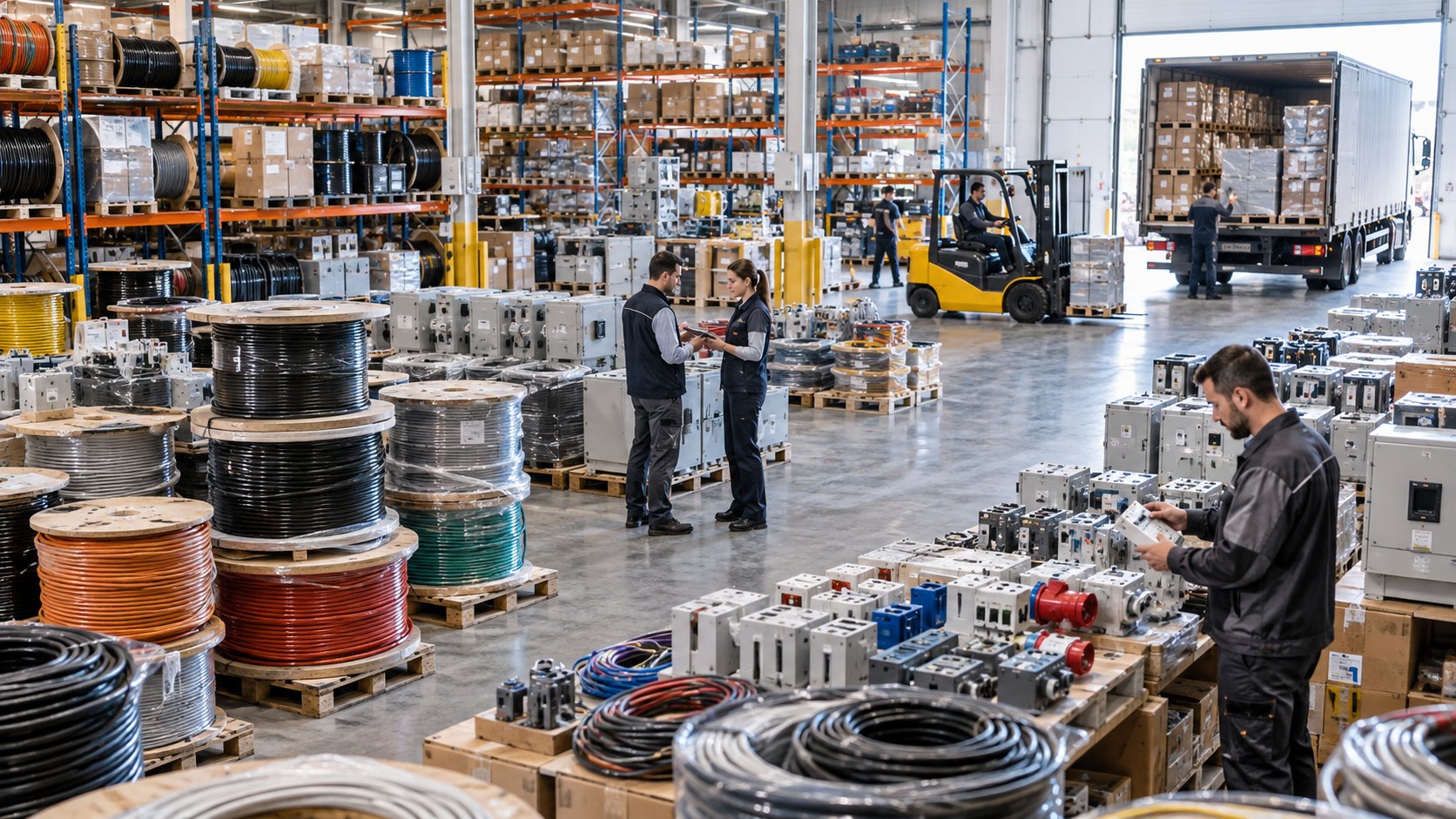
This is componentry, not finished equipment. Nothing in the line plugs in and works on its own; every item is something an electrician installs inside a building, a plant or a distribution network.
Four groups cover almost all of it.
Cable and wire. Single-core and multicore building wire, armoured power cable, control and instrumentation cable, flexible cords, fire-rated and fire-survival cable, welding cable, earthing conductors, and busbar and bar systems at the heavy end.
Containment and accessories. Conduit in metal and plastic, trunking, cable tray and cable ladder, ducting, glands, cleats, clamps, junction and back boxes — the unglamorous half of every installation and a surprisingly large share of the invoice.
Switching and protection components. Switches and isolators, circuit breakers and protective devices, contactors and relays, distribution boards and enclosures, terminals, fuses and fuse carriers, and the metering and indication parts that go on a panel door.
Consumables. Lugs and ferrules, tape, sleeving, ties, markers, glue and sealant. Low value each, ordered constantly, and the items whose absence stops a job as effectively as a missing drum of cable.
What the line does not cover is worth saying once, because two neighbouring activities get confused with it. Lighting fittings are a separate wholesale line with a different buyer and a different sales cycle. Finished electrical machines — motors, transformers and the control gear built around them — sit in the activity next door at CZ 190. And the installation work itself is electrical contracting, which is a different licence entirely and answerable for a different thing.
The buyer is a contractor who needed it yesterday
Six customer types account for nearly the whole order book, and they do not behave alike.
Electrical contractors are the volume. They buy against a job, they buy repeatedly, and they buy in a hurry. MEP subcontractors on large projects buy to a schedule of quantities drawn up by a consultant, in stages, over months. Panel builders and switchboard assemblers buy components rather than finished gear, to a design, and they are the most technically demanding customers on the list. Facilities and maintenance teams buy small quantities of specific items with no notice, at good margins, because availability is worth more to them than price. Industrial plant stores hold their own minimum stocks and replenish predictably, which makes them the best customers in the book. And other traders buy from you to fill their own gaps, at thin margins, with cash.
The route to them splits the business in two, and the split matters more than anything else on this page. At the small end it is a counter-and-van trade: local stock, fast delivery, cash or short credit, and a phone that rings all day. At the large end it is project supply: scheduled deliveries, documentation, retention against the main contractor's payment cycle, and invoices settled long after the goods were consumed. Those two shapes need different money. The counter end finances a shelf; the project end finances somebody else's cash flow, and the risk there is never the sale — it is the collection. A wholesaler who runs both from one balance sheet usually finds that the project side has quietly eaten the stock that made the counter side competitive.
- Take the specification, not the shopping listThe consultant's schedule names the size, the cores, the insulation and the standard it must meet
- Read what the drum on your rack actually isThe print on the sheath, the drum length, the conductor material and the maker's own test papers
- Does the drum match the specification that was written
- YesPrice it, deliver it in full, and the payment argument never begins
- NoSay so and quote the correct item — a substitution nobody approved becomes your liability at the inspection
- Deliver complete, because a part delivery is a stopped site
- The invoice a main contractor certifies without a disputeThe only kind of invoice in this trade that gets paid on time
The question in the middle of that drawing is the one the whole trade turns on, and the tempting answer is the wrong one. A supplier short of the specified item, facing a customer who needs something today, is under real pressure to send the nearest thing on the rack and let the site work it out. That substitution is invisible for weeks and then extremely visible at inspection, and by then the paper trail leads back to the delivery note with your name on it. Saying no costs one order. Saying yes to the wrong drum can cost the account, the retention and the reputation that took three years to build.
Cable is a safety product, and the wrong cable is the trade's real problem
Cable is priced like a commodity and is not one. Two drums marked with the same nominal size can differ in the actual cross-section of the conductor, in the purity of the copper, in the grade and thickness of the insulation, and in the temperature rating the compound will really hold. None of that is visible on a rack. All of it decides what happens during a fault, when the whole point of the cable is that it carries the fault current for long enough to let a protective device operate and does not set fire to the building while doing it.
Counterfeit and under-specified cable is a known and openly discussed problem in this trade across the region, and a guide that does not name it is not being useful. It appears in three recognisable forms. Short measure, where a drum sold as a full length is not one. Conductor substitution, where aluminium or copper-clad aluminium is supplied against a copper specification, or the cross-section is quietly undersized to hit a price. And false marking, where the sheath print claims a standard the product was never tested against.
The defence is documentary and it is dull, which is why the weaker operators in this line skip it. Buy from makers who will hand over their own type test and batch certificates. Keep the trace from the drum number to the delivery note, so that a question two years later has an answer. Weigh or measure inbound drums on a sample basis rather than trusting the label. And refuse a substitution that a consultant has not approved in writing, every time, including when the customer is shouting.
Conformity assessment, national standards and product marking sit with the federal ministry responsible for industry and standards. Fire-rated and fire-survival cable, and anything serving a fire alarm or an emergency circuit, is a civil defence matter in Dubai and is treated far more strictly than ordinary power cable. Naming the kind of control is as far as a general page should go: what a specific product needs, which mark it must carry and what the approval involves depend on the product list and the authority, and those are confirmed for the actual case.
What the licence costs to hold, which emirate suits a counter-led business against a project-led one, and what a particular product range requires before it can be supplied all depend on the range, the premises and the licensing authority — confirmed case by case rather than quoted.
References
- Ministry of Industry and Advanced Technology — national standards, conformity assessment and product marking for electrical goods. Ministry of Industry and Advanced Technology
- Dubai Civil Defence — fire safety requirements, fire-rated cable and emergency circuit approvals in Dubai. Dubai Civil Defence
- Dubai Customs — import entry, customs codes and controlled goods on entry. Dubai Customs
- UAE Government portal — federal law, consumer protection and general government information. UAE Government portal
Elsewhere in Trading
Activities that sit beside this one
Most licences carry more than one activity. Adding a neighbouring line at the application stage costs a fraction of amending the licence afterwards.
Begin with a clear conversation
Tell us what you intend to build.
A consultant will map the structure, jurisdiction, approvals and likely cost against what you actually described — not against a package.
