

Activity CZ 190
How to Start an Electric Motors and Transformers Wholesale Business in Dubai
Motors and transformers are calculated against a load by an engineer, never chosen off a shelf. That one fact decides what a wholesaler in this line must stock, must know and must not guess at.
ConsultZone licensing desk
- Activity code
- CZ 190
- Category
- Trading
- Reviewed
- Read
- 7 min
Listen instead
46 seconds
An audio summary of this guide.
Topic summary
How to Start an Electric Motors and Transformers Wholesale Business in Dubai
A motor is not chosen. It is calculated. Somebody with a load in front of him — a pump curve, a conveyor, a fan, a compressor, a hoist — works out the power it will absorb, the speed it has to turn at, the torque it needs to break away from standstill and how many hours a day it will run. Out of that comes a motor with a particular frame size, a particular number of poles, a particular enclosure rating and a particular efficiency class, and the engineer who did the arithmetic is not interested in an approximate equivalent.
The same discipline applies one level up. A transformer is sized against a connected load, a voltage pair, an impedance and a prospective fault level, and a cooling arrangement that suits where it will physically sit. Nobody buys one because it was available.
That makes this line genuinely unlike most of the wholesale catalogue. In consumer goods the seller persuades. Here the customer arrives already knowing the answer, and the supplier's job is to have that answer in stock, or to say honestly how long it will take to get it. The commercial skill in this trade is not selling. It is stocking decisions and technical credibility, in that order.
CZ 190 — Electric Motors and Transformers
Two families sit under one heading and they behave almost oppositely.
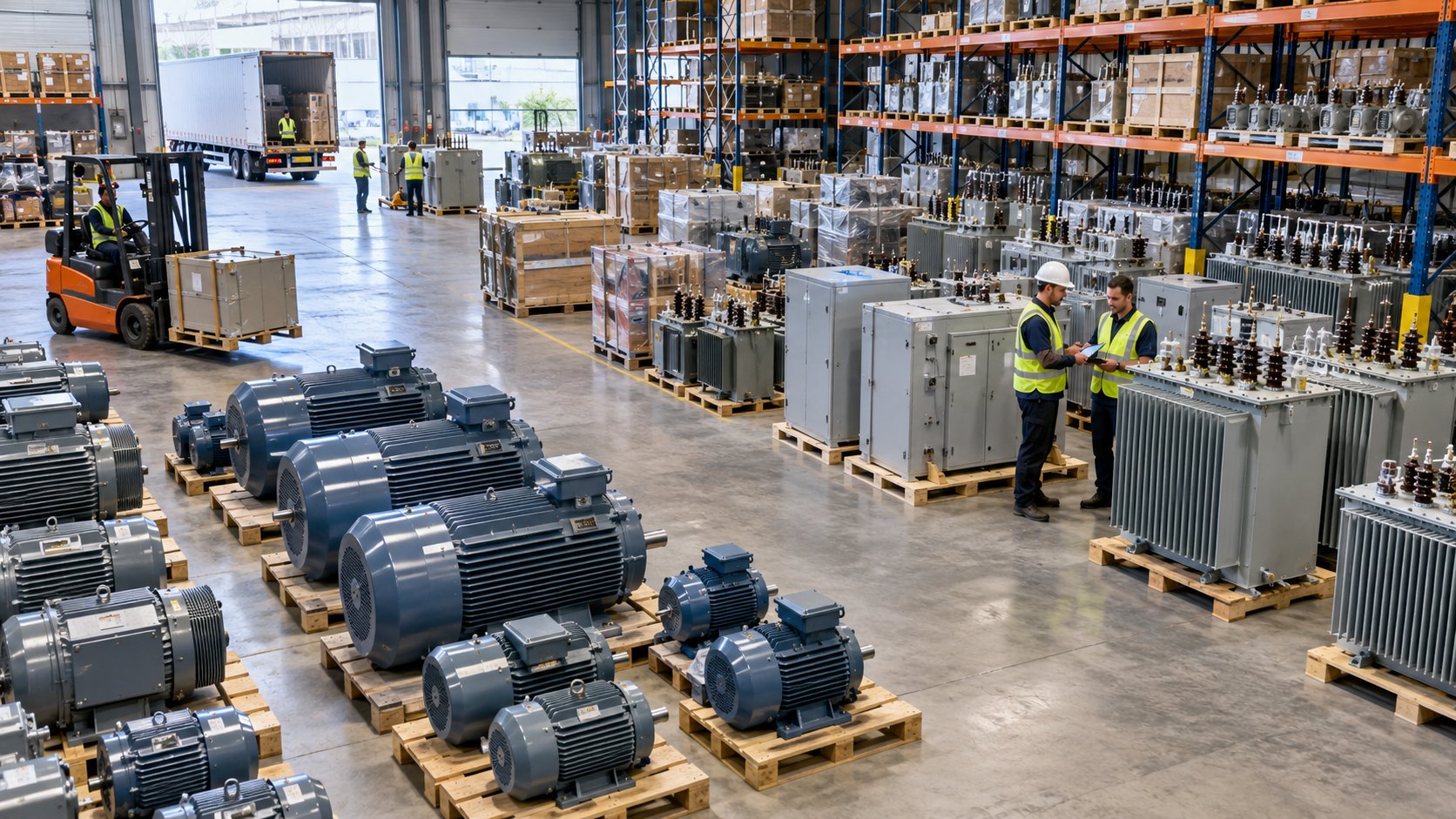
The rotating machines are the bulk of the order book: three-phase induction motors above everything else, single-phase motors, geared and gearbox-mounted motors, brake motors, submersible and pump motors, fan and blower motors, and crane and hoist duty motors. Around them sits the control gear that makes a motor usable — direct-on-line and star-delta starters, soft starters, and variable-speed drives, which have become a line in their own right because they save energy on any load that does not need full speed all day.
The static machines are fewer, heavier and slower to turn: distribution and power transformers in dry-type and oil-filled forms, control and isolation transformers, auto-transformers, current and voltage transformers used for measurement and protection, and reactors and chokes.
The difference between the two families is a stocking problem before it is anything else. Motors multiply: frame size against pole count against mounting arrangement against voltage against enclosure rating produces hundreds of distinct items, most of them cheap to hold individually and impossible to hold completely. Transformers do not multiply so much as weigh — few ratings, each one heavy, expensive and slow-moving, where holding the wrong rating ties up serious money and holding none loses an order you cannot recover. Almost every commercial decision in this activity comes back to that asymmetry.
| Electric motors | Transformers | |
|---|---|---|
| What it is specified against | A driven load, a duty cycle and a starting torque | A connected load, a voltage pair and a fault level |
| What moves inside it | A rotor, and everything that wears is attached to it | Nothing, which is why they outlast the buildings |
| What the engineer checks first | Efficiency class, frame size and enclosure rating | Rating, impedance and the cooling arrangement |
| What the wrong choice costs | A machine that stalls, or one that runs hot until it fails | An installation held at the wrong voltage or fault level |
| What holding stock looks like | Hundreds of items, each one cheap | Few items, each one heavy and expensive |
| Who repairs it instead of replacing it | A rewinding workshop, routinely | A specialist, and usually only larger units |
The focus row is where the sale is won or lost, because those three attributes are what the customer will read off your quotation before he reads the price. The last row is worth a sentence of its own: a burnt-out motor is very often rewound rather than scrapped, which means every motor wholesaler competes with the repair shop down the road on part of the demand. Understanding when rewinding is the right answer for the customer — and saying so — is what turns a first order into a stocking account, and a wholesaler who pretends otherwise gets found out the first time a plant engineer asks.
Four lines that sit beside this one and are not it
Wires, switches and installation equipment, CZ 189. The cable, containment, switchgear components and protective devices that connect a motor to a supply are the activity next door. Holding both is common and entirely sensible, because the same buyer wants both, but the licence wording has to carry both rather than one of them.
Rewinding and repair of electrical machines. Stripping a failed motor, rewinding the stator and rebalancing the rotor is workshop work with its own premises, its own safety questions and its own activity line. It is the most frequent unplanned addition to a motors business, and the honest time to ask about it is before a bay is fitted out.
Machine tools, CZ 191. A lathe or a press contains motors and drives, and the two trades meet in the same factories, but a machine tool is bought as a productive asset against a part it will produce. Different specification conversation, different buyer inside the same building.
Generating sets. A generator is a motor's mirror image and looks like an obvious range extension. It is usually bought by a different department against a different case, it arrives packaged with an engine, and the engine drags fuel storage and its own site approvals in behind it.
Beyond those four, supplying a transformer and installing it are separate activities, and energising it on a network is somebody else's authority altogether.
The customer is an engineer with a load, not a buyer with a catalogue
Five buyer types carry this trade, and each one buys on a different trigger.
Original equipment manufacturers and panel builders buy to build. Their demand is repeatable, forecastable and specified once for a whole production run, which makes them the most valuable accounts and the most price-sensitive.
Industrial maintenance stores buy replacements, usually urgently, often with a failed unit already on the floor. They are margin-tolerant and availability-driven, and they remember who answered the phone at seven in the evening.
MEP contractors buy transformers and motor control gear to a project schedule and a consultant's specification, with the credit and documentation behaviour that goes with project work.
Pump, HVAC and compressor assemblers buy motors as a component of their own product and care intensely about frame dimensions, because a motor that does not bolt to their casting is useless whatever its rating.
Facilities and building management teams buy pump, fan and lift motors for existing plant, where the frame and the mounting are already fixed by whatever was installed years ago.
Where this is the wrong purchase: if the plan is a small stock and a website, this line will disappoint, because the customers here buy on availability and technical confidence rather than on listings. If the plan is to repair motors rather than supply them, that is the workshop activity and not this one. And if the plan is to be a manufacturer's sole channel in the market, that is an agency question decided by the manufacturer.
What the licence costs to hold, which emirate and premises suit a motors-led business against a transformer-led one, and what conformity marking or standards a specific machine must satisfy before it can be supplied all depend on the product list, the site and the licensing authority. Those are confirmed against the actual case rather than quoted from a template — and in this activity the product list, once again, decides almost everything.
References
- Ministry of Industry and Advanced Technology — national standards, conformity assessment and product marking for electrical equipment. Ministry of Industry and Advanced Technology
- Dubai Customs — import entry and customs codes for capital electrical equipment and spares. Dubai Customs
- UAE Government portal — federal law, energy policy and general government information. UAE Government portal
Elsewhere in Trading
Activities that sit beside this one
Most licences carry more than one activity. Adding a neighbouring line at the application stage costs a fraction of amending the licence afterwards.
Begin with a clear conversation
Tell us what you intend to build.
A consultant will map the structure, jurisdiction, approvals and likely cost against what you actually described — not against a package.
