

Activity CZ 192
How to Start an Industrial and Marine Machinery Wholesale Business in Dubai
The residual machinery line covers what the specific lines missed, which is why it reaches marine and survey equipment as well as industrial and catering plant. Breadth wins enquiries and eats capital.
ConsultZone licensing desk
- Activity code
- CZ 192
- Category
- Trading
- Reviewed
- Read
- 7 min
Listen instead
55 seconds
An audio summary of this guide.
Topic summary
How to Start an Industrial and Marine Machinery Wholesale Business in Dubai
Every classification scheme ends in a line like this one. After the machine tools, the farm equipment, the office machines, the robots and the textile machinery have each been given their own entry, something has to catch everything that was not named — and this is it. The four letters that matter in the wording are n.e.c., not elsewhere classified, and the elsewhere they refer to is the rest of this very catalogue.
Treating that as a weakness is the mistake. A residual line is the most commercially useful wording in the machinery family, because industrial buyers do not shop by classification. A packaging plant wants a compressor, a conveyor, a labeller and a filtration skid, and it would rather ask one supplier than four. The trader who can answer all four questions gets the account. The trader who can answer one gets a line item.
The commercial case is breadth, and breadth is expensive
Breadth is genuinely worth money in this market. Industrial buyers in the UAE are time-poor and deadline-driven: a plant with a line down, a hotel two weeks from opening, a vessel in a shipyard with a sailing date. Whoever can quote the whole list credibly, and deliver inside the window, wins work that a specialist with a better product will lose on availability alone.
The cost sits on the other side of the same coin. A catalogue with no boundary cannot be stocked. Hold a little of everything and the store fills with slow-moving items whose value drains quietly while the fast lines run out. Hold nothing and the business is really brokering — every order placed with a factory, every lead time somebody else's, and a margin that is a commission in all but name.
Most operations here resolve it by picking a spine and brokering the rest. One or two families are held in depth, with spares, a service engineer and real technical authority behind them; everything else is quoted honestly as an indent order with a stated lead time. That is a decision about identity rather than about stock, and it is worth making deliberately at the start rather than discovering three years in that the business has become a purchasing department for other people's factories.
six choices, weighed on one rule
What it givesWhat it costs
- Quoting for anything a client asks aboutNo enquiry is turned away, and a first order opens an accountNothing is stocked, so the margin becomes a broker cut
- Holding stock across several unrelated familiesSame-week delivery, which is what wins repeat workCapital tied up in slow items and a store that ages badly
- Specialising inside the residual, on one familyGenuine technical authority and the price that goes with itEvery other enquiry goes to somebody else
- Adding marine and survey equipment to the catalogueA buyer with a sailing date and no appetite for delayApprovals a factory buyer never has to think about
- Taking on catering, laundry and commercial cleaning plantFit-out projects that repeat across a hotel or facilities groupConditions that belong to the client's premises, and are still your problem
- Selling on a manufacturer's appointment rather than the open marketFactory backing, spares and a defensible priceA territory obligation and a catalogue you no longer choose
The marked row is marked because it is the one that changes the nature of the business rather than its size, and the next section explains why.
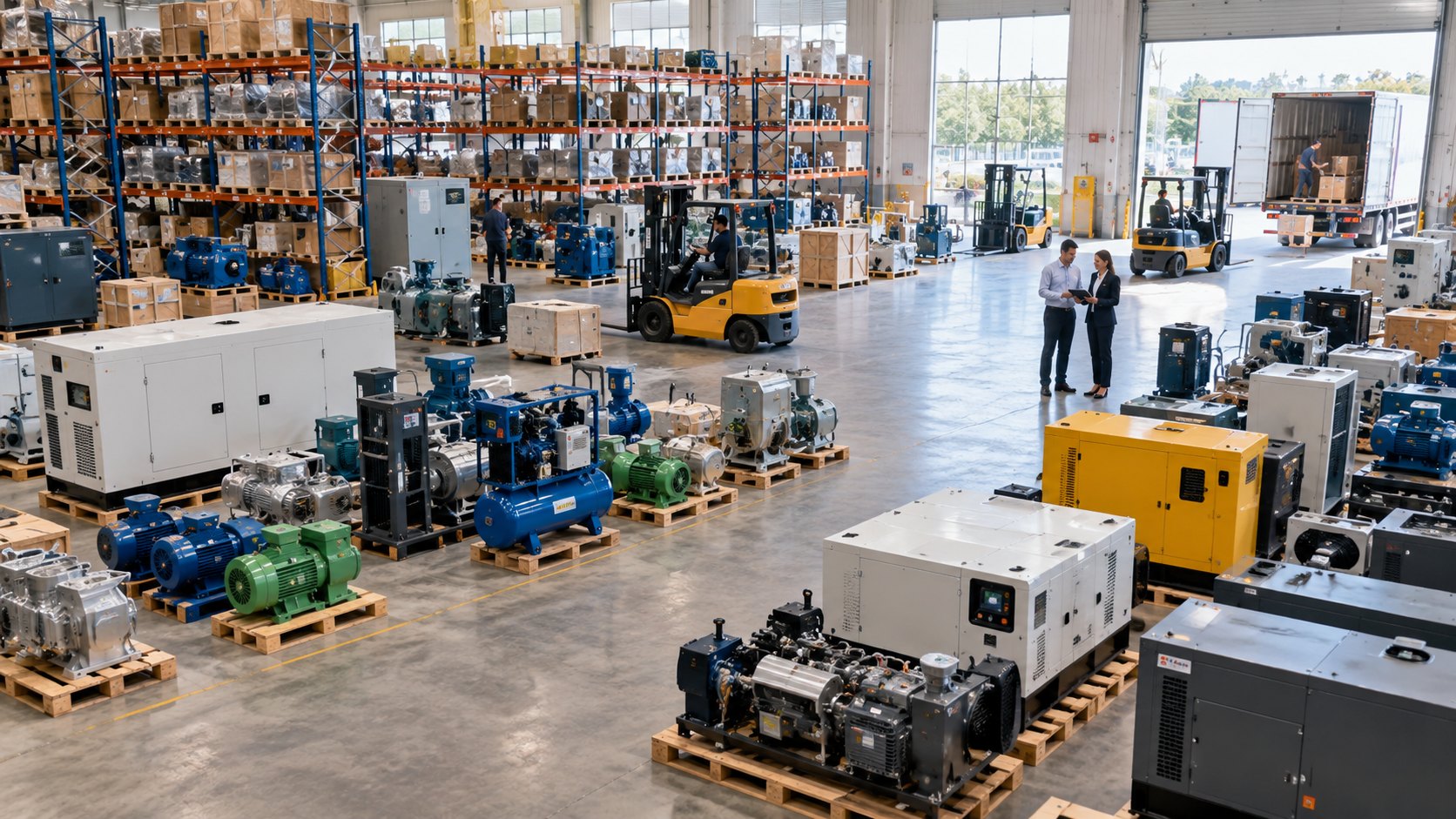
CZ 192 — Wholesale of other machinery, n.e.c.
Read the wording in its four parts, because each one opens a different market.
For use in industry is the largest share and the most predictable: compressors and air treatment, pumps and hydraulics, conveyors and materials handling, packaging, filling and labelling machines, industrial ovens and dryers, filtration and separation plant, industrial weighing equipment, hoists and lifting gear. The buyers are factories, contractors and facilities operators, and they buy on specification, availability and whether anybody local can service the thing.
For use in trade is the equipment a shop or a warehouse runs on rather than the goods it sells: display refrigeration, shop fittings and counters, scales, packing and wrapping equipment, trolleys and warehouse handling gear. Lower value per unit, faster turnover, and a buyer who thinks in fit-out budgets.
And navigation is the phrase that is easy to read past, and it quietly brings an entire sector inside the line. Marine and survey equipment belongs here: radar and echo sounders, chart plotters and autopilots, compasses and marine radio, winches, deck machinery and davits, pumps and separators for engine rooms, and the survey instruments that go with them. The UAE has working ports, shipyards, a large service-vessel fleet and an offshore industry, so this is a real market rather than a footnote — but it behaves nothing like the factory trade. A vessel has a sailing date, equipment is often specified so that a class surveyor will accept it, and anything that transmits is radio equipment before it is marine equipment.
And other services closes the wording out, and it reaches the plant behind service businesses: commercial catering and kitchen equipment, laundry and dry-cleaning machinery, commercial cleaning and floor care plant, car wash equipment, vending and dispensing machines.
What the line does not do is override a more specific entry. Machine tools have their own wording at CZ 191 and the computer-controlled versions at CZ 193; textile, sewing and knitting machinery sits at CZ 194; measuring instruments at CZ 195; agricultural machinery, office machinery, production-line robots and transport equipment each have their own lines. If the plan is squarely one of those, ask for that wording. The residual is for the trader whose catalogue genuinely does not fit any single one of them, and it is not a shortcut around a line somebody would rather not apply for.
A residual line does not override what the goods themselves need
This is the point on which files in this activity go wrong, and it is worth stating plainly: the breadth of the licence wording says nothing at all about the conditions that attach to a particular product. Those follow the goods, not the paperwork.
Three examples out of the sections above make the pattern clear.
Marine radio and radio-bearing navigation equipment transmits, and equipment that transmits meets the federal type-approval gate for telecommunications and radio equipment. That approval attaches to the device model rather than to the trading company, so it is a question to settle while a supplier is still being chosen. Alongside it sits a commercial condition that no authority imposes: a shipowner or shipyard will often specify equipment that a vessel's classification society and flag authority will accept, and an item that is technically fine but will not be accepted on the survey is unsellable at any price.
Commercial catering and food-handling equipment lands in the middle of food control. The equipment itself is ordinary machinery, but the premises it is installed into is inspected against food hygiene conditions, and a kitchen that fails on layout, surfaces or extraction is a problem the supplier gets drawn into whether or not it is formally his. Suppliers who do well here understand the client's conditions well enough to specify equipment that will pass.
Industrial machinery generally meets national standards and conformity requirements, and safety guarding, electrical compliance and marking are ordinary parts of importing it. Everything crosses the border, which means a customs code, a correct classification and a clearance on every consignment.
None of that can be quoted as a fee or a timetable from a page. Which approvals apply, which body holds each one, what a specific consignment needs and what the licence itself costs to hold depend on the product list, the emirate and the licensing authority, and they are confirmed against the actual catalogue before a supplier agreement is signed. On this activity the catalogue is the file, and narrowing it is usually the fastest way to make the answer simple.
References
- Ministry of Industry and Advanced Technology — national standards, conformity assessment and industrial machinery requirements. Ministry of Industry and Advanced Technology
- Telecommunications and Digital Government Regulatory Authority — type approval for telecommunications and radio equipment, including marine radio. Telecommunications and Digital Government Regulatory Authority
- Dubai Municipality — food control, premises suitability and public health conditions for catering installations in Dubai. Dubai Municipality
- Dubai Customs — customs codes, classification and clearance of imported machinery. Dubai Customs
- UAE Government portal — federal law, industrial and maritime strategy and general government information. UAE Government portal
Elsewhere in Trading
Activities that sit beside this one
Most licences carry more than one activity. Adding a neighbouring line at the application stage costs a fraction of amending the licence afterwards.
Begin with a clear conversation
Tell us what you intend to build.
A consultant will map the structure, jurisdiction, approvals and likely cost against what you actually described — not against a package.
