

Activity CZ 193
How to Start a CNC Machine Tool Wholesale Business in Dubai
A controller turns a machine tool into a system, so the CNC sale is programming, training and service response as much as iron. That changes who buys it and what the supplier has to become.
ConsultZone licensing desk
- Activity code
- CZ 193
- Category
- Trading
- Reviewed
- Read
- 6 min
Listen instead
47 seconds
An audio summary of this guide.
Topic summary
How to Start a CNC Machine Tool Wholesale Business in Dubai
The iron is the same. A controlled lathe and a manual one are built from the same castings, the same spindles and the same hardened slideways, and a machinist who has run one will recognise the other. Put a controller on it and almost nothing about selling it survives the change.
The reason is simple and it is worth saying before anything else on this page. A conventional machine does what the operator's hands tell it to do, so the operator is the skill and the machine is a tool. A controlled machine does what a program tells it to do, so the skill has moved into software, fixturing and process — and what the customer is buying is no longer an object but a system that has to be made to work. Programs have to be written. Post-processors have to match the machine. Tooling libraries and offsets have to be built. Operators have to be taught. And when the spindle stops on a Tuesday afternoon with a delivery due Thursday, somebody has to arrive.
That is why this line separates so sharply from CZ 191, the conventional machine tool wording next door. Same customers, often the same building, entirely different business. CZ 191 rewards a good dealer. This one only rewards a support organisation.
The same iron, and a completely different sale
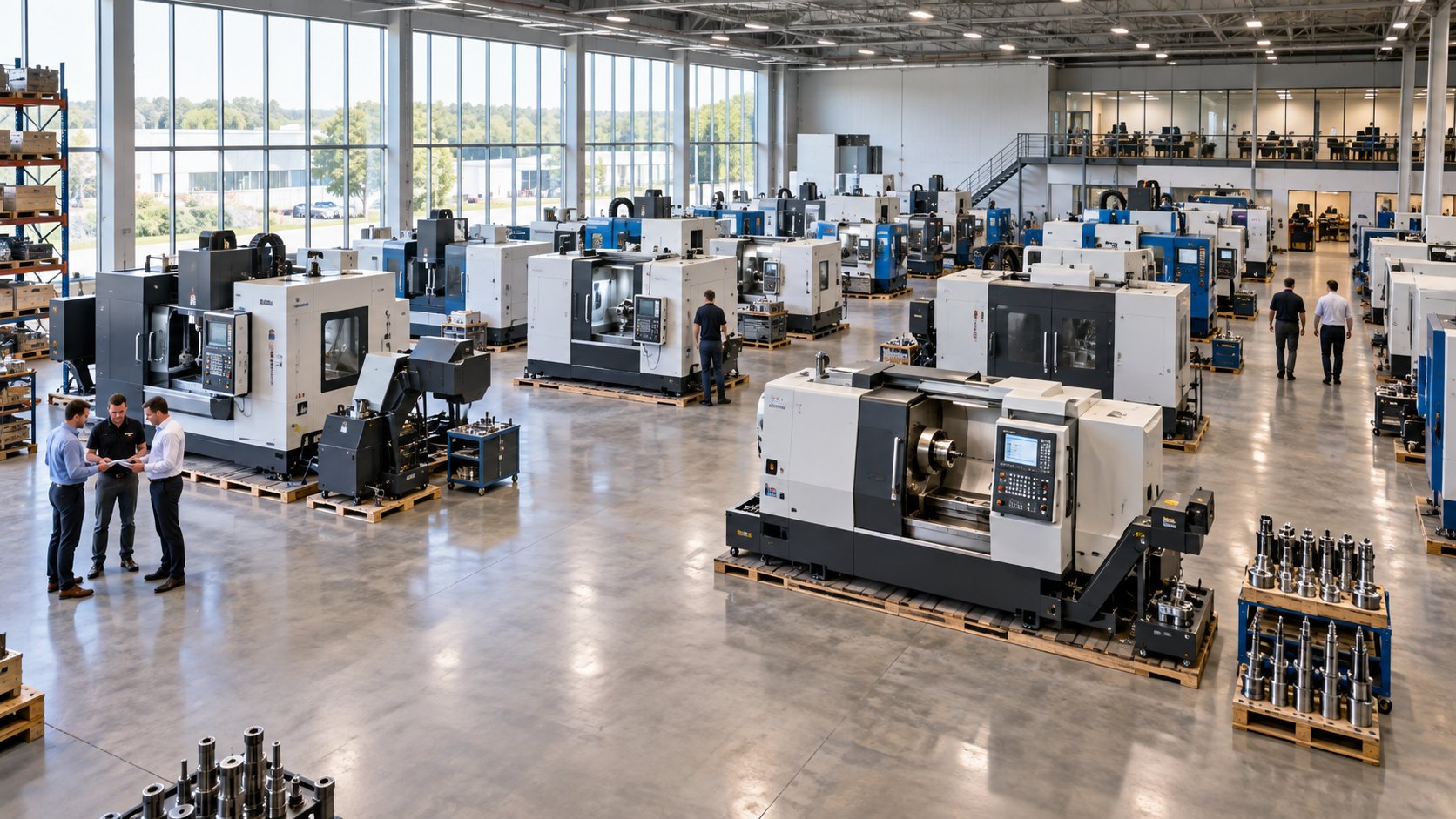
What the wording reaches is the controlled version of the metalworking catalogue: turning centres and CNC lathes, vertical and horizontal machining centres, multi-axis and mill-turn machines, controlled grinders, wire and sinker electrical discharge machines, controlled boring and gear machines, and the controlled cutting equipment that sits beside them — laser, plasma and waterjet tables, press brakes with controlled backgauges, and turret punches. The workholding, probing and toolholding that a controlled machine depends on belongs with it, because a machining centre without a tooling package is not a usable machine.
The part of the sale that does not appear in the wording is the part that decides whether the customer ever produces anything. Four things are handed over with every machine, and none of them is hardware.
A process. Somebody has to establish how this customer's part will be held, in what order it will be cut, and with which tools. On a first machine that work usually falls to the supplier, because the customer does not yet have anybody who can do it.
Programming. The part exists in software before it exists in metal, which means CAM output, a post-processor that matches this controller and this machine, and a simulation that catches the collision on screen rather than in the spindle.
Training. A machine is only as productive as the person at the panel. Under-trained operators run controlled machines at a fraction of their capability and blame the machine for it.
Service response. A stopped controlled machine is expensive in a way a stopped manual one is not, because the work queued behind it was scheduled on the assumption that it would run.
Sell the hardware and skip those four and the machine becomes a monument. Customers know this, which is why the second question in a serious enquiry is almost never about price.
Who buys a controlled machine, and what each one is really buying
The buyer has changed as well. A conventional machine is bought by a machinist or a workshop owner who will run it himself. A controlled machine is bought by somebody responsible for output — a production engineer, an operations manager, a plant director — who is answering for cycle times, capacity and delivery dates rather than for the machine. That person is not evaluating a machine. They are evaluating whether their plant will hit its numbers with it, and the supplier is part of the answer.
six buyers, three things they are actually buying
- A job shop taking delivery of its first controlled machineNobody on the floor has written a program before
- A fabricator adding controlled cutting to sheet workThe operators are fabricators, not machinists
Training and a written process
- A mould or tooling maker working to fine toleranceThe part is defined in software long before metal moves
- A subcontractor supplying oilfield or aerospace work under auditThe documentation is part of what is being bought
Programming and software support
- A plant running two shifts against delivery datesAn hour of stopped spindle costs more than the discount was worth
- A dealer reselling into markets with no local supportIts own customers call it, and then it calls you
An engineer who can be on site fast
Three destinations for six buyers, and the marked row is the one that sets the standard for the whole business. A single-shift job shop can wait two days for a part. A plant on two shifts cannot, and it will pay a premium to a supplier who holds spares locally and can put a trained engineer in a van. Once a business has committed to serving that buyer, the spares holding and the engineer are fixed costs it carries whether or not machines are selling that month — which is the real reason this line needs more capital than its conventional neighbour, and why a dealer who has not planned for it ends up losing exactly the customers worth having.
Where this is the wrong purchase: if the plan is to import machines and move them on without touching them, the conventional wording at CZ 191 describes that trade more honestly and carries none of the expectation. If the plan is to write programs or provide machining services rather than to supply machines, that is a service activity and not a wholesale one. And if the plan is to sell the software alone, software wholesale has its own line.
Where this line sits between the mainland and a free zone
The structural question is the usual one, and on this activity the service obligation answers most of it.
A supplier selling controlled machines to UAE factories is selling to UAE businesses on UAE soil, delivering to their premises, installing on their floor and returning to service what was installed. That pattern of work — one UAE company invoicing another, with engineers attending sites across the emirates — is what a mainland licence is shaped for, and it is where almost every serious support organisation in this line ends up.
The free zone case is real but narrower. Machines consolidated here and shipped onward to markets around the Gulf, East Africa and South Asia never enter the UAE market at all, and a free zone store is designed for exactly that: goods that land, are held, and leave. A business whose customers are overseas dealers rather than UAE plants may find the whole operation fits there.
Plenty of established operations do both, and the sequence matters more than the choice. The mainland entity carries the customers, the engineers and the spares; the free zone side carries transit stock for export. Which of the two a specific plan needs, whether it needs both, and what that costs to hold depend on where the customers actually are, what premises the work requires and which licensing authority is involved — and those are settled against the real plan rather than quoted from a table, before a lease is committed.
References
- Ministry of Industry and Advanced Technology — industrial licences, national standards, conformity marks and in-country value for advanced manufacturing equipment. Ministry of Industry and Advanced Technology
- Dubai Customs — customs codes, classification and clearance of imported machinery. Dubai Customs
- Ministry of Human Resources and Emiratisation — work permits and labour contracts for applications engineers and service technicians. Ministry of Human Resources and Emiratisation
- Dubai Municipality — premises suitability for industrial storage and demonstration space in Dubai. Dubai Municipality
- UAE Government portal — federal law, industrial strategy and general government information. UAE Government portal
Elsewhere in Trading
Activities that sit beside this one
Most licences carry more than one activity. Adding a neighbouring line at the application stage costs a fraction of amending the licence afterwards.
Begin with a clear conversation
Tell us what you intend to build.
A consultant will map the structure, jurisdiction, approvals and likely cost against what you actually described — not against a package.
