
Activity CZ 188
How to Start a Production-Line Robot Wholesale Business in Dubai
Nobody buys a robot on its own. A production-line robot arrives with tooling, guarding and programming, so the sale is a project and the margin sits in the integration rather than in the arm.
ConsultZone licensing desk
- Activity code
- CZ 188
- Category
- Trading
- Reviewed
- Read
- 8 min
Listen instead
48 seconds
An audio summary of this guide.
Topic summary
How to Start a Production-Line Robot Wholesale Business in Dubai
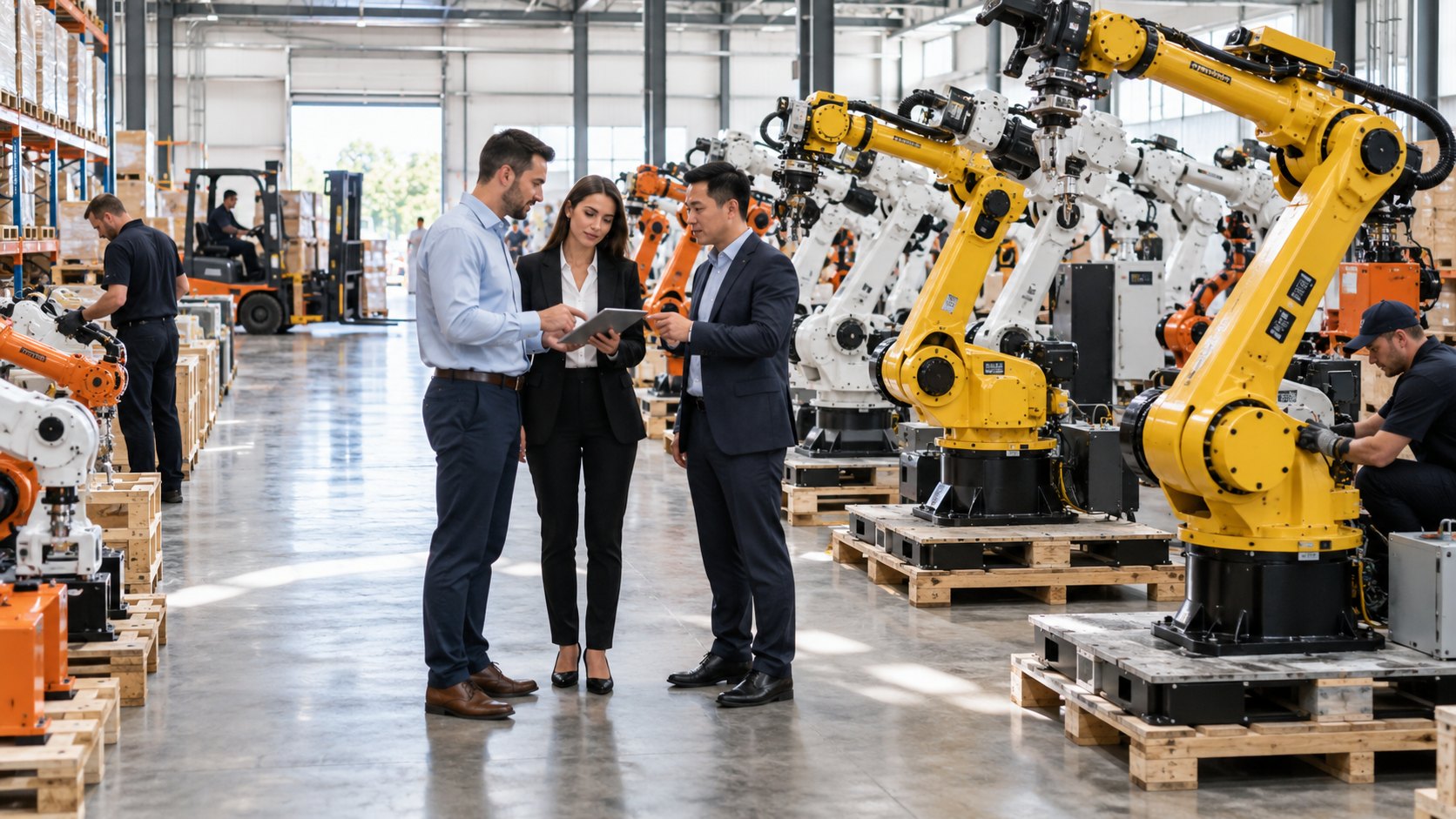
A six-axis arm delivered on a pallet does nothing at all. It cannot pick anything up, because it has no gripper. It cannot be switched on where people are standing, because it has no guarding. It does not know what to do, because nobody has taught it. Left exactly as it arrives it is an expensive sculpture, and every serious conversation in this trade starts from that fact.
So the thing being sold is not the robot. It is a solved bottleneck — a cycle time, a defect rate, a shift nobody wants to staff — and the robot is one component of the answer. That reframing is the whole commercial character of the line, and it is why a wholesaler here looks more like a systems house than like a distributor. The factory is not comparing your price against a competitor's price list. It is comparing your proposal against its own labour cost, and increasingly against its own inability to hire.
Industrial automation also has policy behind it in this country. Advanced manufacturing and industrial technology are an explicit national priority, and the federal ministry responsible for industry and advanced technology holds industrial licensing, national standards and the in-country value programme that sits over local manufacturing. A factory investing in automation is doing what national industrial strategy asks of it, and a supplier in this line can say so without overstating it.
The buyer is a factory with a bottleneck, not a factory with a budget
Most manufacturers are not candidates, and learning to tell the difference quickly is worth more than any sales training.
The plants that convert have three things in common. The operation is repetitive and high-volume, so the machine gets the hours it needs to pay for itself. The work is physically awkward, dirty, hot or genuinely unpleasant, so the labour is hard to keep. And the process is already stable — somebody can describe exactly what happens, in what order, to what tolerance. In this market that profile shows up in food and beverage packing, plastics and injection moulding, metal fabrication and welding, building materials, pharmaceutical and cosmetics packing, warehouse palletising and case handling, and automotive and electrical components.
The plants that do not convert are just as recognisable. A job shop with a different product every week spends more on changeovers than it saves on cycle time. A plant whose process is not yet under control is the harder case, and the honest sentence is the one that wins trust: a robot repeats what it is given, faithfully, including the mistake. Automating an unstable process multiplies the defect instead of removing it. Telling a prospect that his process is not ready is the strongest qualification move available in this line, and it also means the deal you eventually close is one that works.
The business case the customer actually runs has two halves, and the second is the one that closes. The first half is labour cost, which is easy to model and easy to argue with. The second is consistency and uptime — a machine that performs the same motion to the same tolerance at three in the morning as it does at nine, that does not take leave, and whose output does not vary between shifts. Scrap, rework and customer complaints are where the money quietly is, and a supplier who can talk about those is talking to the plant manager rather than to the purchasing clerk.
CZ 188 — Wholesale of Production-Line Robots
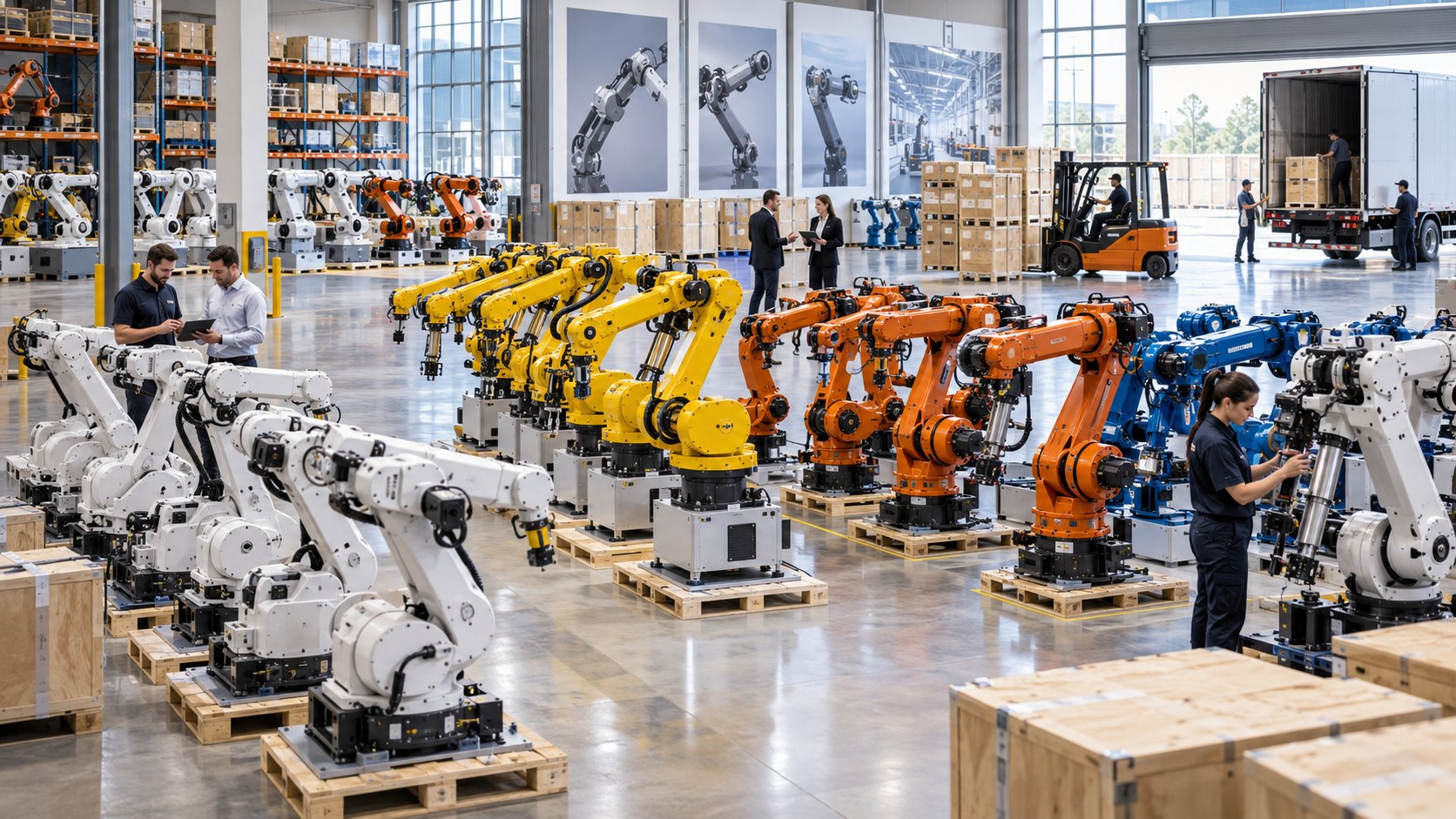
The arm is the visible part of a much longer bill of materials. The activity covers articulated and six-axis industrial arms, SCARA and delta arms for fast light handling, collaborative arms designed to work beside people, and gantry or Cartesian systems for long reaches and heavy loads. It also covers everything that makes one of those useful: end effectors and grippers, vacuum and magnetic tooling, tool changers, positioners and turntables, conveyors and part feeders, vision systems and sensors, safety guarding, fencing, light curtains and interlocks, controllers and teach pendants, cabling, and the spares and consumables that follow for years afterwards.
On a real working cell the arm is often around a third of the invoice and rarely more than half. The rest is tooling, guarding, controls and engineering hours — which is precisely why the margin in this business is in the integration and not in the robot. A wholesaler who sells arms alone is competing on a published price against anybody with a shipping account. A wholesaler who sells a cell that runs at a stated rate is selling something nobody can price-match from a catalogue.
Safety of machinery is the genuine technical requirement in this trade, and it is not paperwork. An arm on its own is a component; enclosed, guarded, interlocked and programmed, it becomes a machine, and the party who assembled it is the party answering for what it does. That is a design responsibility with real weight: risk assessment, guarding that cannot be defeated, emergency stops that actually stop, and safe access for the operator who has to clear a jam. Conformity and national standards sit with the federal ministry responsible for industry and standards, and the fire and safety approvals attaching to the premises where a cell is installed or stored are a civil defence matter in Dubai. What each of those requires for a specific machine is confirmed against the actual equipment rather than assumed.
three ways to sell it, on the same six rows
| Judged on | The arm on its own | A complete working cell | A cell with a support contract |
|---|---|---|---|
| Where the margin actually sits | Thin, and it moves to whoever ships faster | In the integration hours | In the years after handover |
| Engineers you have to employ | Few | A team | A team, plus people on call |
| Who carries the risk if the line misses its rate | The customer | You, in writing | You, for the life of the contract |
| What the customer compares you against | A price list | His own labour cost | His own downtime |
| Who answers for safety of the finished machine | The customer | You, as the party who built it | You, throughout |
| How long a deal takes to close | Days | Months | Months, then renewals |
Read the drawing down the first column and the trade explains itself. Selling arms is the easiest business to start and the hardest to keep, because there is nothing in it a buyer cannot replicate with a search. Selling cells is slower, needs engineers on the payroll and transfers real risk onto the supplier, and it is where the money is. The third column is not a different business so much as the second one grown up: once a plant depends on your cell, the spares, the programming changes and the callout cover are annuity revenue that arrives without a tender.
The licence sells the robot; it does not install it
This is the distinction that catches people in this activity, and it catches them after the first project rather than before it.
A wholesale licence lets the company buy the goods, hold them and sell them on. It does not, by itself, make the company a mechanical or electrical contractor, and integrating a cell is contracting work — mounting, power, pneumatics, guarding fixed to a floor, commissioning on a client's site. It does not make the company an engineering consultancy, and a cell design carrying a stated cycle time is an engineering deliverable. It does not make the company a maintenance provider, which is what a callout contract actually is. And it does not make the company anybody's appointed agent: whether a robot manufacturer will recognise you as a channel at all is decided by that manufacturer and by no government body.
Where the plan includes any of that, the activity mix has to carry it, and the right moment to settle the wording is before the first project is signed rather than during an inspection afterwards. Building the machine rather than supplying it is a further step again — that is manufacturing, with a different licence shape and a different premises question.
Where this is the wrong purchase: if the intention is to make robots or tooling here, this is not the line. If the intention is to run automation projects and buy the hardware as an input, the contracting and engineering activities are the ones to ask about, with the trading line beside them. And if the intention is to hold an exclusive arrangement for one manufacturer, that is a commercial agency conversation rather than a wholesale one.
What the licence costs, which emirate and which activity combination suit the plan, and what approvals attach to a specific machine and a specific site depend on the equipment list, the premises and the licensing authority. Those get confirmed for the actual case rather than quoted from a template.
References
- Ministry of Industry and Advanced Technology — industrial licensing, national standards, conformity assessment and in-country value. Ministry of Industry and Advanced Technology
- Dubai Civil Defence — fire and safety approvals attaching to industrial premises where automated equipment is installed or stored. Dubai Civil Defence
- Dubai Customs — import entry and customs codes for capital equipment and spares. Dubai Customs
- UAE Government portal — federal law, national industrial and advanced technology strategy, and general government information. UAE Government portal
Elsewhere in Trading
Activities that sit beside this one
Most licences carry more than one activity. Adding a neighbouring line at the application stage costs a fraction of amending the licence afterwards.
Begin with a clear conversation
Tell us what you intend to build.
A consultant will map the structure, jurisdiction, approvals and likely cost against what you actually described — not against a package.
