

Activity CZ 187
How to Start a Transport Equipment Wholesale Business in Dubai
Transport equipment wholesale is what remains once cars, motorcycles and bicycles are taken out: hulls, airframes, rolling stock, trailers and terminal plant. Every unit carries its own papers.
ConsultZone licensing desk
- Activity code
- CZ 187
- Category
- Trading
- Reviewed
- Read
- 7 min
Listen instead
1 min 2 sec
An audio summary of this guide.
Topic summary
How to Start a Transport Equipment Wholesale Business in Dubai
Three things are named in this activity only so that they can be removed from it. No cars. No motorcycles. No bicycles. Between them those three account for very nearly every vehicle a private individual will ever buy, which means this line is defined by subtraction, and what is left over is not a consumer market at all. It is capital plant.
That changes the nature of the goods. A used-car dealer sells an object, and one grey saloon is much the same as the next. A dealer here sells an asset with an identity of its own — a hull with a name and a number, an airframe with a maintenance history, a semi-trailer with a plate, a forklift with a load chart and a date of last inspection. The documents travel with the unit, they are examined harder than the paintwork, and a unit whose file is incomplete is worth a fraction of the same unit with a clean one. In this trade the paperwork is not administration. It is most of the value.
CZ 187 — the five families inside one activity line
Read the name literally and five distinct trades fall out of it, sharing a licence line and almost nothing else.
Marine. Workboats, tugs, barges and pontoons, crew and supply boats, small commercial craft, leisure hulls and the outboard engines that push them. Buyers are marine operators, port service companies and charter fleets, and the asset's papers come from its flag authority and its classification surveyor rather than from a licensing counter.
Aviation. Aircraft, airframes and the very large secondary trade in aircraft parts. This is the one family of the five with an unmistakable federal control in front of it: airworthiness, and the approvals governing who may supply and certify a part, sit with the General Civil Aviation Authority. A part with an incomplete trace is not a cheap part, it is an unusable one, and anybody entering this family should establish the approval position before buying stock rather than afterwards.
Rail and rolling stock. Locomotives, wagons, passenger vehicles, bogies and track maintenance plant. Very few buyers, very large tickets, and procurement that runs on tenders and technical submissions rather than on availability.
Trailers and semi-trailers. Flatbeds, curtainsiders, tippers, tankers, low-loaders and skeletal chassis for containers. This is the only family that meets a public road, so the Roads and Transport Authority's vehicle and transport permitting is in the picture for anything operating in Dubai, and the axle and dimension question belongs in the sales conversation rather than after delivery.
Materials handling and terminal plant. Forklifts, reach stackers, container handlers, yard tractors, platform trucks and aerial work platforms. Highest unit volume of the five, and the family that behaves most like ordinary equipment distribution, which is why most new entrants to this activity start here.
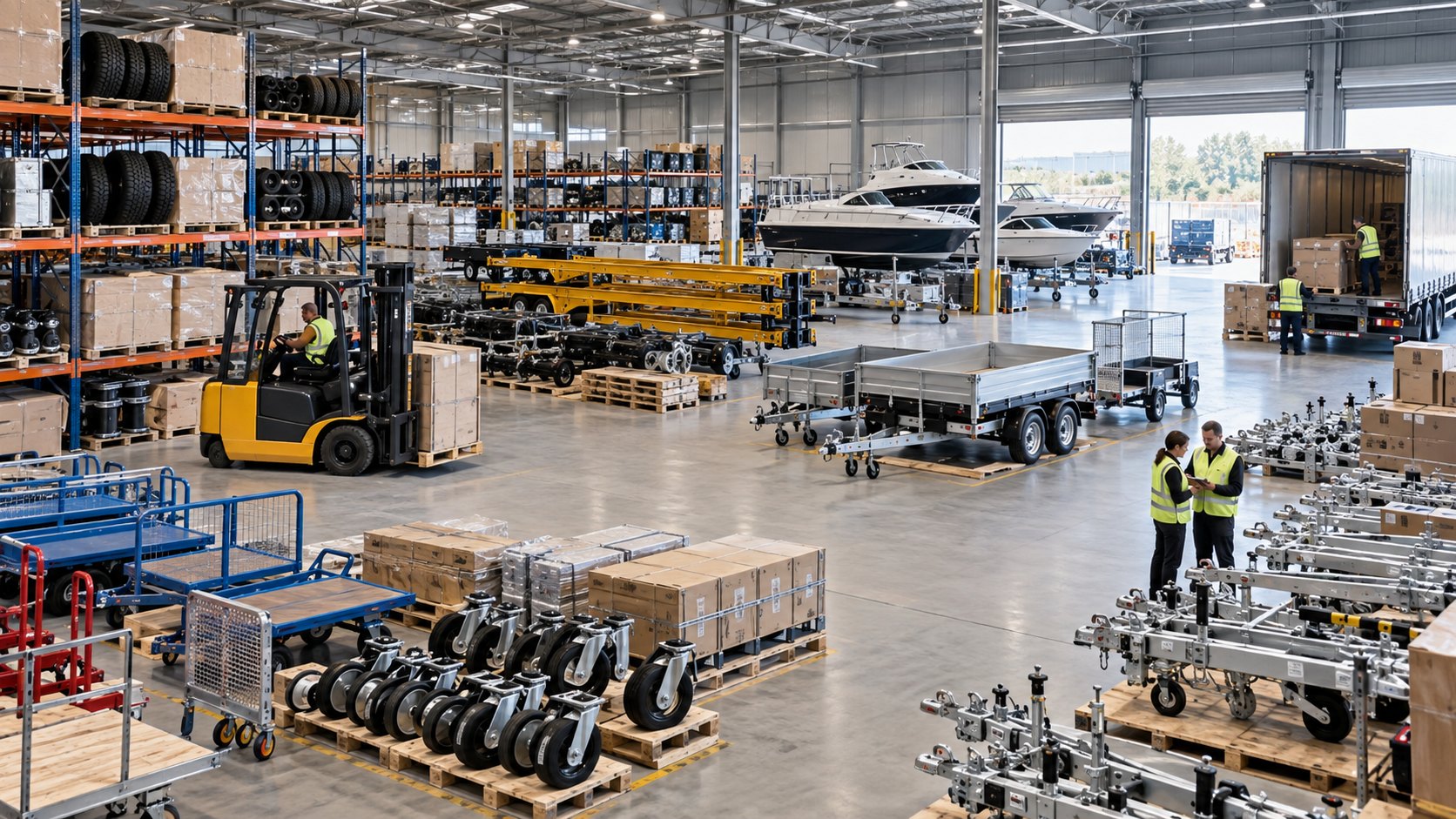
The buyer is an operator, a port or a fleet
Nobody in this line sells to a person. The buyer is a port or terminal operator, a shipping or marine services company, an airline or an approved maintenance organisation, a logistics or construction fleet, a municipal or government fleet, or a rental company that will hire the unit out again. Every one of them is buying against a utilisation figure they already hold, and they can calculate what an hour of standstill costs them.
The ports and the airports are the reason this trade has a home here. A container terminal running around the clock consumes handling plant, spares and replacement units continuously, and a maintenance base beside a major hub needs parts in hours rather than weeks. That demand is local, permanent and largely indifferent to the retail economy, and it is the strongest argument for holding stock in this market rather than brokering from a distance.
What the buyer wants from a supplier follows from that. Technical credibility first — a buyer who senses you are reading the specification off the same sheet he is will go elsewhere. Then parts and support, because the unit will stop and the only real question is who answers the phone. Then an honest condition report, since most transactions in the marine, aviation and handling families involve used equipment, and a seller who understates a defect meets it again at handover.
- Fix which of the five families the company will really deal inFixes the licence wording, and the approvals that follow it
- Trade licence carrying the wholesale activityCreates the company and allows a unit to be invoiced
- Read the unit's own file before agreeing a priceDecides whether it sells as working equipment or as parts
- Yard, berth or hangar space the unit can physically occupyDecides what you can hold rather than only broker
- Import entry and a customs code in the company's own nameLets the unit clear and change hands here
- Handover: condition report, papers and transfer of the certificateEnds the deal, and is the step that most often fails
The drawing is worth reading from its third row and its last, which are really the same row seen twice. Almost everything that goes wrong in this trade goes wrong in the unit's file — a certificate that lapsed while the asset sat in a yard, an ownership chain with a gap in it, a maintenance record that stops two years before the sale. That is discovered either before the price is agreed or during handover, and the distance between those two moments is the distance between a negotiation and a loss.
Mainland or free zone follows where the unit will actually work
The structural choice here is unusually easy to reason about, because the goods themselves answer it.
If the equipment is going to be sold to a UAE operator and put to work on UAE soil — handling plant into a local terminal, trailers onto a local fleet, a workboat to a local marine contractor — then the buyer is a UAE business buying inside the UAE, and a mainland licence is the straightforward position. If the trade is re-export, which in this activity is a real and substantial business, a free zone licence keeps the goods out of the domestic market and the customs treatment follows that. Plenty of operators want both, and that usually resolves into either two positions or a distribution arrangement with somebody who already holds the one you lack.
What decides it is the buyer list, not the price of the licence. Write down the first ten customers you expect to invoice, look at where each of them takes delivery, and the answer is generally obvious before anybody quotes you anything.
Where this is the wrong purchase: if the plan is to sell cars, off-road vehicles or motorcycles, those are separate activity lines and this one excludes them by name. If the plan is to operate the vessels or the fleet rather than trade the equipment, that is a transport or marine services licence and a different conversation. And if the plan is to repair or overhaul aircraft parts rather than supply them, that is an approved maintenance activity with its own authority standing in front of it.
What the licence costs to hold, which emirate suits the plan, what premises a particular family of equipment requires, and what a specific unit needs before it can clear, all depend on the product list, the site and the licensing authority. Those are confirmed case by case rather than quoted, and on this activity the product list decides nearly everything.
References
- General Civil Aviation Authority — airworthiness, aircraft parts and maintenance approvals. General Civil Aviation Authority
- Roads and Transport Authority — vehicle and transport permits in Dubai, including trailers and heavy equipment on public roads. Roads and Transport Authority
- Dubai Customs — import and export entry, customs codes, and restricted or controlled goods. Dubai Customs
- UAE Government portal — federal law and general government information. UAE Government portal
Elsewhere in Trading
Activities that sit beside this one
Most licences carry more than one activity. Adding a neighbouring line at the application stage costs a fraction of amending the licence afterwards.
Begin with a clear conversation
Tell us what you intend to build.
A consultant will map the structure, jurisdiction, approvals and likely cost against what you actually described — not against a package.
