

Activity CZ 186
How to Start an Office Furniture Wholesale Business in Dubai
An office furniture order has a date attached to it before it has a price. The work is specified by a designer, bought by a project and installed to a programme — and that is what decides the margin.
ConsultZone licensing desk
- Activity code
- CZ 186
- Category
- Trading
- Reviewed
- Read
- 8 min
Listen instead
41 seconds
An audio summary of this guide.
Topic summary
How to Start an Office Furniture Wholesale Business in Dubai
An office furniture order has a date attached to it before it has a price. The date is a lease that starts on the first of the month, a handover a landlord will not move, or a weekend when three hundred people are expected to leave one building on Friday and sit down in another on Sunday. Everything else in the transaction is negotiable and that is not, which is why this trade is a logistics and installation business that happens to sell furniture rather than a furniture business that happens to deliver.
The second thing to understand is that the person who chooses the product almost never pays for it. A workstation layout is drawn by an interior designer or a workplace consultant, written into a schedule with codes and finishes against it, and then priced by a fit-out contractor who is competing for the whole job. The end user sits in the chair and had no say in it. So a supplier who spends its effort persuading tenants is selling to the wrong audience: the sale is won earlier, upstream, at the point where somebody decides what goes into the schedule.
The margin is decided in the programme, not on the price list
Four buyers put work into this trade, and they behave differently enough that a supplier should choose deliberately rather than take whatever arrives.
Fit-out contractors are the largest source of volume and the hardest commercially. They buy against a schedule they did not write, at a price they tendered months earlier, with a delivery date they cannot move, and they pay when the main contract pays — which puts the credit risk a step further away than it looks. Corporate tenants and facilities teams buying direct are slower to decide and much better to invoice, and a company that lands one of them lands the refurbishments and the churn for years afterwards. Government and semi-government buyers purchase in quantity against specifications and expect a supplier that can produce documentation on request. Dealers and showrooms resell a range and give reach without a sales force, at the cost of a share of the margin and of control over how the product is presented.
Where those buyers sit determines the structural question of a mainland licence against a free zone one, and it is a question about where the furniture ends up rather than where the company would prefer to be.
six buyers, two destinations
- Fit-out contractors working on offices inside the UAEOne UAE company invoicing another for goods delivered here
- Corporate tenants and facilities teams buying directThe buyer is a UAE business and the goods stay in the country
- Government and semi-government supplyPublic buyers expect a UAE-licensed supplier on the invoice
- Dealers and showrooms reselling your rangeSelling on UAE soil to buyers standing on it
Mainland licence
- Consolidating a regional project for onward shipmentThe goods are handled in transit and never clear into this market
- Container re-export to nearby marketsThe furniture does not enter the UAE market at all
Free zone licence
The marked row is the one worth building towards. A direct corporate relationship pays properly, repeats without a tender, and brings the small continuous work — a floor reconfigured, thirty chairs replaced, a new meeting room — that keeps an installation crew busy between projects. Contractor work fills a warehouse and a forecast; direct work builds a business.
CZ 186 — Wholesale Of Office Furniture
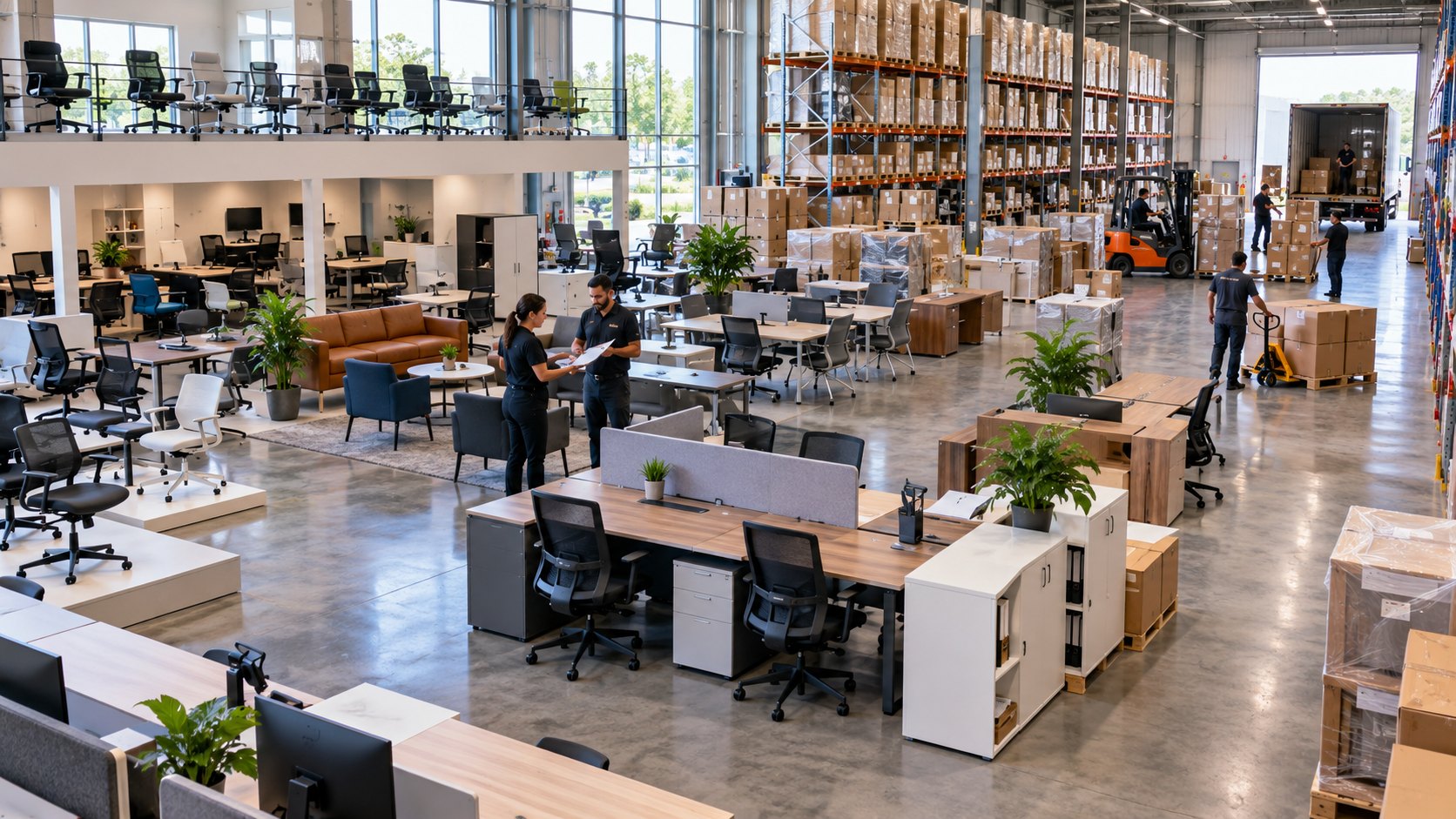
The line is the bulk trade in furniture and seating for commercial and institutional interiors, sold on to businesses and in the condition it arrived in: desks and benching systems, workstations and screens, task and visitor seating, executive furniture, meeting and conference tables, storage, pedestals and lockers, reception furniture, breakout and soft seating, acoustic pods and booths, and the accessories that go with them — monitor arms, cable management, power modules, height-adjustment mechanisms.
The boundary with household furniture is the buyer, not the object. Beds, sofas, dining and outdoor furniture belong to the household line, and a chair bought for a living room and a chair bought against a workstation schedule are two different trades however similar they look on a shelf. The confusion is worth naming because a project schedule mixes them: a co-living development or a serviced-office building will ask one supplier for apartment furniture and office furniture in the same tender, and a licence naming only one of the two lines does not cover the schedule.
Knocked-down is the rule here, and the cost moves rather than disappears
Desks, storage and benching are panel products and they ship flat almost without exception, which spares this trade the container problem that dominates upholstered household goods. The cost does not vanish; it relocates to the site. A hundred desks arrive as five hundred parts, and somebody has to book the goods lift, protect the lift lobby and the floor, carry the packs up, build them in a sequence that matches the floor plan, level them, run the power and data modules, place the seating, and remove a mountain of cardboard before the client walks in on Sunday morning. That is the real deliverable, and it is priced in hours and access rather than in units.
Three consequences follow. Installation capability is not a service bolted onto the sale, it is the product. Access surveys matter more than showroom photography — a lift that will not take a 2.4-metre bench top decides the job. And out-of-hours working is normal, because an occupied building will not give up its lift at eleven on a Tuesday.
Two shifts in how offices are used, and both change the product mix
The move away from one fixed desk per person has reduced the number of desks a floor buys and increased almost everything else: shared settings, meeting and collaboration furniture, acoustic pods for calls, lockers because nobody owns a pedestal any more, and booking sensors so a desk can be claimed from a phone. At the same time ergonomics has become a specification item rather than a selling point, with adjustable chairs and height-adjustable desks written into schedules as standard. A supplier whose range is mostly desks is selling into the part of the market that is shrinking.
What attaches to the goods before a project will accept them
The licence permits the trade. It is not evidence about a product, and on a fit-out job the evidence is asked for by somebody who has never seen the licence.
Fire performance of upholstered items is a real requirement and it is asked for at the wrong moment. Seating, soft furniture and acoustic materials going into a commercial interior will be asked for the manufacturer's own testing evidence, usually by the project's fire or design consultant, and usually at the point the goods arrive on site. Product testing and conformity evidence sit with the manufacturer, and national standards and conformity marking are the remit of the federal ministry responsible for industry and standards.¹ Buying a range without that documentation and discovering the gap at acceptance is expensive, because the alternative to evidence is a container going back.
Fire safety of the building you store it in is a separate matter and it is yours. Flat-packed panel goods, cardboard and foam in volume are combustible stock, and the unit is a question for the emirate's civil defence authority — settled with the tenancy rather than after the racking is in.²
Anything with a radio in it needs type approval on the model. This is newer than most people in the trade expect. Height-adjustable desks with an application, occupancy and booking sensors, powered seating and wirelessly charging tables are all radio products, and radio and telecommunications equipment offered in the UAE needs type approval from the federal telecommunications authority.³ A furniture licence does not answer that question.
Importing in your own name means a customs code held by the company and consignments classified properly at the border, both with the emirate's customs authority.⁴ Installers are staff, which means work permits and labour contracts under the federal labour ministry, and on this activity the crew is the margin rather than an overhead.⁵
Four things the licence does not let you do are worth stating. Manufacturing or assembling furniture for sale is industrial activity on approved premises with its own conditions. Fixed joinery, partitioning, raised floors and anything anchored to the structure is construction and fit-out work, not the supply of loose furniture. Interior design and space planning is a consultancy activity, and a supplier who offers a drawn layout as a service rather than as sales support has crossed into it. And a showroom taking payment from walk-in customers is retail — frequently held alongside wholesale, and still a second activity.
What the licence costs to hold, which lines may sit on it together, what conformity evidence a specific range needs and what fire conditions apply to a chosen unit all depend on the emirate, the premises and the goods. ConsultZone establishes those against the chosen jurisdiction and the actual product schedule before a lease or a supply agreement is committed.
References
- National standards, conformity marks and product testing evidence, including fire performance documentation for upholstered and acoustic products. Ministry of Industry and Advanced Technology
- Fire safety approvals for the storage of panel goods, packaging and foam in volume on commercial premises in Dubai. Dubai Civil Defence
- Type approval for radio equipment, which is what connected desks, booking sensors and powered furniture contain. Telecommunications and Digital Government Regulatory Authority
- Import and export, customs codes and consignment classification for furniture shipments. Dubai Customs
- Work permits and labour contracts for installation crews and sales staff. Ministry of Human Resources and Emiratisation
Elsewhere in Trading
Activities that sit beside this one
Most licences carry more than one activity. Adding a neighbouring line at the application stage costs a fraction of amending the licence afterwards.
Begin with a clear conversation
Tell us what you intend to build.
A consultant will map the structure, jurisdiction, approvals and likely cost against what you actually described — not against a package.
