

Activity CZ 138
How to Start a Household Goods Wholesale Business in Dubai
Household goods is the umbrella line above a dozen narrower ones. What unites them is that a consumer takes the goods home, so conformity, Arabic labelling and the retailer relationship decide the trade.
ConsultZone licensing desk
- Activity code
- CZ 138
- Category
- Trading
- Reviewed
- Read
- 7 min
Listen instead
44 seconds
An audio summary of this guide.
Topic summary
How to Start a Household Goods Wholesale Business in Dubai
A kettle, a duvet, a dinner service and a floor lamp have nothing in common as objects and almost everything in common as a trade. They are made abroad in long runs, bought in containers, sold to somebody who will put them on a shelf, and taken home by a person who is not a professional buyer of anything. That last fact is the one that governs this activity, and it governs it more than any individual product's rules do.
Household goods is the umbrella row in the catalogue. Underneath it sit a dozen narrower lines — textiles, clothing, footwear, household linen, furniture, domestic appliances, consumer electronics, lighting, cutlery, glassware — each of which is a licence line in its own right. So the first real decision on this page is not how to start the business. It is whether the business belongs on this row at all, or on one of the narrower ones, and that decision is worth making deliberately because it is awkward to unwind later.
The case for the umbrella is genuine and specific: a retailer who wants one invoice, one delivery and one point of contact for a mixed pallet of homeware is not served by four specialist suppliers. Consolidation is the product. The case against it is equally specific — a buyer who needs a serious lighting supplier does not read a household goods company as one, and breadth reads as shallowness to a professional purchasing department. Optionality on a licence is not free if it costs you credibility with the customer you actually want.
The operators an umbrella line actually suits
The consolidator. A business whose value is putting nine categories on one pallet, holding stock locally and taking the container risk off a retailer's balance sheet. This is the strongest version of the line and the one the activity was written for.
The own-label operator. Sourcing across categories under a single brand — a homeware range rather than a product. Here the umbrella licence matches the business exactly, because the range is deliberately broad and the brand, not the category, is what the customer buys.
The institutional supplier. Hotels, facilities managers, staff accommodation and property developers buy homeware by the floor rather than by the item, and they buy across categories at once. A furnishing or fit-out contract is a mixed order by nature, and an umbrella supplier quotes it in one document.
The marketplace and e-commerce seller. An online catalogue grows sideways faster than any physical shop, and a licence that admits several categories keeps pace with it. The warehouse work, the product files and the returns handling are wholesale work regardless of how the customer arrives.
Where this is the wrong purchase. If the business is really one category with ambitions, take that category's own line. A specialist licence is easier to explain, easier to market and in most cases no harder to obtain, and it can be added to later. The umbrella is for a business that is genuinely multi-category from the first container, not for one that hopes to be.
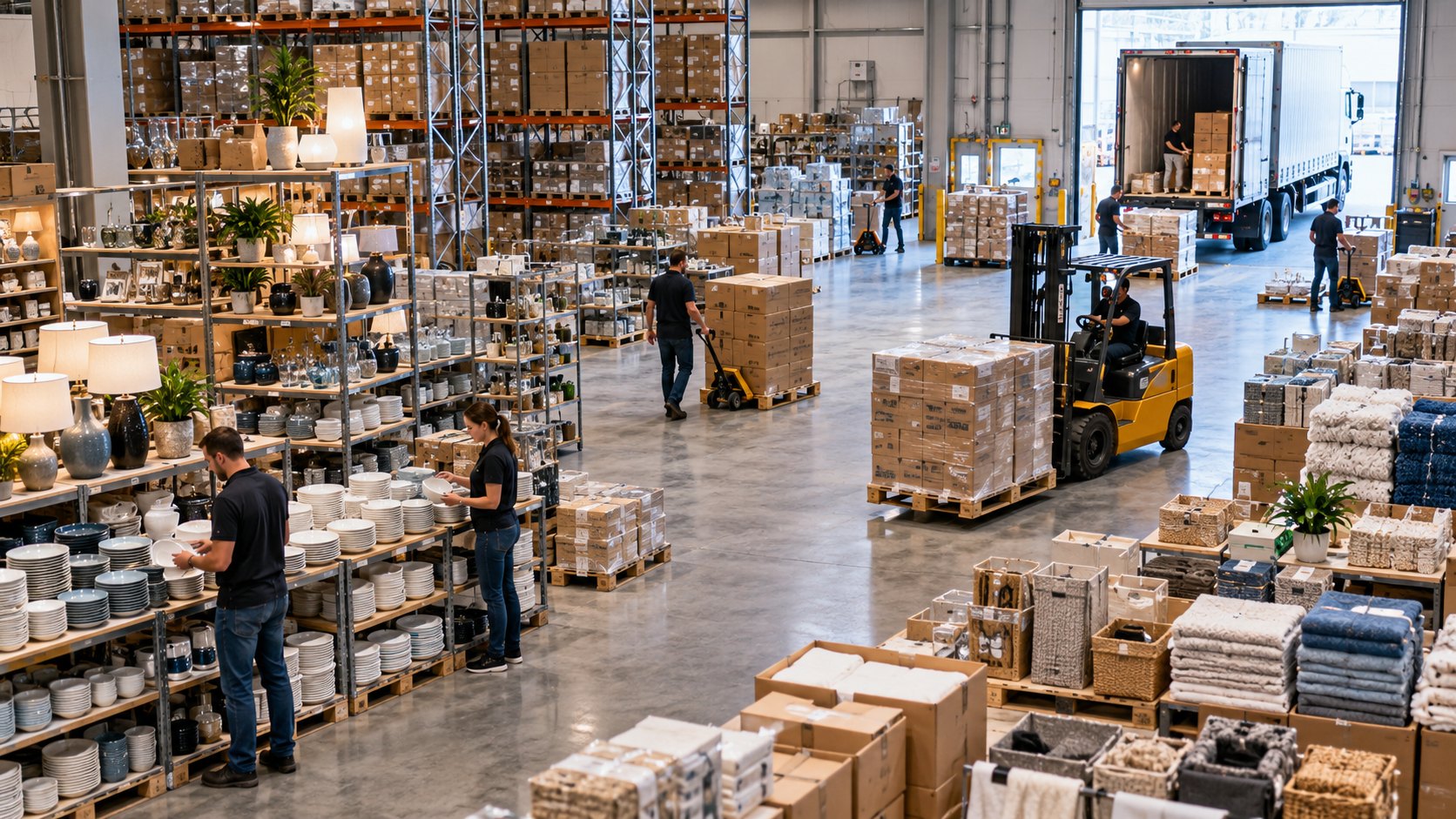
CZ 138 — Wholesale Of Household Goods
What unites them is that a consumer takes them home
The unifying fact is not the shape of the goods; it is the buyer at the end. Consumer products sold in the UAE are subject to national standards and conformity requirements administered federally, which is what a conformity mark on a pack is evidence of.¹ That obligation attaches to the product family rather than to the company, so an umbrella range does not get one approval — it gets the approval each family needs. A duvet, a kettle and a set of tumblers are assessed against different standards, and the kettle's assessment is the harder one because it plugs in.
Two further consumer-facing duties follow from the same place. The pack a household takes home carries labelling obligations, including Arabic, and the sensible time to establish them is when the artwork is being approved with the factory rather than when a container is sitting at the border. And a household good that fails in use is a product-safety matter rather than a commercial dispute, which is why a serious retailer's compliance team asks a new supplier for its conformity evidence before it asks for a price list.
Who holds each gate
Most of what looks like licensing work on this line is not licensing work at all.
six gates, and one body holding half of them
The emirate's economic department
- How many product categories the activity wording really admitsFirst, because every later question is asked against it
The federal standards and conformity authority
- Conformity with the national standard for each product familyPer family, and before a retailer's compliance team asks for it
- Arabic labelling on the pack a household takes homeAt artwork stage with the factory, not at the port
- Electrical safety on anything in the range that plugs inBefore the first order is placed, because it can change the specification
The municipality
- A warehouse of the right class, and how high the racking may goWith the tenancy, not after it
The emirate's customs authority
- Customs classification for each category in the rangeOnce the licence is cut, and separately per category
Read where the rows pile up. One body holds three of the six gates, and all three are about the goods rather than the company — which is the practical answer to why an umbrella line takes longer to get trading than its single-category neighbours. The licence is one conversation. Conformity is one conversation per family, and the range decides how many of those there are.
What the licence does not cover, and which narrower line to take instead
The narrower lines, when the range is really one thing. Textiles, clothing, footwear, household linen, furniture, domestic appliances, consumer electronics, lighting, cutlery and glassware each have their own activity. If the intended range sits overwhelmingly in one of them, that line is the better purchase and this page is not the one to act on.
Anything with its own control regime. Food, medicines, medical devices, cosmetics and supplements are not household goods for licensing purposes even when a household buys them in the same trip. They clear under their own product regimes with their own authorities, and none of them is reached by this activity.²
Retail. Selling to the person who will use the goods is a retail licence, with premises, fit-out and, for a shop, entirely different approvals. This line supplies the shop; it is not the shop.
Manufacture and assembly. Making, finishing or assembling the goods is an industrial undertaking on approved premises with its own conformity and in-country obligations.¹ Importing components and putting them together locally crosses that boundary even when the finished item is identical to one that could have been imported whole.
Installation and after-sales service. Fitting a kitchen, wiring a lighting scheme or repairing an appliance are service activities under their own lines. A wholesaler who starts offering them without adding the activity has quietly moved outside the licence.
What the licence costs to hold, which conformity requirements attach to a given product family, and how each category is classified at the border all depend on the emirate, the premises and the actual range.³ ⁴ ConsultZone confirms those against the chosen jurisdiction and the real product list before anything is committed — and on an umbrella line the useful sequence is to settle the range first, because the range is what sets the workload.
References
- National standards, conformity marks, industrial licensing and in-country value. Ministry of Industry and Advanced Technology
- Federal framework for consumer protection, product safety and the separate regimes for controlled goods. UAE Government portal
- Import and export of consumer goods, customs codes and restricted and prohibited lists. Dubai Customs
- Warehouse and premises suitability, storage conditions and public health in Dubai. Dubai Municipality
- Emirate-level licensing and municipal conditions where the business is based in Sharjah. Sharjah Government
Elsewhere in Trading
Activities that sit beside this one
Most licences carry more than one activity. Adding a neighbouring line at the application stage costs a fraction of amending the licence afterwards.
Begin with a clear conversation
Tell us what you intend to build.
A consultant will map the structure, jurisdiction, approvals and likely cost against what you actually described — not against a package.
