

Activity CZ 185
How to Start an Office Machinery and Equipment Wholesale Business in Dubai
There is a fair chance the copier on your office floor was never bought by anybody. Office machinery stopped being sold as boxes and is now sold as contracts, and the money is in pages rather than hardware.
ConsultZone licensing desk
- Activity code
- CZ 185
- Category
- Trading
- Reviewed
- Read
- 8 min
Listen instead
41 seconds
An audio summary of this guide.
Topic summary
How to Start an Office Machinery and Equipment Wholesale Business in Dubai
There is a fair chance the copier standing on your office floor was never bought by anybody. It was placed there by a supplier, and what the company pays for is not the machine but the pages that come out of it — billed by the click, black and colour at different rates, with toner, parts and a technician's visits folded into the price. That arrangement is the single most important commercial fact about this activity, and a business built on it looks nothing like a business that sells equipment and issues an invoice.
The shift is easy to describe and hard to fund. Selling a machine gives you cash today and nothing afterwards. Placing a machine gives you a stream that runs for years and a piece of hardware you have paid for out of your own pocket until the volume repays it. The second model is why the established names in this trade behave like service companies with a warehouse attached, and why a new entrant who prices only the box will win the first order and lose the customer at renewal.
Who this line is for, and it is rarely a shopkeeper
Four kinds of company make this work, and what they have in common is a service capability rather than a product range.
A dealer building a managed fleet takes on one or two manufacturers' ranges and grows a base of placed machines, each one billing monthly. The business is measured in machines under contract and in pages per month, not in units shipped, and it is worth more every year it survives.
A supplier serving other suppliers sells hardware and consumables into the dealer channel and into IT resellers who do not want a service department. Margins are thinner, the sale is repeatable, and the customer understands the product — which cuts the cost of selling it.
A mailroom and document-handling specialist sells the equipment large organisations need and small ones have never heard of: high-volume folder-inserters, franking and mailing systems, addressing equipment, industrial shredders, binding and laminating lines, scanning stations for records projects. Buyers are banks, insurers, hospitals, universities, government bodies and the service bureaux that work for them, and the sale is consultative because it is usually part of a process change.
A reprographics and wide-format supplier serves architects, engineers, contractors and print shops with plotters, large-format scanners and copiers. Consumption is high and lumpy, which makes consumables and service the core of the relationship rather than an add-on.
Each of those faces the same set of choices, and they pull against each other.
six choices, weighed on the same rule
What it givesWhat it costs
- Selling the machine outright and walking awayCash on delivery and no obligation afterwardsOne sale, no annuity, and a customer a rival can take next year
- Placing the machine on a cost-per-page contractYears of billed volume from a single installationYou fund the hardware until the pages repay it
- Holding consumables for every range you have placedSame-day supply, which is what keeps a contract aliveShelf space and cash tied up in toner and drums
- Employing your own service techniciansResponse times you can promise in writingA payroll that runs whether machines break or not
- Leaning on the manufacturer's service network insteadNo technicians to carry, and factory-trained partsResponse you have promised and do not control
- Taking on a second and third brandA wider range, and a route out of one supplierTwice the parts to stock and twice the training
The marked row is where the trade actually lives now, and it is marked because it is the one that looks like a sales decision and is really a financing decision. A placed machine is working capital sitting on a customer's floor. Whether that is a strong position or a trap depends entirely on the contract underneath it — on the minimum volume, on what happens if the customer moves out, and on whether the rate per page was calculated against real consumable cost or against a hopeful one. A supplier who gets the rate wrong does not find out for eighteen months, and by then the machine is installed and the price is agreed.
What the line covers, and what "except computers" takes out of it
CZ 185 — Office Machinery, Except Computers
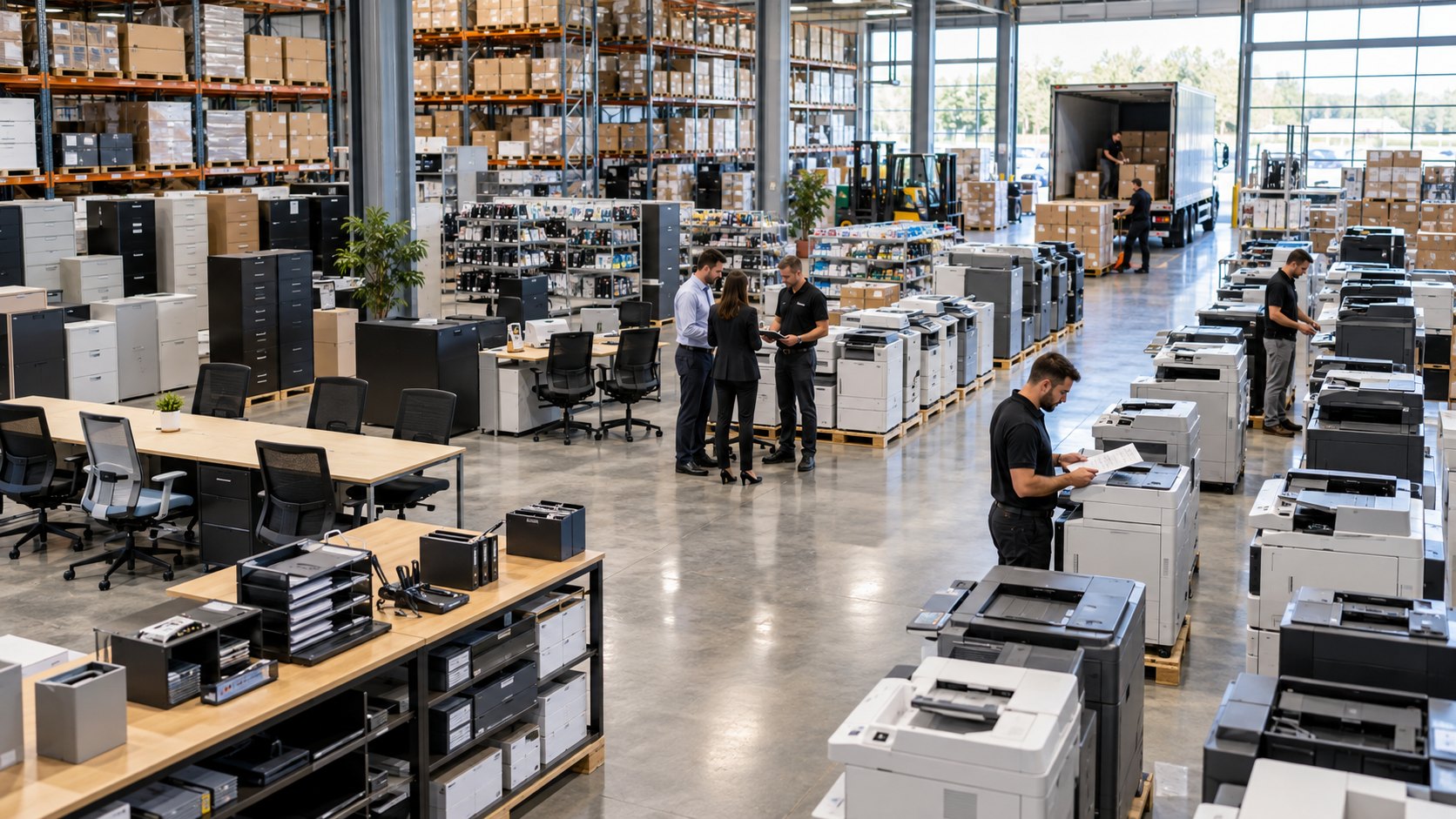
The activity is the bulk trade in machines and equipment used to run an office and process its paper. Printers, copiers and multifunction devices. Scanners and document-capture equipment. Shredders and secure-disposal machines. Franking, mailing, folding, inserting and addressing systems. Binding, laminating, trimming and finishing equipment. Plotters and wide-format devices. Presentation and projection equipment, dictation and transcription equipment, calculating and cash-handling machines, and the consumables and spare parts that keep all of them running.
The exclusion in the name is the most useful sentence on this page. Computers and computer peripheral equipment are not in this line. Desktops, laptops, servers, tablets, monitors, keyboards, mice, external drives and network hardware sit in the separate line the catalogue keeps for computing equipment, and the boundary matters because the two trades sell to the same person on the same day. An IT manager replacing forty workstations and the floor printer beside them is placing one order across two activities, and a licence naming only office machinery does not cover the whole schedule. Read the schedule before agreeing the activity.
Three more things sit outside it. Making or remanufacturing the goods — assembling machines, refilling or rebuilding toner cartridges — is industrial activity carried out under an industrial licence on approved premises. Repairing third-party equipment as a trade in itself is a service line; servicing what you supplied under your own contract is part of the supply, but opening a workshop to anybody who walks in is not. And office furniture is a separate line entirely — the desk the printer stands on and the printer are two different trades, and both routinely appear on the same fit-out schedule.
One condition does cross the boundary, and it surprises people. A modern multifunction device is a network product with wireless inside it, and some mailroom and presentation equipment carries a radio too. Radio and telecommunications equipment offered in the UAE needs type approval on the specific model from the federal telecommunications authority, and the fact that the machine is a copier rather than a computer changes nothing about that.¹
Premises: a warehouse that is also a store, a bench and a demonstration room
This is not a business that can run out of a desk, and the reasons are specific.
A consumables store, dry and clean. Toner is a fine powder and inks are liquids; both are sold in sealed units that do not enjoy heat, damp or being dropped. The store also needs to be organised by machine rather than by brand, because the question a technician asks at seven in the morning is which cartridge fits the device he is standing in front of.
A bench with parts bins. Fusers, rollers, drums, feed assemblies and boards are the difference between a two-hour response and a two-day one. A contract is judged on response time, and response time is decided by what is on the shelf rather than by what is on the phone.
A demonstration area. A buyer comparing two document systems wants to watch one run, hear how loud it is, and feel the finish on the paper coming out of it. Nothing in a brochure replaces that, and for high-volume mailroom equipment it is effectively the whole sale.
Delivery and installation capability. A floor-standing production device is heavy, awkward and destined for an upper floor reached by a goods lift in a booked window. The cost of getting it there is real, it is frequently left out of a quotation, and it is the commonest source of a job that made no money.
Security proportionate to the value. Cartridges are small, valuable per box and easy to move, which makes a consumables store a theft target in a way a furniture warehouse is not.
Two conditions attach to the building itself. Paper, packaging and toner in volume are combustible stock, so fire safety of the unit is a matter for the emirate's civil defence authority and it belongs in the conversation before the tenancy is signed rather than after the racking goes in.² And if the company imports in its own name, it needs a customs code held by the company and consignments classified correctly at the border, both with the emirate's customs authority.³ Technicians and sales staff are work permits and labour contracts under the federal labour ministry.⁴
What the licence costs to hold, which activity lines may sit on it together, what type approval a specific connected device needs and what fire conditions apply to a particular unit all depend on the emirate, the premises and the range. ConsultZone confirms them against the chosen jurisdiction and the real machine list before a lease or a dealer agreement is signed.
References
- Type approval for radio and telecommunications equipment, which is what a network-connected copier or multifunction device contains. Telecommunications and Digital Government Regulatory Authority
- Fire safety approvals for the storage of paper, packaging and consumables in volume on commercial premises in Dubai. Dubai Civil Defence
- Import and export, customs codes and consignment classification for office equipment and consumables. Dubai Customs
- Work permits and labour contracts for service technicians and sales staff. Ministry of Human Resources and Emiratisation
- National standards, conformity marks and product conformity evidence for equipment placed on the UAE market. Ministry of Industry and Advanced Technology
Elsewhere in Trading
Activities that sit beside this one
Most licences carry more than one activity. Adding a neighbouring line at the application stage costs a fraction of amending the licence afterwards.
Begin with a clear conversation
Tell us what you intend to build.
A consultant will map the structure, jurisdiction, approvals and likely cost against what you actually described — not against a package.
