
Activity CZ 145
How to Start a Clothing Accessories Wholesale Business in Dubai
A tie has no size, and that one fact makes accessories wholesale the cheapest way into apparel. Where the gifting money is, why uniform lists are steadier, and the line that runs through a glove.
ConsultZone licensing desk
- Activity code
- CZ 145
- Category
- Trading
- Reviewed
- Read
- 7 min
Listen instead
45 seconds
An audio summary of this guide.
Topic summary
How to Start a Clothing Accessories Wholesale Business in Dubai
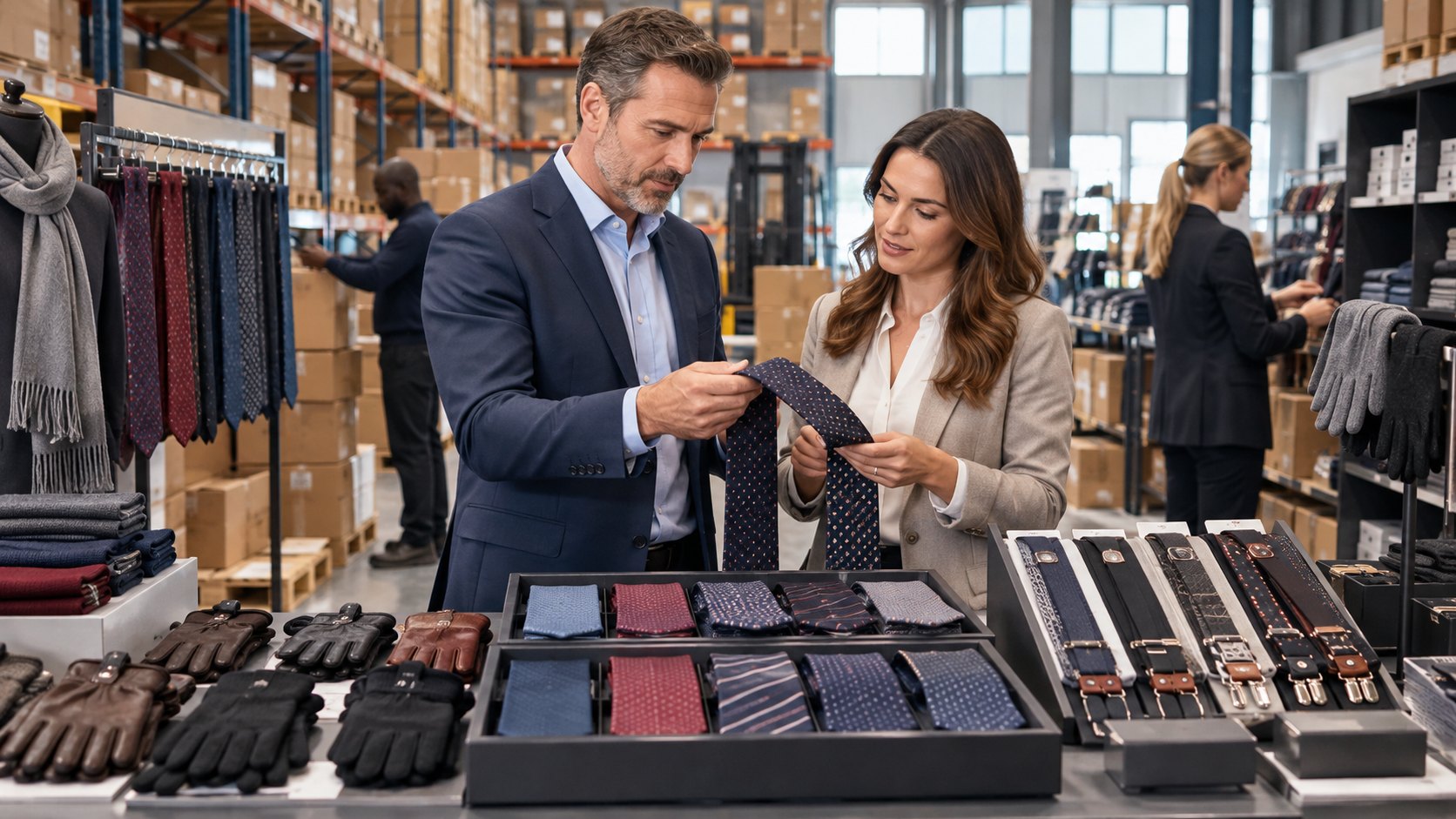
A tie has no size. Neither does a scarf, a pocket square, a handkerchief or a set of cufflinks, and braces, belts and gloves have three or four sizes between them at most. That single fact separates this line from every other apparel activity in this catalogue, because it removes the problem that defines them. There is no size curve to buy, no run of sizes to hold before one article can sell, and no broken range left standing at the end of a season.
The consequence is arithmetic rather than opinion. Forty tie designs is forty units of commitment, not forty multiplied by anything. A wholesaler can therefore carry a genuinely wide assortment on a small capital base and compete on choice and design rather than on depth and price. That is the opposite of footwear, where a single style is a dozen purchases before it earns a dirham, and it is the reason this is usually the cheapest serious entry into apparel wholesale in the whole family.
It has a matching weakness. Because the articles are small, cheap to make and easy to copy, nothing here is defensible for long. A design that sells is on somebody else's shelf within a season. The businesses that last do not last on their products. They last on a customer list.
What this line covers, and why the stock problem is unlike the rest of apparel
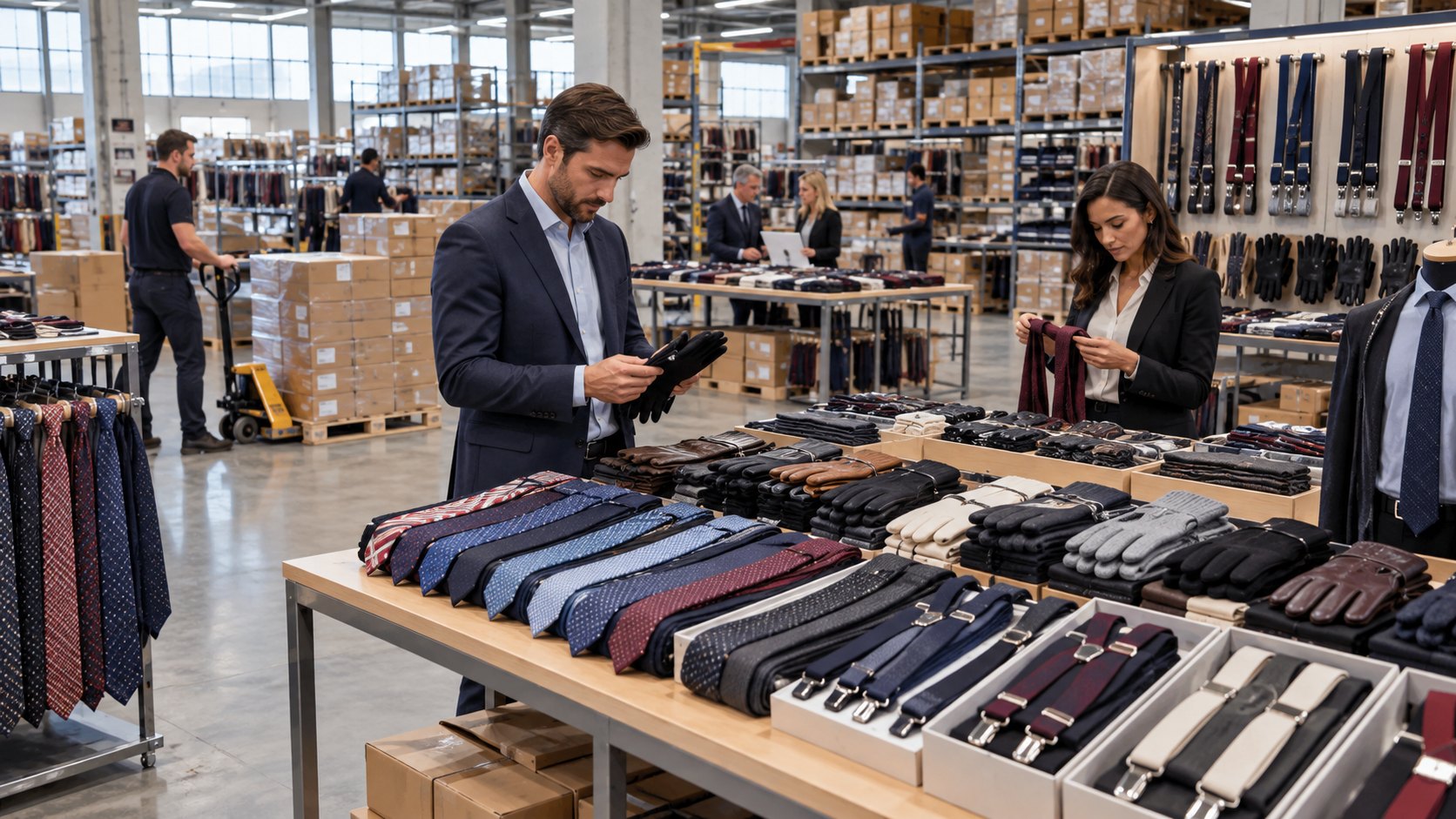
The goods are the finishing items of a wardrobe: gloves, ties and bow ties, braces and belts, scarves and shawls, hats and caps, cufflinks, pocket squares, handkerchiefs, hair accessories and similar articles bought finished and resold to businesses.
Two things follow from that list. The first is that most of it does not date the way clothing does. A plain navy tie is worth what it was worth last year, and a leather belt in a common width does not go out of fashion so much as sit quietly until it sells. Only the fashion-led part of the range carries real markdown risk, which means the stock can be split into a stable core that can be bought deep and a seasonal top layer that should not be.
The second is where the margin comes from. A customer knows roughly what a shirt costs and will notice when a shirt is priced oddly. The same customer carries no strong reference price for a tie or a pair of gloves, which is why percentage margins in this line tend to sit above the garment lines and why they survive being discounted. The gross margin per article is good and the absolute margin per article is small, so the business only works at volume or through accounts that re-order.
The steadiest money is a uniform list, not a gift shelf
Three quite separate demand engines run through the same stockroom, and a new business normally has to choose which one it is actually built for.
Gifting, which is a calendar business
Ties, cufflinks, scarves and gloves are bought as presents far more often than they are bought as clothing, so demand concentrates around Eid, National Day, graduations, weddings and the corporate gifting season. It is good money in short bursts, it wants presentation and packaging as much as product, and it leaves the shelf quiet in between.
Impulse, which means the retailer's counter is the real shelf
Accessories sell when they are within reach of somebody already paying for something else. That makes the wholesaler's job partly a merchandising job: the retailers who sell the most are the ones given a stand, a fill plan and a reason to keep the spot stocked. A supplier who only delivers cartons is competing with one who delivers a working display.
Specification, which is dull and pays every year
Branded ties, scarves, caps and gloves for hotels, airlines, schools, banks, clinics and security firms are ordered to a specification, in an agreed colourway, against a contract, and re-ordered as staff turn over and articles wear out. There is no fashion risk, no markdown and no guessing. It is the least interesting part of the trade and reliably the best part of the order book, and it is won on colour matching, consistency between deliveries and the ability to reproduce the same article in two years.
Getting from an activity line to any of those three requires the same file, and the gates on it are held by more parties than most people expect.
six gates, five deciders
The emirate's economic department
- The activity line the trade licence carriesWith the initial approval, and awkward to amend later
The federal standards and industry ministry
- Whether a glove is clothing or protective equipmentBefore the order is placed, not when the goods land
- Labelling, fibre content and origin on the article itselfBefore the goods reach a retailer's shelf
The federal environment ministry
- Documentation for articles made from protected speciesBefore the order, because it cannot be fixed at the border
The emirate's customs authority
- A customs code in the company's own nameOnce the licence is cut
The municipality
- Whether the unit may hold the stockWith the tenancy, not once the shelving is in
The conditions attach to the goods, and one of them runs straight through a pair of gloves
The marked gate above is the one worth reading twice, because it is the only genuinely awkward thing in this line and it is invisible on a spreadsheet.
A glove sold to finish an outfit is clothing. A glove sold to protect a hand at work is personal protective equipment, and protective equipment carries conformity obligations that clothing does not. The article can be physically identical; what decides which side of the line it falls on is what it is sold as and what is claimed for it. The same split runs through a high-visibility scarf, a hard-wearing belt sold into industry and a cap sold as head protection. Classification happens before the order rather than at the border, and a consignment bought as fashion and described as safety equipment is a consignment sitting somewhere at the importer's cost.¹
The rest is the ordinary weight of a consumer-goods trading line. Articles sold on to consumers fall inside the national standards, conformity and Arabic labelling expectations, so fibre content, care and origin belong on the article and not only on the carton.¹ Belts, gloves and straps made from exotic skins fall under international controls on trade in protected species, and the documentation for those is arranged with the order rather than discovered at clearance — the federal environment ministry is the authority to ask, and the honest answer for any specific skin is that it has to be checked rather than assumed.² Imported stock clears through the emirate's customs authority, which is where the code the company deals under comes from.³ Staff need work permits and contracts, with the wage payments behind them a continuing obligation.⁴ Corporate tax applies as to any UAE business, and the mandatory turnover threshold brings the company into the VAT system.⁵ What any of this costs to hold depends on the emirate, the premises and the exact activity mix, and it is confirmed for the specific case rather than quoted from a page.⁶
Where this is the wrong purchase. Garments themselves are CZ 144, and the distinction is sizing rather than importance — an article with a size curve belongs there. Footwear is CZ 146 for the same reason, magnified. Making the articles is a production licence. Selling them to the public is retail. Handbags and luggage are leather goods rather than clothing accessories, and jewellery is its own trade with its own controls; neither is carried by this line however naturally they sit beside it on a shelf.
References
- Ministry of Industry and Advanced Technology — national standards, conformity marks, labelling, and the classification of protective equipment. Ministry of Industry and Advanced Technology
- Ministry of Climate Change and Environment — controls on trade in articles made from protected species. Ministry of Climate Change and Environment
- Dubai Customs — import and export of finished accessories, and the customs code the company deals under. Dubai Customs
- Ministry of Human Resources and Emiratisation — work permits, labour contracts and wage protection. Ministry of Human Resources and Emiratisation
- Federal Tax Authority — VAT and corporate tax enrolment and filing. Federal Tax Authority
- UAE Government portal — the mainland and free zone licensing structure and general federal information. UAE Government portal
Elsewhere in Trading
Activities that sit beside this one
Most licences carry more than one activity. Adding a neighbouring line at the application stage costs a fraction of amending the licence afterwards.
Begin with a clear conversation
Tell us what you intend to build.
A consultant will map the structure, jurisdiction, approvals and likely cost against what you actually described — not against a package.
