

Activity CZ 125
How to Start a Food and Beverages Wholesale Business in Dubai
Wholesale of food and beverages is the umbrella line, and food is cleared item by item rather than company by company. What that means for premises, cold chain and traceability.
ConsultZone licensing desk
- Activity code
- CZ 125
- Category
- Trading
- Reviewed
- Read
- 8 min
Listen instead
40 seconds
An audio summary of this guide.
Topic summary
How to Start a Food and Beverages Wholesale Business in Dubai
This is the widest permission in the food part of the catalogue and the least useful on its own. It says the company may trade in food and drink at wholesale. It says nothing about which food, and that gap is where every practical question about the activity lives — because in the UAE a licence permits a company to trade, and a separate process permits a product to be sold. The two are decided by different people, on different evidence, at different times.
A trader who has understood that has understood the line. The licence is issued once. The product side is answered again for every item on the price list, and again when a supplier changes a recipe, a label, a pack size or a country of manufacture. A range of four hundred items is four hundred small files, not one large one, and the administrative weight of this business is almost entirely in that arithmetic rather than in the incorporation.
This line is for the trader who has not narrowed the range yet
Importers and distributors building a mixed range
The natural holder of the umbrella line: somebody bringing in dry goods, chilled lines, ambient groceries and drinks from several origins and selling into supermarkets, grocers, hotels, caterers and other distributors. The breadth is the point. Taking a single narrow line instead would mean going back to the licensing authority every time the range moved.
Traders supplying the trade rather than the public
Wholesale means the buyer is another business. That distinction is not decoration — it decides the premises you need, the pack sizes you hold and the way you get paid. A company that intends to sell to consumers as well is holding two activities, and it is cheaper to say so at the start than to explain it at an inspection.
Groups whose food range is one arm of something larger
Contract caterers, hotel groups, facilities companies and commodity traders who want their own supply arm rather than a distributor's margin in the middle. For them the question is rarely whether to hold the licence; it is whether the group's food volumes justify the storage and the product files that come with it.
Investors
Food wholesale is a working-capital business with a demand floor, in a country that imports most of what it eats. Volume is reliable and margins are thin, which means the return is made on buying well, holding little and turning stock fast, not on a clever product. The risk is equally structural: stock that ages is stock that loses value every week, and there is no discount deep enough to sell food that has run out of shelf life.
Where this is the wrong purchase. If the plan is to prepare, cook or assemble food, this is not the licence — that is food production or food service. If the plan is a shop, that is retail. And if the whole range is one family of goods, one of the narrower lines below will serve better and read more credibly to a buyer.
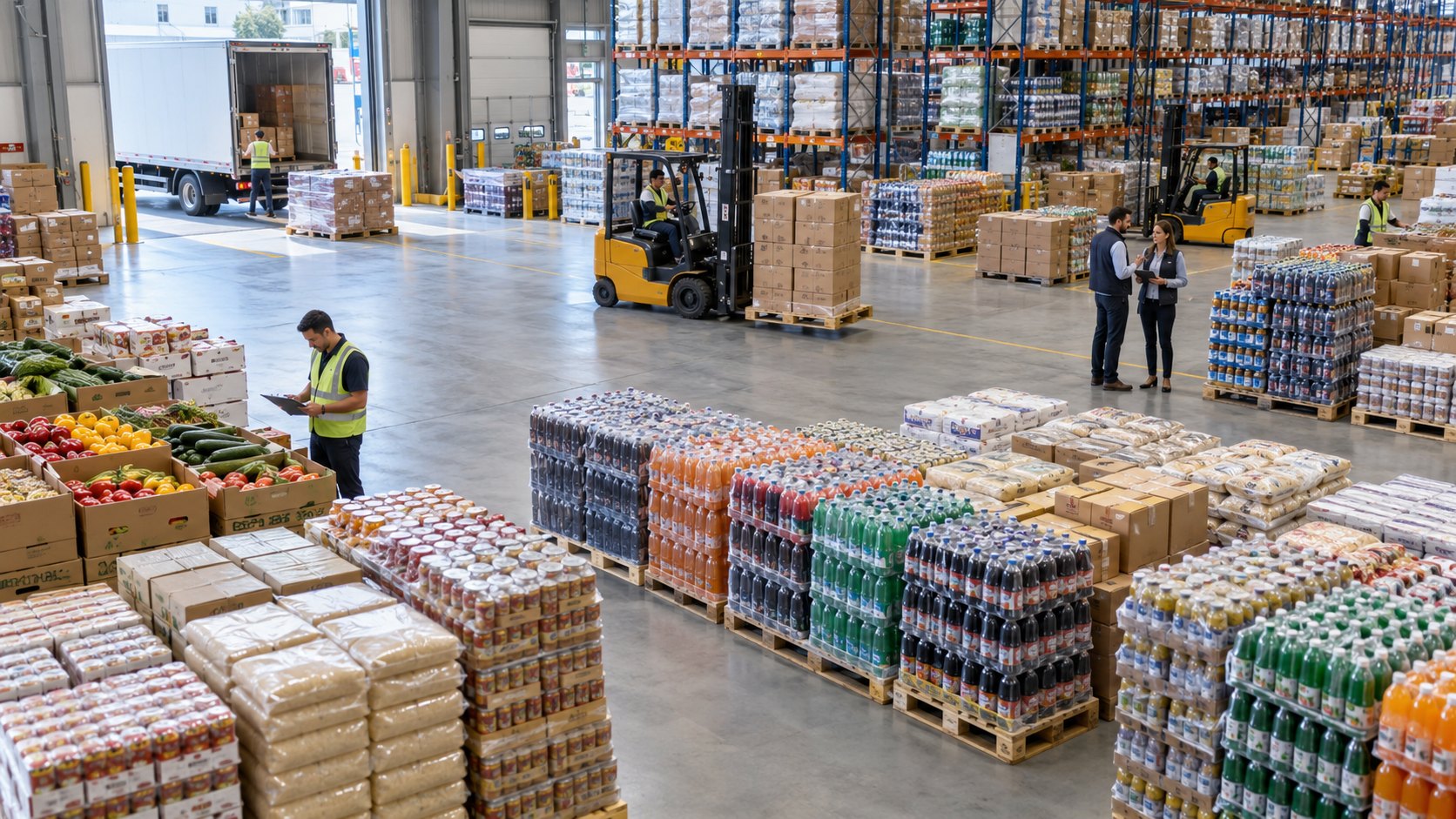
CZ 125 — Wholesale Of Food And Beverages
Under this line you buy food and drink in bulk, hold it, and sell it on to other businesses. The commercial shape is consistent whatever the goods: you buy in pallets and sell in cases, and the gap between those two units is both where the margin is and where the risk sits. Break-bulk, storage and delivery are the service you are actually being paid for.
Shelf life is the clock the whole business runs on. A product with most of its life ahead of it is worth full price; the same product with a short remaining life is worth whatever a discounter will give you, and eventually nothing. That single fact explains most of the operating discipline in food wholesale — why buyers refuse short-dated stock, why first-in-first-out is enforced rather than encouraged, and why a trader who over-orders on a promotion can lose the margin of a whole quarter in one aisle.
Payment terms are the second structural fact. Large retail buyers pay on their own timetable and expect support on price; small grocers and restaurants pay quickly but buy in quantities that barely cover a delivery. Most established wholesalers run both, deliberately, because the small accounts fund the cash gap the large ones create.
The product is cleared, not the company
This is the sentence worth carrying away. Food and drink offered for sale in the UAE is assessed per item — the product itself, its ingredients, its label, its claims and its shelf life — by the emirate's food control side, working within the federal food safety framework. A licence to trade in food is not a clearance for any particular food. Traders who assume otherwise discover it at the point where a consignment is sitting at a port with nothing to do.
six gates, and three of them are the same authority
The emirate's economic department
- How wide the food range on the licence may beWith the initial approval, before a supplier is signed
The emirate's food control authority
- Whether each product, its label and its shelf life may be sold hereItem by item, before the first consignment is released
- Whether the store and its cold rooms are fit to hold foodWith the tenancy, and again at every inspection
- Whether chilled and frozen vehicles may carry the loadOnce distribution starts, and on renewal
The emirate's customs authority
- Whether the goods may enter the country at allAt the border, on every consignment
The federal tax authority
- Tax enrolment for the trading companyOn the turnover test, not on the licence
Read the drawing rather than the list: three of the six sit with food control. That is the shape of this activity. The incorporating authority is the first gate and the quickest to clear; the body that decides whether your goods can actually be sold is the one you will deal with for the rest of the company's life.
Premises and cold chain are a condition, not a feature
Food wholesale is a building with rules attached. The store has to be suitable for the goods it holds, separated so raw and ready-to-eat lines do not meet, protected against pests, and temperature-controlled where the product demands it. Chilled and frozen lines extend that requirement to the vehicles, because a cold chain broken on a delivery run is broken for good and cannot be repaired by putting the pallet back in the freezer.
The practical failure is almost never a missing rule. It is a unit taken on price, without checking whether it can be made suitable, followed by a fit-out that costs more than the rent saved. Settle the premises question before signing the tenancy, and let the answer narrow the choice of jurisdiction rather than following it.
Traceability is what an inspector actually asks for
Not certificates on a wall. The question is: where did this pallet come from, and where did it go. A wholesaler who can answer that from records — batch and lot codes, supplier declarations, delivery notes tied to customers — can withdraw a batch in an afternoon. A wholesaler who cannot has to withdraw everything, tell every customer, and explain why. Build the record-keeping before the range grows, because retrofitting it across four hundred items is the part nobody costs in.
The narrower lines, and when to take one instead
Several activities in this catalogue carve a single family of goods out of this one, and each of them carries conditions specific to its own products: CZ 126 for fruit and vegetables, CZ 127 for dairy, CZ 128 for eggs and egg products, CZ 129 for edible oils and fats, CZ 130 for meat, CZ 131 for fishery products, CZ 132 for sugar and confectionery, CZ 133 for bakery, CZ 134 for beverages and CZ 135 for coffee, tea, cocoa and spices. If the range is genuinely one of those, take that line — it is a clearer statement to a buyer and to an inspector about what the company is. The umbrella is for a range that crosses several of them.
What the licence does not cover
Cooking, preparing and assembling food are not on it. A kitchen, a central production unit or a catering operation is food production or food service, licensed on different conditions and inspected against different standards.
Selling to the public is not on it. Wholesale describes the customer, not the volume, and a unit the public walks into is retail whatever the pack size.
Making or repacking under your own label is not on it. Putting somebody else's bulk product into your own packaging makes you the producer of that pack in the eyes of the people who assess it, and that is a manufacturing activity with a manufacturer's obligations.
Clearing a product on somebody else's behalf is not on it either. The product file belongs to whoever owns the goods being offered for sale; a trader holding stock for a principal should be clear in writing about who carries that responsibility.
And two families of goods sit outside this page entirely. Tobacco has its own line, CZ 136, and its own controls. Alcohol is controlled separately in every emirate and nothing here should be read as extending to it.
What the approvals are in detail, what conditions attach to a particular store, and what any of it costs depends on the emirate, the premises and the exact range — which is what ConsultZone confirms for a specific case rather than quoting from a page.
References
- Dubai Municipality — food control, food store suitability and public health conditions in Dubai. Dubai Municipality
- Abu Dhabi Agriculture and Food Safety Authority — food safety and agriculture matters within Abu Dhabi. Abu Dhabi Agriculture and Food Safety Authority
- Ministry of Climate Change and Environment — the federal remit for food safety and food security policy. Ministry of Climate Change and Environment
- Dubai Customs — import and export, customs codes, and restricted and prohibited goods. Dubai Customs
- Federal Tax Authority — value added tax, excise tax and corporate tax enrolment and filing. Federal Tax Authority
Elsewhere in Trading
Activities that sit beside this one
Most licences carry more than one activity. Adding a neighbouring line at the application stage costs a fraction of amending the licence afterwards.
Begin with a clear conversation
Tell us what you intend to build.
A consultant will map the structure, jurisdiction, approvals and likely cost against what you actually described — not against a package.
