

Activity CZ 127
How to Start a Dairy Products Wholesale Business in Dubai
Dairy is the shortest-lived stock a wholesaler can hold, and the chilled chain decides whether it arrives saleable. Fresh and long-life dairy are two trades sharing one licence line.
ConsultZone licensing desk
- Activity code
- CZ 127
- Category
- Trading
- Reviewed
- Read
- 7 min
Listen instead
52 seconds
An audio summary of this guide.
Topic summary
How to Start a Dairy Products Wholesale Business in Dubai
Every other food line in this catalogue forgives a slow day. Dairy does not. A pallet of fresh milk that stands on a loading bay for two hours in August has not lost a little quality — it has moved from stock to write-off, and no discount recovers it. That single fact shapes the whole business: the routes, the vehicle spend, the order cycle, the terms a supplier will give, and the reason margins read thinner than the turnover suggests.
The temperature point deserves stating plainly, because newcomers treat it as a quality matter and the authorities treat it as a safety one. A break in the chilled chain is not a cosmetic problem to be argued over with a buyer. It is the event that makes the product unfit, and a wholesaler whose vehicles cannot hold temperature is not a cheaper dairy wholesaler — it is one selling a different and unsaleable thing. Inspectors look at the cold store and the vehicle, not at the invoice.
Which leads to the division that actually matters here, and it is not the one the activity name implies. Fresh dairy and long-life dairy are two businesses. Fresh milk, laban, fresh cream, soft cheese and yoghurt live in days, have to be sold before they are fully paid for, and cannot travel far. Long-life cartons, evaporated and condensed milk, milk powders, processed and hard cheeses and butter live in months, sit at ambient or gentle chill, and will cross a border without complaint. One trade is a daily logistics operation with a small radius. The other is stock trading with storage. Most people who came unstuck in dairy priced the first as though it were the second.
CZ 127 — Wholesale Of Dairy Products
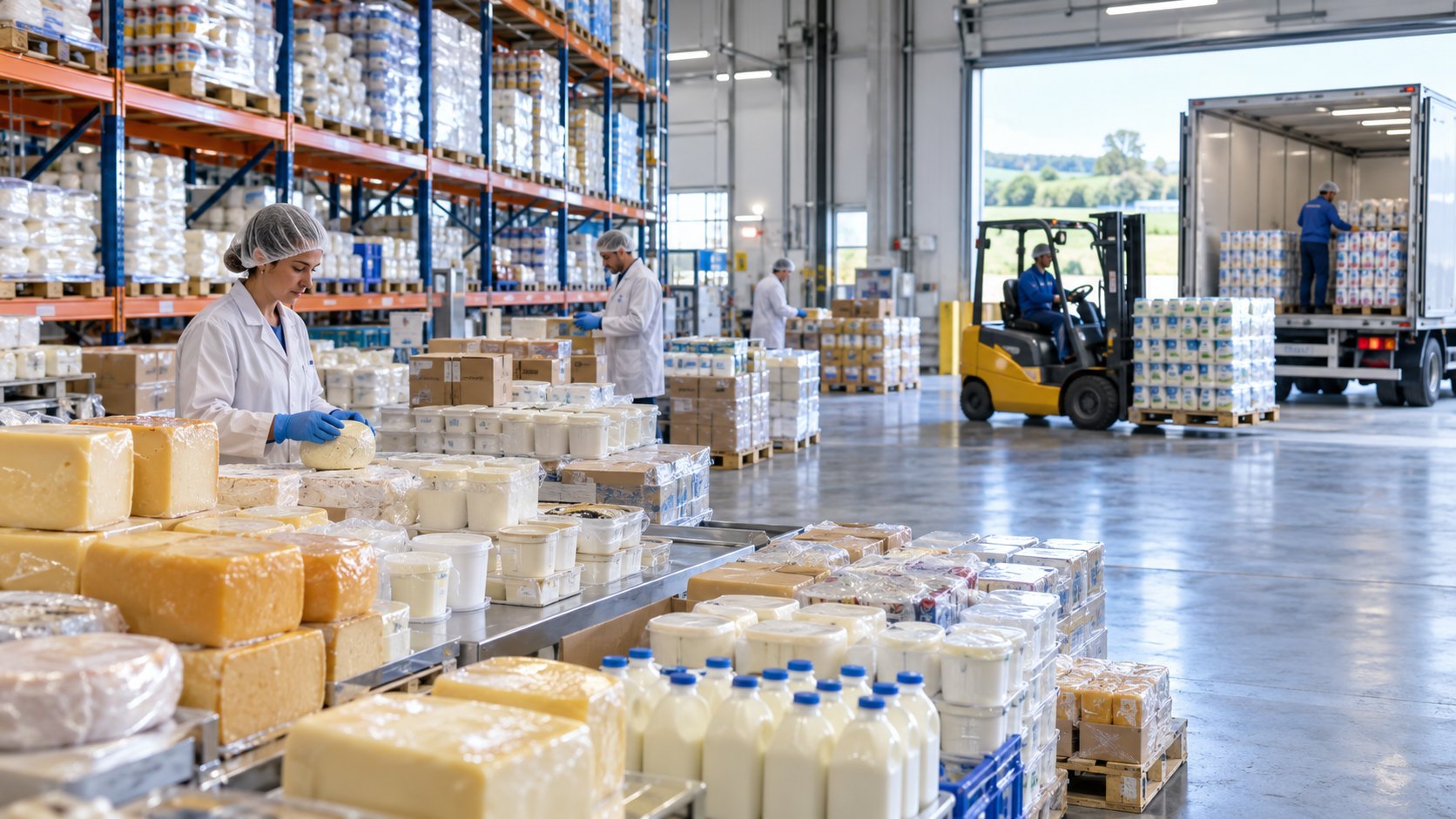
The line covers buying dairy in bulk and selling it on to businesses rather than to the public: milk and flavoured milk, laban and buttermilk, yoghurt and labneh, cream, butter and ghee, cheeses fresh and matured, milk powders, condensed and evaporated milk, and the ingredient-grade dairy that bakeries and food manufacturers buy by the sack or the drum. It covers holding that stock, breaking it into the case and tray formats each buyer wants, and delivering it. It does not cover making any of it, and it does not cover selling over a counter to consumers, which is retail and a separate line.
Where the licence sits depends almost entirely on who signs the purchase order and where that buyer stands. This is the decision that catches people, because the answer is set by the customer list rather than by the product.
six dairy buyers, two destinations
- Supermarket and grocery chains taking chilled shelf stockSold into the UAE market and consumed here
- Hotels, caterers and bakery kitchens ordering on a daily cycleA UAE buyer whose order is placed and delivered inside the country
- Hospital, school, camp and airline catering contractsInstitutional supply inside the domestic market
- Provision shops and groceries served by van salesOne UAE company invoicing another for goods delivered locally
Mainland licence
- Long-life cartons, powders and butter held for onward exportAmbient stock that never clears into the local market
- Ingredient-grade dairy traded between two overseas partiesNeither the seller nor the buyer sits in the UAE market
Free zone licence
Read the weight of that drawing rather than the individual rows. Almost all fresh dairy money belongs to buyers who are themselves inside this market, which is why the mainland side is the heavier one — and why a free zone licence chosen on price is the wrong instrument for anyone whose plan is chilled delivery to UAE customers. The free zone answer is genuinely right for the long-life and powder trade, where the stock is ambient, the buyer is abroad and the goods are passing through. Which conditions attach in a given emirate, what the premises must provide and what the licence costs to hold are set by the jurisdiction and the activity mix, and ConsultZone establishes those for the specific case before a lease is signed.
Three neighbouring lines that are not this one
Making it is manufacturing. Pasteurising, homogenising, culturing yoghurt, filling cartons, churning butter, cutting and wrapping cheese are production operations with their own premises, their own plant conditions and their own product files. Buying finished dairy and breaking it into cases is this line. Turning raw milk into a product is not.
Ice cream and frozen desserts behave differently. They share a dairy base and share almost nothing else operationally: the chain is frozen rather than chilled, the storage runs at a much lower temperature, the vehicles are different units, and the seasonality is sharper. A wholesaler equipped for chilled dairy is not equipped for frozen confectionery by adding a product code.
Infant formula and specialised nutrition sit under health control as well as food control. They are dairy-derived and they are treated as a health product, with a documentary and labelling burden that has nothing to do with selling cheese to a hotel. Anyone intending to trade them should expect to satisfy the health authority alongside the food authority, and should have that confirmed before committing to stock.
There is a fourth boundary worth naming because it runs beside this page rather than against it. Eggs are a separate catalogue line, and a dairy wholesaler who also carries eggs is running two chilled products with different grading, different handling losses and different buyers out of one cold store. Plenty do it and it works well. It is a decision about the store and the delivery round, not a free extension of the dairy licence.
Who this actually suits
An operator who already owns cold storage and vehicles. This is the strongest entry by a wide margin. The capital that defeats new dairy wholesalers is the chilled infrastructure, not the stock. Anyone already running a chilled store and a temperature-controlled fleet for another food line is adding product to an asset that is already paid for, and can survive the first months when volume does not yet cover the round.
A distributor with the accounts and not the products. A company already delivering to supermarkets, hotels or provision shops several mornings a week holds the hardest asset in the trade, which is a standing order pattern. Dairy fits the same vehicles on the same route on the same morning. The work is buying and holding, not selling.
Someone with a supply relationship rather than a sales plan. Domestic dairy production exists at real scale in this market, and imported long-life and cheese lines arrive through a small number of channels. A first-time wholesaler who has an agreed supply arrangement — pricing, allocation, delivery frequency — starts from the part everybody else discovers last. Without one, a buyer's order becomes a promise nobody can fill twice.
A trader whose plan is genuinely long-life or powder. Ambient dairy is a stock and storage business and it rewards different skills: working capital, a view on price, and patience. It needs no chilled fleet, and it should not be dressed up as a fresh dairy operation to look more substantial than it is.
Who this rarely suits is the operator whose whole model is price. Fresh dairy is bought on availability and reliability, and a buyer let down once on a morning delivery does not come back for a slightly better rate. The margin here is earned by turning up.
References
- Ministry of Climate Change and Environment — food safety and food security policy, animal health, and federal control of food consignments entering the country. Ministry of Climate Change and Environment
- Dubai Municipality — food control, cold store and premises suitability, and public health conditions on food handling in Dubai. Dubai Municipality
- Abu Dhabi Agriculture and Food Safety Authority — food safety and animal health control in Abu Dhabi, including conditions on dairy handling and storage. Abu Dhabi Agriculture and Food Safety Authority
- Dubai Customs — import and export of food consignments, customs codes and restricted goods procedures. Dubai Customs
- UAE Government portal — the federal food safety and food security framework, and general government information for traders. UAE Government portal
Elsewhere in Trading
Activities that sit beside this one
Most licences carry more than one activity. Adding a neighbouring line at the application stage costs a fraction of amending the licence afterwards.
Begin with a clear conversation
Tell us what you intend to build.
A consultant will map the structure, jurisdiction, approvals and likely cost against what you actually described — not against a package.
