
Activity CZ 128
How to Start an Eggs and Egg Products Wholesale Business in Dubai
One wholesale line holds two trades. Shell eggs are a handling and grading business where breakage is the margin; liquid, frozen and powdered egg products are an industrial ingredient sold to manufacturers.
ConsultZone licensing desk
- Activity code
- CZ 128
- Category
- Trading
- Reviewed
- Read
- 8 min
Listen instead
51 seconds
An audio summary of this guide.
Topic summary
How to Start an Eggs and Egg Products Wholesale Business in Dubai
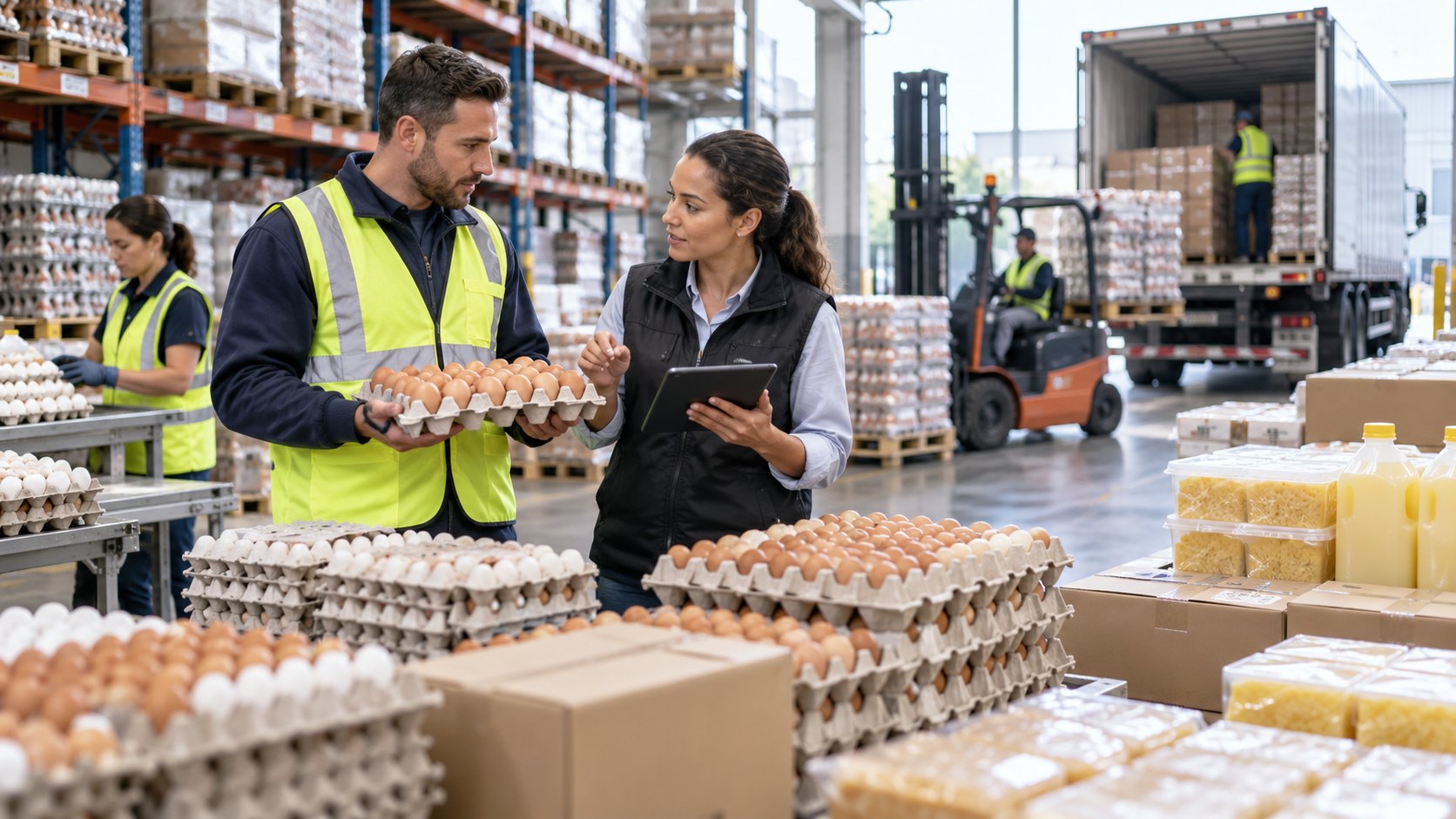
A tray of eggs is the most fragile thing a food wholesaler moves, and the arithmetic of this trade is decided by that. On a low-margin case, a two per cent breakage rate and a five per cent breakage rate are the difference between a profitable round and a pointless one. Nobody wins in shell eggs by buying better; they win by handling better — by how a pallet is stacked, how a van is driven, how a tray is lifted at the buyer's gate and how quickly a short-dated case is moved rather than rotated to the back.
That is the first of two businesses inside this one line, and the second looks nothing like it. Processed egg — liquid whole egg, separated white and yolk, frozen egg, and dried egg powder — is an industrial ingredient. It is bought by bakeries, biscuit and confectionery plants, sauce and mayonnaise makers, pasta producers, and large central kitchens that will not crack six thousand eggs by hand at four in the morning. It arrives in bags, cartons, pails or drums, it carries a specification rather than a grade, and its buyer is a production manager working to a recipe and a microbiological standard.
The two trades share a supply origin and share very little else. Shell eggs are sold on freshness, size grade and appearance, in small and frequent orders, to buyers who mostly sell them on unchanged. Processed egg is sold on consistency, documentation and a delivery schedule that matches a production plan, to buyers who are turning it into something else. A wholesaler can run both. A wholesaler who assumes the second is simply a bulk version of the first will misjudge the cold storage, the customers and the paperwork all at once.
Who this suits, and it is not usually a general food trader
A distributor already delivering chilled food daily. Shell eggs are a near-perfect add-on to an existing morning round. The customer overlap with dairy, bread and fresh produce is close to total, the stock turns quickly, and the marginal cost of adding trays to a van that is already going is very low. This is the most common successful entry and the least dramatic.
An operator with a bakery or manufacturing client base. Anyone already supplying flour, fats, sugar or dairy ingredients to production kitchens is selling to precisely the buyers who want liquid and powdered egg, and is already trusted on specification and documentation. Adding processed egg is a line extension into a customer relationship that exists.
A grading and packing operator. There is real, unglamorous money in the middle of this trade — taking bulk arrivals, candling and grading them, and repacking into the retail trays, cartons and catering cases that each buyer's shelf or kitchen actually needs. It requires premises, labour and equipment rather than a large sales team, and it is where the value a supermarket will pay for is added.
Someone with a settled source. Eggs come to this market both from domestic production and from imports, and allocation matters more than price. A wholesaler who has an agreed volume and a delivery frequency can promise a supermarket a standing order; one who is buying opportunistically cannot, and a supermarket that has been short once will not restore the listing quickly.
Who should think twice
An operator with no temperature-controlled storage or transport, and no intention of acquiring any. And a trader whose whole plan is to undercut the incumbent — shell eggs are near-commodity, the spread is narrow, and a price war is won by whoever has the lowest breakage and the most efficient round, which is an operational answer rather than a commercial one.
What you can and cannot do under this line
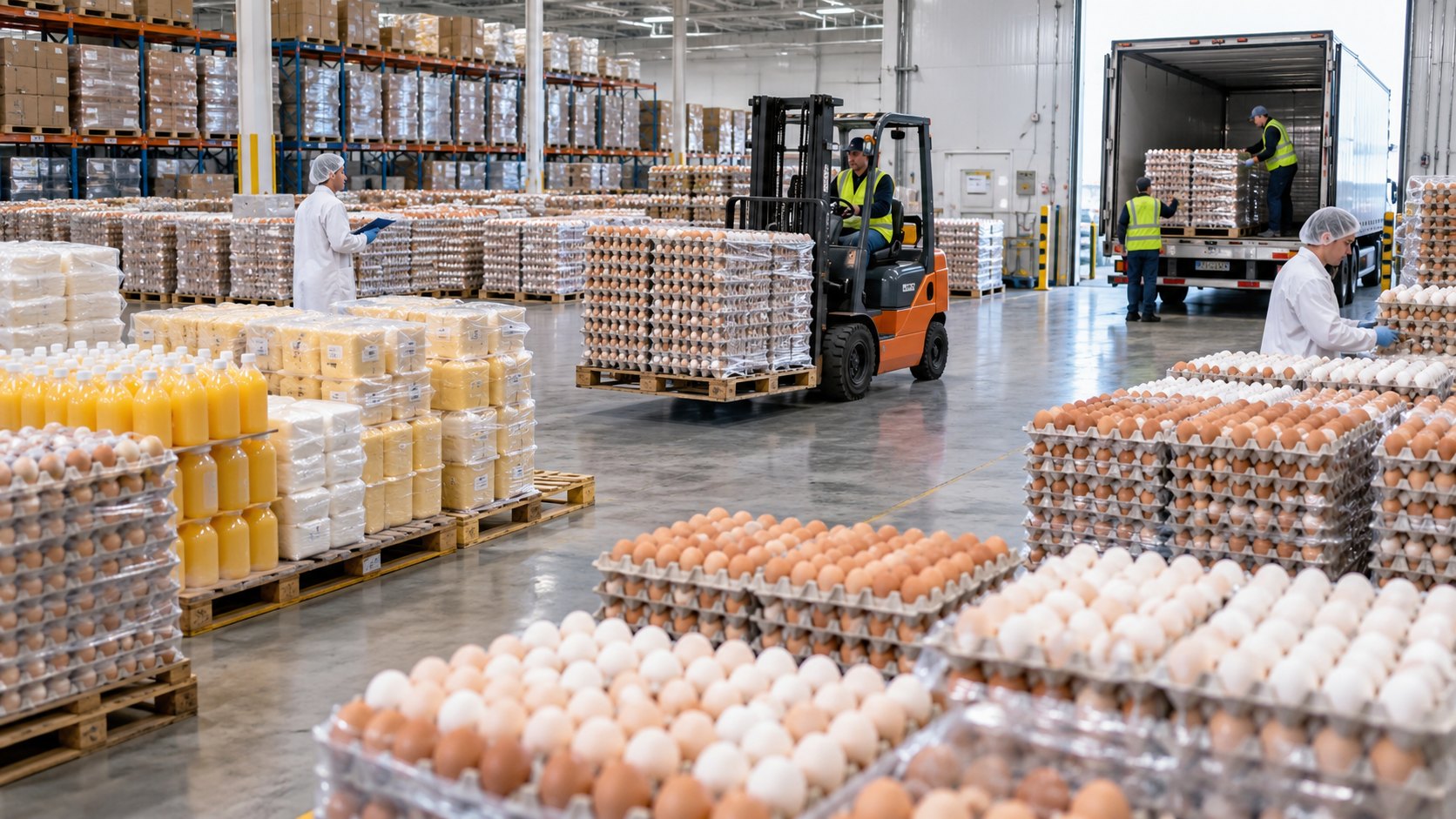
The activity covers buying eggs and egg products in bulk and selling them on to businesses: shell eggs in all sizes and grades; liquid whole egg, whites and yolks; frozen egg; and dried or powdered egg. It covers holding that stock in suitable conditions, candling, grading and repacking shell eggs into the formats buyers want, and delivering to trade customers. It does not cover selling to the public from a shop, which is retail, and it does not cover keeping the birds.
Four things sit outside it and each one catches somebody.
Keeping laying hens is farming. Poultry production is an agricultural activity with its own premises, its own animal health conditions and its own authority relationship. Buying eggs from a farm is this line; running the farm is not, and a wholesaler who takes a share in a production site has acquired a second and quite different licensing problem.
Breaking eggs for sale is food processing. Cracking shell eggs and selling the liquid — even unpasteurised, even to one customer — is a manufacturing operation requiring an approved processing premises, a product file and controls on the process itself. Buying liquid egg that somebody else made and selling it on is wholesale. Making it is not.
Cooking or preserving it is a different product again. Boiled and peeled eggs, pickled eggs, egg-based sauces and prepared egg products are manufactured foods with their own approvals.
No product moves before its own file is cleared. Eggs and egg products are cleared per product and per source establishment by the federal food authorities and the emirate's food control, and imported consignments answer to that clearance before they answer to a customer. A wholesaler who sells forward a product whose file is not yet in order has sold a delivery date they do not control. What that file requires for a particular product and a particular origin depends on the product and the emirate, and ConsultZone establishes it for the specific case rather than assuming it from a similar one.
Between arrival and a customer's door the stock passes through a fixed order, and the losses in this trade concentrate in two of the stages.
- Product and source file cleared before the consignment is promisedReleases the goods instead of holding them
- Arrival check: temperature, shell condition, breakage and gradeFixes what is saleable and what is a claim on the supplier
- Candling, grading and repacking into each buyer's formatTurns one bulk arrival into retail trays and catering cases
- Chilled holding with stock rotated strictly by dateProtects the shelf life the buyer is paying for
- Picking and delivery on a temperature-controlled vehicleCompletes the sale, or produces a rejection at the door
Arrival and delivery are the two stages where eggs actually break, and the marked one is the stage a new wholesaler routinely gives away. What is not counted at the loading bay cannot be claimed from the supplier later, which is why experienced operators put their best people at goods-in rather than on the phone.
Premises and practical conditions
The cold store is the centre of this business and it is specified rather than chosen. Shell eggs need steady chilled holding with controlled humidity — cycling temperature is worse than a slightly higher steady one, because condensation on a shell is a contamination route. Liquid and frozen egg need their own separate space at their own temperature, and powdered egg needs dry ambient storage away from moisture and odour. Anyone planning to run all four is planning three storage environments, not one.
Layout does more work here than it looks. Eggs pick up smells, so they cannot be held next to strongly aromatic stock. Trays stack only so high before the bottom layer pays for it. Racking, aisle widths and the depth a picker has to reach all show up in the breakage figure at the end of the month, and a store designed for cases is not a store designed for trays.
The grading and packing area is the part that turns a haulier into a wholesaler. Candling to find cracks and blood spots, weight grading, date marking and packing into trays and cases needs a clean, lit, temperature-controlled space with hand-washing and waste handling, and staff who have been trained for it. Premises suitability for food handling is assessed by the municipality or the emirate's food control alongside the licence, and it is assessed against what will actually happen in the room.
Vehicles complete the chain and are where a good operation is undone most often. A temperature-controlled body, a logger that can evidence the journey, and loading practice that does not let trays shift are the whole of it. An egg delivered warm is refused at the gate, and the refusal is recorded against the supplier rather than the driver.
References
- Ministry of Climate Change and Environment — animal health, poultry production, food safety policy and federal control of food consignments entering the country. Ministry of Climate Change and Environment
- Dubai Municipality — food control, premises and cold store suitability for food handling and repacking in Dubai. Dubai Municipality
- Abu Dhabi Agriculture and Food Safety Authority — food safety, animal health and poultry controls in Abu Dhabi. Abu Dhabi Agriculture and Food Safety Authority
- Dubai Customs — import procedures for food consignments, customs codes and restricted goods. Dubai Customs
- UAE Government portal — the federal food safety framework and national food security policy. UAE Government portal
Elsewhere in Trading
Activities that sit beside this one
Most licences carry more than one activity. Adding a neighbouring line at the application stage costs a fraction of amending the licence afterwards.
Begin with a clear conversation
Tell us what you intend to build.
A consultant will map the structure, jurisdiction, approvals and likely cost against what you actually described — not against a package.
