
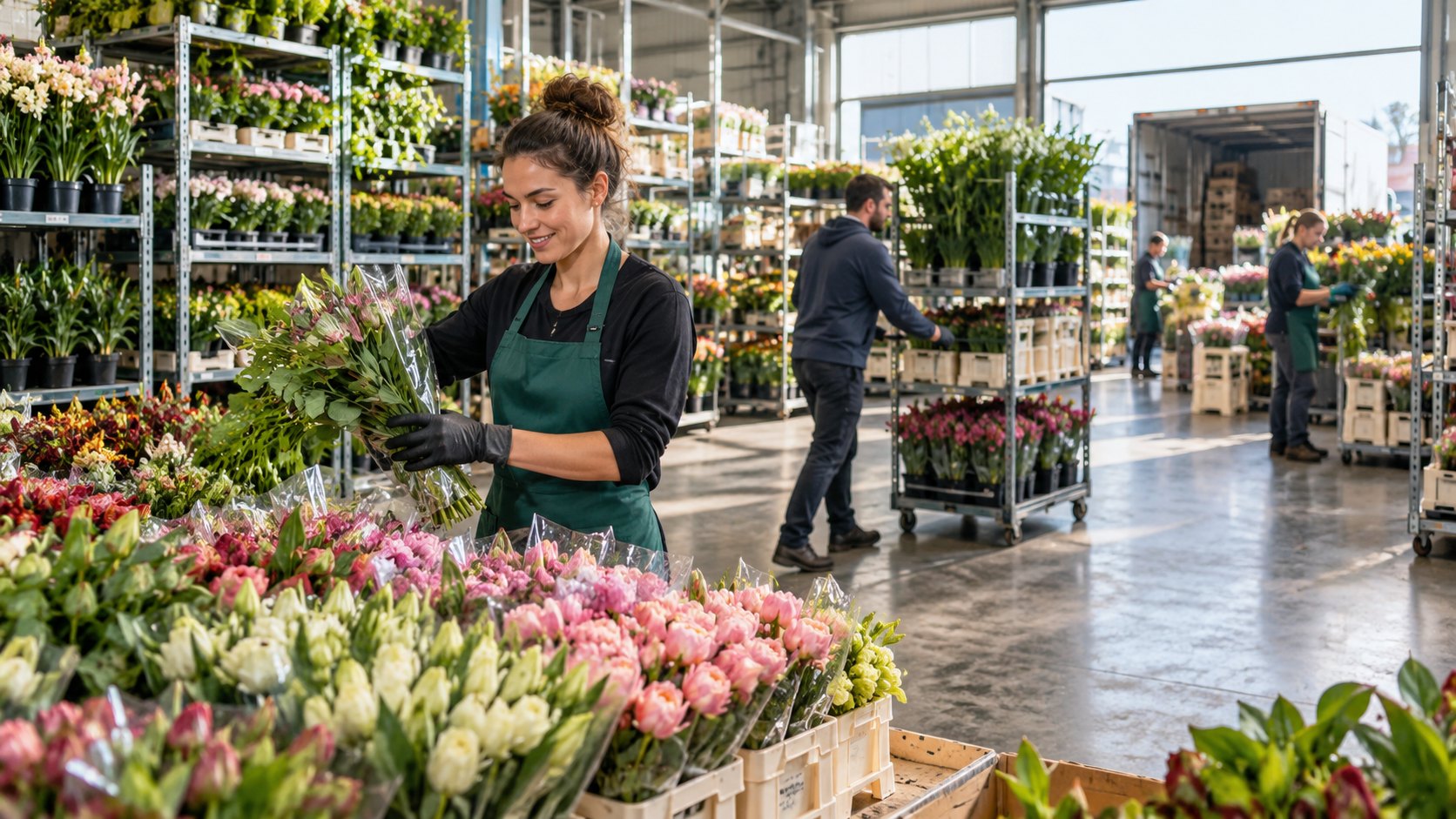
Activity CZ 112
How to Start a Flowers and Plants Wholesale Business in Dubai
Cut flowers lose value by the hour, so a wholesale file on this line is really a cold-chain and air-freight file. Who buys in volume, what the activity covers, and why live plants are the harder half.
ConsultZone licensing desk
- Activity code
- CZ 112
- Category
- Trading
- Reviewed
- Read
- 6 min
Listen instead
45 seconds
An audio summary of this guide.
Topic summary
How to Start a Flowers and Plants Wholesale Business in Dubai
Almost every other trading line in this catalogue sells something that can wait on a shelf. This one does not. A cut stem begins losing value the moment it leaves the field, and nothing a trader does afterwards reverses that — the only variable under anyone's control is how much of the loss happens before the flowers reach a buyer.
Everything commercially distinctive about flower wholesaling follows from that sentence. The stock has a life measured in days. It travels by air because the sea is too slow. It has to be cold from the farm to the vase, and every hour it spends outside that temperature band is subtracted from the shelf life the customer is actually paying for. The business is therefore not really about flowers. It is about scheduling, refrigeration and the reliability of a supply line that runs through somebody else's airport.
Dubai's advantage here is genuine and it is an aviation advantage rather than a horticultural one. The great flower-growing regions — East Africa, the Netherlands, India, Colombia, Ecuador — are all within reach of a city with the freight connections, the handling capacity and the cold storage to break a consignment and move it on the same day. That is the whole commercial case, and it explains why a trade in a product the country barely grows is viable here at all.
Live plants are a different problem wearing the same licence. They are not perishable in days, they are heavier, they need light and water rather than refrigeration, and on import they are a plant-health matter, because a plant, its soil and its container can carry pests and disease across a border in a way a cut stem largely cannot. The federal agriculture and environment authority is the body concerned with that, and the clearance is granted against the specific plant material rather than against the company.¹
Who this line is for
Event, hotel and hospitality suppliers
The steadiest buyers in the market, and the most demanding. A hotel with a weekly floral contract and an events company with a wedding on Thursday are both buying certainty, and both will change supplier permanently over one late delivery. The margin is respectable and the tolerance for error is close to zero.
Retail florists outgrowing a retail supply chain
Shops that have reached the point where buying from another wholesaler is costing them the difference between surviving and expanding. For them the licence is a route to origin pricing, and the decision turns on whether they can absorb a whole consignment rather than the part of it they can sell.
Landscaping and nursery operators
Plants rather than stems: contractors, facility managers and developers who need trees, shrubs and groundcover in quantity. A slower, heavier, less glamorous trade with a longer cash cycle and far less waste — and for many operators the more durable half of the business.
Traders with a relationship at origin
The people for whom this line works best are those who already know a farm or an exporter well enough to be given consistent grade and honest packing. That relationship is the asset. The licence is the easy part.
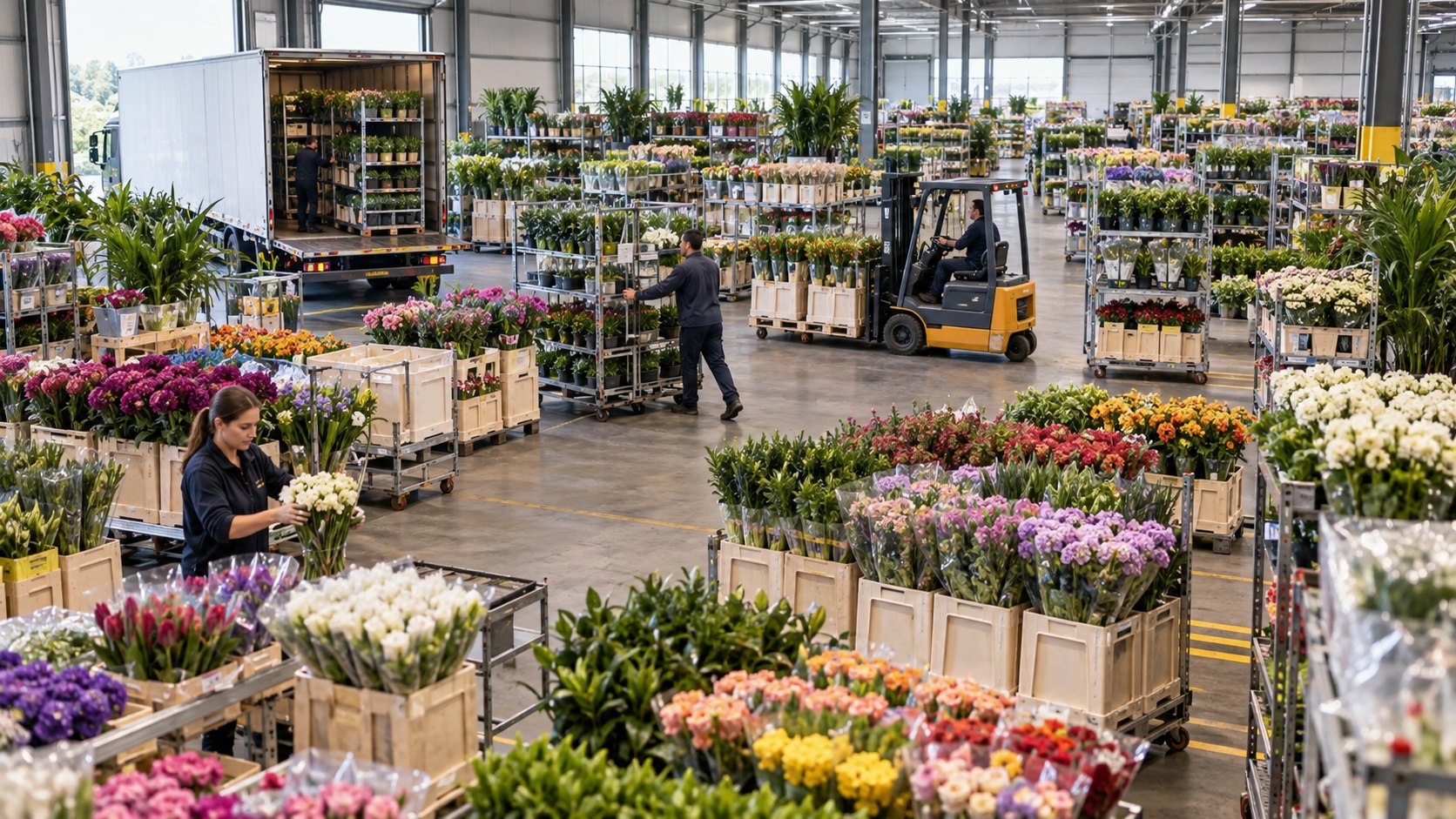
What the line permits, and where the cold chain draws the limit
Under this activity the company buys and sells cut flowers, foliage, live plants, bulbs, seedlings and the cut greens that go with them, in volume and to businesses. It permits importing, holding, breaking bulk, sorting, bunching and moving the goods on. It does not make the company a grower — raising the plant is a farming activity on agricultural premises, and it is a different undertaking entirely. It does not by itself make the company a retail florist selling to the public from a shopfront, which is its own activity and its own premises question. Nor does it cover landscape construction: supplying the trees is trade, planting and maintaining a garden is a contracting service.
The other boundary worth stating early is dried and preserved material. Dried flowers, preserved stems and artificial arrangements behave like ordinary non-perishable goods, and a trader who drifts into them is running a stock business rather than a cold-chain one — which is a reasonable thing to do, but it is a different company with a different set of problems.
The order in which the file has to be built follows the physical trade, not the paperwork, and getting the sequence wrong is what makes a first consignment sit on a tarmac.
- Fix whether the company sells cut stems, live plants, or bothDecides whether a plant-health file exists at all
- Reserve the trade name and take the initial approval on the wholesale activityLets the constitutional documents be drawn
- Take a cold store and a loading bay that actually holds temperatureRecorded against the licence, and the only thing keeping the stock alive
- Open a clearance file for imported plant materialLets a live consignment land instead of waiting
- Obtain a customs code in the company's own nameTurns a licence into the ability to clear an air waybill
Read the third row as the one that decides the business. It is ordinary for a new trader to treat premises as a cost to be minimised and discover afterwards that a warehouse without working refrigeration is not a smaller version of a cold store — it is a different building, and on this line it is the difference between selling flowers and writing off flowers.
The premises are a refrigerator with a loading bay
Physical conditions do more to settle where this company should be incorporated than any tax or fee comparison. A cut-flower operation needs cold rooms holding a stable low temperature, insulated doors, a bay where a truck can be loaded without the chain breaking in the open air, drainage for water and cut material, and enough floor to grade and bunch under cover. A plant nursery operation needs the opposite: shade, irrigation, drainage and open area, with weight rather than temperature as the constraint. Very few addresses suit both well, which is why the first real decision on this licence is the one in the top row of the drawing above.
Waste is the running cost nobody budgets. A wholesaler on this line throws away a share of everything it buys, as stems fail, plants are damaged and trimmings accumulate, and organic waste of that kind is a municipal matter with conditions attached to how it is stored and collected.² Odour and drainage complaints are the usual reason a food-adjacent unit falls out with its neighbours, and they are cheaper to design for than to answer.
Where this is the wrong purchase. If the plan is to grow the plants, this is not the activity — that is farming, and it needs agricultural land with its own approvals. If the plan is a florist's shop serving walk-in customers, a wholesale licence is the wrong shape and will not sit comfortably in a retail location.
Which approvals attach, what the plant-health clearance requires for a specific species, how the premises must be fitted out and what the whole arrangement costs to hold all differ by emirate and by jurisdiction.³ Those are questions with real answers for a real case, and ConsultZone confirms them against the intended product list and site before a lease is signed.
References
- Plant health, agriculture and the federal framework for imported plant material. Ministry of Climate Change and Environment
- Premises suitability, public health and the handling of organic waste in Dubai. Dubai Municipality
- Import clearance, customs codes and the treatment of restricted consignments. Dubai Customs
Elsewhere in Trading
Activities that sit beside this one
Most licences carry more than one activity. Adding a neighbouring line at the application stage costs a fraction of amending the licence afterwards.
Begin with a clear conversation
Tell us what you intend to build.
A consultant will map the structure, jurisdiction, approvals and likely cost against what you actually described — not against a package.
