

Activity CZ 132
How to Start a Sugar, Chocolate and Confectionery Wholesale Business in Dubai
Two trades share this line. Sugar moves on a world price and chocolate moves on a shelf plan, and one of them melts. What the confectionery wholesale licence covers and why temperature sets the cost.
ConsultZone licensing desk
- Activity code
- CZ 132
- Category
- Trading
- Reviewed
- Read
- 7 min
Listen instead
50 seconds
An audio summary of this guide.
Topic summary
How to Start a Sugar, Chocolate and Confectionery Wholesale Business in Dubai
Two trades share this line on the sheet and they behave almost nothing alike. One of them is bulk sugar: a commodity with a world price, bought by the tonne against a specification, sold to factories, bakeries and re-packers on a margin thin enough that a fraction of a fils per kilo decides the deal. The other is chocolate and sugar confectionery: branded goods bought by the case and sold into a shelf somebody else controls, on a margin that looks generous until the cost of winning a listing and holding stock through a slow season comes off it.
The practical consequence is that the two halves want different companies. A sugar trader needs storage, a clean specification, a customs code and the patience to work on volume. A confectionery distributor needs a brand somebody already wants, a sales team that calls on buyers, and a store that stays cold in August. Plenty of licences carry both lines. Very few businesses run both well.
And then there is heat, which is this trade's real operating problem and the reason it is not the same business here that it is in Europe.
One licence line, two unrelated trades
Sugar as a commodity
Refined white sugar, brown and raw sugar, icing and caster grades, liquid sugar and syrups, and the bulk sweeteners a food manufacturer buys as an ingredient. The buyer is a factory, a bakery, a beverage plant or a repacker, and the conversation is about grade, moisture, packaging and delivered price rather than about a label. Working capital is the constraint: a container of sugar is a large amount of money standing still, priced against a market that keeps moving while it stands.
Chocolate
Bars, boxed assortments, seasonal and gift lines, chocolate for baking and coating, and the industrial chocolate a factory melts. Chocolate is the most temperature-sensitive thing in the confectionery trade. Above a fairly narrow range the cocoa butter separates and migrates to the surface, leaving the grey-white streaking the trade calls bloom, and a bloomed bar is unsellable even though nothing about it has become unsafe. Nothing reverses it. Storage and transport that hold a steady temperature are not a refinement in this market; they are the condition on which the stock exists at all.
Sugar confectionery
Boiled sweets, toffee and fudge, gums, jellies and pastilles, liquorice, chewing gum, marzipan and sugar-paste products, halva and the regional sweet lines, and the white chocolate and compound coatings that sit beside real chocolate on the same shelf. Most of it tolerates heat better than chocolate does and none of it tolerates humidity: gums go tacky, boiled sweets weep and fuse into one solid mass, and that damage is done in the store rather than on the road.
Where cocoa stops and chocolate starts
The neighbouring line in the catalogue covers coffee, tea, cocoa and spices, and the boundary between it and this one falls at the point cocoa becomes confectionery. Beans, nibs, butter and powder sold as ingredients belong there. A finished bar, a coating, a filled chocolate or a boxed assortment belongs here. An importer who intends to handle both should say so while the activity lines are being chosen, rather than find the gap on a consignment that has already shipped.
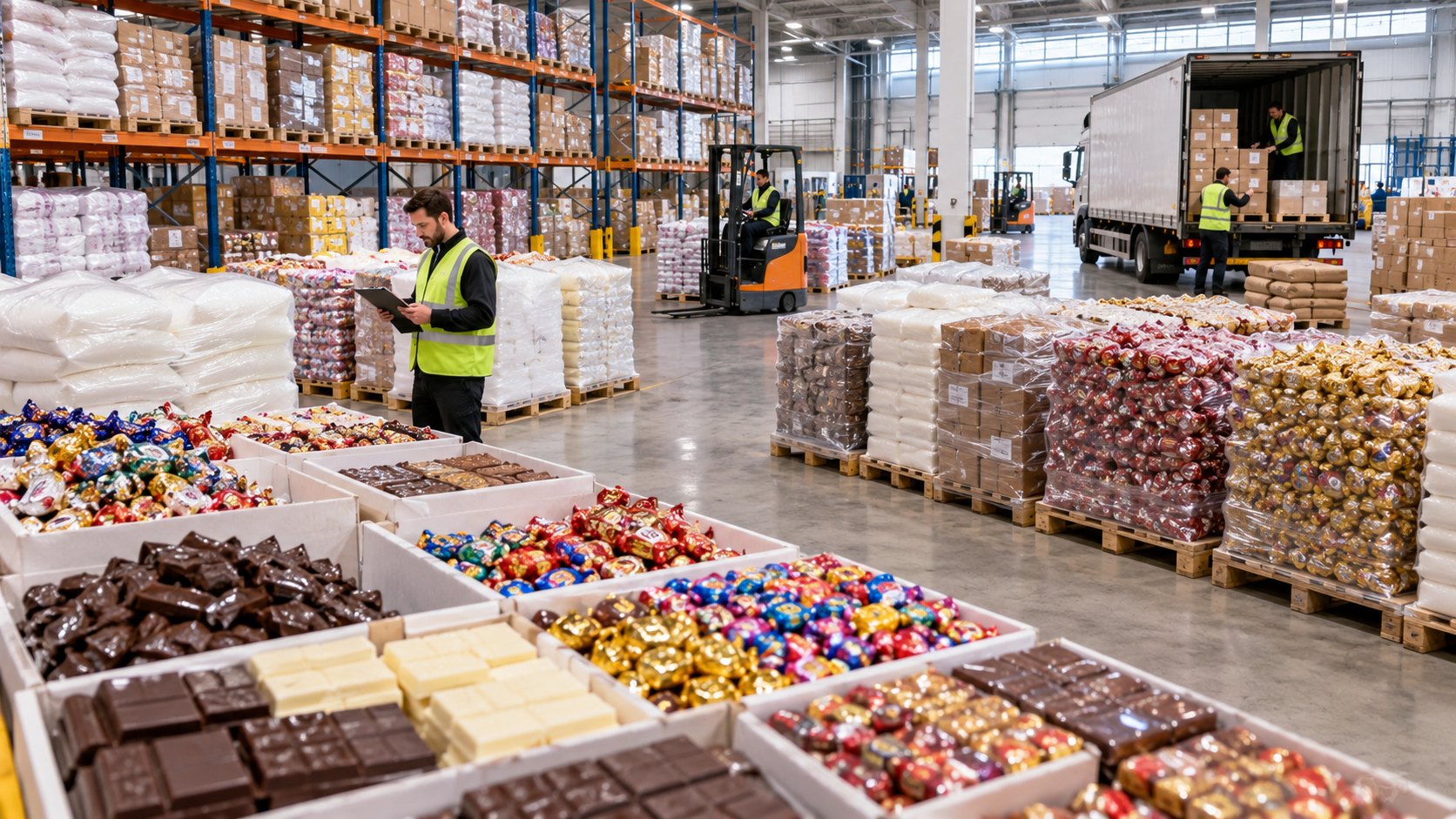
The buyer list is short and the shelf is somebody else's
Confectionery is an impulse purchase, which means the distributor's customer is not the person who eats it. It is whoever controls the place the decision gets made.
Supermarket and hypermarket chains are the largest buyers and the hardest. A listing is negotiated rather than sold: shelf position, promotional calendar, payment terms and the volume the buyer expects you to support all arrive as one package, and a distributor who wins a listing without the working capital to carry it has bought a problem. Convenience stores, petrol forecourts and groceries are the counterweight — smaller drops, faster payment, and the locations where impulse buying actually happens. Hotels, airlines, catering companies and the corporate-gifting trade buy differently again, in bursts, around occasions.
Bulk sugar has no shelf to buy. Its customer is a plant with a production plan, the order is placed against a delivery window, and the relationship survives on reliability rather than on marketing. It is a quieter business and a considerably less crowded one.
Seasonality runs through both halves, and it is not the European calendar. Ramadan and Eid, the wedding and gifting seasons and the school year move confectionery volumes far more than any month on a spreadsheet does, and the stock for a season is bought months ahead — in heat, and held in heat.
Heat, and the tax that follows the sugar
Two conditions attach to these goods that a new entrant usually underestimates. The first is the cold side of a warm country. An air-conditioned store is the minimum, and for chocolate in the summer months a temperature-controlled vehicle between the store and the customer is part of the cost of sale rather than an upgrade to it: the last twenty minutes of a delivery in an unrefrigerated van in July can undo a container that travelled perfectly.¹
The second is tax. Certain sweetened products fall inside the federal excise regime, and the point about excise is not the rate — it is that the charge lands on landed cost before a price list is written. A distributor who quotes a customer and then discovers the tax position has quoted at a loss. Which specific lines are caught, and what the company's own obligations are, is a question for the federal tax authority against the actual products, and it is answered before purchasing rather than after.²
Everything else on the file is a gate held by somebody, and it is worth seeing where they cluster.
six gates, and half of them sit with food control
The emirate's economic department
- Trade licence carrying the wholesale lineFirst, and nothing else can be applied for ahead of it
The emirate's food control authority
- Clearance of each imported product and its labelPer item and per source plant, before the first case is sold
- Suitability of the store for food, and its temperatureInspected with the premises, not promised on paper
- Condition of the vehicles that carry chocolate in summerBefore a delivery round starts, and at inspection afterwards
The federal tax authority
- Whether a sweetened line falls inside the excise regimeBefore the price list is printed
The emirate's customs authority
- Customs code, and the clearance of each consignmentOnce the licence is cut
The shape of that matters more than the rows. Half the gates on this file belong to a single authority, which makes food control the relationship to get right and then to keep. The marked row is the only gate held by a tax body, and it is also the only one that has to be answered before money is committed rather than during an application: a product cleared and stored perfectly can still be sold at a loss if its tax position was discovered late.
What any of it costs to hold, and which of the conditions above genuinely apply, differs by emirate, by premises and by the exact mix of lines on the licence. Those are answers to obtain for the specific case rather than to assume from another company's file, and ConsultZone confirms them with the issuing authority before anything is committed.
References
- Dubai Municipality — food control on imported products and labels, premises suitability, and the temperature conditions applying to food stores and delivery vehicles in Dubai. Dubai Municipality
- Federal Tax Authority — excise tax on sweetened products, and the enrolment and filing obligations that follow from it. Federal Tax Authority
- Dubai Customs — importer code, and the clearance of food and confectionery consignments. Dubai Customs
- Abu Dhabi Agriculture and Food Safety Authority — food safety conditions for stock held or sold in Abu Dhabi. Abu Dhabi Agriculture and Food Safety Authority
- UAE Government portal — federal government information on food, consumer protection and tax policy. UAE Government portal
Elsewhere in Trading
Activities that sit beside this one
Most licences carry more than one activity. Adding a neighbouring line at the application stage costs a fraction of amending the licence afterwards.
Begin with a clear conversation
Tell us what you intend to build.
A consultant will map the structure, jurisdiction, approvals and likely cost against what you actually described — not against a package.
