
Activity CZ 135
How to Start a Coffee, Tea, Cocoa and Spices Wholesale Business in Dubai
Coffee, tea, cocoa and spices are dry goods whose enemies are moisture, odour transfer and pests rather than temperature. The margin sits in grading, blending and sending the parcel on again.
ConsultZone licensing desk
- Activity code
- CZ 135
- Category
- Trading
- Reviewed
- Read
- 7 min
Listen instead
52 seconds
An audio summary of this guide.
Topic summary
How to Start a Coffee, Tea, Cocoa and Spices Wholesale Business in Dubai
Leave a pallet of green coffee beside a pallet of cardamom for a fortnight and you have two damaged parcels instead of one. Coffee takes on whatever it is stored next to; cardamom gives off more than enough to be the thing it takes on. That is not a point about housekeeping. It is the first commercial fact of this activity, because all four families inside it hold their value for months and then lose it to the same three enemies — moisture, odour and infestation — none of which is temperature.
That makes the line unusual among food trades. A wholesaler of chilled or frozen goods is really operating a refrigeration business with a sales desk attached, and a compressor failure at three in the morning costs him the stock. Here there is no cold chain to fail. The fixed cost of entry is a dry, sealed, pest-managed store with the discipline to keep pungent goods away from absorbent ones, and the risk shifts off the equipment and onto judgement. What loses money on this line is buying the wrong grade at the right price.
The trade this coast already had
The positional argument for doing it here is older than any free zone. Coffee, tea and spices moved through these ports long before anything was manufactured on them, and the habit that built the creek — take a parcel, hold it briefly, send it on into somebody else's market — is exactly what a container-scale re-export operation does today. The UAE grows a small share of what it eats and imports the rest, which is the stated premise of its own food security planning.¹ Around that standing requirement sit roasting, grinding, blending and packing operations, and a customs system built to move cargo onward as readily as inward.² A wholesaler here is selling into two markets from one address: local processors and retailers who will consume the parcel, and regional buyers who want it moved on untouched.
The money is made after the container lands, not when it is ordered
A trader who buys a container and sells it on unopened is working a price he does not set. It is a real business and a thin one, because the only thing he adds is a willingness to own the goods for the length of the voyage. The version of this line that pays better adds something to the parcel between the port and the buyer, and on dry goods there are only three things worth adding.
The first is grading. Green coffee is bought on screen size, defect count, moisture and cup score; tea on leaf grade and liquor; cocoa on bean count, moisture and mould; whole spices on volatile oil, cleanliness and foreign matter. Two parcels of the same crop from the same origin can be worth materially different money on the same day, and the buyer who can tell them apart by opening the bag rather than by reading the offer sheet is the buyer who keeps the spread. The second is blending — matching several origins so that a house profile holds steady while the origins move around underneath it, which is what a roaster or a tea packer is actually paying for. The third is breaking bulk: a full container is a working-capital problem for a customer who wants four sacks a week, and solving that problem is worth a margin.
- Fix the origin, the crop year and the grade before the priceSettles everything downstream; a grade agreed loosely becomes a dispute later
- Sample and test the parcel against that gradeTurns a description into something a claim can rest on
- Clear the goods as a food product rather than as freightThe one gate that can hold a container after the licence is already cut
- Take the parcel into dry, odour-separated storageProtects the grade that has just been paid for
- Grade, blend or break bulk to the customer's written specificationWhere the margin above a pass-through trade is earned
Read the third row rather than the sequence. Everything above it is commercial and can be renegotiated; the clearance stage is the only one where the goods stop moving for a reason nobody in the transaction controls. Working capital on this line is heavier than the volumes suggest, not because the goods are expensive but because they sit — at origin, at sea, at the border, and then in store while a buyer draws them down.
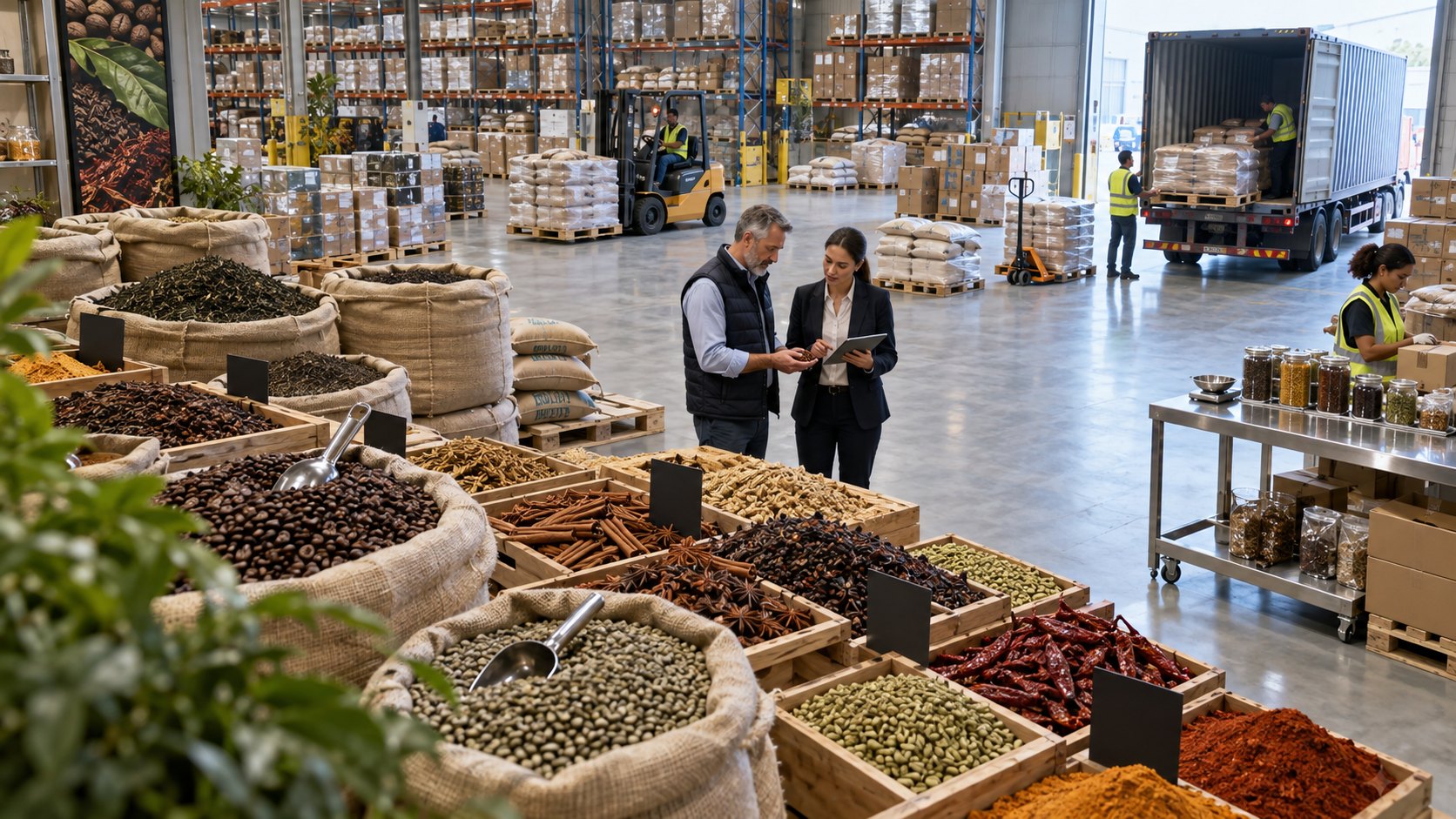
CZ 135 — Wholesale Of Coffee, Tea, Cocoa And Spices
Four families, and four different trades
Coffee splits at the roaster. Green beans are an agricultural commodity with a published price and a laboratory-settled quality; roasted coffee is a short-life product sold on freshness and brand, and a wholesaler holding it is running an inventory clock. Tea is graded and blended more than it is bought and sold, and the wholesale value is in the blend sheet rather than in the leaf. Cocoa arrives as beans, nib, liquor, butter or powder, and each of those behaves like a separate commodity with a separate customer — a bean goes to a processor, a powder goes to a bakery. Spices are the widest family of the four and the least uniform: whole spice is graded on volatile oil and cleanliness, ground spice is a processed product whose specification includes what is absent from it as much as what is in it, and the gap between those two is where most of this trade's reputational risk lives.
What the line stops short of
The activity is the buying and the selling of the goods. Roasting the coffee, grinding the spice, pressing the cocoa or building a branded consumer blend are transformations rather than trades, carried out under an industrial licence on approved premises, and they bring plant, capital and conformity obligations that a warehouse does not.³ Whether a particular operation counts as processing or as ordinary handling is a judgement the licensing authority makes on the facts rather than something to be assumed from the activity name, and repacking into a printed retail pouch sits closer to that boundary than most plans expect.
Approvals and conditions attach to the goods, not to the company
The licence lets the company trade. It does not, by itself, let a specific consignment in. Food products are cleared on a product basis by the food authorities and by the emirate's food control, which means the paperwork on this line scales with the width of the catalogue rather than with turnover: forty spice lines are forty product files, and a new origin for an existing line is not automatically covered by the old one.⁴ Premises suitability for dry food storage sits with the municipality and is answered with the tenancy rather than after it. Customs classification and the importer's code sit with the emirate's customs authority, and the treatment turns on what the specific cargo is, including whether any part of it is restricted.²
One further split is worth planning for early. A sack moving between two businesses and a printed pouch going onto a shelf are the same goods under different obligations, because a consumer-facing pack carries labelling duties that a trade sack does not. Deciding whether the company will ever sell a retail pack changes the artwork, the shelf-life claim and the approvals long before it changes the revenue.
Where this is the wrong purchase. If the intention is to roast, grind, extract or build a branded consumer range, this is not the licence to buy. It permits the trade and not the transformation, and discovering that after a plant has been fitted out is an expensive lesson. If the intention is a café or a retail spice counter, that is a hospitality or retail line and this one does not reach it.
What the licence costs to hold, which approvals attach to a given crop or origin, and how a particular consignment is cleared all depend on the emirate, the premises and the goods themselves. ConsultZone confirms those conditions against the chosen jurisdiction and the actual product list before anything is committed.
References
- National Food Security Strategy 2051 — the UAE's own statement of import dependence and domestic production aims. UAE Government portal
- Import and export of food cargo, customs codes and the treatment of restricted goods. Dubai Customs
- Industrial licensing, national standards and conformity for processing operations. Ministry of Industry and Advanced Technology
- Food control, dry-goods premises suitability and public health conditions in Dubai. Dubai Municipality
- Agriculture, food security and the federal framework for plant and food products. Ministry of Climate Change and Environment
Elsewhere in Trading
Activities that sit beside this one
Most licences carry more than one activity. Adding a neighbouring line at the application stage costs a fraction of amending the licence afterwards.
Begin with a clear conversation
Tell us what you intend to build.
A consultant will map the structure, jurisdiction, approvals and likely cost against what you actually described — not against a package.
