
Activity CZ 181
How to Start an Agricultural Machinery and Supplies Wholesale Business in Dubai
The word doing the work in this line is supplies. Agricultural machinery is the entry point and the consumables behind it are the annuity, which is what separates this licence from a machinery-only one.
ConsultZone licensing desk
- Activity code
- CZ 181
- Category
- Trading
- Reviewed
- Read
- 6 min
Listen instead
43 seconds
An audio summary of this guide.
Topic summary
How to Start an Agricultural Machinery and Supplies Wholesale Business in Dubai
Two activity lines on the client's sheet describe the same equipment, and only one of them ends with the word supplies. That word is worth more than the rest of the sentence put together. A tractor is sold once and argued over for weeks; a set of filters, a drive belt, a box of drip emitters and a roll of greenhouse film are bought again and again by a customer who has stopped shopping around. The machine is the entry point. The consumables are the annuity.
That is the whole commercial argument for taking this line rather than the machinery-only one next to it, and it has a practical consequence that is easy to miss: the business is built on knowing what a farm actually runs. A supplier who has sold and commissioned the irrigation system knows the filter size, the emitter spacing, the pump curve and the controller model, and a competitor quoting on price has to guess at all of it. Information gathered during the capital sale is what makes the repeat sale uncontested.
What the activity actually covers, read from its own name
Three things sit inside it, and the third is the one people skip.
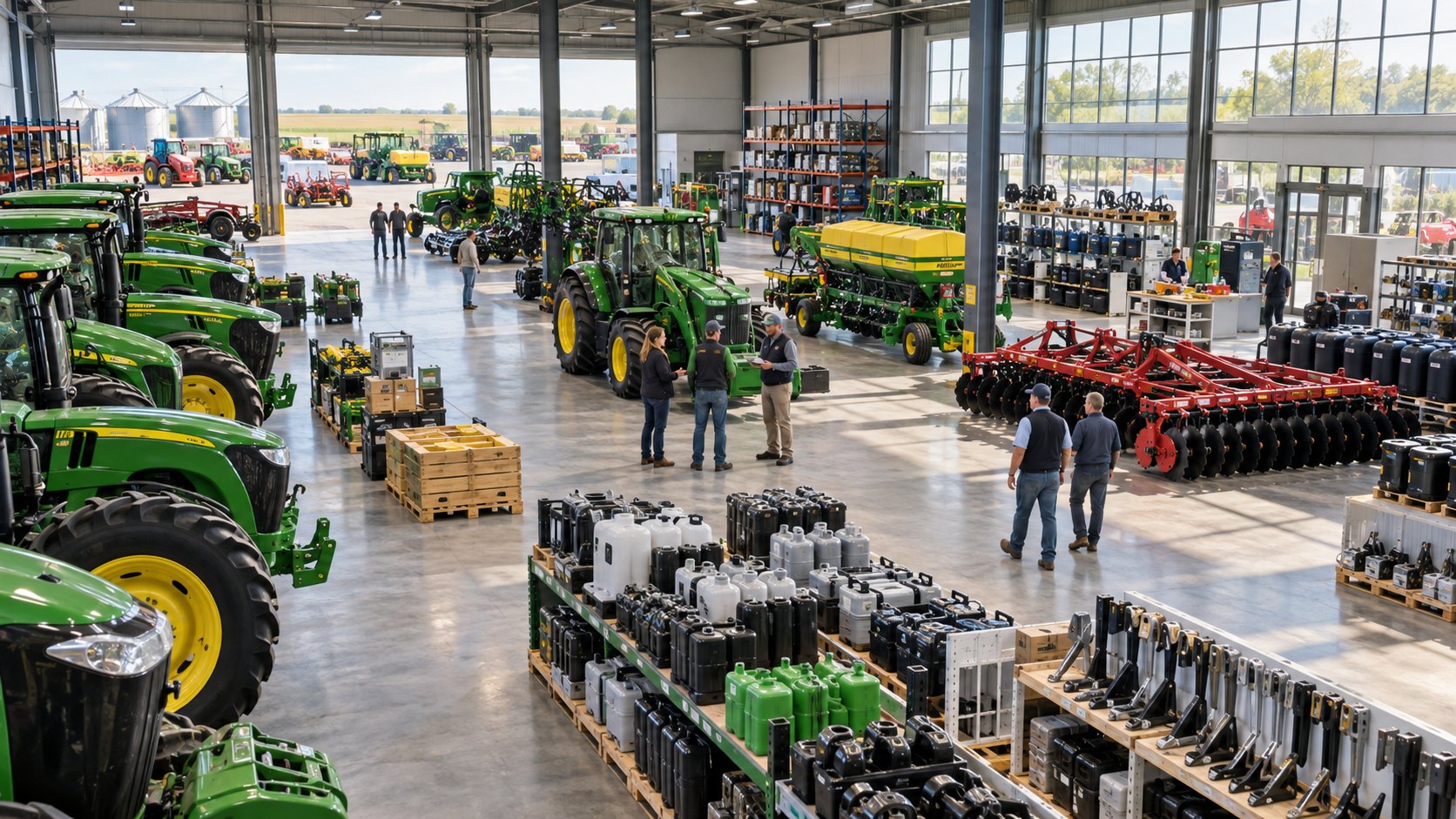
Machinery. Tractors and the implements behind them — ploughs, harrows, rotavators, seeders, sprayers, mowers, balers, loaders and trailers — plus harvesting and post-harvest equipment, graders and sorters, conveyors, feed mixers and mills.
Equipment. Irrigation systems in their entirety: pumps, filtration, mainlines, valves, fertigation units and controllers. Protected-cropping structures and their systems: greenhouse frames, screens, fans, evaporative pads, misting lines, hydroponic benches and climate controls. Livestock equipment: milking units, feeders, drinkers, incubators, brooders, cages and ventilation. Nurseries, landscaping and grounds equipment belong here too.
Supplies. Spares and wearing parts for everything above — blades, tines, discs, bearings, belts, chains, hoses, couplings, nozzles, filters, seals — together with the consumables that protected cropping and irrigation eat continuously: emitters and drip tape, shade cloth, insect netting, greenhouse film, clips, substrate, trays, pots, twine, and machine lubricants and hydraulic fluids.
One boundary has to be drawn firmly inside that third group, because "supplies" invites a wrong reading. It does not mean agricultural inputs. Seeds, fertilisers, pesticides and veterinary medicines are controlled products, and that class of goods sits behind the agriculture and environment ministry's own product controls, with Abu Dhabi's agriculture and food safety authority holding the equivalent position in that emirate. Those are separate permissions attached to the goods themselves, and a plan that includes them is a different conversation from the one this licence opens.
The buyer is a farm with a budget year, not a shopper
Commercial growers and date estates are the volume. Their purchasing follows a season and a budget cycle, which means a supplier who turns up in the wrong month is talking to a closed wallet however good the quotation is.
Protected-cropping and hydroponic operations are the fastest-moving segment in this market and the most technically demanding customer in it. They buy systems rather than items, they expect the supplier to size and specify, and they consume supplies continuously once running — which makes them the ideal customer for this particular line rather than the machinery-only one.
Dairy, poultry and livestock operations buy equipment that cannot stop working. A failed milking unit or a dead ventilation fan is an animal welfare problem within hours, so parts availability outranks price with this buyer by a wide margin.
Landscaping, grounds and municipal contractors run mowers, trimmers, blowers and irrigation at scale across parks, estates and highway planting. They are not farms, but they consume the same catalogue and they buy consumables harder than anybody.
Cooperatives and government agriculture departments buy through tender, on specification, with documentation requirements that defeat casual traders. Slow to win and durable once won.
three ways to trade it, judged on the same six rows
| Judged on | Machines only | Supplies only | Machines and supplies together |
|---|---|---|---|
| Revenue arrives in large, infrequent lumps | Yes | No | Yes, then steadily |
| A customer has a reason to call you next month | Rarely | Yes | Yes |
| Working capital sits in whole units on a yard | Yes | No | Partly |
| Price alone decides the sale | Often | Often | Less often |
| You learn what the farm is actually running | Slowly | Partial | Yes |
| The activity line needed is CZ 182 | Yes | No | No |
The last row is the reason this guide and the CZ 182 guide are different documents rather than the same one twice. A business that intends to sell machines and nothing else has a cleaner, narrower line available to it and should take that one. A business that intends to supply a farm for years should take this one, because the supplies half is where the relationship lives and splitting it across two companies to save a line on a licence is a false economy.
Note also what the fourth row admits. Supplies are not automatically high-margin: a commodity filter is priced by whoever will go lowest. What protects the margin is the combination — being the supplier who specified the system, holds the right part and can get it there today.
Where this sits between the mainland and a free zone
The honest answer depends on which half of the business is the main one, and this activity has two halves pulling in different directions.
Selling to UAE farms, estates, contractors and government departments is selling inside the local market, and a mainland licence is the straightforward route to it. Tenders from cooperatives and public bodies generally expect a mainland counterparty, and a grower who needs a part this afternoon expects to deal with a local supplier holding local stock, not with an entity whose goods have to clear a boundary first.
A free zone licence earns its place where the UAE is the desk rather than the market: consolidating equipment from several manufacturers and distributing it onward into the wider region, or holding stock for an overseas manufacturer who wants inventory close to its customers without a local trading presence. Both are real businesses and both are well served here. Neither of them is a whole-farm supply business selling to the farm up the road.
The yard is the other input to the decision. Whole machines need hard standing, height, a turning area and often a loading dock, while a supplies and spares operation needs racking, a counter and a van. A business doing both needs both, and the premises requirement is usually what settles the jurisdiction question in practice rather than the licence fee.
What the licence costs to hold, which conditions a specific emirate or zone attaches to machinery trading and to warehousing, what the premises must provide, and whether a particular product list reaches into controlled agricultural inputs are all decided against the actual plan and the licensing authority. ConsultZone confirms them case by case.
References
- Ministry of Climate Change and Environment — agriculture, livestock and food security, and the federal controls that attach to agricultural inputs. Ministry of Climate Change and Environment
- Abu Dhabi Agriculture and Food Safety Authority — agriculture, animal health and farm-related controls in Abu Dhabi. Abu Dhabi Agriculture and Food Safety Authority
- Ministry of Industry and Advanced Technology — national standards and conformity assessment applying to machinery and equipment. Ministry of Industry and Advanced Technology
- Dubai Customs — import and export procedures, customs codes, and restricted or prohibited goods on entry. Dubai Customs
- UAE Government portal — federal law, the national food-security strategy and general government information. UAE Government portal
Elsewhere in Trading
Activities that sit beside this one
Most licences carry more than one activity. Adding a neighbouring line at the application stage costs a fraction of amending the licence afterwards.
Begin with a clear conversation
Tell us what you intend to build.
A consultant will map the structure, jurisdiction, approvals and likely cost against what you actually described — not against a package.
