
Activity CZ 182
How to Setup an Agricultural Machinery and Equipment Wholesale Business in Dubai
Machines, no supplies. Agricultural machinery here sells against a farm's investment case, and in this region that case is almost always water saved or a growing season extended rather than acres covered.
ConsultZone licensing desk
- Activity code
- CZ 182
- Category
- Trading
- Reviewed
- Read
- 7 min
Listen instead
46 seconds
An audio summary of this guide.
Topic summary
How to Setup an Agricultural Machinery and Equipment Wholesale Business in Dubai
A farm does not buy a machine. It buys a number of hours it no longer has to pay someone to work, or a quantity of water it no longer has to pump, or a few extra weeks at either end of a growing season. The steel is how that gets delivered, and a quotation that describes the steel instead of the result is competing on price with everyone else who also has a price list.
That shifts where the difficulty lies in this trade. Capital equipment is a slow, considered, comparative purchase, decided by two or three people who will have to live with the decision for years, and it almost never turns on the discount at the end. It turns on whether the buyer believes the machine will still be running in year four — which means it turns on parts and service, and those are the two things a new importer finds hardest to promise credibly.
This is also a line with a genuinely local shape. Very little of the regional demand looks like broad-acre farming. What the market actually buys is water efficiency and controlled-environment growing: drip and micro-irrigation, filtration and fertigation, pivots and controllers, greenhouse structures, screens, evaporative cooling, hydroponic systems. Alongside that sit dairy, poultry and livestock equipment, date palm mechanisation, and tractors and implements sized for small holdings rather than for prairies. A supplier who imports a catalogue designed for thousand-hectare farms will find the equipment does not fit the fields, the labour model or the water.
The customer is an investment case, not a shopper
Protected-cropping and hydroponic growers are the clearest demand in the market. They buy complete systems, they expect specification work from the supplier, and they measure a purchase in yield per cubic metre of water rather than in price per unit.
Irrigation-driven field growers and date estates replace pumps, filtration and controls on a cycle and extend networks as plantings mature. The purchase is technical, the installer and the supplier are often expected to be the same party, and a wrong pump specification is remembered for a long time.
Dairy, poultry and livestock operations buy milking, feeding, watering, incubation and ventilation equipment that is effectively life-support for the animals. Reliability and response time dominate the decision.
Municipal grounds departments and landscaping contractors run mowers, trimmers, utility vehicles and irrigation across parks, estates and highway planting. They buy on tender, replace on schedule, and keep detailed service records that a supplier is judged against at the next round.
Cooperatives and public agriculture bodies procure formally and in volume. Winning is slow and documentation-heavy; losing is usually about not having answered the aftersales question in writing.
On the selling side the same licence supports three shapes: an appointed dealer carrying one manufacturer with a territory and a warranty obligation; an independent importer assembling a multi-line catalogue and competing on availability; and a project supplier who wins greenhouse or irrigation schemes and buys against each specification. The first has brand support and no freedom, the second has freedom and no support, and the third lives or dies on estimating.
- Establish what the farm is trying to fix — water, labour, yield or a season
- Price the result, not the steelThe investment case is the sale; the discount is the last five per cent of it
- Can the parts and service answer be put in writing
- YesThe quotation stands up against a cheaper import, because the cheaper import cannot match it
- NoExpect to lose, however good the machine is, and the loss will be blamed on price
- Agree commissioning, operator training and the first service before delivery
- A machine still running in year four, and a customer who buys the next oneThe second sale is where this business actually earns
The question in the middle of that spine is the whole guide compressed into one row. Everything above it is sales work that any competent trader can do; everything below it is only available to a supplier who has stocked parts, trained a technician and can commit to a response. That is the barrier to entry in this line, and it is also the reason the market tolerates fewer serious players than the size of the catalogue suggests.
CZ 182 — Wholesale Of Agricultural Machinery And Equipment
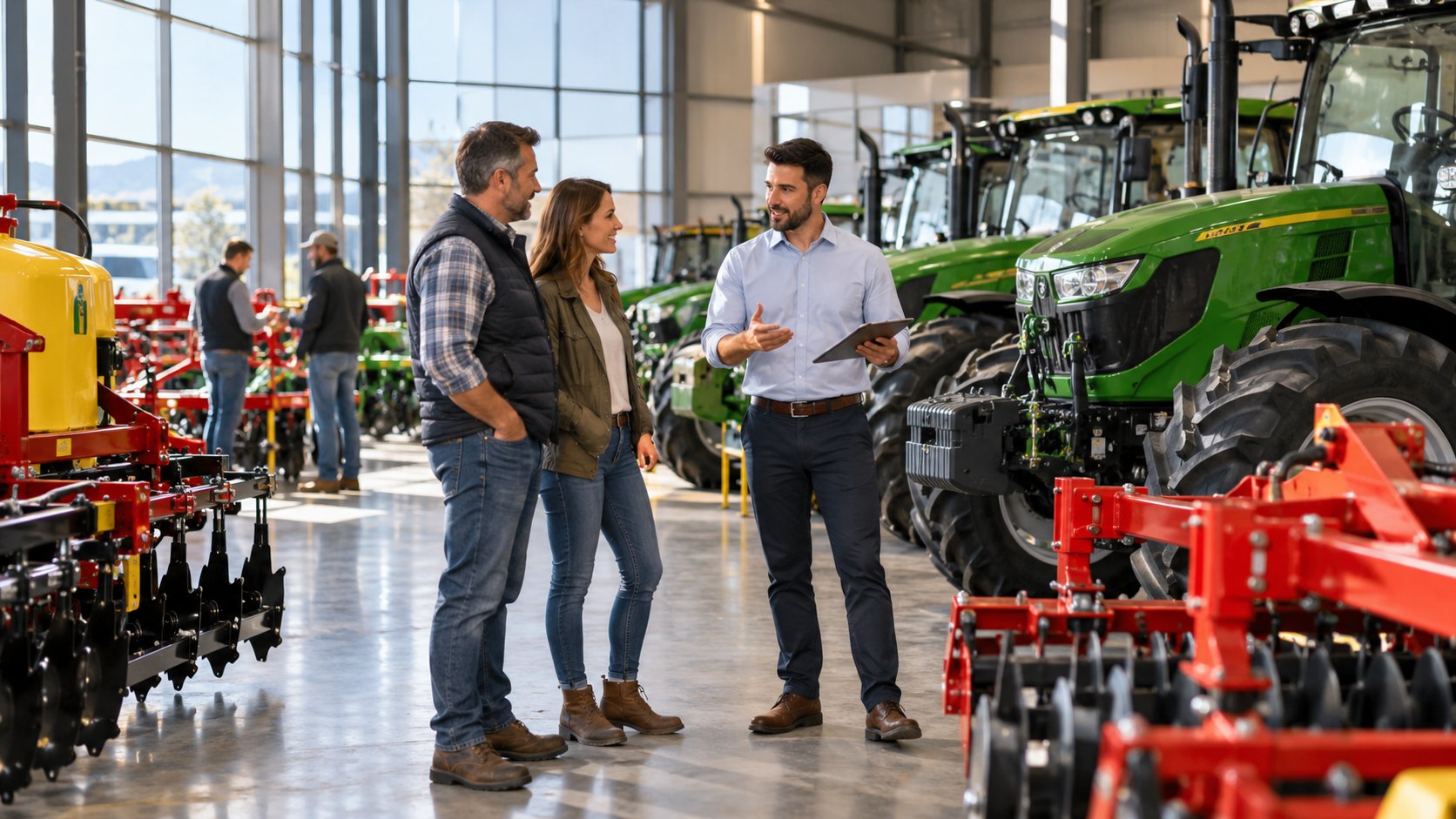
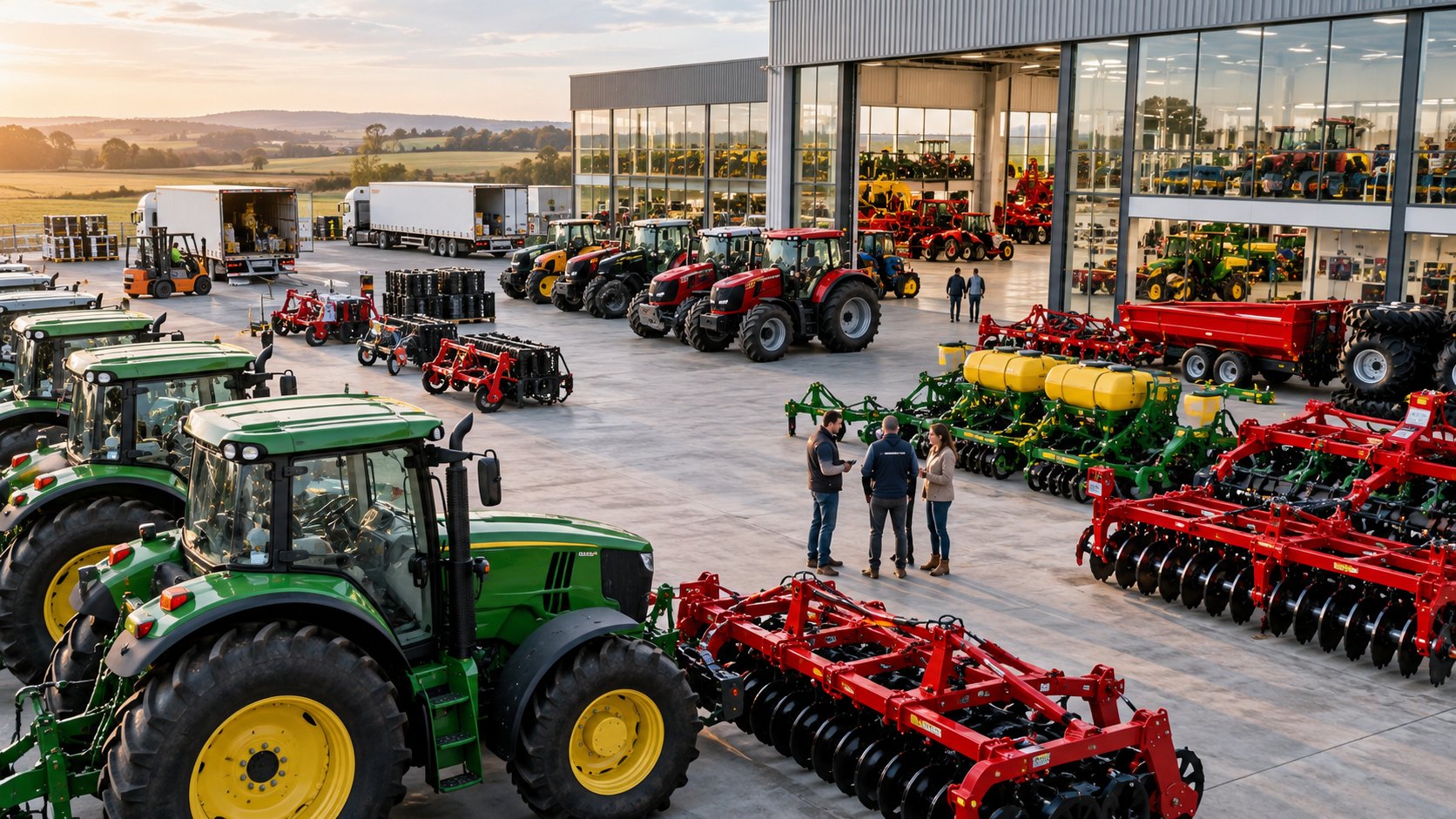
The line covers machines and equipment for agriculture and allied activity: tractors and the implements behind them — ploughs, harrows, rotavators, seeders, planters, sprayers, mowers, balers, loaders, trailers — along with harvesting and post-harvest machinery, graders and sorters, conveyors, feed mixers and mills.
It covers equipment as well as machinery, and in this region that half is the larger one. Irrigation equipment: pumps, filtration units, mainlines and laterals, valves, drip and micro-sprinkler systems, fertigation units and controllers. Protected-cropping equipment: greenhouse and shade-house structures, screens, ventilation fans, evaporative cooling, misting and fogging systems, hydroponic benches and climate controllers. Livestock equipment: milking systems, feeders, drinkers, incubators, brooders, housing systems and ventilation. Nursery, grounds and landscaping machinery sits inside the same catalogue.
What marks this line out is what the name leaves off. It stops at machinery and equipment. The consumables, spares and growing materials that a farm buys continuously belong to the adjacent line, CZ 181, which carries the word supplies for exactly that reason. The distinction is not cosmetic: it decides whether the business is a capital-sales operation with long cycles and lumpy revenue, or a capital-sales operation with a consumables book underneath it earning every month. Read both lines before choosing, because this one is the narrower of the two by design.
What this licence does not cover
Supplies and consumables. Wearing parts, filters, belts, drip tape, netting, film, substrate and the rest are CZ 181's territory. A machinery business that intends to run a parts counter should say so when the licence is drawn rather than find the gap during an inspection.
Repair and maintenance as a service. Selling a machine and servicing machines are different activities. Warranty work performed by a dealer is a service function, and if servicing is going to be a revenue line in its own right it needs to appear as one.
Controlled agricultural inputs. Seeds, fertilisers, pesticides and veterinary medicines are not equipment. They are controlled products sitting behind the agriculture and environment ministry's own product controls, with Abu Dhabi's agriculture and food safety authority holding that role in that emirate. A plan including them opens a separate approval conversation about the goods themselves.
Retail sale to the public. A counter selling garden machinery to householders is retail, with its own permission and its own premises.
Farming, and equipment finance. Operating a farm is a production activity, not a trading one. Offering lease or hire-purchase terms over machinery is a financing activity and is regulated as one, which is why most suppliers introduce a bank or a leasing company instead of carrying the paper themselves.
Where this is the wrong purchase: if the plan is to supply a farm with everything it consumes, CZ 181 is the better line. If the plan is a workshop, the service activity is the one to ask for. And if the plan depends on being the sole UAE channel for a manufacturer, that is an agency question to settle with the manufacturer before a licence is chosen, not afterwards.
What the licence costs to hold, which emirate or zone suits a machinery business, what the yard and storage must provide, and which standards or clearances a specific machine meets on entry all depend on the catalogue, the premises and the licensing authority. ConsultZone confirms those against the actual plan rather than quoting a figure that would not hold.
References
- Ministry of Climate Change and Environment — agriculture, livestock, water use in farming and food security at federal level. Ministry of Climate Change and Environment
- Ministry of Industry and Advanced Technology — national standards, conformity assessment and in-country value as they apply to machinery. Ministry of Industry and Advanced Technology
- Abu Dhabi Agriculture and Food Safety Authority — agriculture and animal health requirements in Abu Dhabi. Abu Dhabi Agriculture and Food Safety Authority
- Dubai Customs — import and export procedures, customs codes and entry requirements for machinery consignments. Dubai Customs
- UAE Government portal — federal law, the national food-security strategy and general government information. UAE Government portal
Elsewhere in Trading
Activities that sit beside this one
Most licences carry more than one activity. Adding a neighbouring line at the application stage costs a fraction of amending the licence afterwards.
Begin with a clear conversation
Tell us what you intend to build.
A consultant will map the structure, jurisdiction, approvals and likely cost against what you actually described — not against a package.
