

Activity CZ 180
How to Setup a Communications Equipment Wholesale Business in Dubai
Communications equipment is the wholesale line where a model, not a company, holds the approval. Type approval from the telecommunications regulator decides what may lawfully be supplied here at all.
ConsultZone licensing desk
- Activity code
- CZ 180
- Category
- Trading
- Reviewed
- Read
- 7 min
Listen instead
45 seconds
An audio summary of this guide.
Topic summary
How to Setup a Communications Equipment Wholesale Business in Dubai
The telephone left the wall about a decade ago and took the business model with it. A desk phone today is a small networked computer that happens to have a handset on it; the switchboard behind it is software, running on a server in a cupboard or on somebody else's server entirely; and what a buyer is actually paying for is a working extension on a desk rather than the object in the box. That is the most useful thing to understand about this activity line, because it explains why the wholesalers who do well in it look more like engineering businesses than like pallet movers.
It also explains where this line gets difficult. Equipment that transmits, or that connects to a public network, is not a free good to import and sell. Type approval for telecommunications and radio equipment sits with the federal telecommunications and digital government regulatory authority, and it is granted against the equipment model. That is the sentence to read twice: the approval belongs to the device, not to the trader holding it, so a licence in your hand says nothing about whether the box you have ordered may lawfully be supplied here.
The margin is not in the box
Hardware margin in this trade is thin and getting thinner, because a model number is searchable and a buyer with a browser can price it in a minute. The money sits in three places around the box, and a wholesaler who ignores all three is running a price-comparison service on somebody else's products.
The first is the attach. A voice project is never just handsets: it is headsets, expansion modules, conference units, patch panels, power injectors, mounting hardware, spare units held against failure, and the software entitlements that make the system do what was promised. The buyer who has committed to a platform buys those from whoever supplied the platform, and the attached items carry better margin than the endpoint did.
The second is the service tail. Equipment that is installed rather than sold gets supported, extended and replaced on a cycle, and a supplier who holds the support relationship holds the next refresh without competing for it. Contracts here are quieter and more durable than the orders that produced them.
The third is availability. In a project business, being able to deliver ninety of something next week beats being cheapest on a hundred in six weeks, because a fit-out with a date on it cannot wait. Stockholding is a real competitive position in this line, and it is also the main way to lose money in it: hold the wrong model through a platform change and the inventory is worth what somebody will pay to strip it for parts.
Three buyer classes sit above all that. Operators and carriers buy infrastructure and subscriber equipment in volume, on long qualification cycles, and they do not move quickly. Enterprise integrators and IT resellers are the day-to-day customer — they win a client's fit-out or refresh and need equipment, staging and lead times they can promise against. Retail and consumer distribution buys handsets and accessories for shelves, and behaves like a fast-moving goods business rather than a technical one.
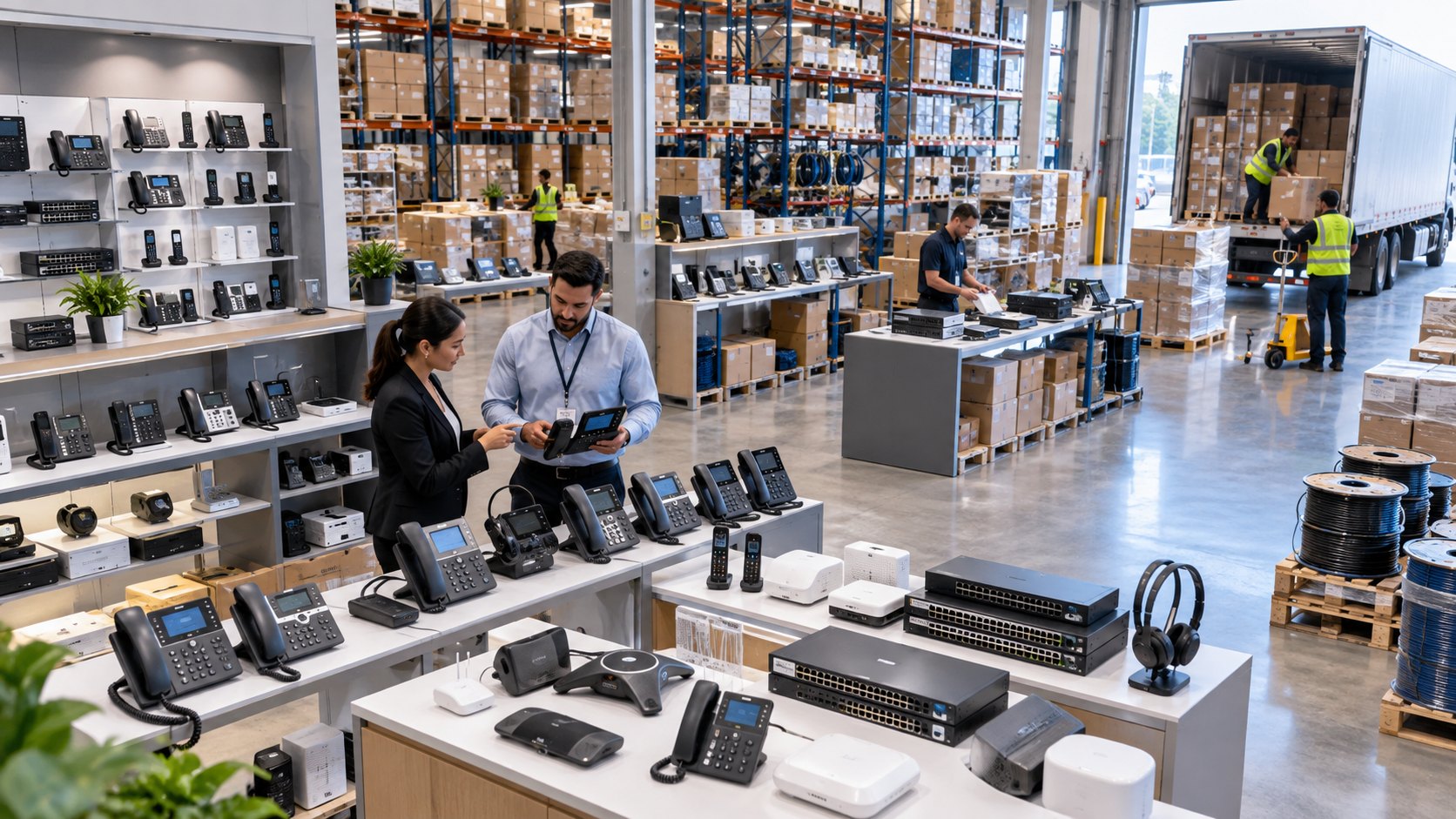
CZ 180 — Wholesale Of Telephone And Communications Equipment
The line covers voice and the equipment that carries it: corded and cordless desk telephones, cordless base stations and handsets, IP telephones and conference units, switchboard and unified-communications equipment, voice gateways and session border controllers, headsets and headset bases, intercom and door-entry telephony, two-way radios and their base stations and chargers, antennas and in-building coverage equipment, fixed-wireless terminals, and the structured cabling, patch panels and test equipment that voice installations are built on.
Two neighbouring lines are worth naming, because a reader deciding between them will otherwise pick by accident.
Consumer electronics, CZ 152. Mobile handsets sold into retail channels sit more naturally there, with televisions, laptops and audio. The split that matters in practice is who the customer is: a mobile phone going onto a shop shelf is consumer goods, while the same manufacturer's enterprise handset going into a call centre with a numbering plan behind it belongs here.
Computer and networking hardware. Switches, routers and wireless access points are frequently quoted on the same page as IP telephones, because the phones will not work without them. If a substantial part of the plan is data networking rather than voice, that should appear on the licence in its own right instead of being carried in on the back of this activity.
Type approval attaches to the model, not to your company
Anything in that catalogue that transmits meets the federal type-approval requirement for telecommunications and radio equipment: cordless base stations and handsets, wireless headsets, two-way radios, antennas, fixed-wireless terminals. Equipment that connects to a public telecommunications network meets it as well. A wired desk phone on an internal system is a different case from a cordless one, and a reader who assumes the whole catalogue is treated alike will be wrong in both directions.
The practical discipline is to establish the approval position model by model, while the purchase order is still a draft. That is a cheap question at quotation stage and a very expensive one once a consignment is at a port, and it cannot be answered by looking at the company's own paperwork, because the approval was never about the company.
- Fix the model list the order will actually be placed againstEvery gate below depends on this list, not on the brand name
- Confirm the type-approval position for each transmitting modelDecides whether the consignment may lawfully be supplied here
- Book the shipment and apply the correct customs codeGets the goods to the border with paperwork that matches them
- Clear and inspect the consignment at entryReleases the pallets into your own warehouse
- Stage the units, load firmware and build the numbering planTurns boxes into something installable in a single visit
- Install, commission and obtain sign-off on siteReleases the invoice
Read that drawing for its second row and its last. The second is the only government gate in the sequence and the only one that can stop the goods outright, and it is the one most often reached after the money has been committed. The last is where this business is actually paid: an uncommissioned system is a delivery note, not revenue, and a wholesaler who cannot get to sign-off is financing a customer's project for free.
Labelling and conformity marking on the packaging of traded equipment is a separate matter from the radio approval, and it sits with the federal ministry responsible for industry and national standards. It is worth settling before goods reach a buyer's stores rather than after.
What a specific model requires before it may be supplied, what the licence costs to hold, which emirate suits a business of this shape, and whether a plan that mixes voice hardware with data networking or with installation work needs more than one activity are all decided against the actual product list and the licensing authority. ConsultZone confirms them case by case, because on this line the product list is what determines the answer.
References
- Telecommunications and Digital Government Regulatory Authority — type approval for telecommunications and radio equipment supplied in the UAE. Telecommunications and Digital Government Regulatory Authority
- Ministry of Industry and Advanced Technology — national standards, conformity assessment and product marking on traded equipment. Ministry of Industry and Advanced Technology
- Dubai Customs — import and export procedures, customs codes, and restricted or prohibited goods on entry. Dubai Customs
- Federal Tax Authority — VAT treatment of imported goods and of equipment supplied with installation. Federal Tax Authority
- UAE Government portal — federal law, digital government policy and general government information. UAE Government portal
Elsewhere in Trading
Activities that sit beside this one
Most licences carry more than one activity. Adding a neighbouring line at the application stage costs a fraction of amending the licence afterwards.
Begin with a clear conversation
Tell us what you intend to build.
A consultant will map the structure, jurisdiction, approvals and likely cost against what you actually described — not against a package.
