
Activity CZ 183
How to Start a Lawn Mower Trading Business in Dubai
However operated is the whole line here: push, petrol, ride-on and robotic. No mower in this market is bought for a garden — the buyer maintains engineered green space in a desert climate.
ConsultZone licensing desk
- Activity code
- CZ 183
- Category
- Trading
- Reviewed
- Read
- 8 min
Listen instead
54 seconds
An audio summary of this guide.
Topic summary
How to Start a Lawn Mower Trading Business in Dubai
There is not much lawn in this country and there is a great deal of grass. Almost none of it grew where it stands. It was drawn by a landscape architect, laid as turf over a graded bed, fed by an irrigation grid that runs before dawn, and it stays alive because somebody waters it, feeds it, cuts it and replaces the patches that burn out in August. That is a maintenance obligation held under contract, and it is the reason a machine business built on this activity has almost nothing in common with a garden centre in a temperate country.
Fix the customer before anything else, because every other decision follows from it. The buyer of a mower here is an organisation with a cutting schedule it cannot miss. Landscaping and soft-landscape contractors holding maintenance contracts across a community or a master development. Municipalities and the contractors who cut for them — parks, verges, roundabouts, the strips between a road and a wall. Golf courses, which are the most exacting grass customers anywhere and buy several different machines for one property. Hotels and resorts, where a lawn appears in a photograph a guest takes. Developers and facilities managers taking over a finished community with green space attached to the handover. Schools, universities and sports clubs with pitches to keep playable. None of those people is buying a machine. They are buying machine hours against a calendar, and the first serious question any of them will ask is what happens on the morning the machine does not start.
Why the catalogue bothered to say "however operated"
The phrase is the catalogue being careful rather than vague, and it is doing real work, because five quite different machines sit under it and they are not variations of one product.
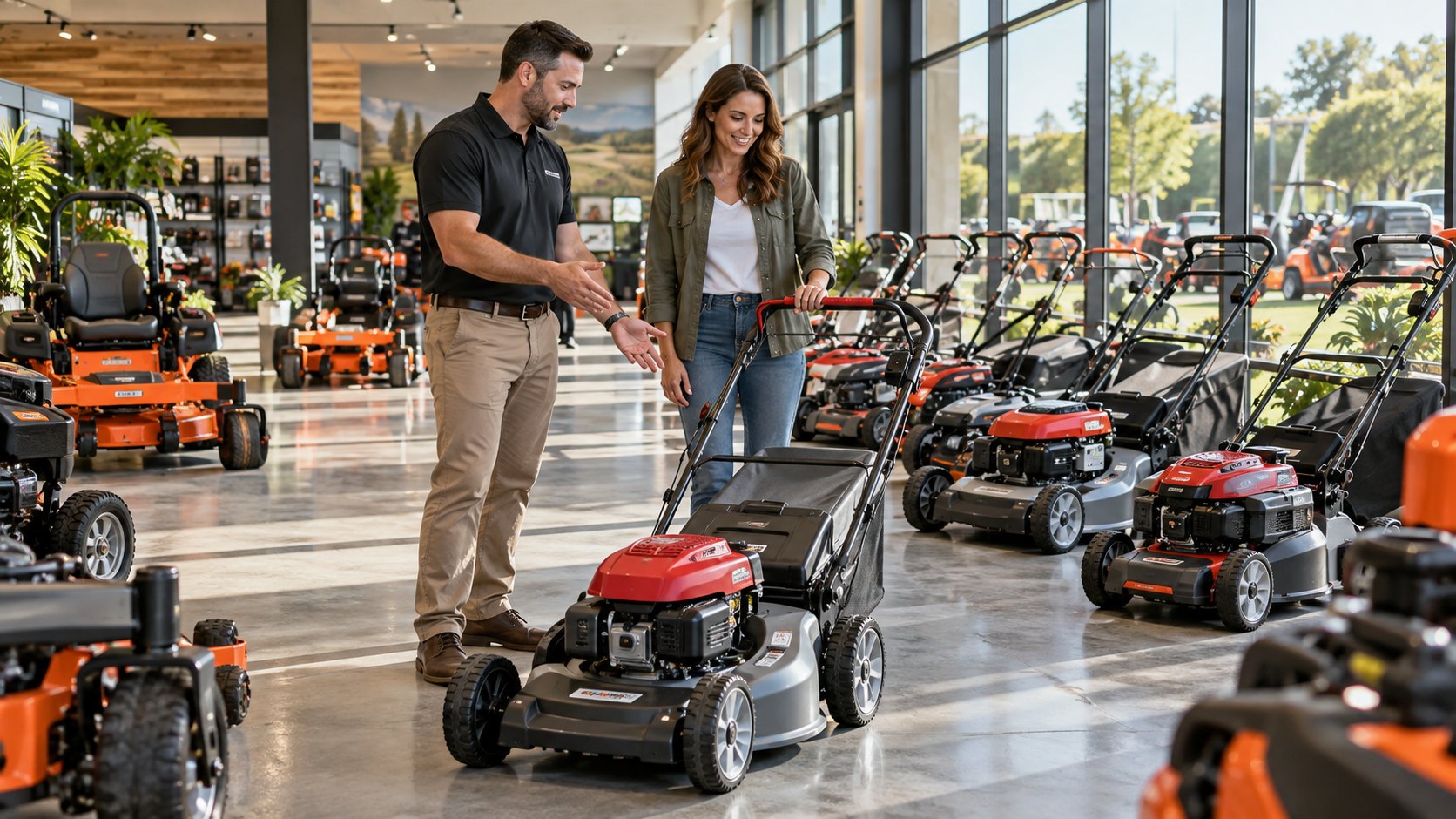
A pedestrian machine is pushed or self-propelled and cuts a strip about the width of a doorway: it is the finishing tool for edges, banks, courtyards and the awkward ground between planting beds. A petrol machine of any size is an internal-combustion product, with an engine, a fuel system, an exhaust and the manufacturer's documentation that goes with all three. A battery machine has swapped that engine for a pack and a charger, which changes the running cost, the noise, the service pattern and what a store on your premises has to be able to hold safely. A ride-on or out-front rotary is a vehicle with a cutting deck, bought by the hectare, kept in a yard, driven by someone trained, and maintained on a schedule. And a robotic mower is a different proposition again — an installed system with a boundary it has to be taught, a docking station, a power supply and, in almost every current model, a radio inside it so the machine can be reached from a phone.
Those five do not share buyers, they do not share failure modes, and they do not share a service model. A trading business that tries to carry all of them at the start carries five parts inventories and masters none.
| Pedestrian and self-propelled | Ride-on and out-front | Robotic | |
|---|---|---|---|
| Who actually buys it | Villa and small-site crews doing finishing work | Municipal contractors, golf courses, large communities | Communities and campuses with level, bounded grass |
| What the ground looks like | Edges, banks, courtyards, gaps between beds | Open turf measured in hectares | A defined area with a boundary the machine can learn |
| What the buyer must supply | A crew trainable in a morning | A trained driver and a yard to keep it in | An installation, and an area kept clear of obstacles |
| What the climate breaks first | Air filters, belts, starter assemblies | Bearings, deck spindles, hydraulics, cooling | Battery packs, wheel motors, boundary cable |
| Where the supplier actually earns | Blades and consumables, season after season | Parts and scheduled service, continuously | The install, then packs and control boards |
The marked row is the commercial answer and it is the same answer in all three columns. The machine is the introduction. What pays for the warehouse is the blade, the belt, the filter, the pack and the visit — the things a contractor buys again in ninety days without shopping around, from whoever answered the phone last time. A business in this line that thinks of itself as a shop will be beaten by one that thinks of itself as a supplier.
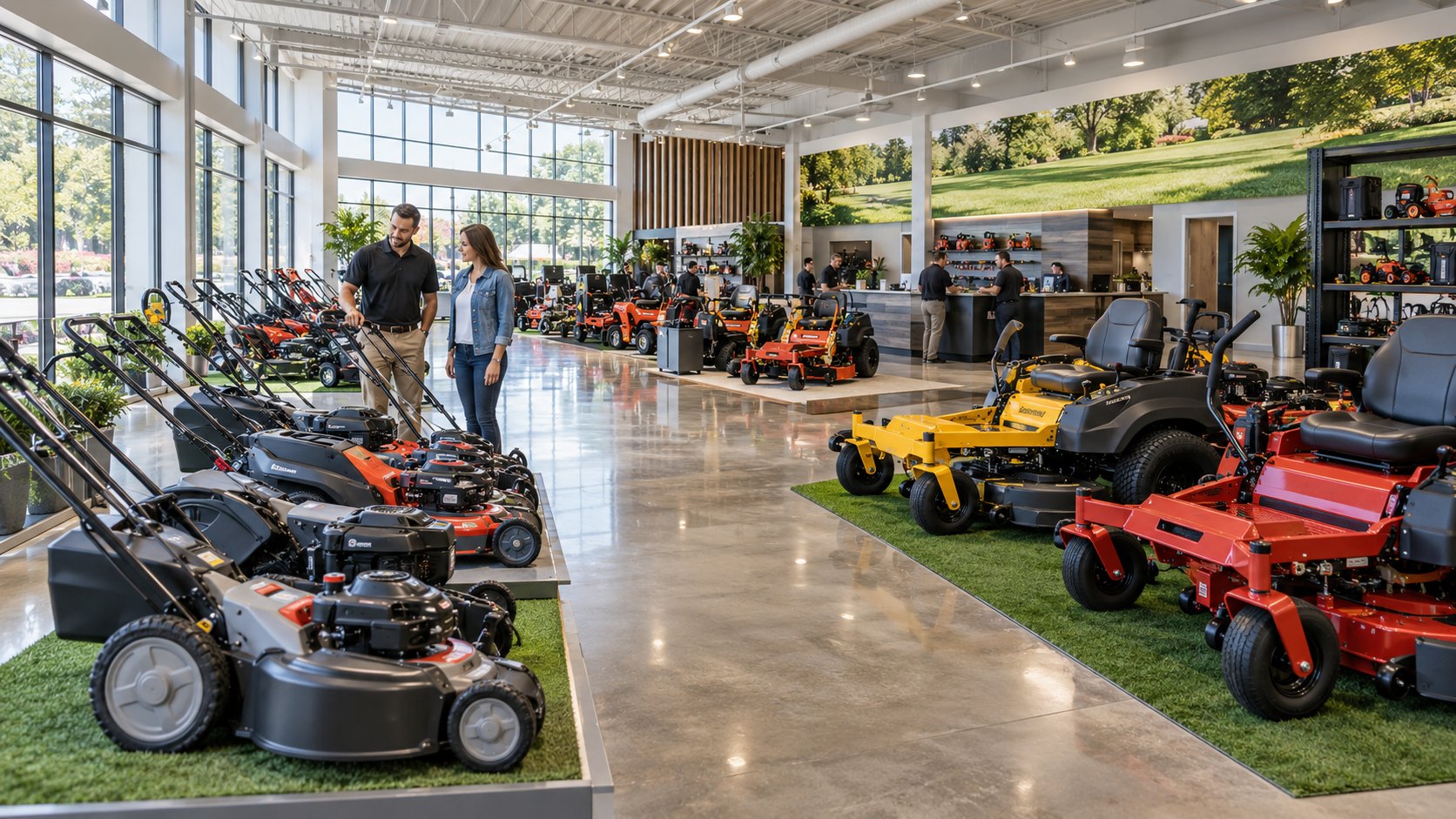
The route to the buyer runs through the specification, not the showroom
Two things about this market change how a sale is won, and both are about heat and dust rather than about price.
The first is that the machines are commercial-grade because the duty cycle is brutal. A domestic mower in a mild climate cuts thirty times a year into cool air. A mower on a maintenance contract here runs through fine sand, in temperatures that make an engine work for its cooling, over turf that is watered daily and therefore cut constantly. Filters clog, belts harden, bearings take grit, and hydraulic oil and rubber age faster than any temperate service interval assumes. A contractor who has been in this market five years knows that, which is why a demonstration on a cool morning in a clean courtyard persuades nobody. What persuades him is a parts shelf he can see and a service answer he can hold you to.
The second is that a large share of this equipment is never chosen by the person who pays for it. It is specified — into a tender for a community maintenance contract, into a developer's handover package, into a golf course's capital plan, into a municipality's framework purchase. Getting onto that specification is the actual sales process, and it happens months before an order exists. So the useful work is upstream: knowing which contracts are coming up for renewal, being the supplier a consultant names when somebody asks what to put in the schedule, and being able to quote the same range again in two years when the fleet is replaced.
That is also why the fleet cycle matters more than the individual sale. A contractor with forty machines replaces a proportion of them every year whether or not he is happy with you. Being the supplier of record on that cycle is worth more than any single deal, and it is won on availability and response rather than on the opening discount.
What attaches to the machine, and what attaches to the premises
The activity is trading machines. The conditions worth knowing about sit on the goods and on the building rather than on the trade description.
A petrol machine is an engine product. It arrives with the manufacturer's own conformity and emissions documentation, and national standards and conformity marking in the UAE are the remit of the federal ministry responsible for industry and standards.¹ A range bought without that paperwork is a range whose evidence is missing at the moment a large institutional buyer asks for it, which is the worst possible moment to find out.
A robotic mower almost certainly contains a radio. It talks to an application, to a base station, sometimes to a satellite positioning service. Radio and telecommunications equipment offered in the UAE needs type approval from the federal telecommunications authority, and that is a question about the specific model, settled before the goods are offered rather than when a shipment lands.² This is the most-missed condition in this line, because nobody thinks of a mower as a communications device.
Fuel on the premises is a fire-safety question, not a convenience. If a unit is going to hold petrol for demonstration or for servicing, the store and the building are matters for the emirate's civil defence authority, and they are settled with the tenancy rather than after the fit-out.³
Importing is a separate capability from selling. Bringing machines in under your own name means a customs code held by the company itself and the goods classified correctly at the border; both sit with the emirate's customs authority.⁴ Buying from a UAE importer avoids all of that and costs a share of the margin.
Service is people. If the business is going to keep its own technicians — and the section above is an argument that it should — those are work permits and labour contracts under the federal labour ministry, and the crew belongs in the plan rather than in an afterthought.⁵
Three things this activity does not cover are worth naming, because each is a common misclassification. Running a workshop that repairs machines for third parties is a service trade with its own line. Cutting the grass yourself under a maintenance contract is grounds maintenance, which sells the cut rather than the machine. And hiring machines out by the day or the month is equipment rental, which is a different activity and a different balance sheet.
What the licence costs to hold, which conformity documents a particular model needs, whether a specific unit may hold fuel and what a robotic range needs before it can be offered all depend on the emirate, the premises and the product mix. ConsultZone establishes those against the chosen jurisdiction and the real range before stock is ordered.
References
- National standards, conformity marks and product conformity evidence for engine-powered machinery. Ministry of Industry and Advanced Technology
- Type approval for radio and telecommunications equipment, which is what a connected or robotic mower contains. Telecommunications and Digital Government Regulatory Authority
- Fire safety approvals for the storage of fuel and flammable materials on commercial premises in Dubai. Dubai Civil Defence
- Import and export, customs codes and the classification of machinery consignments. Dubai Customs
- Work permits and labour contracts for sales and service staff. Ministry of Human Resources and Emiratisation
Elsewhere in Trading
Activities that sit beside this one
Most licences carry more than one activity. Adding a neighbouring line at the application stage costs a fraction of amending the licence afterwards.
Begin with a clear conversation
Tell us what you intend to build.
A consultant will map the structure, jurisdiction, approvals and likely cost against what you actually described — not against a package.
