

Activity CZ 91
How to Start a Motorcycle and Moped Dealership in Dubai
Two customers buy motorcycles in this market and they want nothing in common — the weekend rider and the delivery fleet. A dealership usually has to pick one before it picks a showroom.
ConsultZone licensing desk
- Activity code
- CZ 91
- Category
- Trading
- Reviewed
- Read
- 7 min
Listen instead
58 seconds
An audio summary of this guide.
Topic summary
How to Start a Motorcycle and Moped Dealership in Dubai
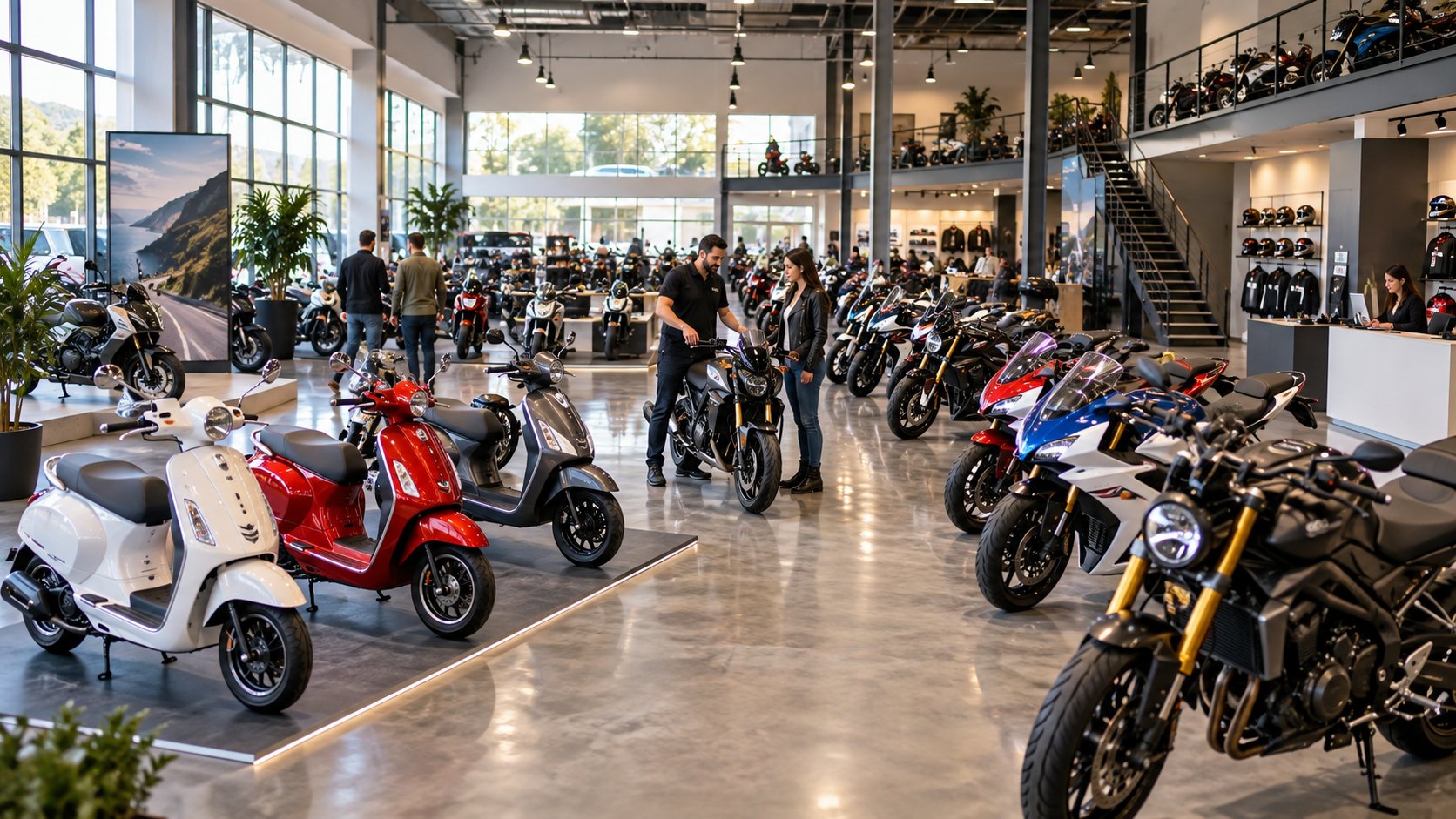
A dealer holding this line is selling into two markets that barely acknowledge one another. On one side is the leisure rider: large-capacity machines, a bike bought for the cool months and the weekend, chosen roughly the way a watch is chosen. There is a real scene behind it — ride-outs into the mountains, track days, owners' clubs, and a used market in which a well-kept machine holds its price. On the other side is the commercial buyer: a delivery operator ordering small-capacity machines by the dozen on a replacement cycle, who will barely look at the bike and will look very hard at the unit price and at whether parts are on the shelf.
Those two customers want almost nothing in common. The leisure buyer wants a floor he can walk into, a conversation, accessories, a trade-in and somebody behind the counter who rides. The fleet buyer wants a price per unit, a delivery date, a warranty that survives a machine doing long days in August, and a workshop that can turn a broken bike around quickly. A dealership that tries to be both usually serves neither well, and the choice deserves making before a unit is leased, because it sets the location, the stock profile, the staffing and the working capital.
The moped end of the line is easy to overlook and is where the volume sits. Including mopeds is what makes this activity the licence behind most of the two-wheeled traffic actually visible on the roads here — the courier and food-delivery fleets. The large-capacity trade is the more interesting business and the smaller one.
Who this line is for
Riders turning an enthusiasm into a dealership
The commonest founder, and the one most likely to over-buy stock. Knowing the machines is worth real money in the leisure trade, because a customer can tell inside a minute whether the person selling to him rides. It is worth very little in the fleet trade, where the buyer is an operations manager comparing two numbers on a spreadsheet.
Suppliers to delivery and courier operators
A different business wearing the same words on a licence. The customer is a company, the order repeats, the margin per unit is thin and volume is what pays. This founder needs credit terms, a parts holding and a servicing arrangement far more than a showroom.
Motor traders adding two wheels
An established car business putting motorcycles on an existing site. The advantages are genuine — the paperwork discipline, the banking relationships and the yard already exist. The trap is assuming a motorcycle buyer behaves like a car buyer. He does not, and he will not be sold to in the same room or by the same salesperson.
Importers supplying other dealers
The wholesale half of this line: selling to retailers rather than to riders. It is a container business with a clearance problem and a cash-flow problem rather than a retail one, and it is the natural route in for somebody who already holds a supply relationship with a manufacturer or a regional distributor abroad.
What you can and cannot do under this line
The activity is the sale of motorcycles and mopeds, wholesale and retail, new or used, on the company's own account. Four boundaries are worth stating plainly, because each one is a separate activity in this catalogue and holding this line alone does not reach it.
Selling is not servicing. Maintenance and repair of motorcycles is its own line, and most real dealerships hold it beside this one deliberately. A dealer who agrees to service what he sold, under a sales licence alone, has stepped outside it — and since a motorcycle buyer's second question is usually about servicing, this is the pairing most worth settling at the outset. A founder who wants the whole trade in a single line should look at the combined sale, maintenance and repair activity that sits immediately before this one in the catalogue.
Selling machines is not selling parts. Components, accessories, helmets and riding gear form their own activity again. A showroom with a parts counter is holding two lines on purpose.
This licence does not make you anybody's agent. Representing a manufacturer, using its marks and offering its warranty is a commercial relationship the maker grants; words on a trade licence do not create it. A maker's own demands on floor space, workshop, tooling and stock holding are usually heavier than anything the licensing authority asks for.
It does not cover putting machines out for hire. Handing a machine to a paying rider without selling it is a different trade, with a different insurance position and a different relationship with the transport authority.
Inside that boundary, the business is a sequence rather than a single transaction, and the sequence is worth reading closely — because only the first stage of it involves the licensing authority at all.
- Trade licence carrying the motorcycle sales lineCreates the company; no machine has moved yet
- Clearance of the consignment as it landsReleases the machines into the local market
- Each machine entered on the vehicle record and platedIs where a retail sale actually completes
- Pre-delivery preparation, in a bay you controlDecides whether the machine is handed over safe
- Cover in the buyer's own name before he rides outLets the rider leave the forecourt lawfully
The distribution is the useful part. One gate belongs to the licensing authority and is crossed once, at the beginning. The rest recur on every single machine, with bodies that are not the licensing authority — which is why the operating skill in this trade is administrative volume rather than salesmanship. Wholesale changes the shape: selling to another dealer moves the vehicle-record work onto the buyer, and that is the structural reason the wholesale and retail halves of this one line behave like two different companies.
Premises and practical conditions
A motorcycle occupies a fraction of the floor a car does, and that single physical fact is the strongest commercial argument for this line over the four-wheeled trade. A dozen machines in a modest unit is a credible showroom; a dozen cars is not. The ratio works against you on the fleet side, where a batch of small-capacity machines waiting to be prepared and handed over has to sit somewhere, and a yard costs less than a showroom for good reason.
What the premises has to do matters more than what it measures:
- A floor a customer can walk into. The leisure trade is sold face to face. A machine behind a fence is stock; a machine under light with a price on it is for sale.
- A preparation area you control. Every machine is handed over exactly once. Uncrating, assembly on new stock, a pre-delivery check and a clean bike at handover all happen somewhere, and doing them on the display floor is how a display floor stops looking like one.
- Storage that is not the display floor. Crated stock, a batch against a fleet order, and trade-ins waiting to be moved on all compete for the same square metres.
- Fuel and battery handling. A room full of machines with fuel in them is a fire-safety question wherever it stands. The civil defence body in the emirate answers that one; the landlord and the municipality answer for the premises itself.
What it costs to hold
There is no single figure, and anybody offering one has not asked enough questions. The licence fee, the premises, the staff allocation that follows from it, the approvals a particular category of machine attracts and the jurisdiction all move the number. A founder with eight used machines in a shared unit and a company building a franchised showroom with a workshop behind it hold the same words on a licence and nothing else in common. We establish the real figures for the specific case — emirate, premises, activity mix, headcount — before anything is filed.
The structural choice sits underneath all of it. A mainland licence sells to UAE buyers on UAE soil, which is what a retail dealership is. A free zone licence is built for holding, consolidating and re-exporting, which is what an importer supplying the wider region is. Answer who the buyer is and the jurisdiction answers itself.
References
- Roads and Transport Authority — vehicle records, ownership transfer and number plates in Dubai. Roads and Transport Authority
- Dubai Customs — import clearance for motorcycle consignments, the importer's customs code, and restricted goods. Dubai Customs
- Dubai Civil Defence — fire-safety approval for premises holding fuelled machines and batteries. Dubai Civil Defence
- Federal Tax Authority — value added tax treatment of retail sales, wholesale supply and exports. Federal Tax Authority
Elsewhere in Trading
Activities that sit beside this one
Most licences carry more than one activity. Adding a neighbouring line at the application stage costs a fraction of amending the licence afterwards.
Begin with a clear conversation
Tell us what you intend to build.
A consultant will map the structure, jurisdiction, approvals and likely cost against what you actually described — not against a package.
