
Activity CZ 92
How to Start a Motorcycle Parts and Accessories Business in Dubai
This is the rare trading line whose own name allows selling without a shop — by commission agent and by mail order. Motorcycle parts and accessories reward reach over frontage.
ConsultZone licensing desk
- Activity code
- CZ 92
- Category
- Trading
- Reviewed
- Read
- 7 min
Listen instead
46 seconds
An audio summary of this guide.
Topic summary
How to Start a Motorcycle Parts and Accessories Business in Dubai
Read the name of this activity again and notice what the catalogue has quietly permitted: including by commission agents and mail order houses. Most trading lines in this book describe goods. This one describes goods and then describes ways of selling them, and the ways it names are the ways that do not involve a shop. That is unusual, it is the most commercially useful thing about the line, and almost nobody notices it.
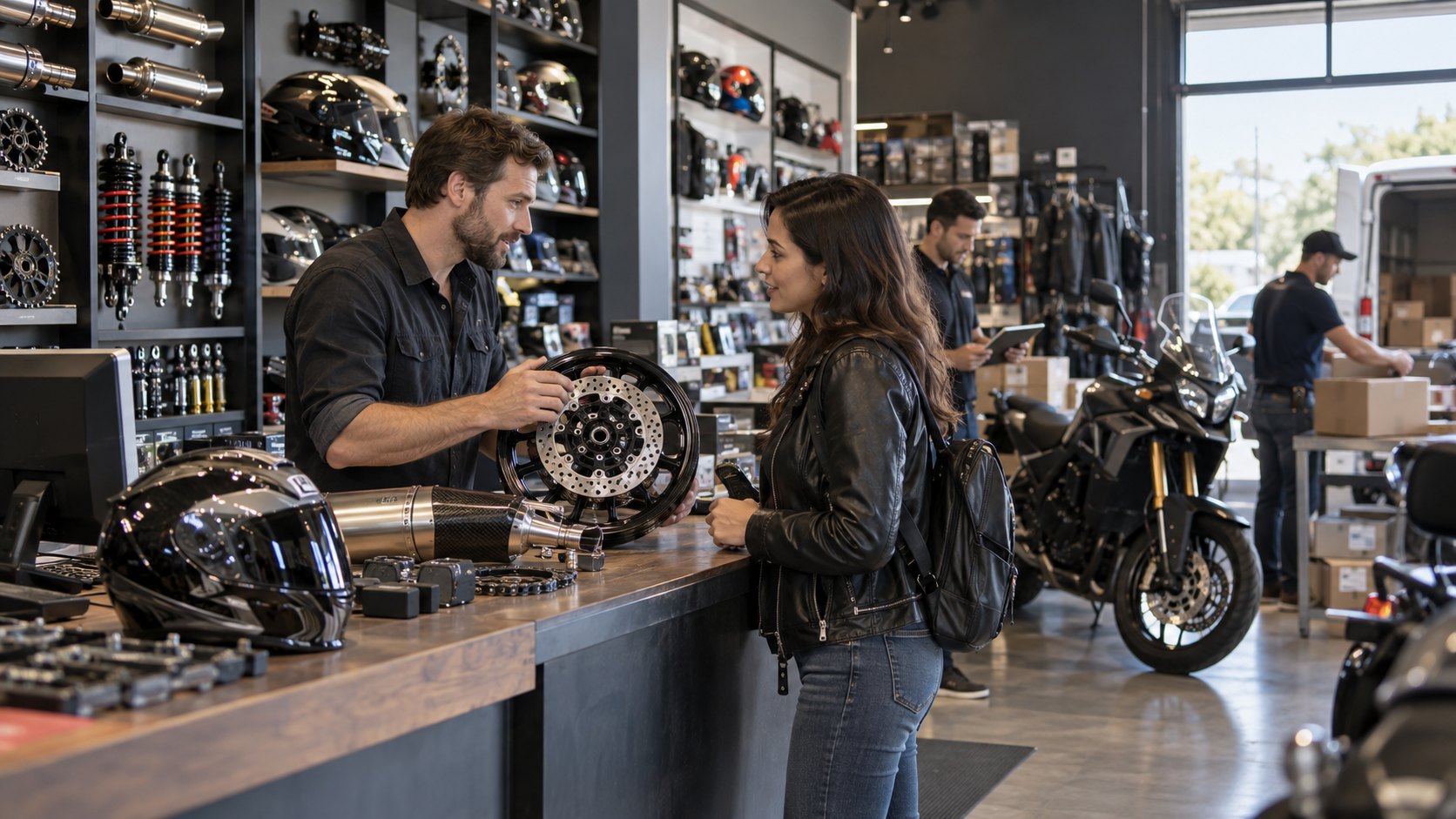
The practical consequence is that a founder here has a genuine choice of shape. A trade counter in a workshop district, a warehouse with a packing bench and a website, or a desk from which somebody sells a manufacturer's range on commission without ever owning it — all three sit inside this one activity. They need different money, different premises and different skills, and they fail for different reasons.
Underneath the shape sits a second thing worth understanding before any stock is bought: this trade is really two catalogues sold to two buyers. There are the parts a machine consumes — chains, sprockets, brake pads, filters, plugs, oil, tyres, batteries, cables — which sell steadily, predictably and thinly, mostly to workshops. And there are the things a rider buys because he wants them — exhausts, screens, luggage, bar-ends, lighting, and above all helmets, jackets, gloves and boots — which sell irregularly, at a much better margin, to individuals who have to be reached and persuaded. A business built only on the first is a supply job with no pricing power. A business built only on the second is a fashion retailer with a seasonal problem. The good ones run both and let the consumables pay the rent.
The commercial case is reach, not frontage
Motorcycle parts have a long-tail problem that car parts have in a milder form: there are a great many models, the fitment is specific, and the customer who needs a part needs that part. No shop can hold the tail. What the shop can do is reach the customer who owns the odd machine, which is why a founder who understands this line thinks about catalogue and delivery before he thinks about a street position.
That is also why the licensing language matters. A mail-order and online operation is not a workaround here; it is written into the activity. The same goes for the commission agent, who carries no stock at all and earns on somebody else's goods. Those three ways of trading pull in different directions on almost every question that decides whether the business survives its first year.
three ways to sell, judged on the same six rows
| Judged on | Trade counter | Mail order and online | Commission agent |
|---|---|---|---|
| You own the stock you are selling | Yes | Yes | No |
| Cash committed before the first sale | Heavy | Heavy | Almost none |
| What the premises has to be | A shop somebody can find | Storage and a packing bench | A desk and a phone |
| Who absorbs a wrong-part return | You | You | The principal |
| Reach beyond your own district | Walk-in only | The whole country | Your principal's |
| Where the margin comes from | The part, sold once | The part, plus volume | Commission on somebody else's part |
The fourth row is the one that surprises people. Returns are a much larger cost in this trade than in most, because fitment errors are common and a returned part often cannot be resold as new. A commission arrangement pushes that risk onto the principal, which is exactly why the commission rate looks low until you have handled a season of returns yourself.
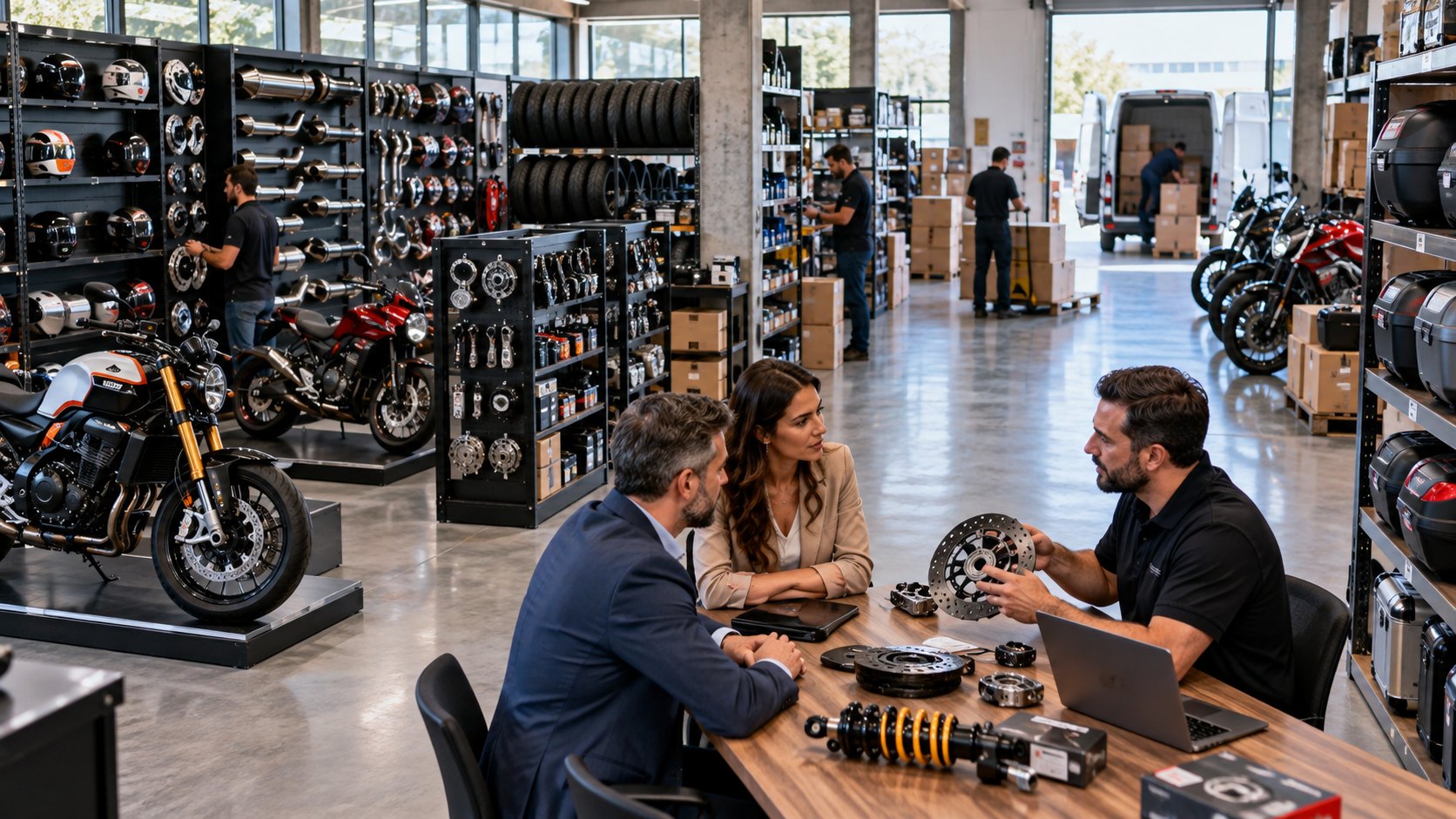
CZ 92 — Wholesale And Retail Sale Of Parts And Accessories For Motorcycles (Including By Commission Agents And Mail Order Houses)
Under this line the company buys and sells parts, components, consumables and accessories for motorcycles, to businesses or to individuals, from a counter or at a distance, on its own account or on commission. Four things sit clearly outside it.
Fitting is not selling. Bolting a part to a customer's machine is repair work and belongs to the maintenance and repair line, not to this one. A parts business that offers fitting as a courtesy has taken on an activity it does not hold, and the insurance position is worse than the licensing one — a part that fails after you fitted it is a different argument from a part that fails after you sold it.
Whole machines are not parts. Selling the motorcycle itself is its own line, and a parts business that starts taking used machines in part-exchange has drifted into it.
Somebody else's trade marks are not yours to use. Selling genuine branded parts is ordinary trade. Selling copies, or describing a copy as genuine, is not, and intellectual property is enforced on goods crossing the border as well as on goods on a shelf. This is the single most common way a new parts importer gets into trouble, and it is usually carelessness at the supplier end rather than intent.
Parts for other things are other lines. Car parts, marine parts and off-road kart parts each have their own entry in this catalogue. A shop that genuinely serves several of them should hold several of them, and the sibling line covering car parts is the one most often needed alongside this.
What has to be provable about riding gear
Here is the distinction that separates a serious parts business from a stall. Most of what this line sells is a component. But helmets, armoured jackets, gloves, boots and back protectors are not components — they are protective equipment, sold on the promise that they will work once, at the worst possible moment. That promise is the product, and it changes what a seller has to be able to demonstrate.
In practice that means provenance. A conformity mark on a helmet, the certificate behind it, the manufacturer's own documentation, an unbroken line back from your shelf to the factory. The UAE operates a national standards and conformity framework, and the sensible assumption for any product sold on a safety claim is that it falls inside it — so the question to put to a supplier before the first order is not the price but what standard the goods are certified to and who issued the certificate. A supplier who cannot answer that quickly is telling you something.
Two more conditions attach to the goods rather than to the business. Tyres are a heat-sensitive product in a country with a great deal of heat, and their age matters commercially whatever else is true of them; a batch bought cheaply because it has sat in a warehouse is not a bargain. Batteries and oils are hazardous in storage and in disposal, which makes them a question for the municipality and for the civil defence body in the emirate, and a question about where the used ones go.
What it costs, and what the answer depends on
Nobody can price this line from the activity name. The licence fee, the premises, the staff allocation, the jurisdiction and the conformity work a particular product family attracts all move the total, and a commission agent's cost base and an importer's are not comparable at all. Selling at a distance also raises a tax question that a counter business does not face in the same form, because the treatment of a supply differs between a UAE buyer and an export. We establish the real figures against the actual plan — which of the three shapes, which emirate, which product families — before anything is filed.
References
- Ministry of Industry and Advanced Technology — national standards and conformity marks for products sold on a safety claim, including protective riding equipment. Ministry of Industry and Advanced Technology
- Dubai Customs — import clearance, the importer's customs code, restricted goods and intellectual-property enforcement at the border. Dubai Customs
- Federal Tax Authority — value added tax on counter sales, distance selling and exports, and corporate tax filing. Federal Tax Authority
- UAE Government portal — the federal consumer-protection framework behind claims made to a retail buyer. UAE Government portal
Elsewhere in Trading
Activities that sit beside this one
Most licences carry more than one activity. Adding a neighbouring line at the application stage costs a fraction of amending the licence afterwards.
Begin with a clear conversation
Tell us what you intend to build.
A consultant will map the structure, jurisdiction, approvals and likely cost against what you actually described — not against a package.
