
Activity CZ 94
How to Start a Jet Ski Trading Business in Dubai
A jet ski is not a road vehicle, and trading them is a marine business: the sale turns on whether the buyer has somewhere to keep and launch it. Private owners and rental fleets buy on different grounds.
ConsultZone licensing desk
- Activity code
- CZ 94
- Category
- Trading
- Reviewed
- Read
- 7 min
Listen instead
39 seconds
An audio summary of this guide.
Topic summary
How to Start a Jet Ski Trading Business in Dubai
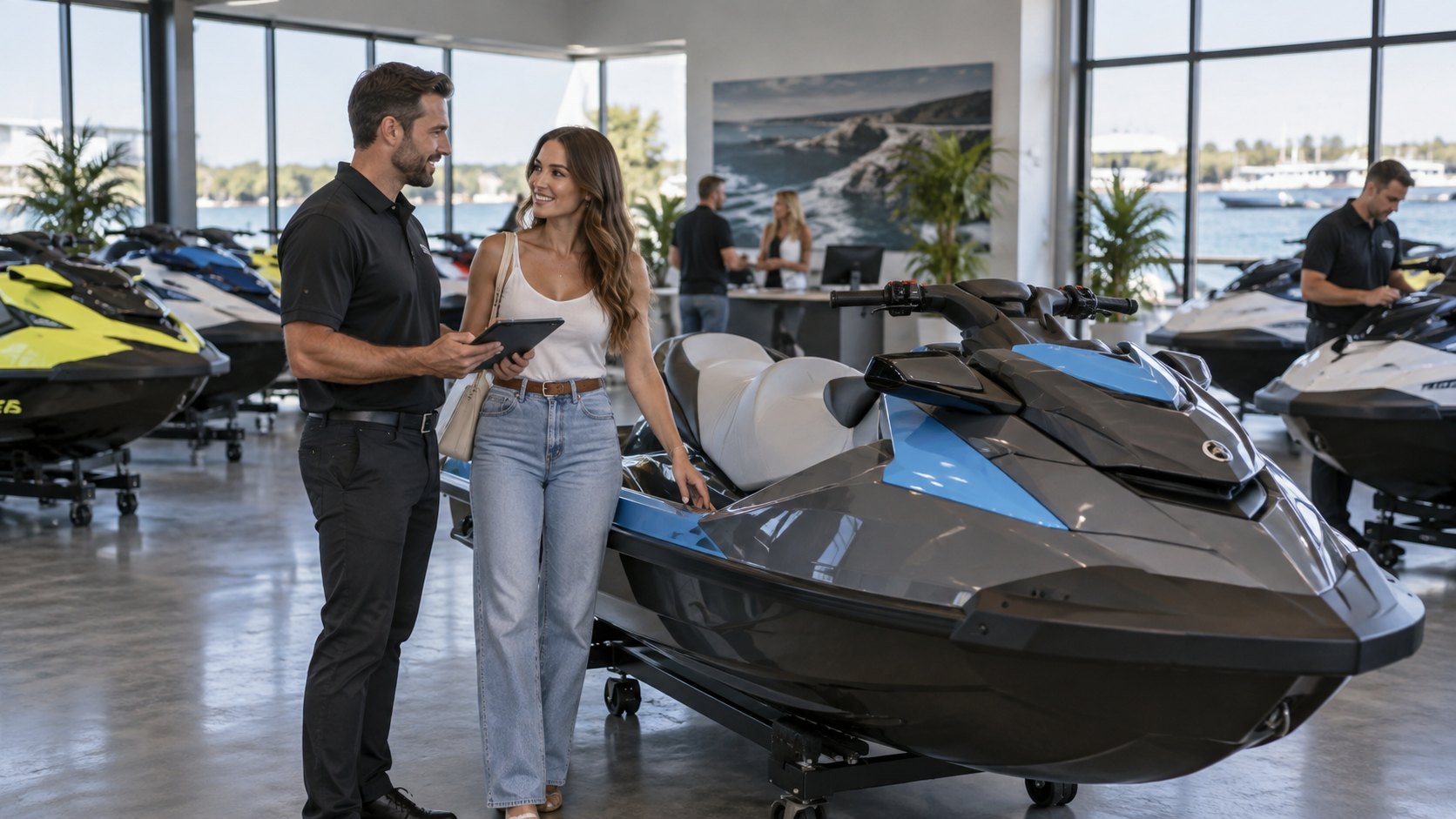
The first useful question to put to a walk-in customer in this trade has nothing to do with the machine. It is: where are you going to keep it, and where are you going to put it in the water? A dealer who cannot help with the answer loses sales to a dealer who can, and that is the single most underrated fact about this line.
A jet ski looks like a vehicle and behaves like a boat. It arrives on a trailer, it is towed on a road, and it is easy to file it mentally beside motorcycles and karts — but it is a marine craft, and once it leaves the trailer it belongs to a different world. Where it may be launched, where it may be ridden, how close to a beach, what the craft itself has to carry, what the person driving it has to hold, and whose permission is needed to operate commercially from a stretch of shore are all matters for the maritime and coastal authorities of the emirate concerned, not for the roads authority. Those answers are not uniform along this coast. They differ between emirates, and they differ between one beach and the marina three kilometres away.
For the buyer, that turns into a storage problem, and the storage problem is what actually closes or kills the sale. A villa with a garage and a driveway can take a trailer; an apartment cannot. A marina berth, a dry-stack rack, a compound space or a friend's yard each solve it differently and cost differently. Access to a slipway that permits launching is a separate question again. The dealers who do well here are the ones who have worked all of this out in advance and can put a trailer, a storage option and a launch arrangement in front of a customer in the same conversation. It reads like service. It is really a sales mechanism.
Who this line is for
Watersports operators buying the trade side
An existing rental or tour operation that already owns machines, knows what they cost to run, and has decided to sell as well as hire. This founder has the strongest starting position in the whole line, because he knows exactly how many hours a machine survives in commercial use and can talk to another operator as a peer.
Marine dealers adding personal watercraft
A boat dealer extending downward into smaller craft. The infrastructure transfers well — the yard, the trailers, the workshop relationships, the customer list — and the buying cycle is faster and the price point far lower, which smooths a boat dealership's income.
Importers and wholesalers supplying the region
The container side of the line. The customer is another dealer or a fleet operator, the margin is thinner, the volume larger, and the whole exercise is a clearance and cash-flow business rather than a retail one. The regional market matters here: machines land in the UAE and go on to buyers elsewhere in the Gulf.
Founders coming from outside the marine trade
People who ride, who have noticed how many machines are on the water at weekends, and who are right that it is a real market. The gap to close is not commercial — it is knowing what a used hull has been through, because a machine that has spent two seasons in a rental fleet and a machine that has done thirty hours in private hands look identical in a photograph.
CZ 94 — Jet Ski Trading
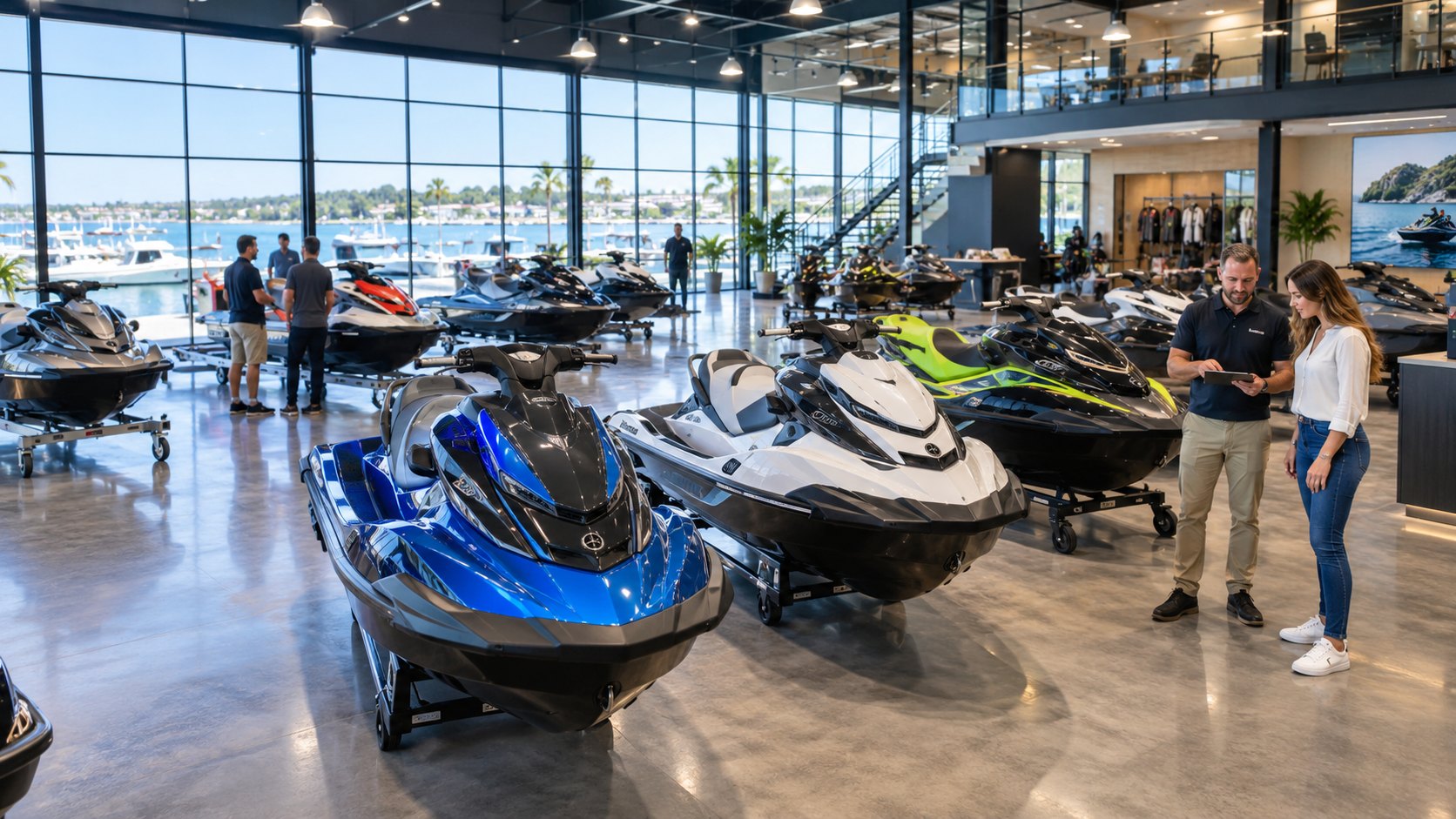
The line covers buying and selling personal watercraft — new or used, one at a time to an individual or in quantity to an operator — together with the trailers, covers and equipment that go with them. Two things about it are worth spelling out.
Three buyers, and they are not after the same machine
A dealer who treats this as one market will price wrongly for all three of them. The private owner, the rental operator and the hotel or beach club buy on entirely separate grounds, and the differences run right through the business — stock profile, warranty exposure, parts holding and where the money is actually made.
| Private owners | Rental operators | Resorts and beach clubs | |
|---|---|---|---|
| What they are really buying | A weekend, and the trailer to reach it | Hours before failure | A guest experience with nobody hurt |
| How many at a time | One, occasionally two | A batch, on a replacement cycle | A small fixed fleet |
| What decides the sale | Storage, launch and the trade-in | Cost per hour and parts on the shelf | Appearance, and the operator behind it |
| Where the dealer actually earns | The second machine, years later | Parts and replacements, continuously | Fleet renewal on a schedule |
| Where it goes wrong | The buyer has nowhere to launch | Salt water and hard use, faster than forecast | One incident in front of guests |
The marked row is the commercial answer. Private sales are the visible half of this trade and the slow half: a good customer returns in several years. Operators return every season, for parts, for replacements and for machines whose hours are up, and they are the reason a jet ski business should think of itself as a supplier rather than a shop.
What travels with a hull
A machine arriving from abroad brings paperwork as well as fibreglass. There is a hull identification number, a commercial invoice, a manufacturer's documentation set, and a clearance to be made by an importer holding a customs code in its own name. A used machine also brings a history — hours, service record, whether it has been submerged, whether it came out of a rental fleet — and the ability to read that history is what separates a trader who survives the used market from one who buys somebody else's problem twice.
What the licence does not cover
It does not cover hire. This is the boundary most often crossed by accident. Selling machines to a rental operator is trade; putting your own machines into the hands of paying riders is a different activity, with its own approvals, its own insurance position and its own relationship with whoever controls that beach or marina. A dealer who lets customers try a machine for a fee has stepped across it.
It does not cover operating from a beach or a marina. A commercial watersports position on the shore is granted by whoever holds that shore, and it is a separate exercise from holding a trade licence. No licensing authority can give you a launch point.
It does not cover repair. Servicing and repairing craft and marine engines are separate lines in this catalogue, and any serious personal-watercraft dealer either holds one of them or has a firm arrangement with a yard that does. Hours-based maintenance is where an operator's loyalty is actually won.
It does not settle what a rider must hold. Whether the person driving a personal watercraft needs a qualification, and what it is, is answered by the maritime authority in the emirate concerned, about the individual. It is worth knowing because customers ask the dealer first — but the honest answer is to send them to that authority rather than to guess on their behalf.
It does not by itself decide the jurisdiction. A mainland licence sells to buyers inside the UAE market, which is what a retail dealership does. A free zone licence suits holding stock, consolidating and re-exporting to the region, which is what a wholesaler does. The correct answer follows from who the buyer is, and it is the first question to settle rather than the last.
What it costs to hold
The activity name cannot be priced, and any number offered before the questions are asked is guesswork. The licence, the jurisdiction, the premises — showroom, yard or both — the staff allocation, and the conditions a particular storage or display arrangement attracts all move the total, and an importer working from a warehouse and a waterfront retailer with a service bay share nothing but the words on the licence. A tax question also follows the sale rather than the company, because the treatment of a machine sold to a UAE buyer and one exported are not the same. We establish the real figures against the actual plan before anything is filed.
References
- UAE Government portal — the federal framework for marine craft and their use in UAE waters, and general government information. UAE Government portal
- Dubai Customs — import clearance for watercraft consignments, the importer's customs code, and export documentation. Dubai Customs
- Ministry of Climate Change and Environment — the marine environment and protected coastal waters that limit where craft may be used. Ministry of Climate Change and Environment
- Federal Tax Authority — value added tax treatment of a domestic sale against an export, and corporate tax filing. Federal Tax Authority
Elsewhere in Trading
Activities that sit beside this one
Most licences carry more than one activity. Adding a neighbouring line at the application stage costs a fraction of amending the licence afterwards.
Begin with a clear conversation
Tell us what you intend to build.
A consultant will map the structure, jurisdiction, approvals and likely cost against what you actually described — not against a package.
