
Activity CZ 90
How to Start a Motorcycle Sales and Service Business in Dubai
One licence line carries motorcycle sales, servicing and parts together — something no car-side activity does. Why delivery fleets rather than weekend riders decide how the business gets built.
ConsultZone licensing desk
- Activity code
- CZ 90
- Category
- Trading
- Reviewed
- Read
- 7 min
Listen instead
43 seconds
An audio summary of this guide.
Topic summary
How to Start a Motorcycle Sales and Service Business in Dubai
Most two-wheelers on the road in this market are working machines. They carry food, parcels and documents, they run most of the day, and they are owned in batches by companies rather than one at a time by enthusiasts. Any plan for a motorcycle business that begins with weekend riding and touring machines has started at the small end of its own market.
This activity line is unusual, and the unusual part is worth stating plainly before anything else: it covers selling, servicing and supplying parts for motorcycles, all three, under one heading. Nothing on the car side of this catalogue works that way — vehicle sales, vehicle repair and vehicle parts are three separate activities there, and a dealership assembles them deliberately. On two wheels they arrive together, and that single fact is the strongest argument for this line over its narrower neighbours.
CZ 90 — Motorcycle sale, maintenance and repair
The line covers motorcycles and their related parts and accessories: selling the machine, maintaining and repairing it, and supplying the components and accessories that go with it. New or used, to a private owner or to a company.
Holding all three matters more here than the same combination would on four wheels, for a reason specific to the machines. A motorcycle in commercial use is serviced far more often relative to its purchase price than a car is. The sale is a small transaction; the servicing and the parts behind it run for years and, on a hard-working fleet, will comfortably exceed what the machine cost. A business licensed only to sell hands that entire revenue stream to somebody else, and hands over the customer relationship with it — because the workshop a fleet manager speaks to weekly is the business he calls when it is time to replace twenty bikes.
There is also a practical reason. Two-wheeler service work is short, frequent and low-value per visit: chains and sprockets, tyres, brakes, oil, filters, batteries, bulbs, cables and levers. It only pays as a business when the parts are on the shelf behind the technician, because a machine waiting three days for a chain is a rider not earning and a customer who leaves. Selling the part and fitting the part are the same visit in this trade far more often than they are in cars.
What the combined line does not do is make the three parts of the business equally profitable for every kind of customer. They pull in noticeably different directions.
six customer types, three places the money lands
- Food and parcel delivery fleetsBought once in a batch, then serviced almost weekly for years
- Riders who own one machine and work on itHigh mileage, out of warranty early, serviced wherever is quickest
- Rental and tour operatorsMachines worked hard by people who do not own them
The workshop and the parts counter
- Weekend and touring owners of large machinesDiscretionary money goes on the machine and what hangs off it
- First-time buyers moving up from a scooterThe sale is the event; the servicing follows somebody cheaper
The showroom and accessories
- Corporate couriers replacing a fleet on a cycleBought in batches, disposed of in batches, serviced in between
The showroom and the workshop
Half of those customers barely touch a showroom and are worth more than the ones who do. That is the case for the combined licence in one drawing: a business holding only the sales side is chasing the two rows that pay once, while the three rows that pay every week belong to whoever holds the workshop and the shelf behind it. The marked row is marked because the owner-rider is the customer most often ignored in a business plan and most reliably present in a service bay.
The three neighbouring lines, and why this one holds all of them
This catalogue carries three narrower motorcycle activities beside this one, and the boundaries are worth drawing rather than blurred.
Wholesale and retail sale of motorcycles, including mopeds is the trading line on its own — buying and selling machines, with no workshop and no parts counter behind it. It suits an importer or a trader moving volume to other dealers, and it suits nobody who intends to keep a customer for the life of the machine.
Wholesale and retail sale of parts and accessories for motorcycles is the supply line, including sales through commission agents and mail order. It is a real business in its own right — supplying independent workshops, online retail, accessories and riding equipment — and it has nothing to do with holding stock or a lift.
Maintenance and repair of motorcycles is the workshop alone. A good specialist shop that fixes what other people sold, buying parts in per job rather than holding them.
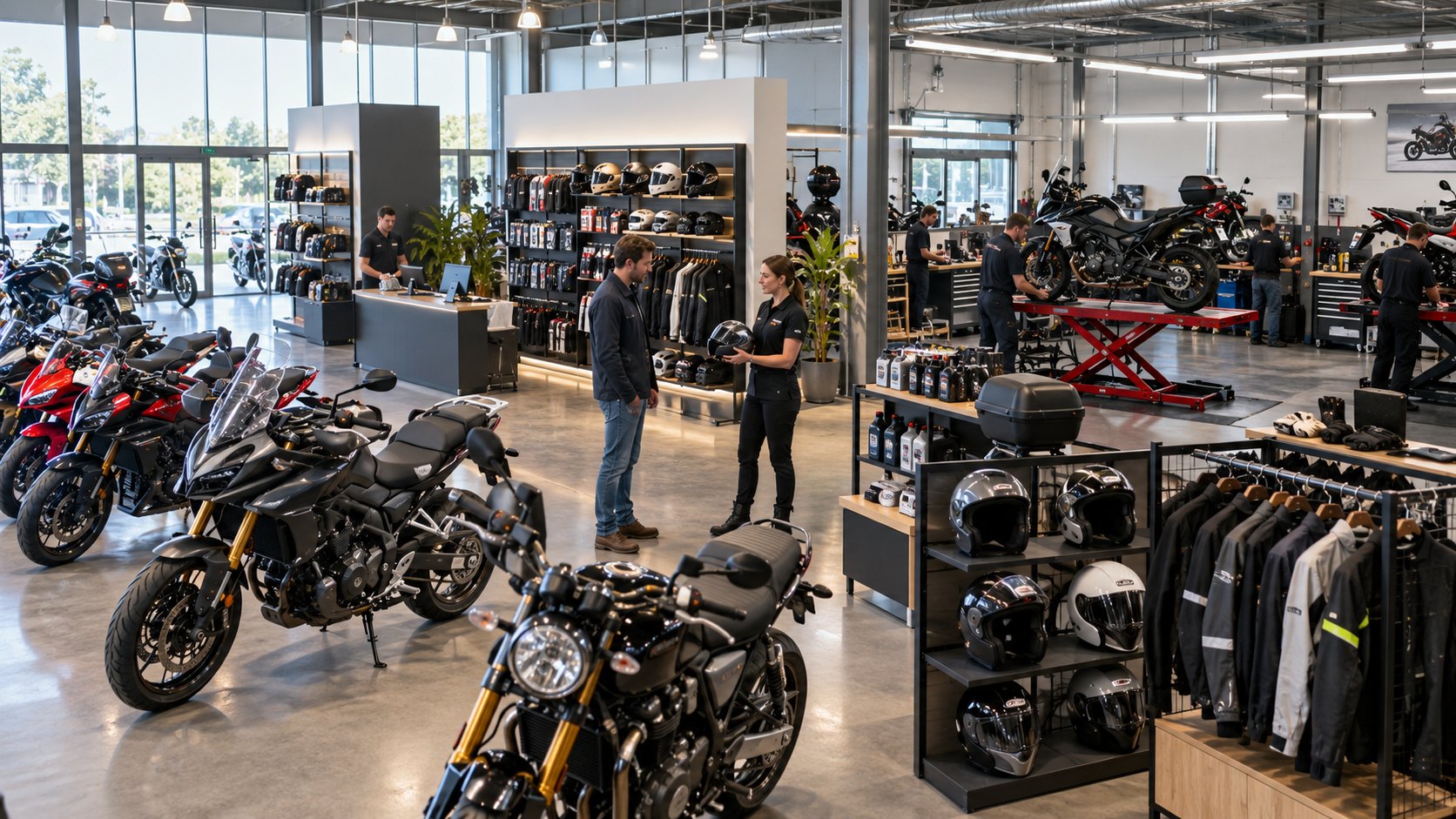
Each of those three is the correct choice for somebody. This line is the correct choice for a dealership: a business that intends to sell a machine, hand it to its own workshop for servicing, and supply the parts out of its own stock — one customer, three revenue streams, one licence. The alternative is holding two or three activities that have to be applied for, priced and amended separately.
Two things sit outside all four of these lines and are frequently assumed to be inside them. Renting motorcycles to paying users without selling them is a rental activity with its own insurance position and its own relationship with the transport authority. And providing the delivery service itself — employing the riders, carrying the goods — is a transport and courier business, not a motor trade one, however many bikes it owns.
The customer who changes the business is a fleet, not a rider
Delivery and courier operators
The customer worth building for. A company running scooters for food or parcel delivery buys in batches, needs machines back on the road the same day, and will sign a maintenance arrangement rather than call around for quotes. That predictability is what lets a workshop plan technician time and hold the right stock — and it is a genuinely different business from retail, with account terms, scheduled servicing and a contact who cares about downtime rather than about the machine.
Rental, tour and leisure operators
Similar economics, different seasonality. Machines are used hard by riders who have no stake in looking after them, so wear items move quickly and cosmetic damage is constant. Volume is reliable and the work is unglamorous.
The owner-rider using a machine to commute
Individually small, collectively the backbone of a service bay. They ride high mileage, leave warranty behind early, and choose on turnaround time rather than on brand loyalty. A shop that can complete a service while the rider waits owns this customer.
Enthusiast and touring owners
The highest-margin retail customer and the smallest group. They buy accessories, riding equipment, upgrades and the labour to fit them, and they care who does the work. Worth serving properly; not worth designing the whole business around.
The specialist independent
A founder whose plan is to repair, not to sell. They should take the maintenance and repair line on its own, keep the premises small, and buy parts in per job — the combined licence carries obligations and premises expectations that a two-bay repair shop does not need.
What none of this settles. The premises the business requires, the approvals a specific emirate attaches to a showroom or a workshop, how many machines the space may hold, and what the licence costs depend entirely on the emirate, the jurisdiction and the activity mix. The recorded ownership of every machine sold sits with the emirate's traffic and transport authority, work permits for technicians sit with the federal labour ministry, and the company is inside the corporate tax net with VAT enrolment following the federal threshold. ConsultZone confirms the specific conditions before anything is filed, because a workshop taken on the wrong terms is the expensive mistake in this trade.
References
- Roads and Transport Authority — vehicle and transport permits in Dubai, and the recorded ownership of a machine on sale or transfer. Roads and Transport Authority
- Ministry of Human Resources and Emiratisation — work permits and labour contracts for workshop technicians. Ministry of Human Resources and Emiratisation
- Ministry of Industry and Advanced Technology — national standards and conformity requirements for safety-critical components such as tyres and brake friction material. Ministry of Industry and Advanced Technology
- Federal Tax Authority — VAT enrolment thresholds and corporate tax filing for a trading and services company. Federal Tax Authority
- UAE Government portal — the commercial agency framework, relevant where a maker's agency stands behind the machines sold. UAE Government portal
Elsewhere in Trading
Activities that sit beside this one
Most licences carry more than one activity. Adding a neighbouring line at the application stage costs a fraction of amending the licence afterwards.
Begin with a clear conversation
Tell us what you intend to build.
A consultant will map the structure, jurisdiction, approvals and likely cost against what you actually described — not against a package.
