
Activity CZ 95
How to Start an Off Road Karts & Spare Parts Trading Business in Dubai
Karts sold here come back as parts orders. What the line covers, why the fleet buyer is the customer worth having, and which conditions attach to the goods rather than to the licence.
ConsultZone licensing desk
- Activity code
- CZ 95
- Category
- Trading
- Reviewed
- Read
- 8 min
Listen instead
56 seconds
An audio summary of this guide.
Topic summary
How to Start an Off Road Karts & Spare Parts Trading Business in Dubai
Sand is an abrasive. That one physical fact is the commercial case for this licence, because a machine driven hard over dunes six days a week consumes wearing parts at a rate no brochure describes. Air filters load and choke, drive belts glaze, constant-velocity boots split and fill, bearings grind themselves dry, and a camp operator who cannot get the part by Thursday loses the weekend that pays for the month. The machine sale is a single transaction, argued down on price against every other importer in the emirate. The parts that follow it are the reason the customer keeps your number.
So the trade has two halves that behave nothing alike. One is capital-hungry, seasonal and thin. The other is small-ticket, repeated, and where the money actually sits.
What the line covers: the machines, and the parts that outlive them
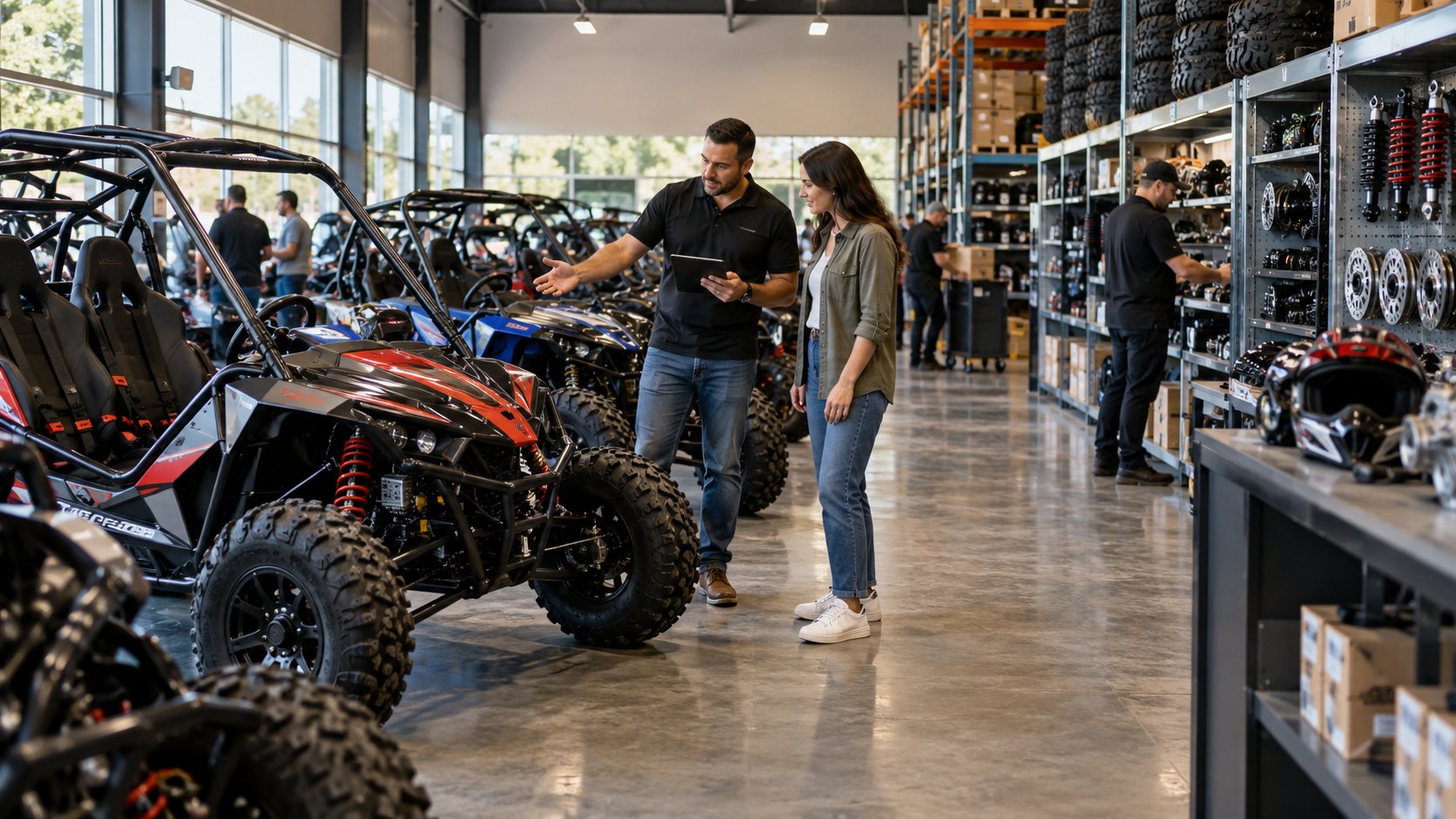
The machines are recreational and utility off-road vehicles rather than road transport: single-seat and two-seat buggies, go-karts and dune karts, quad bikes, and the side-by-side utility vehicles that a farm, an estate or a site crew uses as a workhorse. They are supplied complete, sometimes crated for assembly, and they are sold for use on private land, on closed circuits and on permitted desert ground.
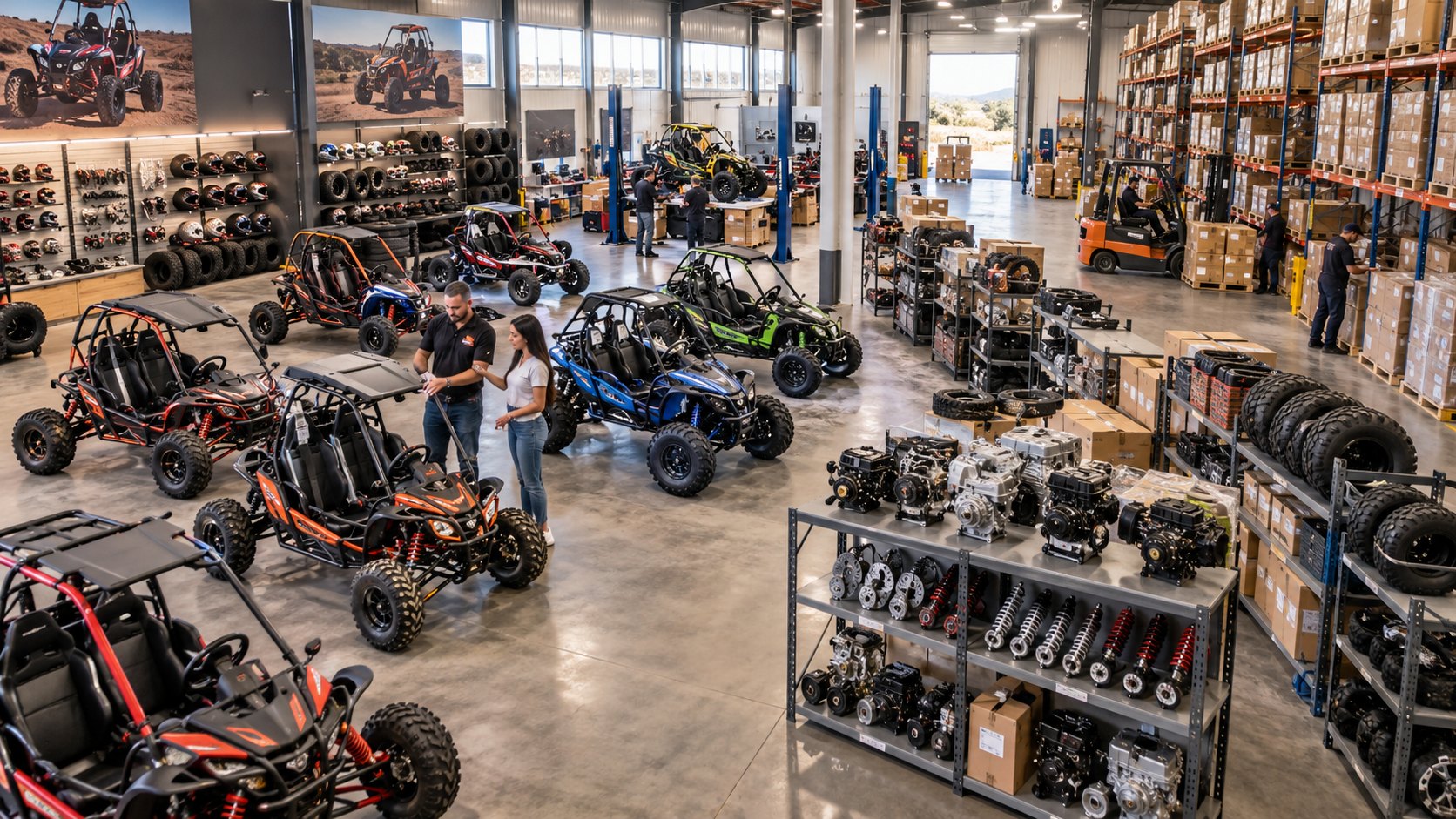
The parts half is the larger catalogue and the harder discipline. It runs from the fast-moving consumables a fleet reorders without thinking — filters, belts, brake pads, plugs, oils, tyres, chains and sprockets — through the wear items that fail on a predictable cycle, such as constant-velocity joints and boots, shocks, bushes, bearings, clutch components and cables, and on to the parts a crash produces: bodywork and plastics, seats, harnesses, cage tube, wheels and steering components. Accessories and safety equipment sell alongside all of it, because the operator buying a replacement harness is usually buying helmets in the same order.
The skill in this business is not breadth of catalogue. It is knowing which two hundred part numbers move, holding those deep, and taking the slower lines to order. Stock is the whole working-capital question here, and a warehouse full of parts nobody asks for is money that has stopped being money.
Where the line stops
Four neighbouring activities are commonly assumed to come with it, and none of them does. Repairing and servicing customers' machines is workshop activity, with its own line and its own premises conditions. Renting karts out, or running a desert tour on them, is a leisure and tourism activity answering to a different set of permissions entirely. Building or assembling machines for sale as your own product is manufacturing. And these are not road vehicles: they are not supplied to be plated for use on a public highway, and a machine intended for the road is a different product governed by the road transport authority rather than by this trading line.
The fleet buyer is the customer who comes back
Two of the buyer groups below purchase a machine perhaps once in three years. Two of them purchase parts every month. Where the business is built decides how the stock is chosen.
Desert camps and dune-tour operators
The core account. These buyers run a fleet in the worst operating conditions the machines will ever see, they cannot take a vehicle out of service on a Friday, and they buy on availability far more than on price. They will pay a premium for a part that is in the building, and go elsewhere permanently for a part on a four-week lead time.
Circuits, resorts and entertainment venues
Karting circuits, hotel activity programmes and family entertainment sites buy machines in batches and then buy parts on a maintenance schedule rather than on breakdown. The purchase is a procurement exercise with a written specification, and the supplier who wins it is usually the one who can evidence parts support for the life of the fleet.
Private owners and enthusiasts
Individual buyers of quads, buggies and karts. Good margin on accessories and upgrade parts, poor predictability, and almost entirely won through the showroom and social media rather than through a sales call. This is the group that keeps a retail counter busy between fleet orders.
Workshops, estates and other traders
Independent repair shops, farms and equestrian estates running utility vehicles, and smaller traders buying at trade terms to resell. Lower margin per line, but volume, and it is the customer group that clears slow stock.
The route to each is different enough to matter. Fleet and venue accounts are won by visiting them, quoting on availability and holding credit terms, which means the balance sheet has to carry receivables as well as stock. Private buyers are won at a counter and online. Trade buyers are won on price lists. A business that serves all four from one pricing structure ends up subsidising the least profitable of them. The same logic settles the structural question of jurisdiction: buyers who are UAE businesses and consumers taking delivery inside the UAE market point towards a mainland licence, while a business whose real plan is to bring parts in and move them out again to other markets is the case a free zone licence is built for.
The conditions sit on the goods and the building, not on the licence
The trade licence is the beginning of the file rather than the substance of it. What actually governs this business attaches to the products and to the unit they are stored in.
Importing is the first of those. Goods do not move on the strength of a trade licence alone; an importer's code held with the emirate's customs authority is what lets a consignment be cleared, and that same authority decides whether a particular item is freely importable, restricted or prohibited. Product compliance is the second. National standards and conformity marking in the UAE are administered federally, and whether a given item — a tyre, a helmet, a battery, a lighting or electrical component — falls inside a mandatory conformity scheme is a question to put to the standards authority before a container is ordered, not after it has landed.
The unit is the third condition, and it is settled with the tenancy rather than afterwards. Oils, lubricants, aerosols, fuel left in a demonstration machine and lithium battery packs all change what a storage space is allowed to be, and fire-safety approval for that space is a civil defence matter. Whether the premises may be used as a store, a trade counter or a showroom at all is a municipal question about the building.
the six gates named on this page
The emirate's economic department
- The trade licence carrying the trading activityFirst, and every other gate waits behind it
- How the activity is worded — machines, parts, or bothAt initial approval, and awkward to widen afterwards
The emirate's customs authority
- An importer's code, without which nothing clearsOnce the licence is cut, before the first consignment
The federal standards authority
- Whether an item sits inside a mandatory conformity schemeProduct by product, before it is ordered in volume
Civil defence
- Storing oils, aerosols and battery packs in the unitWith the fit-out, decided at the tenancy
The municipality
- Whether the premises may be used as a store or a showroomAt the tenancy, not once the racking is in
Read that drawing for its spread rather than its rows. Only two of the six gates belong to the authority that issues your licence, and the marked one is the gate most new traders meet late: a licence permits you to trade, and a customs code is what permits the goods to arrive. Three of the remaining gates are decided by the product and the building rather than by the company, which is why a lease signed before the storage question is asked is the most expensive mistake available in this trade.
One further condition is commercial rather than administrative, and it is worth stating plainly. Parts sell in two grades — the maker's own and the pattern equivalent — and both are honest trade as long as the customer is told which they are buying. What is not honest is stock carrying a manufacturer's mark it has no right to, and the customs authority enforces that at the border. Beyond these, the approvals, conditions and cost of holding the licence depend on the emirate, the premises and the activity mix, and ConsultZone confirms them for the specific case.
References
- Dubai Customs — importer codes, clearance, and the restricted and prohibited goods lists that decide whether an item may arrive at all. Dubai Customs
- Ministry of Industry and Advanced Technology — national standards, conformity assessment and the marks that apply to regulated products. Ministry of Industry and Advanced Technology
- Dubai Civil Defence — fire-safety approval for premises holding oils, aerosols and battery packs. Dubai Civil Defence
- Roads and Transport Authority — vehicle and transport permits in Dubai, and why an off-road machine is not a road vehicle. Roads and Transport Authority
- Dubai Municipality — premises suitability for storage, trade counter and showroom use. Dubai Municipality
Elsewhere in Trading
Activities that sit beside this one
Most licences carry more than one activity. Adding a neighbouring line at the application stage costs a fraction of amending the licence afterwards.
Begin with a clear conversation
Tell us what you intend to build.
A consultant will map the structure, jurisdiction, approvals and likely cost against what you actually described — not against a package.
