

Activity CZ 89
How to Start a Motor Vehicle Parts Wholesale Business in Dubai
Wholesale parts supply is judged on availability rather than on price: the workshop with a car on the lift buys from whoever has the tyre today. Where the margin sits, and what deep stock costs to hold.
ConsultZone licensing desk
- Activity code
- CZ 89
- Category
- Trading
- Reviewed
- Read
- 7 min
Listen instead
47 seconds
An audio summary of this guide.
Topic summary
How to Start a Motor Vehicle Parts Wholesale Business in Dubai
There is a moment that decides this entire trade. A car is on a lift with a wheel off, a customer is in the waiting room, and the workshop needs one specific item within the hour. Whoever can supply it gets the order at whatever the price is. Whoever can only supply it on Thursday gets nothing — and, more expensively, is not called first next time either. Wholesale supply to the motor trade competes on availability, and price is a distant second argument.
Everything difficult about this business follows from that sentence. Availability means depth, depth means capital sitting on shelves, and the discipline is deciding how much of somebody else's convenience you are willing to finance.
What this line covers, and why its name runs so long
The activity is deliberately wide: parts, components, supplies, tools and accessories for motor vehicles, wholesale and retail, with tyres and inner tubes named explicitly. Read as four distinct product families rather than one long phrase, that is what the business is licensed to carry.
Parts and components are the replaceable mechanical, electrical and body items a vehicle needs over its life — from service items bought by the hundred to slow-moving assemblies bought twice a year.
Supplies is the consumable side, and it is quietly the best part of the trade: oils, greases, filters, coolants, brake and transmission fluids, sealants, cleaning chemicals, adhesives, fasteners, wipe cloth and shop consumables. Nobody specifies a supplier for these by brand, they are reordered without a conversation, and they arrive back in the purchase ledger every single month.
Tools and workshop equipment are the capital side. A workshop buys a diagnostic unit, a press or a set of specialist sockets once and remembers who supplied it. These are low-frequency, high-value sales that pull the consumable business along behind them.
Tyres and inner tubes are named in the line because they behave unlike everything else in it. They are bulky, they are safety-critical, they are dated, and they move in a market where a fitter three streets away is selling the same item. Tyres are a business inside a business.
The important boundary is not what the line covers but who it serves. Selling across a counter to the owner of a car — the walk-in, the accessory buyer, the one-off repair — is the counter trade, and CZ 88 in this catalogue is that page. It is a legitimately different operation: retail display, consumer expectations, small tickets, cash. This page is about supplying the trade itself, and the two businesses share almost nothing beyond the goods.
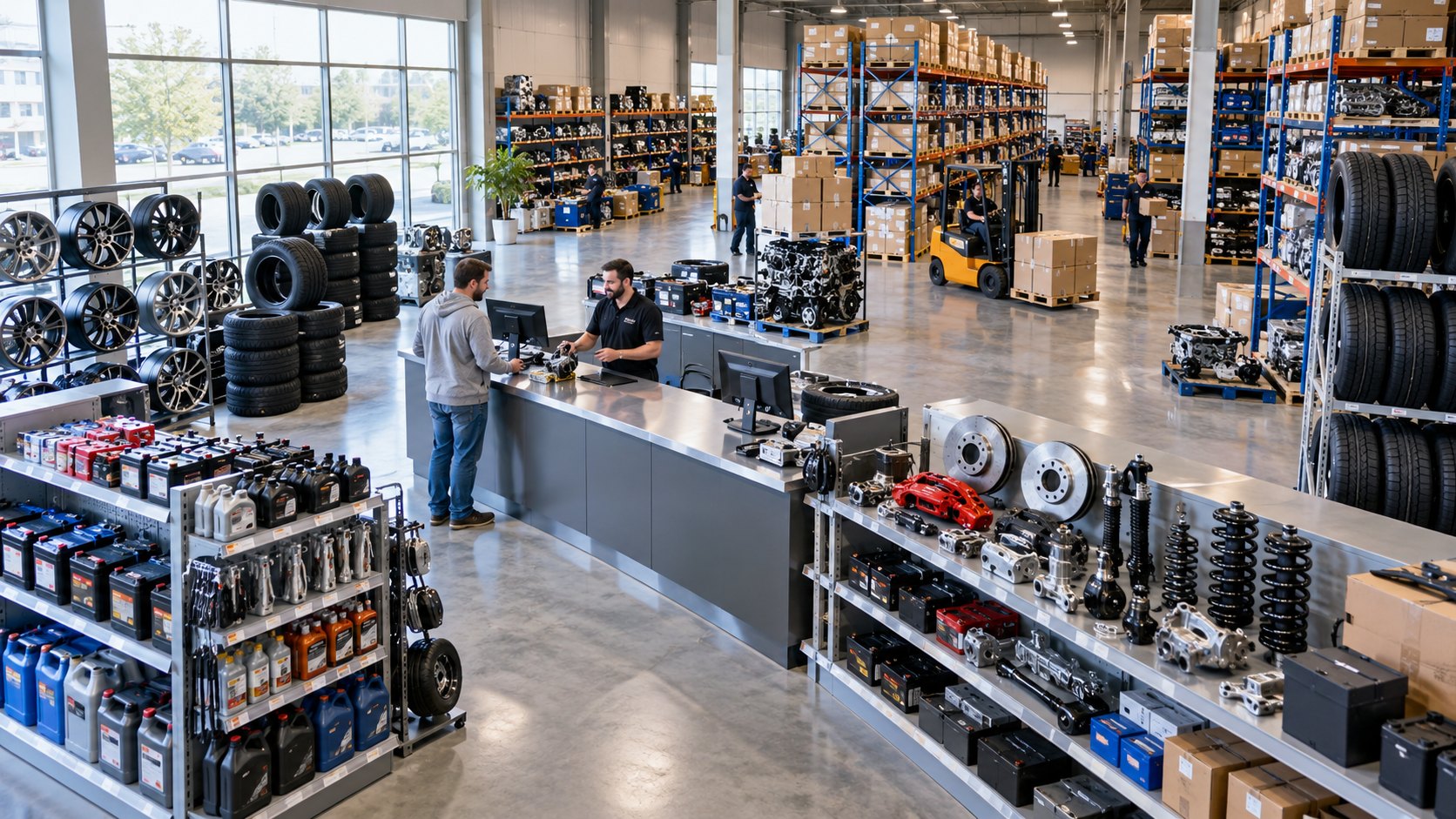
The buyer has a car on the lift, and that changes everything
The customers here are independent workshops, service centres, tyre and battery fitters, fleet maintenance departments, dealership service bays buying outside their franchise supply, and smaller retailers who hold no depth of their own. Every one of them is buying to consume, not to keep, and they are all buying under pressure from a customer standing behind them.
Three things follow, and they are what the trade actually runs on.
Delivery, not collection. A workshop cannot send a technician across the city and leave a car half-assembled. Same-day delivery, in a van, to the bay, is part of the product rather than a service wrapped around it — which makes logistics a core cost of a wholesale parts business and one of the two things a new entrant usually underestimates.
Credit. The other one. The trade buys on account and settles later, because a workshop is itself waiting to be paid by an insurer, a fleet or a retail customer. A supplier insisting on cash will be used only when nobody else has the item. This is the real working-capital problem of the business: the stock is financed, then the receivable is financed on top of it, and both sit between you and your own money.
Depth over breadth. A trade buyer forgives a narrow range and does not forgive a gap inside it. Being the supplier who always has the item for one class of vehicle beats being the supplier who sometimes has the item for all of them.
Those three pressures set up the choices below, and each of them genuinely costs something.
What it givesWhat it costs
- Importing containers direct from the makerThe full margin, and control of that brand in this marketCapital locked in one shipment, and a bet on which numbers move
- Buying from a UAE importer and breaking bulkSmall lots, no clearance exposure, a fast startSomebody else's price, and no control of your own supply
- Deep stock across slow-moving numbersAvailability, which is the thing the trade actually pays forShelves of items that may sit for a year or never sell
- Fast-moving lines onlyStock that turns and cash that comes backThe one call you cannot answer is the call that loses the account
- Selling on account to workshopsVolume, and customers who stayYour working capital financing somebody else's cash flow
- Cash terms onlyNo bad debt and no collection problemTrade buyers go to whoever gives them a month
The marked row is marked because it is the one decision that defines the business rather than describing it. Depth is expensive, illiquid and impossible to reverse quickly — and it is the only thing that makes a workshop call you first. Most successful operations in this trade run a barbell: genuine depth in a narrow, well-chosen range, and shallow coverage of everything else bought in from another importer at a thinner margin, so the phone is always answered even when the shelf is not the source.
Tyres and fluids are not simply boxes
Two of the four families in this line carry conditions that the others do not, and they are worth understanding before the first order is placed rather than after it lands.
Tyres. They are a safety-critical product class, and what may be offered for sale in the UAE is set nationally through standards and conformity requirements rather than by the emirate that issued the licence. The control attaches to the product line and is assessed per line. Commercially, tyres are also the most perishable thing in the warehouse without ever going off: the date moulded into the sidewall is read by trade buyers here, and stock that has sat too long becomes harder to place at any price. Volume, storage conditions and turn matter more in tyres than anywhere else in the catalogue.
Oils, chemicals and aerosols. Lubricants, solvents, brake cleaners, adhesives and pressurised cans are flammable goods held in quantity, and a warehouse holding them is subject to fire safety conditions on storage, separation and suppression. That is a civil defence matter, decided on the building, and it is the single most common reason a warehouse that suited one product mix does not suit a wider one.
Brake friction material, lighting and glazing sit in the same safety-critical family as tyres and are assessed the same way — on the product, per line.
Everything else in the range is ordinary trade goods. The general conditions of the business are the ones any UAE importer faces: a customs code in the company's own name, a clearance file per consignment, a warehouse whose size and approvals match what is stored in it, corporate tax, and enrolment for VAT once taxable supplies pass the federal threshold. What a specific product class requires, what the premises will be permitted to hold, and whether a mainland licence or a free zone one is the right base for a regional distribution operation all depend on the emirate and the jurisdiction. ConsultZone establishes those for the actual product mix before a warehouse is taken, because the warehouse is the decision that is hardest to undo.
References
- Ministry of Industry and Advanced Technology — national standards and conformity requirements for tyres and other safety-critical vehicle components. Ministry of Industry and Advanced Technology
- Dubai Civil Defence — fire safety conditions for the storage of oils, chemicals and pressurised containers in a warehouse. Dubai Civil Defence
- Dubai Customs — customs codes, consignment clearance, and the treatment of goods imported for re-export. Dubai Customs
- Federal Tax Authority — VAT enrolment thresholds and the difference in treatment between a domestic supply and an export. Federal Tax Authority
Elsewhere in Trading
Activities that sit beside this one
Most licences carry more than one activity. Adding a neighbouring line at the application stage costs a fraction of amending the licence afterwards.
Begin with a clear conversation
Tell us what you intend to build.
A consultant will map the structure, jurisdiction, approvals and likely cost against what you actually described — not against a package.
