

Activity CZ 70
How to Start a Used Truck Trading Business in Dubai
A used truck is priced as a working asset rather than as a vehicle. Hours, duty cycle and the body bolted to the chassis decide what a truck is worth and who will buy it.
ConsultZone licensing desk
- Activity code
- CZ 70
- Category
- Trading
- Reviewed
- Read
- 7 min
Listen instead
41 seconds
An audio summary of this guide.
Topic summary
How to Start a Used Truck Trading Business in Dubai
Nobody buys a truck to enjoy it. Every buyer in this market has a job for the machine and a cost per kilometre or per operating hour in his head, and above a certain number the truck stops making sense to him. That is the whole difference between this line and used-car trading: the customer is running arithmetic, not taste, and he will tell you exactly which number he is running if you ask.
It also means odometer readings are close to useless on their own. A tipper that has spent three years on a quarry haul at low speed and high load is more worn out at 200,000 kilometres than a highway tractor unit at six hundred thousand. Engine hours, the kind of work the truck has done, and what the operator did about servicing are the real measures, and a trader who cannot read them is guessing at the most important number in the transaction.
The market behind this activity is large and it is not only local. The UAE sits on a route to East and Central Africa, South Asia and the wider region, and demand for serviceable used commercial vehicles in those markets absorbs a great deal of equipment that a local haulier has finished with. That regional demand is a floor under the trade, and it is the reason a truck that nobody in Dubai wants is still worth money.
The licence covers the whole machine, not just the chassis
Used commercial vehicles are a broader set of goods than the name suggests: tractor units and rigid trucks, tippers, tankers, mixers, flatbeds and curtain-siders, refrigerated bodies, recovery trucks, and chassis carrying cranes, compressors or specialist equipment. The activity permits buying and selling them used, on the company's own account, wholesale to other traders or retail to an operator.
The consequence worth understanding is that most of these are two assets bolted together, and they depreciate at different rates.
A well-maintained refrigerated body, a crane with a current inspection, or a tanker in good order can be worth more than the cab and chassis it is mounted on — and a tired chassis under good equipment is a completely different proposition from a good chassis under scrap equipment. Traders who value a truck as one number miss this in both directions: they overpay for a clean cab with worn-out equipment, and they walk away from bargains because the paint is bad.
Wholesale and retail behave differently here too. Selling to another trader is fast, low margin, and the release valve for stock that has sat too long. Selling to an operator is slower, better paid, and depends on trust that the machine will work on Monday.
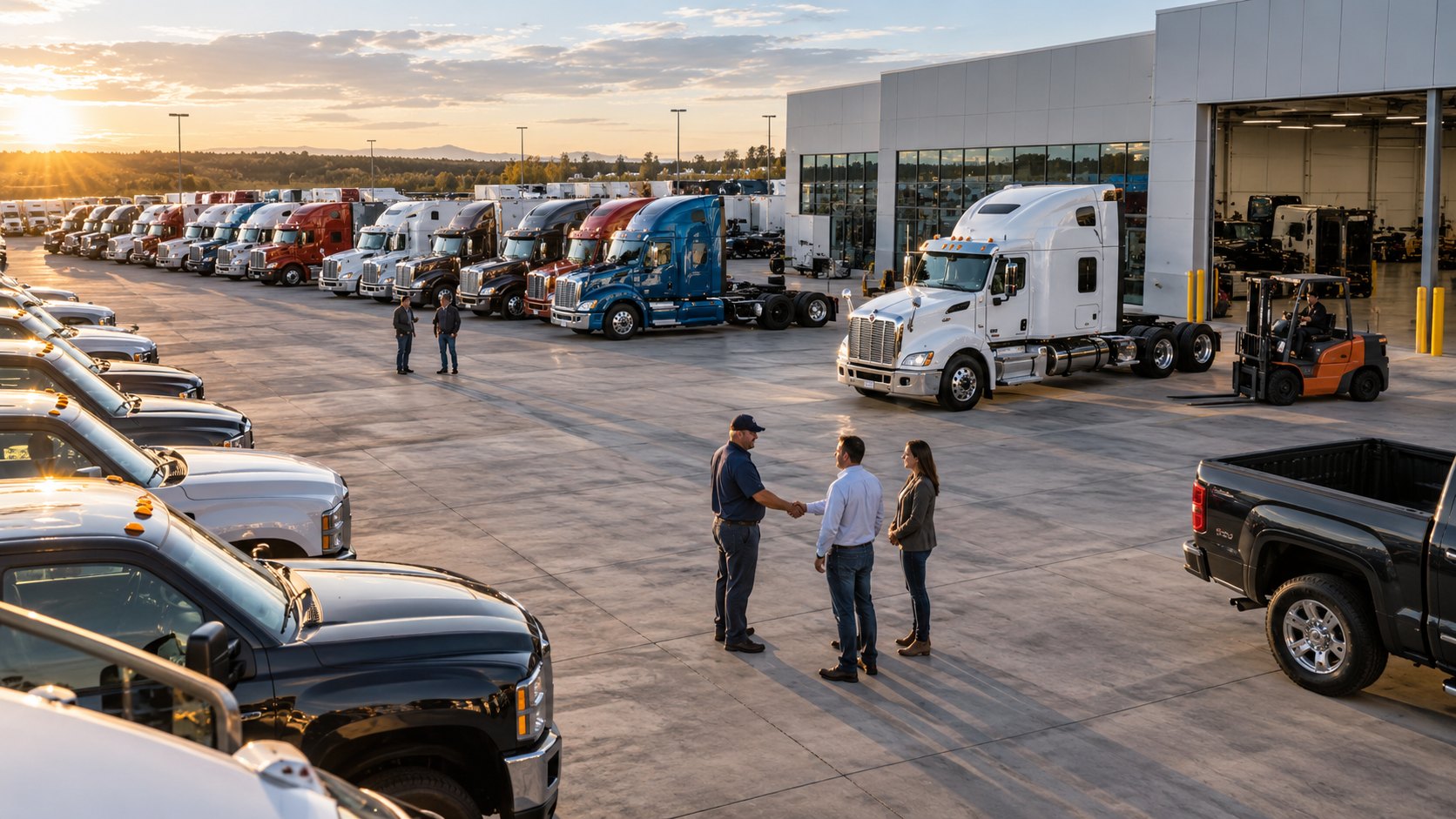
The buyer runs a cost per kilometre, not a wishlist
There are three or four buyers for any used truck and they want different things from it, which is why the same machine can be cheap to one and expensive to another. Knowing which one you are holding stock for is most of the skill.
Local hauliers and contractors buy to put the truck straight to work and read the service record before anything else. Regional export buyers buy on price and speed, often against photographs, and will take almost anything that runs. Plant, utility and municipal operators are usually buying the equipment rather than the truck. Other traders buy what you want gone.
| A local haulier | A regional export buyer | A plant or utility operator | |
|---|---|---|---|
| What they read first | Hours and the service record | Price, and how fast it can ship | The body or equipment on the chassis |
| What they will forgive | Cosmetics, and a high odometer | Almost anything that is roadworthy | A tired cab and chassis |
| What ends the deal | A doubt about engine or gearbox | A delay in the paperwork | Equipment that will not pass its own inspection |
| Where your margin comes from | Preparation you can demonstrate | Volume and turnaround | Knowing what the equipment is worth |
| How and when they pay | Bank credit, slowly | Against documents, quickly | Against a purchase order, on terms |
The fourth row is the one to plan the business around. Each column is a different company: one that prepares machines properly, one that moves volume through a yard near the port, and one that understands attached equipment. Trying to be all three at once is how a truck yard ends up with capital in stock that none of its three buyers wants.
What travels with a truck when it changes hands
Title, and anything owed against it. Commercial vehicles are financed and leased far more often than private cars, and a fleet disposing of equipment may not hold clean title on the day it offers it to you. This is settled with the lessor or the lender before money moves.
The vehicle's own record with the emirate's transport authority. Ownership transfer, permits attaching to the class of vehicle and the roadworthiness inspection all sit with the vehicle rather than with the trader, and each one happens per machine.
Whatever governs the equipment on it. A lifting appliance, a pressure vessel or a tanker barrel is generally subject to its own inspection and certification regime, set by the authority responsible for that class of equipment rather than by anything to do with motor trading. A crane with lapsed certification is a crane the buyer cannot use, and its value reflects that.
Fire and hazardous-goods control, where the load is the reason. Vehicles built to carry fuel, gas or chemicals sit inside a safety regime, and so do the premises where such a vehicle is parked or worked on. This is a real class of control and the specifics belong to the civil defence authority and the emirate, not to a page.
Customs, in both directions. An imported truck has to be entered before it can be dealt with locally, and an exported one has to be documented — and for the export buyer that documentation is much of what he is paying for.
Why a figure here would be invented
The licence fee, the yard the activity requires, how many machines that yard will hold, the handling equipment needed to move non-runners, and the approvals attaching to a particular class of vehicle all depend on the emirate, the licensing authority and the rest of the activity mix. A trader dealing in three tractor units a month and a company holding forty mixed machines and a workshop share an activity name and nothing else. We cost the actual plan before anything is filed.
What a yard full of standing machines actually needs
A commercial vehicle deteriorates faster standing still than it does working, and it does so in ways a car does not. Air systems leak down and brakes bind to the drums. A battery left flat long enough stops being a battery. Tyres flat-spot where they sit and sidewalls perish in the sun whatever the tread still looks like. Hydraulics weep, fluids separate, and a cab shut up in the heat for a season smells like it. None of this is dramatic, and all of it comes off what an operator will pay.
The answer is a rotation rather than a budget line: machines started, run up to pressure and moved on a cycle, by somebody whose job that is. It is the cheapest work in a truck yard and the first thing dropped when the yard gets busy.
Moving a machine that will not run is a capability, not an expense. A non-runner cannot be driven onto a transporter. Shifting it wants a unit able to pull it, air to release the spring brakes and room to do it in — and a trader who buys a dead machine cheaply without any of that is the owner of a fixed object.
Capacity follows access rather than area. A truck needs room to turn, and a yard laid out so that showing the machine at the back means moving four in front of it is a yard where the back row never gets shown and therefore never sells. Heavy axles on soft ground and leaks under standing equipment belong on the same list, and both are easier to plan for than to put right afterwards.
References
- Roads and Transport Authority — vehicle and transport permits, ownership transfer and testing in Dubai. Roads and Transport Authority
- Dubai Customs — entering imported vehicles and documenting exported ones, and restricted goods procedure. Dubai Customs
- Dubai Civil Defence — fire safety and the approvals attaching to hazardous and flammable goods and the premises that hold them. Dubai Civil Defence
- UAE Government portal — the general basis for commercial licensing and the federal instruments behind it. UAE Government portal
Elsewhere in Trading
Activities that sit beside this one
Most licences carry more than one activity. Adding a neighbouring line at the application stage costs a fraction of amending the licence afterwards.
Begin with a clear conversation
Tell us what you intend to build.
A consultant will map the structure, jurisdiction, approvals and likely cost against what you actually described — not against a package.
