
Activity CZ 72
How to Start a Full-Service Vehicle Workshop in Dubai
The wide repair line lets one workshop take a car in for mechanical, electrical, bodywork and paint work and hand it back finished. Breadth is the commercial case; the building is what it costs.
ConsultZone licensing desk
- Activity code
- CZ 72
- Category
- Trading
- Reviewed
- Read
- 7 min
Listen instead
47 seconds
An audio summary of this guide.
Topic summary
How to Start a Full-Service Vehicle Workshop in Dubai
The most costly sentence in a vehicle workshop is "we do not do that here, try the place on the next street." A customer sent away for paint takes the bodywork with them. A customer sent away for auto electrics often does not come back for the service either, because the shop that solved the hard problem now owns the relationship. Every referral out is a partial loss of a customer already won, already parked and already talking to you.
The wide repair line exists to close that leak. It is the same trade as general vehicle repair, licensed at full width: one workshop able to take a damaged or faulty car in at the gate and hand it back complete, without the owner having to manage three suppliers and without anybody being able to blame anybody else for the result. That is the commercial case, and the rest of this page is about what it costs to be able to make it.
What the wide line actually covers
CZ 72 — the wide repair line
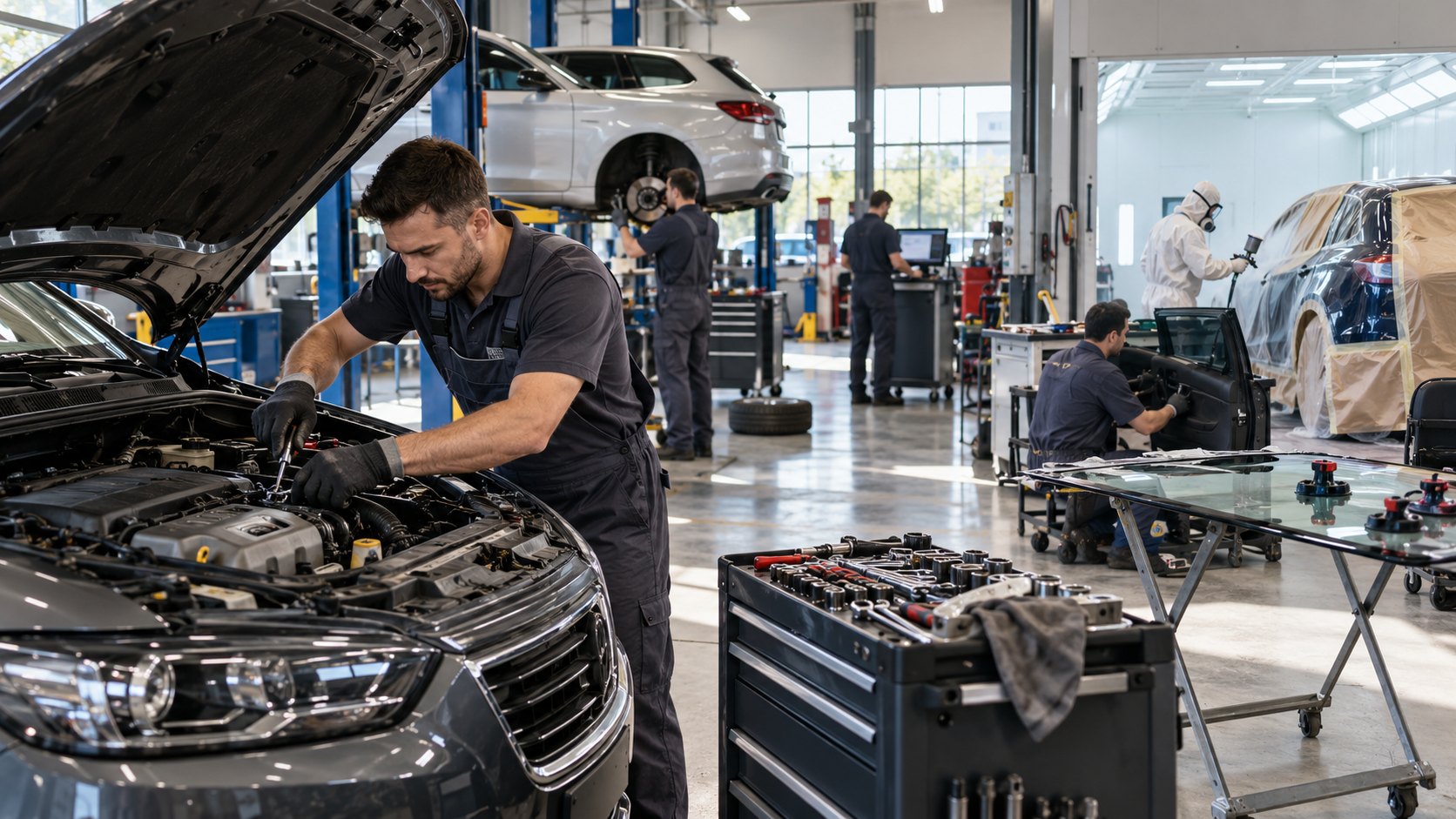
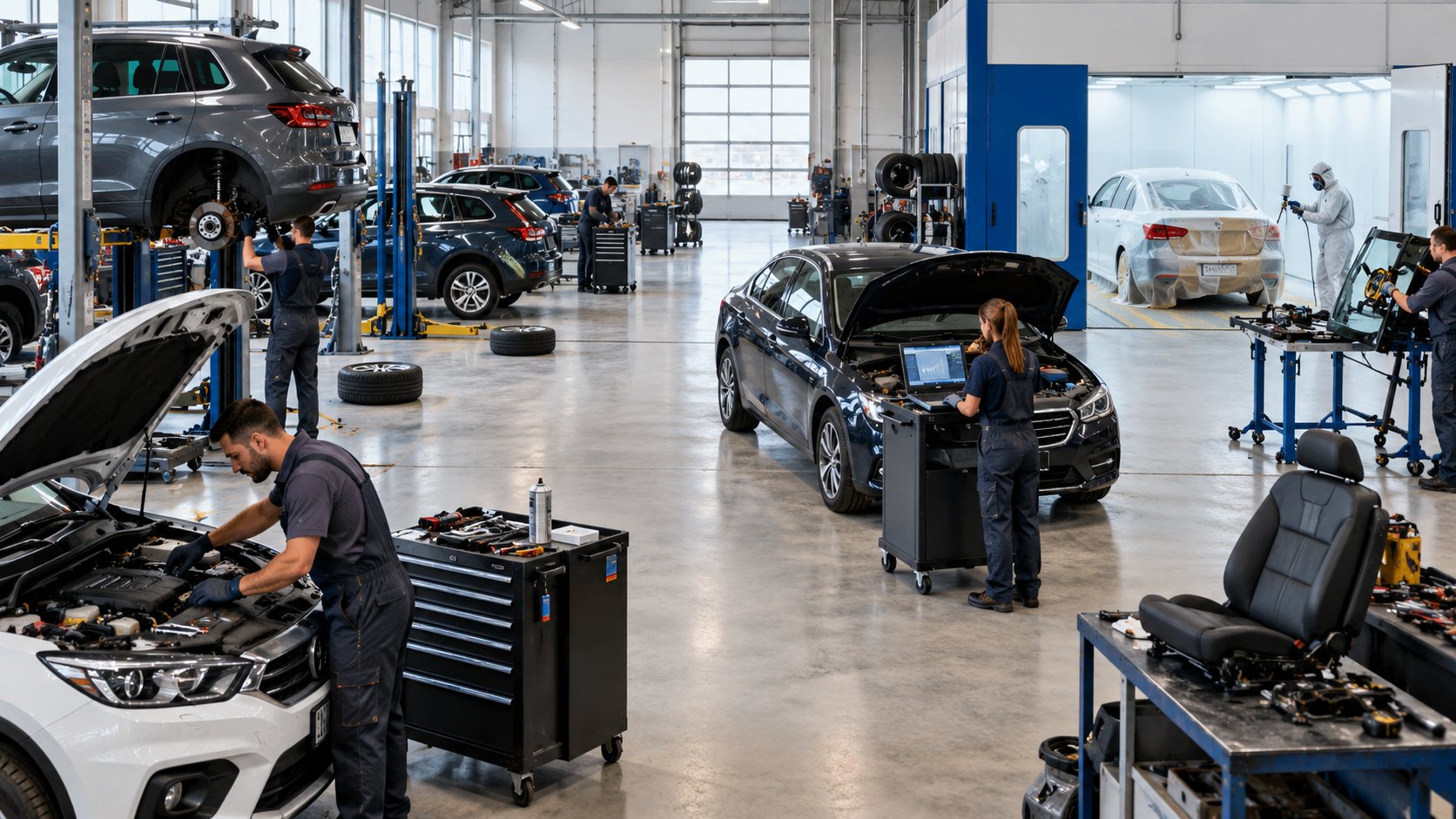
The catalogue writes this activity out as a list rather than a phrase, and the list is the point: mechanical repairs, electrical repairs, electronic injection systems, ordinary servicing, bodywork repair, repair of vehicle parts, washing and polishing, spraying and painting, repair of screens and windows, and repair of vehicle seats. Read it as three trades bundled into one licence, not ten items on a menu.
The mechanical and servicing trades are the base load — engines, transmissions, brakes, suspension, cooling, air conditioning, and the scheduled work that keeps a shop occupied between failures. Any general repair licence reaches this.
The electrical and electronic trades are where the modern value sits. Fault-finding on an injection system, sensors, body electronics and charging systems is diagnostic work: the cost is a subscription, a licensed tool and a technician who can read data rather than turn a spanner, and the margin is knowledge rather than hours. A shop without this refers out the very jobs that other shops cannot solve.
The bodywork, paint and trim trades are a different industry sharing a yard with the first two. Panel beating, filling, preparation, a spray booth, curing, glass replacement and seat and interior repair are process work with a queue, a skilled sprayer and a finish that is judged by eye in daylight. They are also, by a wide margin, the expensive half of the licence.
The buyers who pay for breadth, and the route to each
Insurers and their approved repairer lists. The largest single reason to hold bodywork and paint. An accident claim is one job with one assessor, one estimate and one settlement, and an insurer wants it handled by one shop it can hold responsible. A workshop that can only do the mechanical half of an impact repair is not a candidate for that list, and the list is where the volume lives.
Fleet, leasing and rental operators. They buy availability, not repairs. A vehicle off the road is lost revenue, so the operator with fifty cars values the shop that will handle a scrape, a warning light and a service in the same booking over the shop that is cheaper on any one of them. These are contract relationships, negotiated annually, and they are won on turnaround and reporting rather than on hourly rate.
Used-car dealers preparing stock for sale. Steady, unglamorous, price-sensitive work with excellent bay utilisation: paint correction, minor panel work, interior repair and a mechanical check before a car goes on the forecourt. A dealer cluster within a short drive is worth more to this business than a main-road frontage.
Private owners out of manufacturer warranty. The retail end. They arrive because of price or because of trust, they stay because of one job done well, and they are reached by reputation and location rather than by tender.
Note what the first three have in common: they are businesses, they place repeat work, and they choose on capability rather than on the cheapest quote for a single job. That is why breadth is a commercial strategy and not merely a longer licence — the buyers who place volume are precisely the buyers who will not split a job across two suppliers.
Breadth is not free, and it is worth being honest about each piece of it before the unit is taken.
five capabilities, each weighed against the same rule
What it givesWhat it costs
- Mechanical and servicing baysBase load, repeat customers and a payroll that is covered in a quiet monthOrdinary margins in the most crowded part of the market
- Auto electrics and injection diagnosticsThe jobs other shops send away, priced on knowledge rather than hoursLicensed tooling, live data subscriptions and a technician who is hard to replace
- Bodywork, spraying and paintingWhole accident jobs and a place on an insurer's repairer listA booth, extraction, solvent storage and the premises approvals that follow them
- Glass, screens, seats and interior trimThe car goes back finished, so no third supplier touches the jobStock and trim skills that sit idle between jobs
- Washing and polishing at handoverA visible finish on every car, and the reason owners recommend a shopWater, drainage and floor space earning nothing by itself
The focus row is the decision. Everything above bodywork can be housed in an ordinary repair unit. Paint cannot: it needs a booth, forced extraction, a controlled store for solvents and thinners, and a fire authority satisfied that the whole arrangement is safe. That single row is usually the difference between a modest unit and a substantially larger, more expensive and more heavily approved one — and it is also the row that opens the insurance work. Deciding it early is far cheaper than discovering it during a fit-out.
The conditions attach to the building, not to the trade
Nobody is asked to prove they can weld. What is examined is the site.
Zoning and the unit. An industrial or workshop use, with the floor, height, access and yard a vehicle needs. A wide licence asks for more floor than a narrow one because bodywork holds cars for days rather than hours, and the queue has to stand somewhere.
Extraction and the paint booth. Spraying releases solvent vapour and overspray. Doing it in an open bay is neither lawful nor survivable for the people working there, so the booth and its ventilation are examined as part of the premises rather than treated as equipment you happen to own.
Fire. Flammable liquids, compressed gases, hot work and a building full of fuel tanks. This is Civil Defence's subject, it is assessed against the layout actually built, and it is revisited when the layout changes.
Waste. Used oil, spent solvent and thinners, contaminated rags, filters, cut panels and old glass. These are controlled streams, they leave the site through a proper route rather than the building's bins, and the municipality treats them as an ongoing condition rather than a one-off filing.
People. A full-width shop needs a panel beater, a sprayer, an auto electrician and mechanical technicians. Lawful permits, written contracts and wages paid through the protected channel are the real running constraint on capacity, and they are the ministry's subject rather than the licensing authority's.
Which of these applies in a particular emirate, in what order, and on what conditions depends on the jurisdiction and on the unit, and no honest figure can be quoted for the licence, the approvals or the fit-out without all three. ConsultZone confirms each of them against the actual premises before anything is filed, because the sequence here is unforgiving: a lease signed on a unit that cannot host a booth is money already spent.
References
- Dubai Civil Defence — fire safety for a workshop holding flammable paint, solvents and compressed gases, and for the spray booth arrangement itself. Dubai Civil Defence
- Dubai Municipality — premises suitability, ventilation and drainage, and the routes by which solvent, oil and panel waste leave the site. Dubai Municipality
- Ministry of Human Resources and Emiratisation — work permits, written contracts and wage protection for panel, paint and mechanical staff. Ministry of Human Resources and Emiratisation
- Roads and Transport Authority — vehicle records and testing in Dubai after a structural or accident repair. Roads and Transport Authority
Elsewhere in Trading
Activities that sit beside this one
Most licences carry more than one activity. Adding a neighbouring line at the application stage costs a fraction of amending the licence afterwards.
Begin with a clear conversation
Tell us what you intend to build.
A consultant will map the structure, jurisdiction, approvals and likely cost against what you actually described — not against a package.
