

Activity CZ 71
How to Start a Motor Vehicle Repair and Servicing Business in Dubai
A workshop sells bay-hours, and the two demands that fill them — scheduled servicing and repair on failure — behave nothing alike. What the repair line covers, and who holds each gate.
ConsultZone licensing desk
- Activity code
- CZ 71
- Category
- Trading
- Reviewed
- Read
- 8 min
Listen instead
1 min 1 sec
An audio summary of this guide.
Topic summary
How to Start a Motor Vehicle Repair and Servicing Business in Dubai
A vehicle workshop sells time in a bay. The tools, the diagnostic subscriptions, the technician who can read a fault trace and the one who can only change a part — all of it exists so that an hour on the lift is worth more than the hour costs to keep open. Rent on an industrial unit is paid whether a car is on that lift or not, which reduces the whole business to a single number: the share of available bay-hours that were sold last month. Founders arriving from the parts trade or from a dealership floor tend to plan around the work itself. The work is the easier half.
Two kinds of demand fill those hours, and they behave nothing alike. Confusing them is the most expensive planning error in this line, because each one wants a different shop.
Scheduled servicing is close to a subscription
An oil and filter round at a set mileage, a brake inspection, fluids, belts, air conditioning before the summer. This work is known in advance, priced to the minute and repeatable. It fills quiet mornings, it can be sold forward to a fleet as a contract, and an owner who brings a car for a fourth service will usually bring it for a fifth. Margin per job is modest and the customer knows roughly what it should cost. Predictability is the product.
Repair on failure is an emergency, and it prices like one
A car that will not start, a gearbox that has begun to slip, an air-conditioning system that died in July, damage after an impact. Nobody schedules it, the owner is anxious rather than price-sensitive, and the invoice is a multiple of a service. It also cannot be planned: no workshop can staff for the week three compressors fail at once, and none can send technicians home in the week nothing breaks.
A shop built only on servicing is busy and thin. A shop built only on repair is lucrative and idle by turns. The workshops that hold a trained crew together through a slow month are the ones using contracted servicing to underwrite the payroll and letting repair carry the profit — and that is a decision about who you sell to long before it is a decision about what equipment to buy.
Who actually opens a workshop here
The technician who has been running somebody else's bays. The commonest founder in this line, the best prepared for the work and the least prepared for the rent. Nothing about diagnosis or dismantling will surprise them. The unit, the tenancy, the staff allocation and the cash gap between paying for parts and being paid for labour will.
The fleet or transport operator bringing maintenance in-house. A company with enough vehicles of its own that outside labour has become a visible cost line. For them the workshop begins as a cost centre that stops leaking and becomes a trade the day it starts taking third-party work — at which point the licence, the premises and the tax position all have to be looked at as a business rather than as an internal department.
The investor buying capacity rather than skill. Someone funding bays, a brand and a manager. This works where the manager is genuinely the operator and fails where the investor believes the equipment is the asset. In a repair shop the asset walks out at six o'clock.
The parts trader extending forward into fitting. A natural move, because the components are already on the shelf and the customer is already through the door. It is also a different licence conversation: supplying a part and installing it are not the same line in this catalogue, and a trader who begins fitting has stepped into this one.
CZ 71 — Maintenance And Repair Of Motor Vehicles
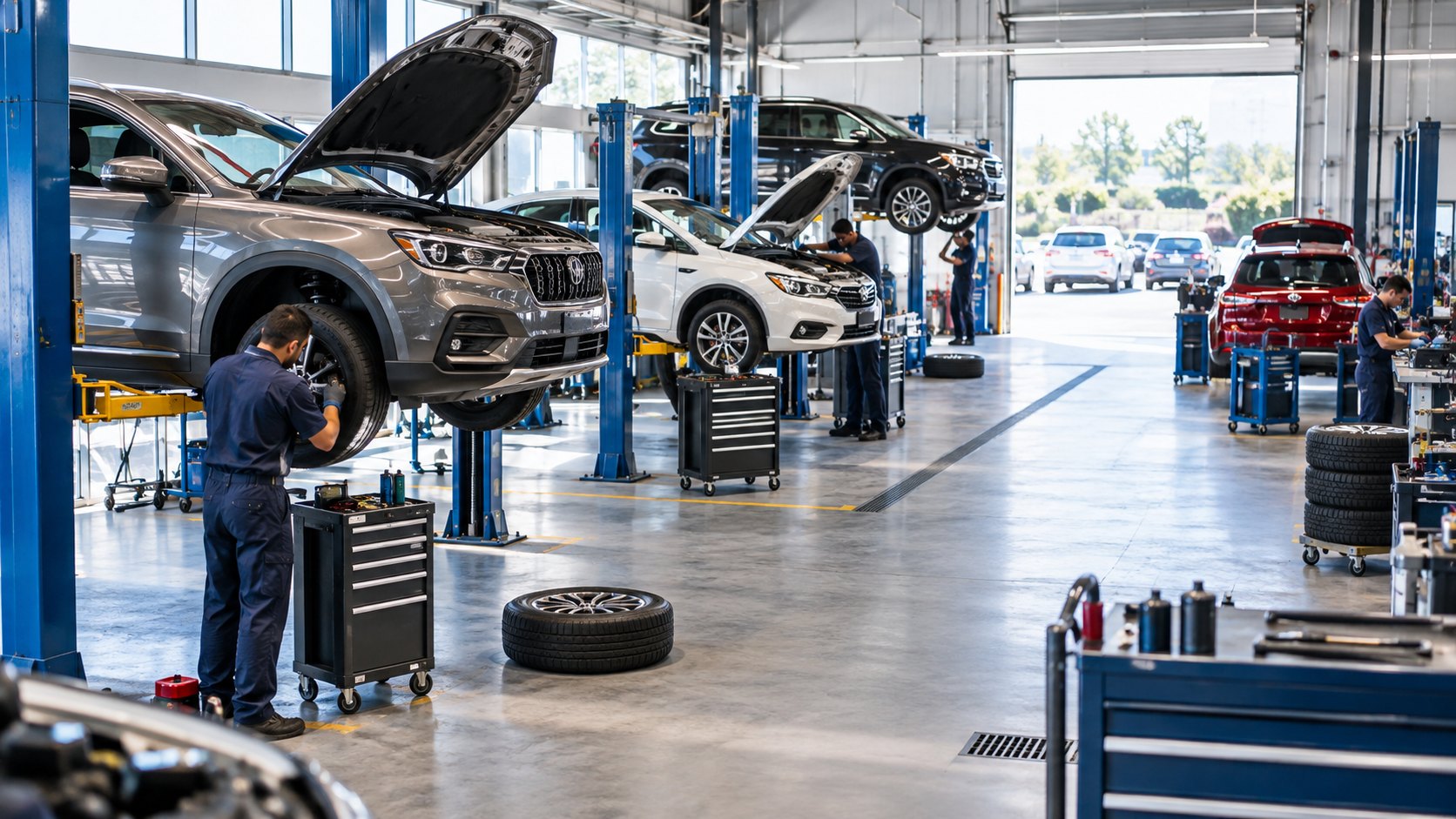
This is the umbrella line for working on a vehicle somebody else owns: fault-finding, dismantling, replacing worn or failed components, adjustment, testing and handing the car back roadworthy. It is the parent of a group of narrower lines in the same catalogue — tyres, washing, oil changes, accessory fitting, rust treatment — each of which a specialist can hold on its own, and several of which a general workshop will hold alongside this one on purpose.
The important thing about it is not what the words permit. It is that the licence names a trade while the building decides whether you can practise it.
A repair bay is a wet, hot, heavy industrial use. It needs floor loading for a lift, height for a raised vehicle, drainage that does not send oil into the surface water, ventilation, somewhere to hold fuel drained from a tank and solvents in a cabinet, and a compressed-air supply. Used oil, old filters and spent coolant are a controlled waste stream rather than ordinary rubbish, and where they go is a question the municipality asks. A commercial shopfront on a retail street cannot host any of that, whatever the licence says, which is why the search for premises should begin before the trade name is chosen and not after it.
the five gates named on this page
The emirate's economic department
- Trade licence carrying the repair activityFirst, and every other gate waits behind it
The landlord and the municipality
- The unit itself — zoning, drainage, ventilation, floor loadingBefore the licence, because the licence is cut against a place
Civil Defence
- Fire clearance for fuel, solvents and compressed gases on siteWith the fit-out, and again whenever the layout changes
The municipality
- Disposal of used oil, filters and coolantContinuously, and it is inspected rather than filed once
The Ministry of Human Resources and Emiratisation
- Technicians on lawful permits and written contractsAs the crew is hired, and it is what turns a licence into capacity
Read the weight of that drawing rather than the rows. One of the five gates belongs to the licensing authority. Three are questions about a building and what happens inside it, and one is about the people. That is what it means to call this a premises-led activity: the trade licence is the cheap, quick, early part of the exercise, and the unit is the part that decides whether the business can exist at the price the plan assumed. Which body signs which clearance, in what order and on what conditions differs between the emirates and between an industrial unit and a workshop plot, and those are exactly the points ConsultZone settles with the licensing authority for the specific case before anything is committed.
What the licence costs to hold follows the same logic. The fee, the premises requirement, the staff allocation that comes with it and the approvals a particular bay attracts all depend on the emirate, the jurisdiction and the activity mix. A two-bay unit in a light industrial terrace and a twelve-bay shop with a paint line hold similar words on a licence and share almost no cost structure at all.
What the repair licence does not reach
It does not let you sell vehicles. Buying and selling cars, new or used, locally or for export, sits in the trading lines of this catalogue. A workshop that takes a car in part-payment and moves it on has traded, not repaired.
It does not make you a parts retailer. Fitting a component as part of a repair is repair. Holding a shelf of parts for over-the-counter sale to anyone who walks in is a trading activity, and most established workshops take it deliberately alongside this line rather than assuming it is included.
It does not automatically include the wide workshop line. The same catalogue carries a broader version of this activity that names mechanical work, auto electrics, injection systems, servicing, bodywork, parts repair, washing and polishing, spraying and painting, glass and seats as a single licence. That wider line is the one to ask for if paint and bodywork are in the plan, because a booth and a solvent store change the premises conversation entirely. Taking the narrow line first and discovering the gap after the unit is fitted out is an expensive sequence.
It does not cover the specialist bays that sit beside it. Tyre fitting, wheel alignment, washing and polishing, oil changes as a standalone trade, accessory installation and anti-rust treatment are each their own line here. A general workshop doing any of them inside a repair job is repairing; a business whose whole offer is one of them should be licensed for that one.
It does not cover recovery or towing. Moving a broken vehicle along the public road is a transport activity answering to the roads authority rather than a workshop function, and it is usually bought in rather than built.
It does not let you change what a vehicle legally is. Engine swaps, structural modification and anything altering the specification a vehicle was approved against are decided by the transport authority, not by the shop that fitted the part. A workshop treating a modification as ordinary repair exposes its customer, not only itself.
References
- Dubai Municipality — premises suitability for a workshop unit, drainage, and the handling of used oil and other controlled workshop waste. Dubai Municipality
- Dubai Civil Defence — fire safety requirements for a bay holding fuel, solvents and compressed gases. Dubai Civil Defence
- Roads and Transport Authority — vehicle records and testing in Dubai, and where an altered vehicle specification is decided. Roads and Transport Authority
- Ministry of Human Resources and Emiratisation — work permits, written contracts and wage protection for technicians. Ministry of Human Resources and Emiratisation
Elsewhere in Trading
Activities that sit beside this one
Most licences carry more than one activity. Adding a neighbouring line at the application stage costs a fraction of amending the licence afterwards.
Begin with a clear conversation
Tell us what you intend to build.
A consultant will map the structure, jurisdiction, approvals and likely cost against what you actually described — not against a package.
