
Activity CZ 50
How to Start a Sewage Tanker Transport Business in Dubai
Sewage tanker work exists because parts of the UAE were never put on a sewer line. What the activity covers, why the discharge point decides the business, and who holds each gate.
ConsultZone licensing desk
- Activity code
- CZ 50
- Category
- Sewerage
- Reviewed
- Read
- 7 min
Listen instead
43 seconds
An audio summary of this guide.
Topic summary
How to Start a Sewage Tanker Transport Business in Dubai
Not every building in the UAE sits on a sewer. Labour accommodation on the edge of an industrial area, villas in outlying communities, farms, construction camps, remote plant rooms and a good deal of older housing hold their wastewater underground in a septic or holding tank. Those tanks have to be emptied on a rhythm, and when nothing empties them the site stops working within days rather than weeks.
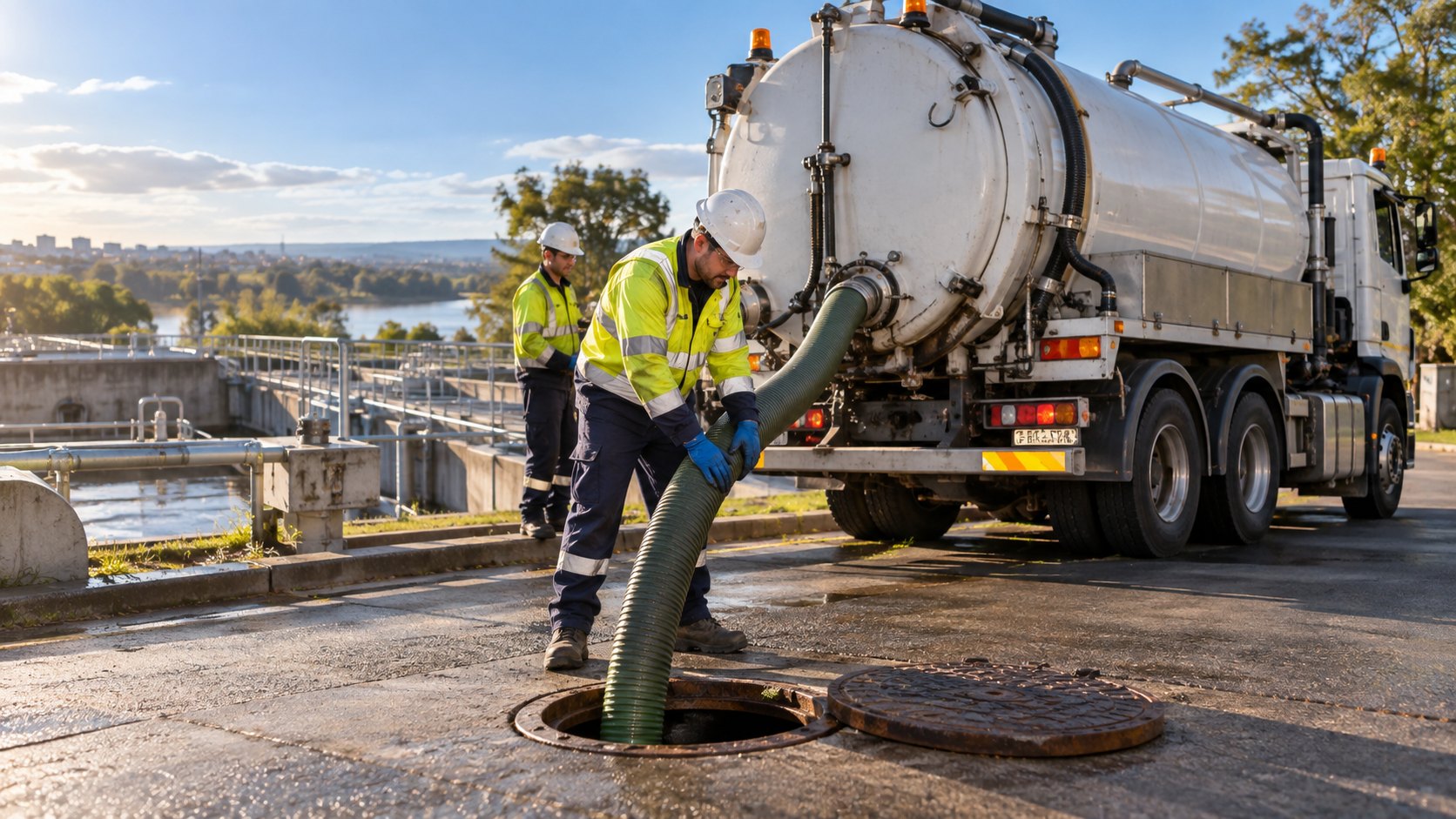
The vehicle that does it is a vacuum tanker: a road tanker carrying a pump that draws liquid waste out of a tank, holds it under vacuum, and releases it at a point somebody else has approved. This activity is the movement of that liquid and nothing beyond it. The operator lifts, carries and discharges; the treatment works at the far end does everything that happens afterwards.
The commercial shape follows straight from the physical one. Money arrives a load at a time. The cost is a driver, a truck, fuel and the minutes spent waiting to discharge. What is left over is decided almost entirely by how many loads one unit turns between the start and the end of a shift — which makes this a route business with a tank bolted to the front of it. Scheduled work for accommodation blocks and facility managers is what makes a day predictable. The emergency call at two in the morning pays better and cannot be planned for, and a fleet that lives on those calls has no idea what next month looks like.
The operators who do well here already own a truck or a customer
Fleet owners adding a liquid stream
Transport companies already running tippers, water bowsers or mixers know the parts of this business that break people: axle loading, driver turnover, tyre and pump maintenance, and the discipline of a daily run sheet. For them the tanker is a new body on a familiar chassis problem.
Facility management and camp operators
Anyone already responsible for accommodation, a labour village or a remote site is buying this service from somebody else, and usually buying it badly, because it is nobody's priority until a tank overflows. Bringing it in-house turns a cost line with no service level into an asset with spare capacity to sell.
Site services contractors
Companies supplying construction sites with water, power, fencing and welfare units are already on the gate list and already trusted by the project manager. Desludging is the one service on that list they almost always sub-contract.
Investors buying a contracted round
The only version of this business worth buying rather than building is one with signed, repeating collection schedules. A fleet with no contracted rounds is a set of trucks; a fleet with rounds is a revenue line, and the price between the two should not be close.
CZ 50 — Transport of sewage Water using Pumping Tankers
What the tanker is permitted to lift
The line is written around domestic and municipal wastewater held in a tank and moved by pump: septic tanks, holding tanks and sumps on premises with no mains sewer connection, plus the wash-down and grey water that collects with it. The service is a lift and a delivery. Nothing in the name implies treating, settling, separating or reusing what comes out of the tank.
Adjacent liquids are where operators guess and get it wrong. Grease from a kitchen interceptor, silt from a car-wash pit, oily water from a workshop and process effluent from a factory all come out of underground chambers behind the same kind of truck, and they are not the same material to the body that has to accept them. Whether a given liquid may travel on this licence is a question for the licensing authority in your emirate before the first job, not after a rejected load.
The discharge point, not the truck, is the constraint
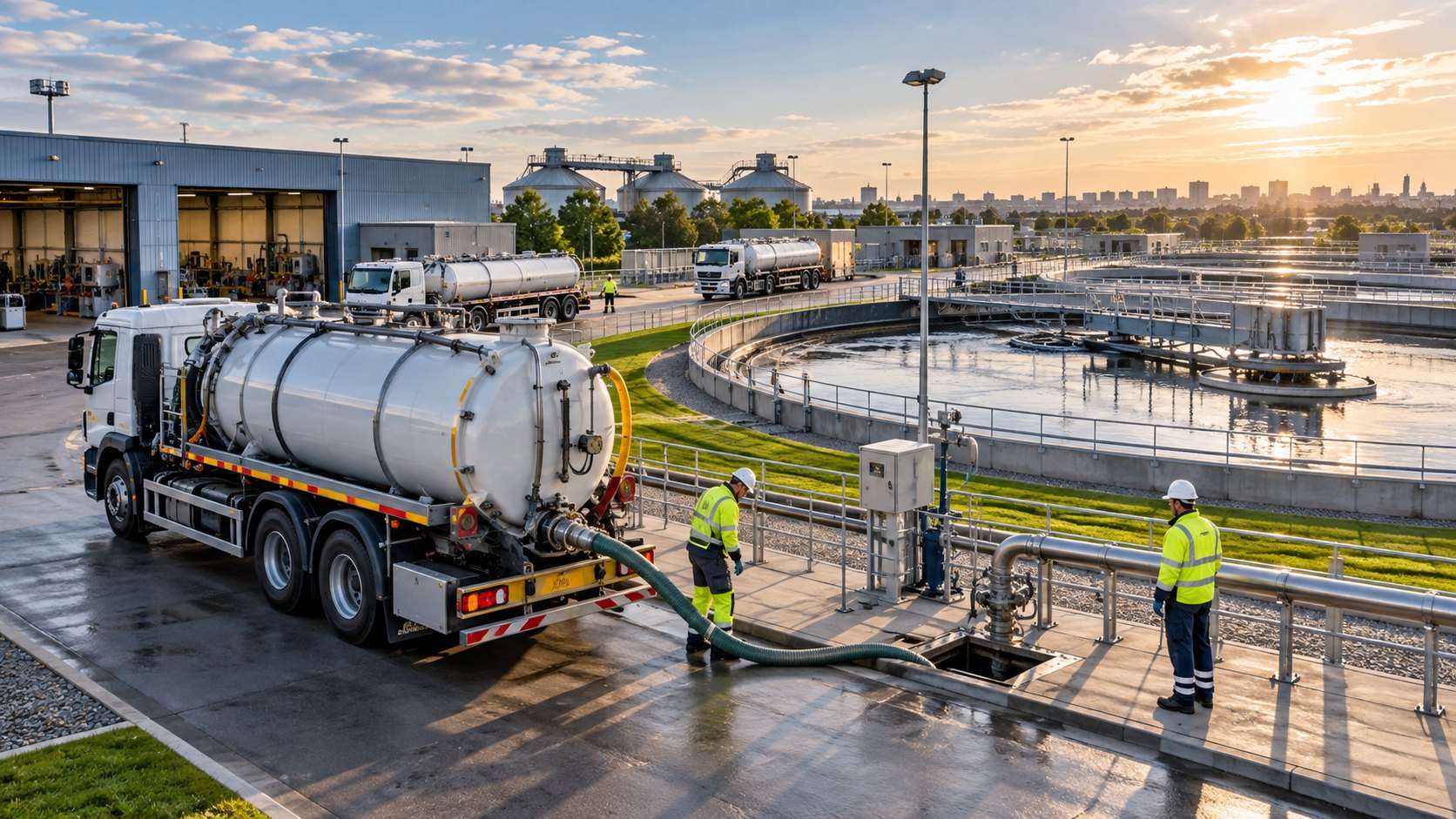
A tanker is easy to buy. Somewhere lawful to empty it is not, and that asymmetry decides whether the business works. Wastewater has to reach a treatment or disposal facility designated to receive it, the receiving works controls what it will take and when it is open, and the operator carrying the load answers for where it ended up. Tipping a load anywhere else is not a paperwork failure; it is the offence the whole permit structure exists to prevent.
Two figures that never appear on a business plan follow from this. The first is the round trip to the nearest approved discharge point, because that distance, not the pump, sets how many loads a truck turns in a day. The second is the queue at that facility at the hour your drivers arrive. A route priced without both of them is priced wrong.
The gates, and who holds them
A trade licence is the first of several permissions and on its own it puts nothing on the road. The vehicle needs its own authorisations, the driver needs the correct class for what is in the tank, the yard the fleet returns to has to be suitable for parking and washing a tanker, and the disposal point has to accept the material. These sit with different bodies, they are not obtained in one application, and in more than one emirate the municipality holds more of them than the licensing department does.
the four gates named on this page
The emirate's economic department
- Trade licence carrying the liquid-waste transport lineFirst, and everything else waits on it
The municipality
- Where a tanker load may lawfully be dischargedBefore the first job — the disposal point is the service
- The yard where the fleet is parked, washed and maintainedWith the tenancy, not after it
The emirate's roads and transport authority
- Permits for the tanker and for the driver operating itWith the vehicle, not after it
The conditions attached to each of those differ by emirate and by authority, and they are confirmed for the specific case rather than assumed from another emirate's wording. That is the part of the file ConsultZone settles before a truck is ordered, because the order of the approvals decides how long capital sits idle.
Where this licence stops
Treatment is somebody else's business
Operating a treatment works, a settling facility or a reuse plant is a processing activity with its own approvals and its own premises. Carrying the influent to one is this activity; running one is not.
Building the network is a construction line
Laying, lining, jetting or repairing sewer pipework and pump stations is civil and mechanical contracting. The overlap is real in practice, because the same customer often wants both, but it is a different licence and a different classification of workforce.
Solid waste belongs to the neighbouring lines
Bins, compactors and municipal refuse rounds sit under garbage collection and transport. Broken concrete, excavated soil and demolition arisings sit under construction and demolition waste. Both move in trucks; neither moves by pump, and that difference is exactly where one licence ends and the next begins.
Hazardous and industrial effluent is a further approval
Chemical, solvent, oily and clinical liquids are handled under hazardous waste controls, with class-specific approvals, trained crews and a named treatment outlet for every consignment. A tanker fleet that drifts into that work on a domestic wastewater licence is the most common and most expensive mistake in this family.
Where this is the wrong purchase. If the plan is to sell, hire out or maintain vacuum tankers rather than to operate them, this is not the line — trading and equipment maintenance are separate activities and cost less to hold. If the plan is to treat wastewater and sell the output, the licence you want is a processing one, and taking this one first buys a permission you will never use.
References
- Dubai Municipality — wastewater and sewerage services, designated disposal facilities, and the suitability of premises used for waste handling. Dubai Municipality
- Roads and Transport Authority — vehicle and commercial transport permits for trucks and tankers operating in Dubai. Roads and Transport Authority
- Environment Agency Abu Dhabi — environmental permits for waste transport and disposal in Abu Dhabi. Environment Agency Abu Dhabi
- UAE Government portal — federal environment and waste policy, and the general framework the emirates license within. UAE Government portal
Elsewhere in Sewerage
Activities that sit beside this one
Most licences carry more than one activity. Adding a neighbouring line at the application stage costs a fraction of amending the licence afterwards.
Begin with a clear conversation
Tell us what you intend to build.
A consultant will map the structure, jurisdiction, approvals and likely cost against what you actually described — not against a package.
