
Activity CZ 53
How to Start a Hazardous Waste Collection and Transport Business in Dubai
Hazardous waste is the most controlled line in this family. What a collection and transport licence permits, what it does not, and why the yard and the disposal outlet decide the business.
ConsultZone licensing desk
- Activity code
- CZ 53
- Category
- Waste collection
- Reviewed
- Read
- 8 min
Listen instead
43 seconds
An audio summary of this guide.
Topic summary
How to Start a Hazardous Waste Collection and Transport Business in Dubai
The thing a hazardous waste contractor actually sells is a documented chain of custody. A factory with forty drums of spent solvent in a corner of its yard is not buying a lorry journey; it is buying the certainty that those drums were correctly classified, correctly packaged, carried by a permitted vehicle and a trained crew, and received and destroyed at a facility that will confirm in writing that they no longer exist. The transport is the visible part. The paperwork is the product.
That is why Hazardous Waste Collection & Transport behaves so differently from the other lines it sits beside in the catalogue. A refuse round or a skip exchange is judged on turning up. This is judged on what happens after the truck leaves, because the material remains traceable to the company that generated it and to the company that moved it. Liability does not transfer with the tailgate.
Two consequences follow, and they are the reason operators either do well here or should not enter. Margins are better than in general waste haulage, because the work is technical, the barriers are real and the number of companies able to do it properly in any emirate is small. And the downside is not a lost contract but an environmental incident with a named carrier attached to it. The trade rewards the careful and punishes the improvised more severely than anything else in waste.
Who this suits, and it is rarely a first fleet
The customers are industrial and commercial rather than municipal, which changes the whole sales motion. Vehicle workshops with waste oil, filters, coolant and batteries. Printing, paint and coating operations with solvents and sludges. Oil and gas service yards with contaminated rags, tank residues and drilling by-products. Laboratories, electronics assembly and metal finishing lines. Hospital and clinic estates, whose clinical stream is controlled separately again through the health authority. Construction sites with asbestos sheeting or hydrocarbon-affected ground. Every one of them has a compliance officer rather than a procurement clerk, and every one of them asks for evidence before they ask for a rate.
Industrial services contractors
Companies already doing tank cleaning, plant shutdowns, degreasing or industrial cleaning are inside the gate, hold the safety accreditations the customer's HSE team wants to see, and are already removing material they currently hand to a third party. This is the most natural entry into the line and the one with the shortest path to first revenue.
Tanker and haulage operators with a compliance record
A fleet that already moves liquid or bulk waste understands driver management, vehicle condition and the discipline of a designated discharge point. What it has to add is classification knowledge, crew training, segregated storage and a documentation system that will survive an inspection.
Environmental and HSE consultancies
Advisers who already write waste management plans know which classes their clients produce and how badly the incumbent performs. Their difficulty is the opposite of the haulier's: they can win the work before they can carry it, so the fleet and the yard have to exist first.
Operators who hold, or can secure, the disposal end
The scarcest asset in this trade is not a truck. It is a confirmed treatment or disposal outlet for every class a company intends to collect. Anyone with an existing relationship at that end of the chain is starting from the part everybody else discovers last.
What you can and cannot do under this line
What the licence permits
Collection and transport means going to a generator, taking custody of correctly identified waste, loading it in a way that keeps incompatible materials apart, carrying it on a permitted vehicle with a trained crew, and delivering it to a facility authorised to receive that class. It includes the documentation that travels with the load and the confirmation that comes back from the receiving site, and it includes the containers, drums and liners placed with the customer so the material is presented safely in the first place.
Approvals arrive in an order, and the order is the whole reason a hazardous waste file takes longer to assemble than a haulage one. The trade licence creates the company and permits nothing operational. The environmental approval decides which classes may be touched at all. The disposal outlet has to be named before a collection is promised. The yard has to be approved for what will be held in it between collections. The vehicles and the drivers are permitted separately from the company.
- Trade licence carrying the hazardous waste lineCreates the company, and nothing operational yet
- Environmental approval for the waste classes to be handledDecides which wastes may be touched at all
- A named treatment or disposal outlet for every class carriedCloses the chain the carrier answers for
- Yard and storage approval for what is held between collectionsFixes what may be kept on site and how it is contained
- Vehicle and driver permits for every unit on the roadPuts a compliant vehicle on a permitted route
Which classes, conditions and outlets apply is set by the environmental authority in the emirate concerned, and the answer for Dubai is not the answer for Abu Dhabi or Sharjah. Those are established for the specific waste list, yard and fleet before anything is quoted — the part of this file ConsultZone does first, because a signed contract for a class the company may not carry is worse than no contract.
What it does not permit
Treating the waste is a different activity. Incinerating, neutralising, stabilising, blending, recovering solvent or reclaiming oil are processing operations with their own site, their own approvals and their own emissions conditions. Carrying material to a plant that does those things is this line; doing them is not.
Storing it is permitted only within the terms the yard approval sets, and that approval is specific about which classes, in what quantities and for how long. A transport company that begins to accumulate drums because the disposal outlet is slow has quietly become an unpermitted storage facility.
Mixing classes is not a loading convenience. Incompatible materials kept apart on the shelf and combined in a load is the single most dangerous thing a crew can do, and blending to dilute a difficult waste into an easier one is a straightforward offence rather than a grey area.
Carrying a class the approval does not name is the same failure in a quieter form. A customer who asks for one extra drum of something unfamiliar is asking the driver to make a classification decision, and the driver is not the person who makes it.
Sending waste out of the country is not a transport decision at all. Cross-border movement of hazardous material sits under its own authorisation and is confirmed with the environmental authority before it is offered to a client.
Premises and practical conditions
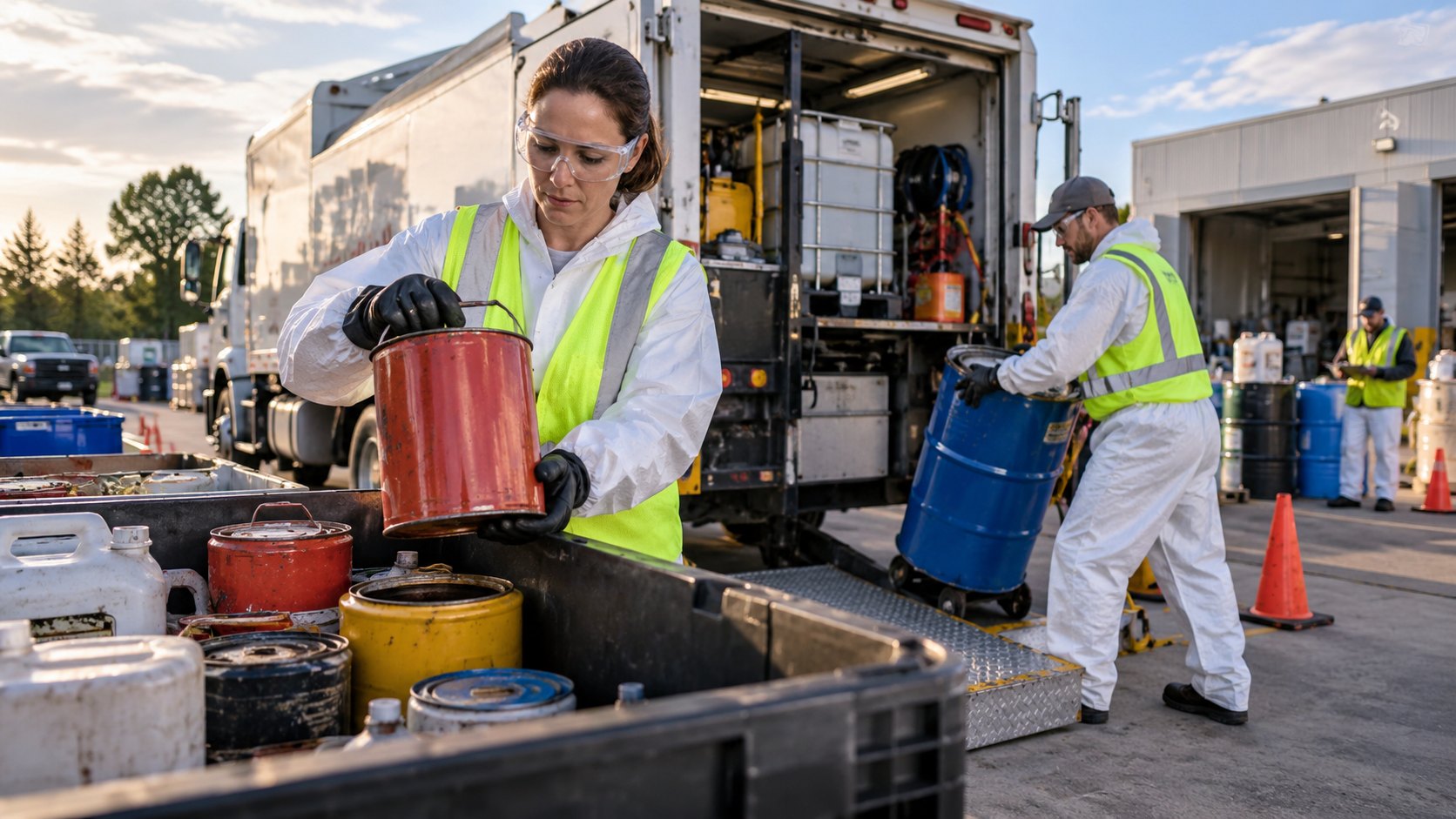
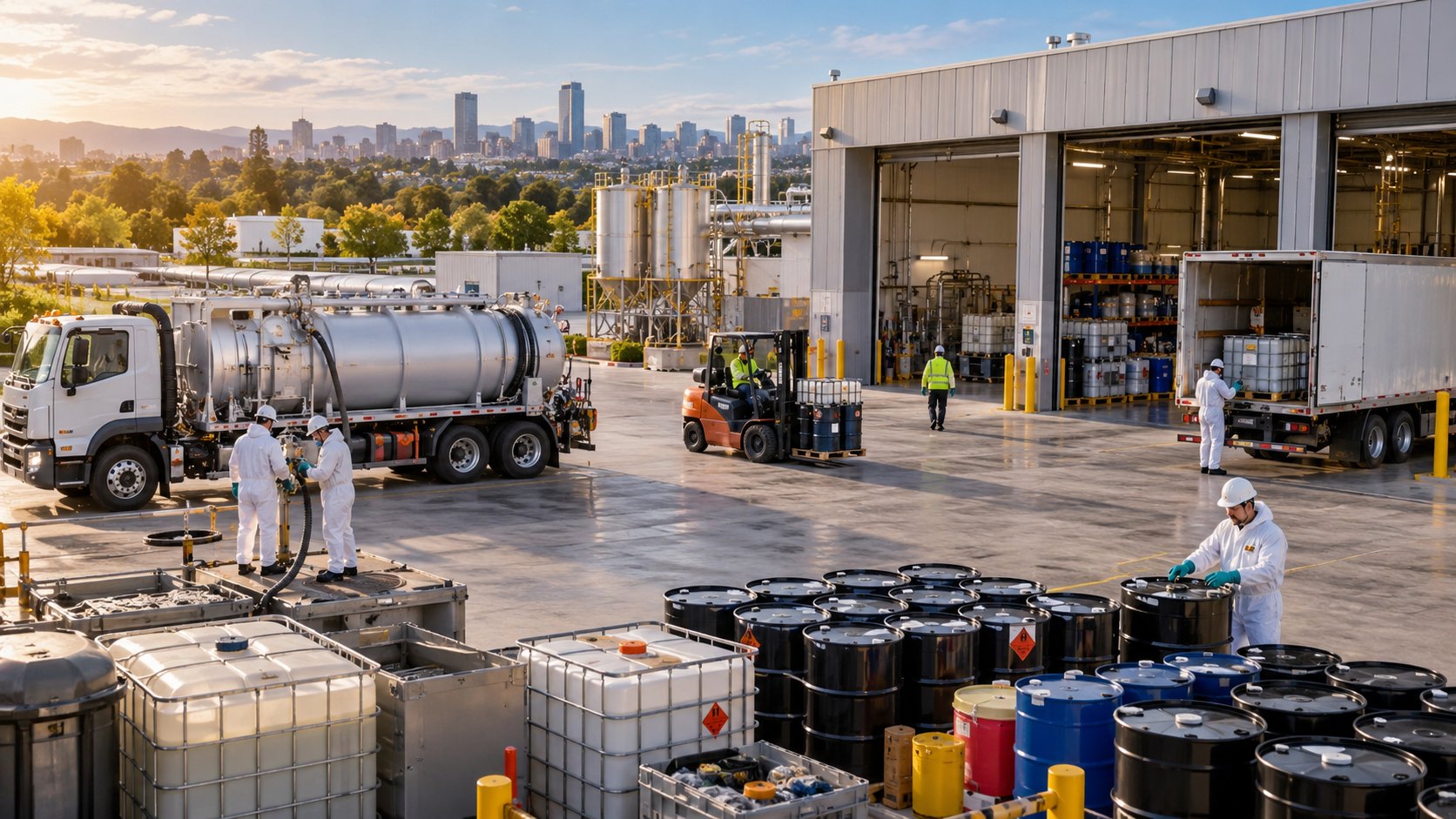
The yard is the part of this business that people underestimate, and it is usually what delays the first collection. Hazardous waste held between pickups needs a hard, impermeable surface with containment around it, so that a split drum reaches a bund rather than a storm drain. Classes have to be kept in separate areas, labelled, and arranged so that incompatible materials cannot meet in a spill. Flammables bring fire safety requirements and the interest of civil defence. Anything with vapour needs the storage to be ventilated. The site needs security, because a drum removed by somebody else remains the carrier's responsibility, and it needs a spill response capability on site rather than in a procurement plan.
Vehicles are specified rather than chosen. A unit used for this work is fitted for containment, marked for what it carries, and not shared with food, general freight or potable water loads — which means the fleet is dedicated and cannot be flexed onto other work in a slow month. That fixed cost is one reason operators enter this line with revenue already coming from elsewhere.
Crews are the other specified input. Loading, segregation, documentation and spill response are competencies held by named people and evidenced by training records a customer's HSE auditor will ask to see. Turnover is expensive here in a way it is not on a refuse round, because a replacement driver is not productive until the training exists.
The documentation system is infrastructure rather than admin. A consignment record per load, the receiving facility's confirmation and a retained history that can be produced years later are what allow a generator to prove its own compliance, and operators who treat that as filing lose contracts to operators who treat it as the service. Environmental liability cover is not something a licence hands out, but industrial customers commonly require it before a vehicle is allowed through the gate.
References
- Environment Agency Abu Dhabi — environmental permits for the handling, transport, treatment and disposal of hazardous waste in Abu Dhabi. Environment Agency Abu Dhabi
- Dubai Municipality — waste control, designated treatment and disposal facilities, and conditions on premises used to hold waste in Dubai. Dubai Municipality
- Dubai Civil Defence — fire safety and approvals for the storage of hazardous and flammable materials. Dubai Civil Defence
- Roads and Transport Authority — vehicle and commercial transport permits for the units used on this work in Dubai. Roads and Transport Authority
- Dubai Health Authority — health facilities and the separately controlled clinical waste stream. Dubai Health Authority
Elsewhere in Waste collection
Activities that sit beside this one
Most licences carry more than one activity. Adding a neighbouring line at the application stage costs a fraction of amending the licence afterwards.
Begin with a clear conversation
Tell us what you intend to build.
A consultant will map the structure, jurisdiction, approvals and likely cost against what you actually described — not against a package.
