
Activity CZ 54
How to Start an Electrical and Plumbing Installation Business in Dubai
Electrical and plumbing installation is a manpower business wearing a trade licence. What the activity covers, who actually holds each gate, and where the line stops.
ConsultZone licensing desk
- Activity code
- CZ 54
- Category
- Maintenance
- Reviewed
- Read
- 6 min
Listen instead
44 seconds
An audio summary of this guide.
Topic summary
How to Start an Electrical and Plumbing Installation Business in Dubai
Almost every licence line in the catalogue is a business that owns something — stock, a press, a workshop, a tanker. This one owns people. Electrical, plumbing and other installation activities is a contracting line, and the asset on the balance sheet that decides whether it makes money is a crew of qualified tradesmen who can be put on site tomorrow morning.
That single fact drives everything else about it. A trading company can sit in a serviced office and sell from a laptop. An installation company needs a labour file, accommodation for the crew, transport to get them to site, tools, and enough working capital to pay wages for the sixty to ninety days it usually takes a main contractor to settle an invoice. The licence is the cheapest part of the exercise.
The work is won from three kinds of buyer, and they pay differently
New-build fit-out comes through main contractors, in packages, against a programme somebody else controls. Retrofit and maintenance comes through facility management companies and building owners, in smaller tickets, and repeats. Direct residential and small commercial work comes from the end client, pays fastest and is the hardest to scale.
Most young companies in this line start at the third and try to reach the first. The middle one is where the steady money usually sits, because a facilities contract is recurring revenue on a building somebody else has to keep running.
Who is this for?
Trade contractors already operating elsewhere
An electrical or mechanical contractor with a crew and a track record in another market, coming to the UAE for the volume of construction and refurbishment. The adjustment is rarely technical. It is the labour file, the accommodation standard, and the discovery that the payment cycle is longer than the one they left.
Facility management operators widening their scope
A company already holding cleaning or maintenance contracts that keeps subcontracting the electrical and plumbing work and wants the margin back. For them this is an activity added to an existing licence rather than a new company, and the question is whether the in-house crew can be kept busy between call-outs.
Engineers and foremen going out on their own
The most common founder in this line: someone who has run other people's sites for a decade, knows the buyers personally and is tired of being the one who solves the problem without the one who prices it. The plan usually works. The thing that breaks it is working capital, not skill.
CZ 54 — Electrical, plumbing and other installation activities
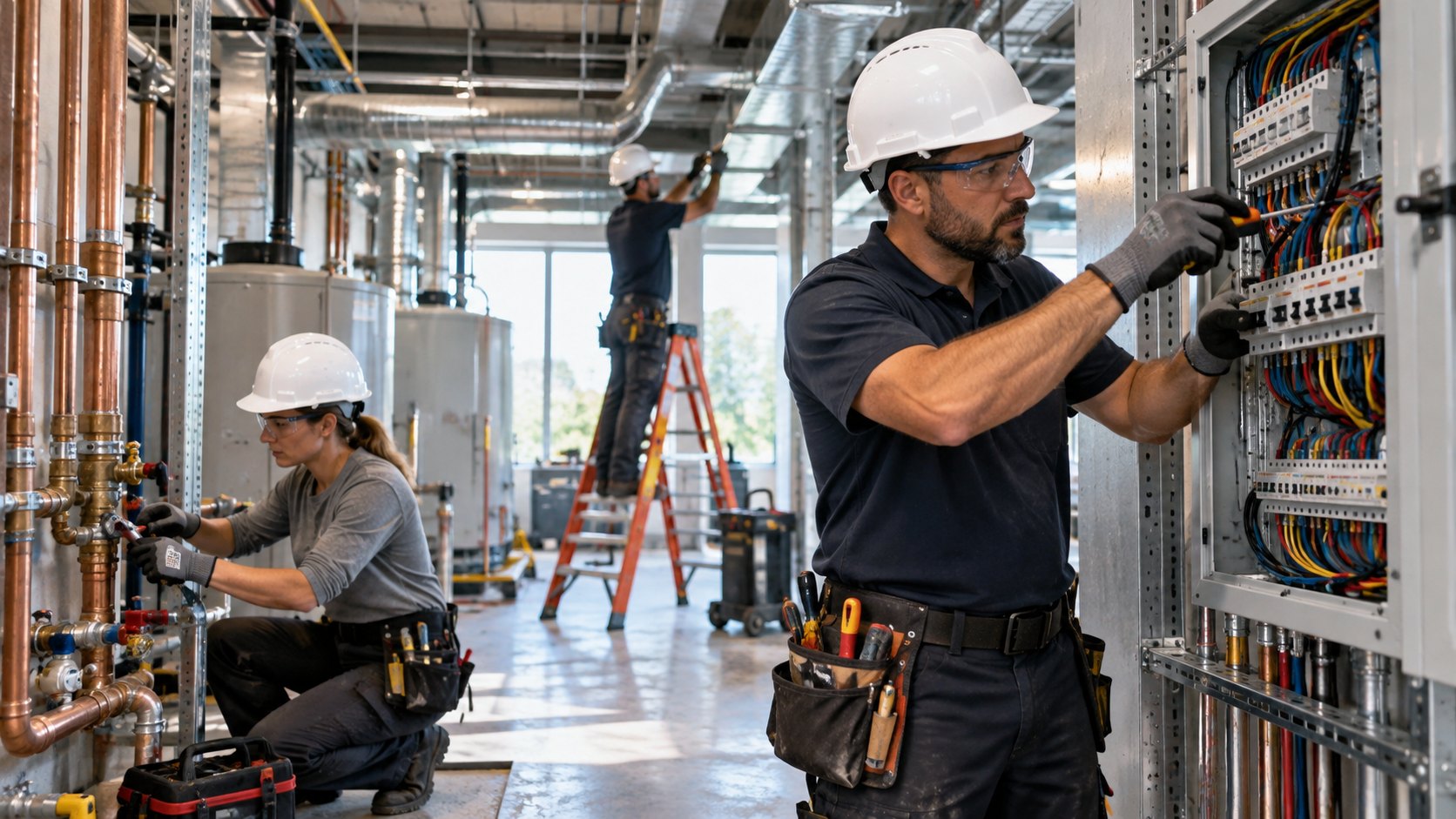
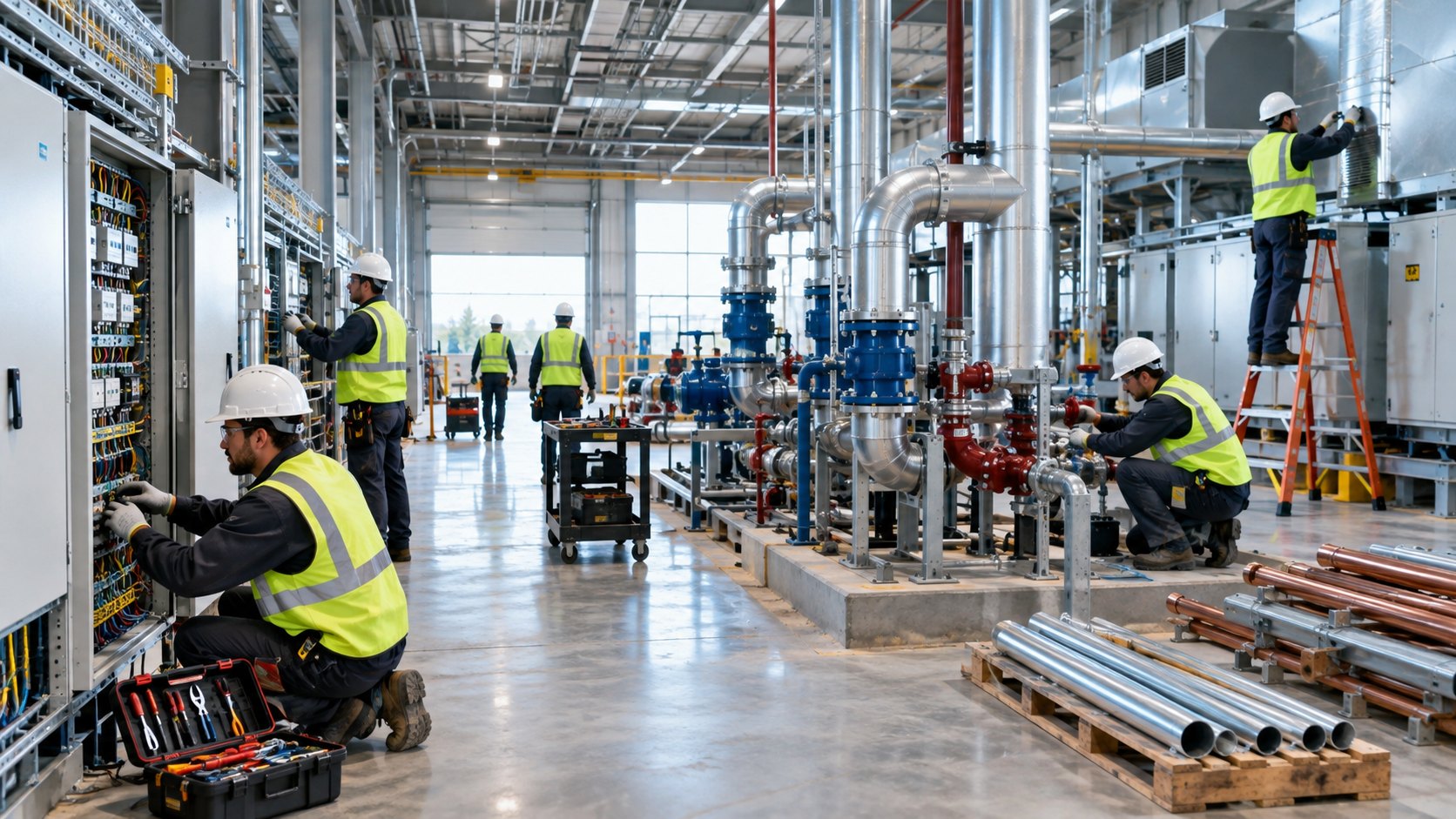
Under this line you install the systems that make a building work rather than the structure that holds it up. In practice that is three families of work, and the "other installation activities" in the name is doing real work in that sentence.
Electrical installation
Wiring, distribution boards, containment, lighting, small power, earthing and bonding, and the terminations that let a building be energised. This is the part of the line where competence is not a matter of opinion: the utility will not connect a supply it is not satisfied with, and the work has to be signed off by somebody qualified to sign it off. A company that cannot produce that person cannot sell the work, whatever its licence says.
Plumbing, drainage and mechanical
Water supply, waste and soil drainage, sanitary fittings, pumps, and the pressure testing that proves the installation holds. Air conditioning installation frequently sits alongside it, because in this climate the mechanical package is the biggest one in the building and the same crews are often competent across both.
Everything the name calls "other"
Fire detection and suppression pipework, gas installation, lifts and hoists, insulation, and the low-voltage systems that get bundled into a services package. Some of these carry their own approvals and some of them sit in other licence lines entirely. This is where reading the licence carefully stops being pedantry.
the five gates named on this page
The emirate's economic department
- Trade licence with the installation activityFirst, and every other gate waits behind it
The municipality
- Building and fit-out permission for the sitePer project, applied for by the party that owns the works
The utility
- Energising the electrical supplyAfter the installation is inspected, and it is the gate that stops a finished job being a paid job
Civil defence
- Approval of the fire and life-safety systemsBefore a building can be occupied
The federal labour ministry
- The labour file and work permits for the crewBefore anyone legally lifts a tool
Read that drawing for the shape rather than the rows. Only the first gate belongs to the authority that issued your licence. Every other one belongs to somebody else, is applied for per project rather than once, and is usually held by a party who is not you — which is why a contractor's programme slips for reasons a contractor cannot fix.
What the licence does not cover
This is the section most worth reading twice, because the boundary of this activity is unusually easy to cross by accident.
It is not a design licence. Designing the electrical or mechanical installation — load calculations, drawings stamped by a consultant — is an engineering consultancy activity with its own requirements. Installing to somebody else's design is this line. Companies drift across that boundary the first time a client asks them to "just sort out the drawings".
It is not a building contracting licence. Structure, blockwork, concrete and the fabric of the building belong to construction activities. A services contractor who agrees to take on the builder's work has agreed to something the licence does not permit.
It is not a trading licence. You may install materials and equipment. Selling them as goods — holding stock and supplying it to other contractors — is a trading activity, and the tax and customs treatment of a company that imports and resells is not the treatment of one that installs.
It is not a maintenance contract in itself. Where the ongoing servicing of installed systems is the actual business, there are activities written for that, and a facilities operator usually holds them alongside this one rather than instead of it.
What all of that means commercially is straightforward: the activity you hold should match the invoice you intend to raise. Amending a licence after a client has already been promised something is slower and more expensive than choosing correctly at the start, and it is the single most common reason a file comes back to us.
What it costs to hold
There is no single answer, and anyone who gives you one is guessing. The licence fee, the premises requirement, the size of the labour quota and the approvals a specific scope attracts all depend on the emirate, on whether the company sits on the mainland or in a free zone, and on the exact activity mix you ask for. A crew of six working on villas and a company bidding tower fit-out packages hold the same words on a licence and nothing else in common. We confirm the real figures for the specific case before anything is filed.
References
- Ministry of Human Resources and Emiratisation — labour contracts, work permits and the wage protection requirements that govern a crew-based business. Ministry of Human Resources and Emiratisation
- Dubai Municipality — building and fit-out permission, inspection and the occupancy requirements that installation work is tested against in Dubai. Dubai Municipality
- Dubai Civil Defence — fire detection, suppression and life-safety approval for installed systems. Dubai Civil Defence
- UAE Government portal — federal law and the general framework for commercial licensing. UAE Government portal
Elsewhere in Maintenance
Activities that sit beside this one
Most licences carry more than one activity. Adding a neighbouring line at the application stage costs a fraction of amending the licence afterwards.
Begin with a clear conversation
Tell us what you intend to build.
A consultant will map the structure, jurisdiction, approvals and likely cost against what you actually described — not against a package.
