
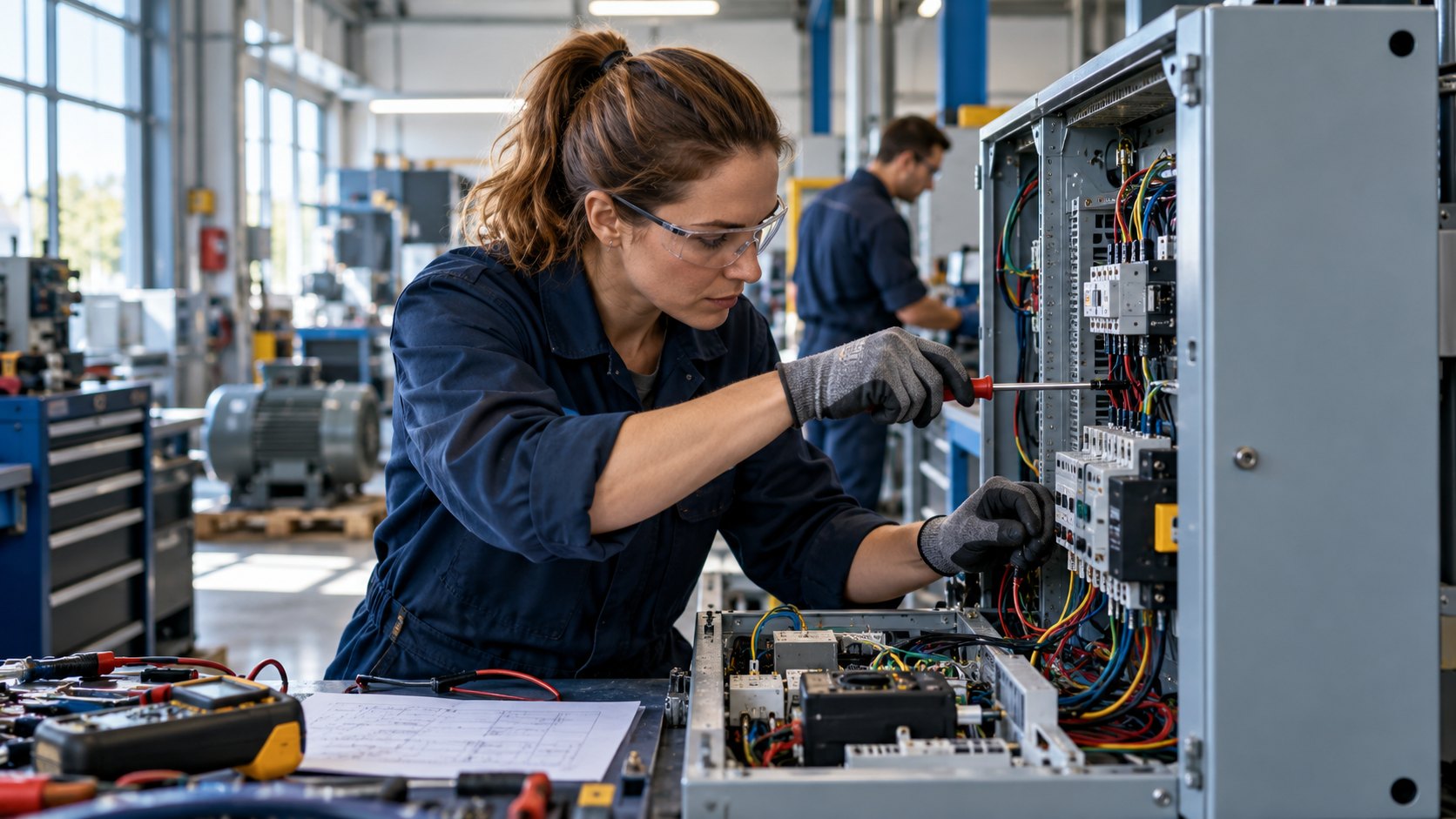
Activity CZ 27
How to Start an Electrical Equipment Repair Business in Dubai
Repair of electrical equipment is catalogued with manufacturing rather than with services, and that placement is why the line arrives with a workshop attached. Where it starts and where it stops.
ConsultZone licensing desk
- Activity code
- CZ 27
- Category
- Manufacturing
- Reviewed
- Read
- 8 min
Listen instead
56 seconds
An audio summary of this guide.
Topic summary
How to Start an Electrical Equipment Repair Business in Dubai
Almost everybody who asks about this line expects to be buying a services licence. The activity catalogue says otherwise. Repair of electrical equipment sits in the manufacturing group, alongside fabrication and assembly rather than beside consultancy and contracting — and that placement is not a clerical detail. It is the reason the line arrives with a workshop attached to it.
The consequence is immediate. A service company runs from a desk and a phone. A repair company needs a unit that can hold a bench, a three-phase supply it is allowed to draw, test equipment, and floor space for two things nobody budgets for: units waiting to be looked at, and units waiting to be collected. Premises come before pricing here, and the people who get into difficulty are the ones who took a cheap office and then discovered they had nowhere lawful to put a 30-kilogram control panel.
The economics are unusual too. You are not selling hours; you are selling against the alternative, which is replacement — and replacement carries a purchase price, a lead time and a capital approval. That sets the ceiling: a repair is worth what the customer saves by not buying new and not standing idle while the new one ships. On a commodity item the arithmetic defeats you, because a new one is cheap and arrives next day. On a drive discontinued eight years ago, the same repair is close to priceless. Which end of that spectrum you work at is the largest commercial decision in the business, and it is made when you buy your test equipment, not when you quote.
The customers come before the workshop, not after it
This line rewards people who arrive with demand already in hand, because the work is trust-led and almost never won on advertising. Three kinds of founder start it successfully.
The technician who is already getting the calls
Someone employed in maintenance, panel building or field service who is quietly being asked to fix things privately. They have the competence and, more importantly, the reputation. What they usually lack is the premises and a clear view of what the fixed costs really are.
The contractor who is currently paying somebody else
Facilities, maintenance and electrical contracting groups that send a steady volume of boards, panels and equipment out to third-party shops. For them the question is not whether there is a market but whether their own internal volume covers the bench before any external work arrives.
The distributor who needs a bench behind the product
Equipment suppliers whose warranty and after-sales obligations are being handled badly or expensively by someone else. Their repair operation exists to protect a sales business, which makes it a different company from the two above — its measure of success is customers retained, not margin per job.
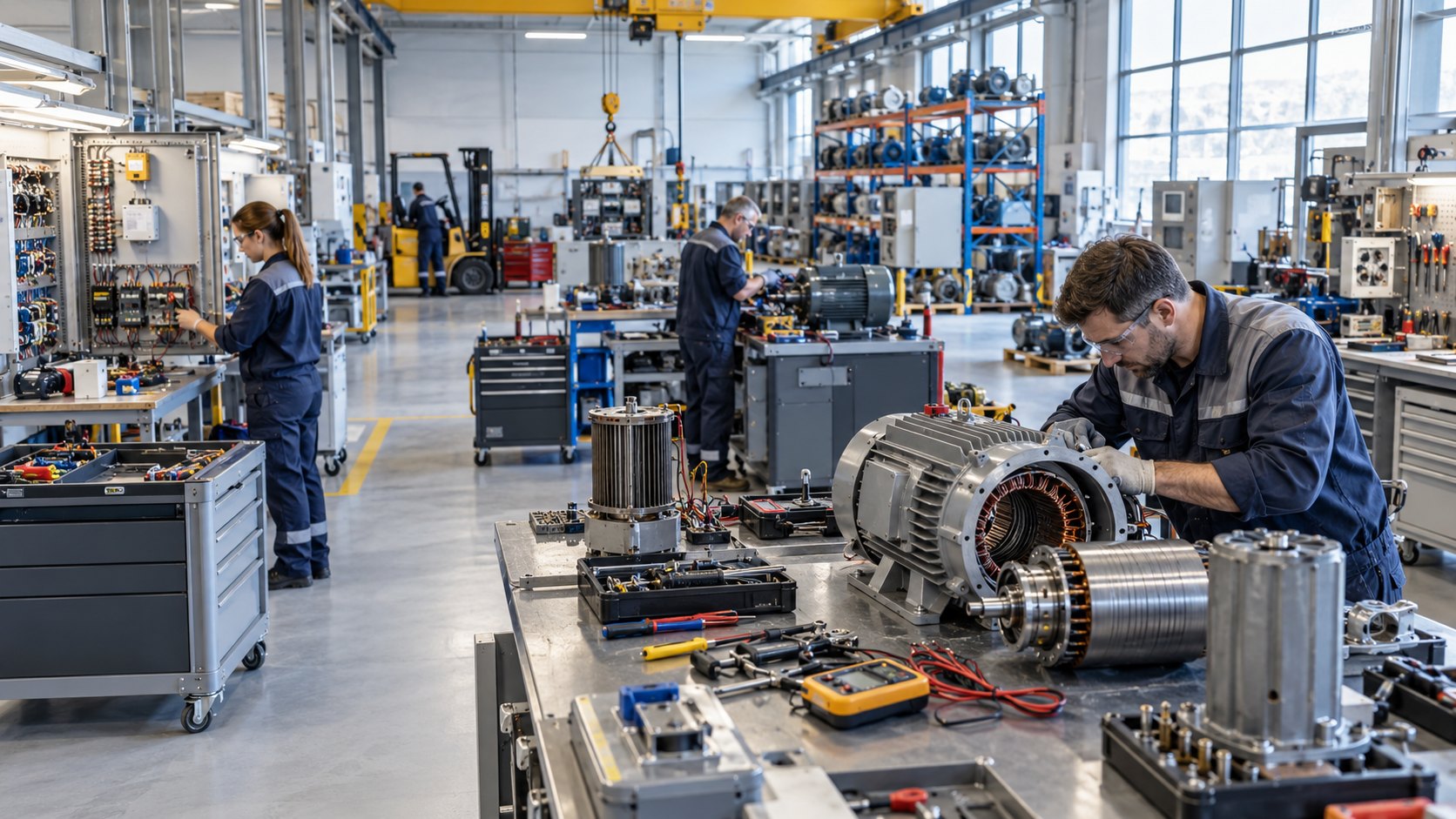
CZ 27 — Repair Of Electrical Equipment
Under this line you diagnose, dismantle, repair, rebuild and test electrical equipment that somebody else owns and intends to keep using. In practice the work falls into four families, and no single shop is genuinely strong at all four.
Switchgear, boards and distribution equipment
Low-voltage panels, distribution boards, breakers, contactors and protection devices. The work is inspection, thermal survey, contact and busbar repair, and the replacement of protective components with parts that match the original specification. It is the closest thing this line has to recurring revenue, because the inspection is periodic and the customer is a building rather than a machine.
Control panels, drives and starters
Variable-speed drives, soft starters and control gear. Diagnosis is the whole skill here — down to the board and the component, not the module — and the most profitable niche in the entire line is the drive the manufacturer no longer supports. A shop that can keep a discontinued drive running has a customer with no alternative.
Industrial and commercial equipment
The electrical side of kitchen and laundry plant, cooling and ventilation equipment, workshop machinery and materials-handling controls. Usually reached through the facilities contractor rather than the end user.
Small and portable equipment
Power tools, portable appliances and bench-level items. Low value per job, high volume, and the only part of the line where a counter that people can walk into actually earns its rent.
The breadth is the difficulty, and it separates a profitable shop from a merely busy one. A business that accepts everything subcontracts the work it cannot do, at somebody else's margin and on somebody else's timescale, while still carrying the customer's complaint. Two families are specialised enough that the catalogue gives them lines of their own — power and distribution transformers, and rotating machines such as motors, generators and generating sets — and the boundary between the three is drawn less by the equipment than by where the asset sits, what it is worth and what it takes to test it.
| Electrical equipment | Transformers | Motors and generators | |
|---|---|---|---|
| Who owns the asset | Buildings and facilities teams | Utilities and industrial plants | Plant, marine and oilfield operators |
| Where the work happens | Mostly on your own bench | Mostly on the customer's site | Either, depending on the frame |
| What the real barrier is | Breadth of competence | Oil handling and test capability | Winding and balancing plant |
| What one failure costs | A circuit or a room | A substation or a feeder | A production line or a vessel |
| Whether hiring the asset out is a market | Not really | Rarely | Yes, standby sets |
What this licence does not put on the bench
Four exclusions catch people out, and all four are about the equipment's destination rather than its voltage.
Anything that goes back onto an aircraft is outside this line entirely. Aviation components are maintained under approvals issued by the General Civil Aviation Authority, and an aircraft part repaired in a general electrical workshop cannot lawfully be returned to service.¹ Medical equipment is the same shape of problem: medical devices sit with the health authorities, federally with the Ministry of Health and Prevention and in Dubai alongside the Dubai Health Authority, so repairing them is a health-controlled activity rather than an electrical one.²
Equipment that transmits radio signals raises a third question. Radio and telecommunications equipment placed on the UAE market is subject to type approval by the Telecommunications and Digital Government Regulatory Authority, and where a repair touches the transmitting part of a device rather than its power supply or its casing, whether that approval still holds is a question to settle before the work is offered commercially, not after.³
The fourth is the one that causes real trouble. Installing new equipment, running cable and altering a building's electrical system is electrical contracting. That is a separate classification with its own conditions, and it is generally the point at which qualified engineering staff and a contractor grading enter the picture. Repairing the panel is inside this line; wiring the panel into a new building is not. Manufacturing the equipment in the first place is a third thing again, even though it shares the same manufacturing group in the catalogue.
On-site work is what points at the mainland
The jurisdiction question answers itself once you know where the screwdriver is. A workshop that takes equipment in, repairs it and sends it out — particularly if a good share of it leaves the country again — can sit comfortably in a free zone industrial unit. A business whose technicians spend their week inside other people's buildings across Dubai and the northern emirates is serving the UAE domestic market on UAE soil, and that is what a mainland licence is for. Most shops do both, which is why the split between bench and site revenue is worth estimating before the licence is chosen rather than after.
The approvals, conditions and costs differ between the emirates and between the licensing authorities inside them, and the workshop's own conditions — supply, ventilation, waste and fire safety — are set locally against the premises you actually take. ConsultZone confirms those for the particular case rather than quoting a figure that will not survive contact with your site. On the federal side, the Ministry of Industry and Advanced Technology is the body behind industrial licensing, national standards and conformity marking.⁴
Where this is the wrong purchase. If the plan is to buy electrical equipment and resell it, with repair offered as an accommodation to customers, this is the wrong line. A trading activity costs less to hold and will not commit you to premises you do not need. The test is short: if the workshop would still exist with no sales, this is your activity. If it exists only to support the sales, it is not.
Corporate tax treats this business as it treats any other UAE business — nine per cent on taxable income above AED 375,000, nothing on the first AED 375,000, with a zero rate available to a qualifying free zone person on qualifying income where the substance conditions are met.⁵ That matters more here than on most lines, because a repair company's substance is unusually visible: the bench, the test equipment and the technicians are all in one place, and it is either the place named on the licence or it is not.
References
- General Civil Aviation Authority — maintenance approvals for aircraft and aircraft components. General Civil Aviation Authority
- Ministry of Health and Prevention — medical devices and health products; the Dubai Health Authority for health facilities and health-product trade in Dubai. Ministry of Health and Prevention
- Telecommunications and Digital Government Regulatory Authority — type approval for telecommunications and radio equipment. Telecommunications and Digital Government Regulatory Authority
- Ministry of Industry and Advanced Technology — industrial licensing, national standards and conformity marks. Ministry of Industry and Advanced Technology
- Federal Decree-Law No. 47 of 2022 on the Taxation of Corporations and Businesses. Ministry of Finance
Elsewhere in Manufacturing
Activities that sit beside this one
Most licences carry more than one activity. Adding a neighbouring line at the application stage costs a fraction of amending the licence afterwards.
Begin with a clear conversation
Tell us what you intend to build.
A consultant will map the structure, jurisdiction, approvals and likely cost against what you actually described — not against a package.
