
Activity CZ 29
How to Start an Electric Motor and Generator Repair Business in Dubai
Two businesses share this licence and only one of them is repair. Rewinding motors and generators is the trade; owning standby sets and hiring them out is the market the neighbouring repair lines do not have.
ConsultZone licensing desk
- Activity code
- CZ 29
- Category
- Manufacturing
- Reviewed
- Read
- 7 min
Listen instead
43 seconds
An audio summary of this guide.
Topic summary
How to Start an Electric Motor and Generator Repair Business in Dubai
Two businesses share this activity, and only one of them is a repair business. The first is the rewind shop: motors and alternators come in on a pallet, are stripped, rewound, balanced, tested and sent back. The second is standby power — generating sets that somebody has to service, and that somebody can also own and hire out. No other electrical repair line in the catalogue has a rental market sitting on top of it, and that is the fact worth building the plan around.
The reason is the machine. A transformer sits still and a distribution board sits still; a motor spins, and spinning things wear in predictable ways. Bearings fail, shafts bend, insulation cooks, alignment drifts. Predictable wear means recurring work, and recurring work on identical machines means a shop can get genuinely fast at one frame size and make money that a general repairer cannot. It also means the same machine you repaired for a customer last year is a machine you understand well enough to own.
CZ 29 — Motor, generator and gen-set repair
The work is mechanical and electrical in the same job, which is the first thing to understand about staffing it.
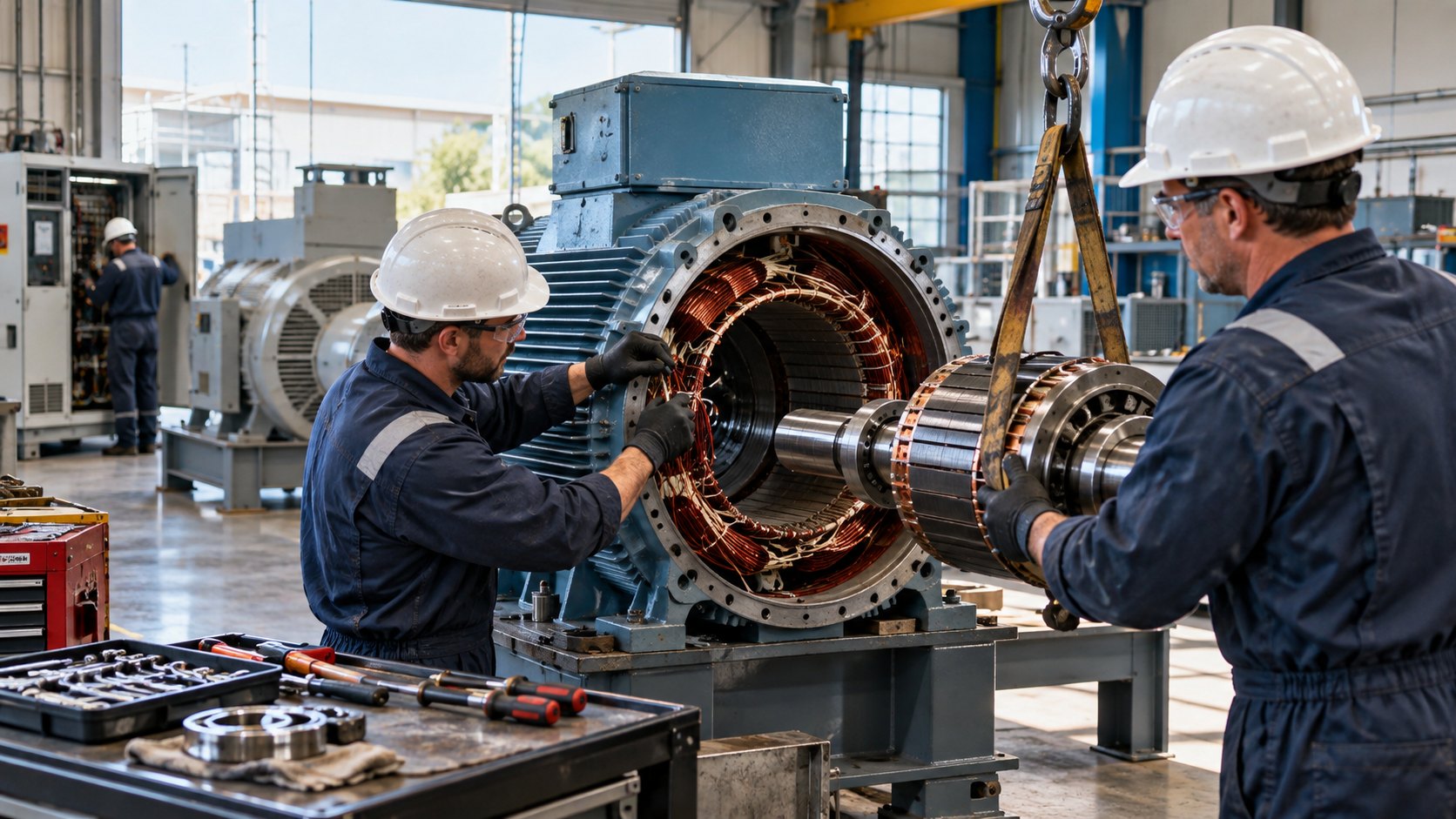
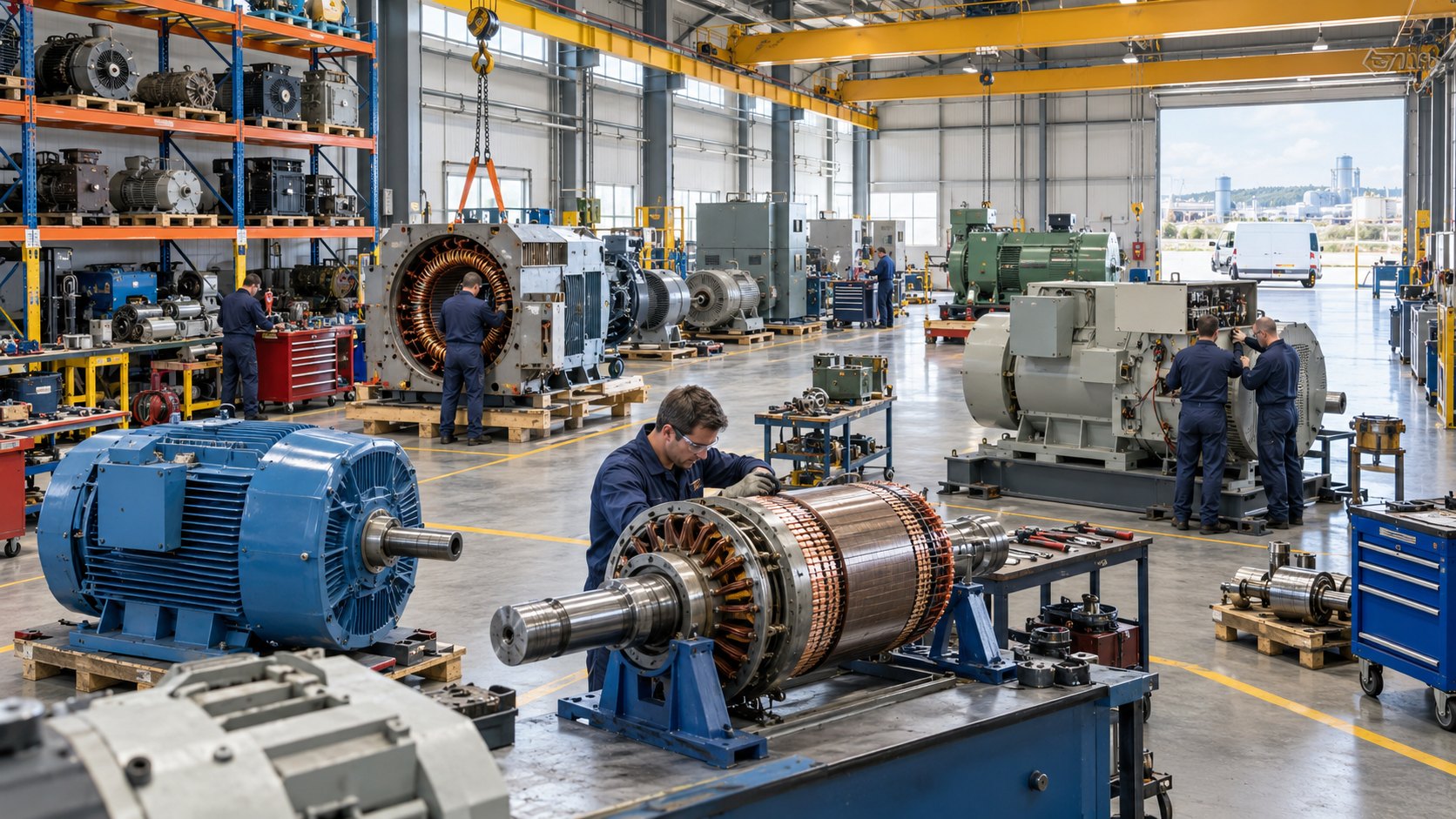
On motors, the core skills are winding and rotating-machine work: stripping and rewinding stators, replacing bearings, machining or replacing shafts, repairing housings and end frames, dynamic balancing, laser alignment, and the test bay at the end of it — insulation resistance, surge comparison, core loss, no-load run. A shop is judged on whether the machine comes back quiet and stays running, and both of those are decided by the bench and the balancing machine rather than by the winder alone.
Generators and alternators add excitation and control. An alternator is a motor run backwards in commercial terms, but its automatic voltage regulation, excitation system and protection are electronics rather than windings, and a shop that can rewind but cannot diagnose an excitation fault will send half its generator work away.
A generating set is two trades in one box
This is where the line differs most sharply from its neighbours, and where new entrants most often misjudge the business. A gen-set is a diesel engine, an alternator and a control panel bolted to a common base. Servicing it properly means engine work — fuel, cooling, exhaust, filters, governors — as well as electrical work on the alternator and the controls, and then load testing the whole assembly to prove it will carry what it is supposed to carry when the mains fails. Most shops are strong on one half and buy in the other. The ones that are strong on both are the ones facilities managers keep.
The commercial shapes available on this one licence are worth setting out side by side, because they demand very different money and very different temperaments. You can earn on the bench, in the field, by owning machines, or by supplying other repairers.
What it givesWhat it costs
- Rewinding and overhaul on your own benchMargin on skill, and control of your own scheduleWinding gear, oven, lathe and balancing plant before the first invoice
- Site service and breakdown call-outAccess to plants you would never win on priceVehicles, standby crews and hours nobody can plan
- Owning standby sets and hiring them outIncome between breakdowns, and the same machines to serviceCapital parked in iron that is idle most of the year
- Supplying windings and parts to other shopsTurnover without the labour riskA competitor's order book instead of your own
Most established businesses on this line end up doing two or three of the four. The mistake is starting with the third — buying sets to hire before the service capability exists — because a hire fleet with no workshop behind it is a finance business dressed as an engineering one.
Adjacent lines people confuse with it
Six neighbouring activities sit close enough to cause classification arguments, and it is cheaper to settle them before the licence is issued than to amend it afterwards.
The broad electrical repair line covers switchgear, distribution boards, control panels and drives — bench-level equipment that does not rotate. Its barrier is breadth of competence; this line's barrier is plant, because you cannot rewind a motor or balance a rotor with hand tools.
Transformer repair is the other specialised carve-out. A transformer has windings, which makes it look like a cousin, but it has no rotor, no bearings and no alignment, and its diagnostics live in an oil sample rather than on a test bay. The two shops share a vocabulary and almost no equipment.
Pump, compressor and fan overhaul is the mirror-image confusion. Here the motor is the driver and the pump is the driven machine; overhauling the pump end is mechanical equipment repair, not electrical. Shops routinely do both and should hold what they actually do.
Generator hire without service is an equipment rental activity rather than a repair one. If the plan is to own a fleet and subcontract every service, the licence you need is not this one.
Installing the set — the plinth, the cabling, the changeover panel, the exhaust run and the fuel line — is electrical and mechanical contracting, with its own classification, engineering staff and grading.
Marine and aviation machines are outside the general line altogether. Anything returning to an aircraft needs aviation maintenance approvals, and marine classification work carries its own survey regime.
Who this line suits, and who should think again
It suits three people, and it has a fourth it consistently disappoints.
The rewind-shop foreman or senior technician is the classic founder. The competence is real, the customers frequently follow, and the gap is capital equipment and the discipline of quoting a job rather than doing one.
The plant or facilities maintenance manager knows the customer side better than any technician does: which machines fail, how much the downtime costs, and who is currently being paid badly to fix them. Their risk is the reverse — the market is understood and the bench is not.
The generator dealer or distributor building a service arm has both the machines and the customer list, and the clearest path to the hire market because the fleet already exists as stock.
The one this line disappoints is the trader who wants to sell machines. Selling motors and generating sets is a trading activity, it is cheaper to hold, and it does not oblige you to take industrial premises. Repair as an add-on to a sales business is a service you provide, not the business you are in.
Staffing is the practical constraint nobody costs properly. A winder is a skilled trade and a good one is hard to find, which makes the employment side of this business unusually consequential: work permits, labour contracts, wage protection and Emiratisation all sit with the Ministry of Human Resources and Emiratisation, and a shop whose whole output depends on four pairs of hands should understand that framework before it hires.¹ On the premises, an industrial unit that can hold a lathe, an oven and a test bay is the starting point, and the Ministry of Industry and Advanced Technology is the federal body behind industrial licensing and national standards.² A test bay for generating sets adds two conditions the motor half does not: fuel stored for load testing is a fire-safety matter for Civil Defence,³ and the noise and exhaust of running a set under load are conditions the municipality sets against your particular unit.⁴ Where a customer's machine arrives from abroad for repair and leaves again, the movement is a customs matter to be arranged with Dubai Customs in advance.⁵
What all of this costs depends on the emirate, the licensing authority, the premises and the activity mix, and there is no honest single figure for it. ConsultZone confirms the conditions and the numbers for the specific case, including whether the plan is really one business on this licence or two.
References
- Work permits, labour contracts, wage protection and Emiratisation for a skilled technician workforce. Ministry of Human Resources and Emiratisation
- Industrial licensing, national standards and conformity marks. Ministry of Industry and Advanced Technology
- Fire safety approvals for premises storing fuel, including fuel held for load testing. Dubai Civil Defence
- Premises suitability, noise and waste conditions in Dubai. Dubai Municipality
- Import and export of machines brought in for repair, and customs codes. Dubai Customs
- General Civil Aviation Authority — maintenance approvals for anything returning to an aircraft. General Civil Aviation Authority
Elsewhere in Manufacturing
Activities that sit beside this one
Most licences carry more than one activity. Adding a neighbouring line at the application stage costs a fraction of amending the licence afterwards.
Begin with a clear conversation
Tell us what you intend to build.
A consultant will map the structure, jurisdiction, approvals and likely cost against what you actually described — not against a package.
