

Activity CZ 26
How to Start a Pump Repair and Maintenance Business in Dubai
A pump is repaired because of what stops when it fails. What pump repair and maintenance covers, why the spares shelf sets the price, and how five kinds of customer differ on urgency.
ConsultZone licensing desk
- Activity code
- CZ 26
- Category
- Manufacturing
- Reviewed
- Read
- 8 min
Listen instead
45 seconds
An audio summary of this guide.
Topic summary
How to Start a Pump Repair and Maintenance Business in Dubai
A pump is usually the cheapest item in the system it serves and the only one that stops all of it. A tower loses its water, a chiller plant loses its flow, a production line loses its coolant, a vessel cannot discharge — and in every case the thing that failed is a small casing, an impeller and a shaft seal worth a fraction of what the stoppage costs per hour. The call never comes because a pump is interesting. It comes because something downstream has gone quiet.
Everything commercial about the trade follows from that. The customer is not comparing hourly rates; they are counting the hours until flow returns. So the two things being sold are how fast somebody arrives and whether the part they will need is already in the country — and the second is the harder of the two, because no amount of hiring solves it.
One technical claim separates the firms that keep accounts from the ones that keep being called back. A pump that turns is not a pump that works. The only honest proof of a repair is flow and pressure measured against what the unit is meant to deliver, and a workshop with no test arrangement is handing its customer an opinion rather than evidence.
What the activity actually covers
The line is the pump and the equipment immediately bolted to it — a wider scope than the name suggests, and a narrower one than a general machinery licence.
The machines divide in two. Centrifugal pumps move liquid by throwing it, and they are most of the installed population: water supply and boosting, chilled water, condenser and cooling circuits, firefighting sets, irrigation, drainage and sewage. Positive-displacement pumps trap a volume and push it — gear, screw, lobe, diaphragm, peristaltic and piston types — and they exist where the fluid is thick, valuable, shear-sensitive or has to be dosed exactly.
"Related equipment" is the useful half of the activity name. It reaches the mechanical seal and its flush arrangement, the bearing housing and its lubrication, the coupling and the alignment between pump and driver, the baseplate and its grouting, the strainers and isolating valves in the immediate line, and the switches and level controls that start and stop the set.
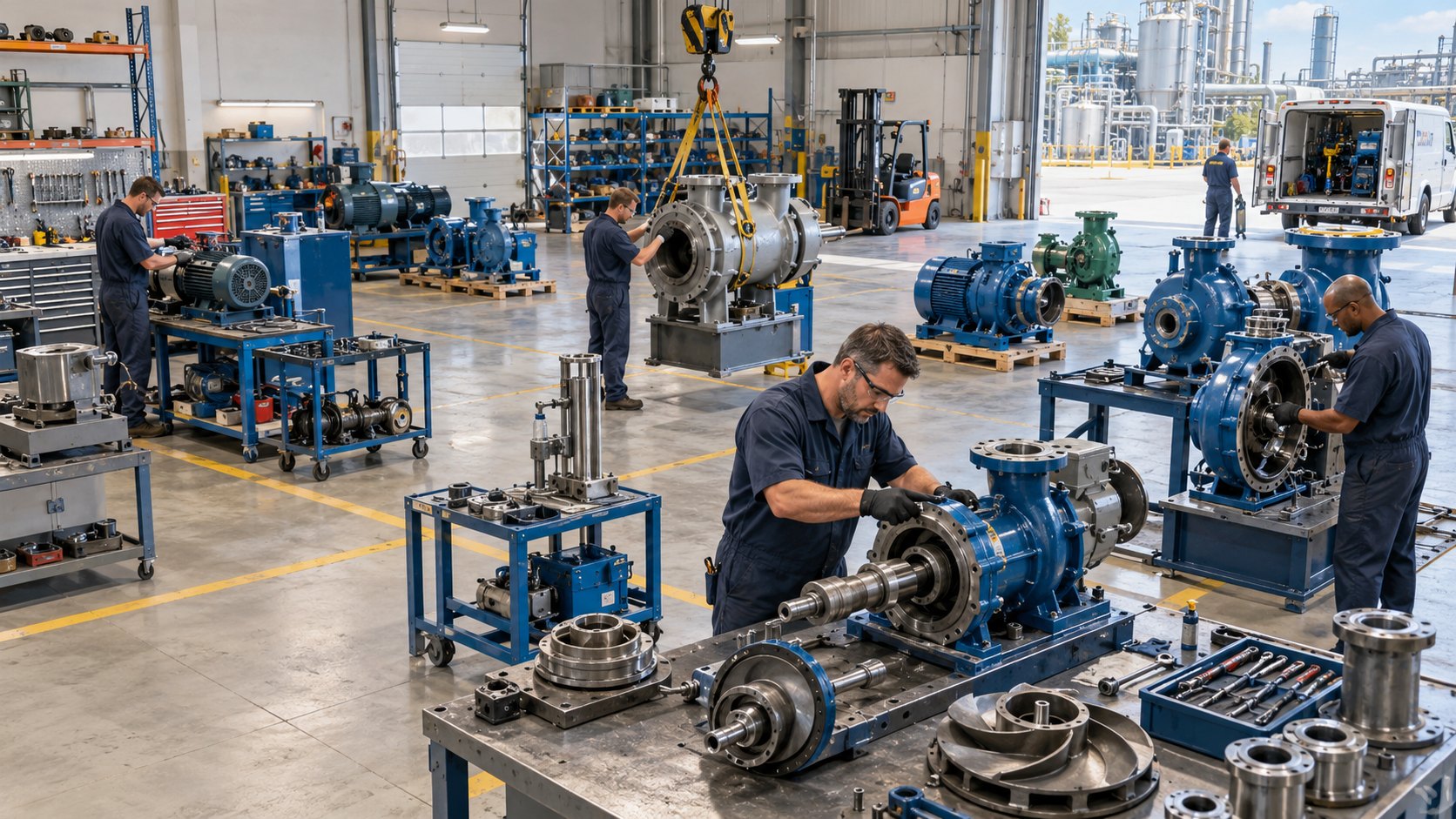
The work is a sequence: fault-finding on site, isolation and removal, strip and inspection, measuring wear rings, clearances, shaft and sleeve against the maker's limits, replacing impellers, seals and bearings, reassembly, alignment, then a run with readings taken.
The fault is usually in the system, not in the pump
A pump that cavitates is generally being starved by a blocked strainer or a suction arrangement the installation was born with. A seal failing every four months is being asked to run dry or hot. A bearing that keeps going is misaligned, or carrying a pipe load nobody meant it to take. Replace the broken component and the same component breaks again; find the cause and the customer stops calling, which sounds like losing revenue and is in fact how a maintenance agreement gets signed.
- Establish what stopped downstream, before opening anything
- Strip and measure the wear parts against the maker's limits
- Is the part that failed available in the country today
- YesThe unit is rebuilt, aligned and tested on your own bench
- NoThe customer runs on a standby or a refurbished exchange unit while it ships
- Align the set and record flow and pressure, not rotation
- Signed offThe readings are the only evidence the repair worked
The question in the middle of that sequence is the business. Everything above it is skill and everything below it is procedure, but the answer to that one row decides whether the customer waits a day or a month — and it is answered by a decision taken months earlier about what sits on your shelf.
Spares are why pumps were given a line of their own rather than left inside general machinery repair. A pump is a small family of wearing parts repeated across thousands of installed units, so one well-chosen shelf of seals, bearings and wear rings covers a great many models — stock no general workshop could hold for everything it might be shown. It is also the largest call on the company's cash, because none of it earns until something breaks.
The trade's own answer to the waiting is the exchange unit: a refurbished pump swapped in while the customer's own goes on the bench. It raises a licensing point worth settling early, because holding units to supply looks like trading, and if that is the intention it belongs in the activity wording.
Who is this for?
The pump maker's service engineer
The strongest entrant on this list. Years on one manufacturer's range buys the failure patterns, the part numbers and the buildings the units sit in. Settle before anything is signed whether the maker's appointment travels with the person — an appointment is granted, not assumed.
The facilities or utilities technician with a district behind them
Water, boosting and chilled-water pumps sit in the basement of every tower, and somebody who has maintained a portfolio of them arrives with the two things that matter: the asset list, and the numbers of the people who own it.
Spares traders adding the repair
A distributor already selling seals, bearings and impellers knows what fails and how often, and has the channel to get it. Adding the service turns a single parts margin into a relationship, and makes the shelf work harder than it does standing still.
The five customers, and how differently each counts the clock
Building services and potable water: a dry tank is a tenant complaint within hours, and the buyer is a facilities manager with a service agreement to defend. District and chilled-water plant: loss of flow becomes loss of cooling for a whole building in a Gulf summer, so the response window is the shortest in the trade and the penalty for missing it is written into somebody's contract. Firefighting sets: a fire pump is a life-safety asset, so work on it is inspected rather than simply invoiced, which brings the civil defence authority into a job that looks purely mechanical. Process and industrial: hot, abrasive or corrosive fluid makes the repair a materials question as much as a mechanical one, and the wrong seal face is a second failure a fortnight later. Sewage, drainage and marine: solids, rag, confined spaces and, on a vessel, a sailing date that bounds the work absolutely.
Pricing the same overhaul identically across those five is the commonest mistake in the trade. The machine is similar. What the customer is buying is not.
Where this is the wrong purchase. Stocking and selling pumps, seals and controls as a business in its own right wants a trading licence, and that carries a warehouse expectation rather than a workshop. Installing and commissioning pumping systems as part of building work is contracting. And the electrical side — motors, drives, panels and instrumentation — sits on other activities in this catalogue.
Where it sits between the mainland and a free zone
Begin with the premises, because they decide more of this than any tax comparison. A pump workshop wants lifting over a bench, three-phase power, a wash-down bay with a drain that can take what comes out of a sewage or process pump, somewhere bunded for oily water, and a test arrangement with water and a way of loading the pump. Site work wants vehicles, tools that live in them, and technicians who can work inside somebody else's plant under somebody else's permit-to-work system. That list narrows the jurisdictions long before anything else does.
Then ask who signs the order. The customers here are overwhelmingly inside the UAE market: building owners and their facilities contractors, district cooling operators, utilities, municipalities, factories and marine yards. Work bought by a UAE business and performed on UAE soil points at a mainland licence, and public and utility purchasing generally contracts with mainland suppliers. A free zone licence answers a narrower set of cases — where the customer base sits inside a zone or a port, or where units arrive from outside the country, are overhauled and leave again, which is a re-export pattern rather than a domestic service one.
The conditions on the unit follow the water and the waste rather than the machines. Washing down a pump that has handled effluent or process fluid produces contaminated water needing an accepted disposal route, which the municipality sets, and the same applies to used oil and spent absorbents. Cutting, welding and the solvents beside a bench bring fire-safety requirements the civil defence authority inspects, and a firefighting pump brings that same authority into the work itself. Where the activity is treated as industrial rather than commercial, national standards sit federally with the Ministry of Industry and Advanced Technology. Technician permits are issued against the licence and the premises through the federal labour ministry, which in a business selling response times is a limit on the product and not merely on the payroll. Spares and exchange units arrive under a customs code held in the company's own name. What applies in a given emirate, and what each of those costs to satisfy, is confirmed against the actual plan before a tenancy or a customer agreement is signed.
References
- Dubai Civil Defence — fire-safety requirements on a workshop, and the inspection reaching firefighting pump sets. Dubai Civil Defence
- Dubai Municipality — premises suitability, and accepted disposal routes for contaminated wash-down water, used oil and spent absorbents. Dubai Municipality
- Ministry of Industry and Advanced Technology — national standards and conformity requirements where pump overhaul is treated as industrial work. Ministry of Industry and Advanced Technology
- Ministry of Human Resources and Emiratisation — work permits and labour contracts for a technician crew, and the cap the premises place on its size. Ministry of Human Resources and Emiratisation
- Dubai Customs — importing spares, seals and refurbished exchange units, and the code an importer holds in its own name. Dubai Customs
Elsewhere in Manufacturing
Activities that sit beside this one
Most licences carry more than one activity. Adding a neighbouring line at the application stage costs a fraction of amending the licence afterwards.
Begin with a clear conversation
Tell us what you intend to build.
A consultant will map the structure, jurisdiction, approvals and likely cost against what you actually described — not against a package.
