
Activity CZ 28
How to Start a Transformer Repair and Maintenance Business in Dubai
A transformer is the one thing in a substation nobody can pull off a shelf, which is why its owner will pay to keep it alive. What the work is, who buys it, and what the oil obliges you to do.
ConsultZone licensing desk
- Activity code
- CZ 28
- Category
- Manufacturing
- Reviewed
- Read
- 7 min
Listen instead
50 seconds
An audio summary of this guide.
Topic summary
How to Start a Transformer Repair and Maintenance Business in Dubai
Every other component in a substation has a replacement somewhere in the country. A power transformer does not. It is built to a specification, it is heavy enough that moving it is its own project, and a buyer who needs a new one joins a queue. That single fact is the whole commercial premise of this activity: the owner of a failing transformer is not comparing your quotation against the price of a new unit, they are comparing it against the cost of being without one.
Which is why the customer relationship runs the other way round from most repair businesses. On a bench trade the customer appears when something breaks. Here the serious money is in making sure it does not — because the asset is worth keeping and because the consequence of a failure is not a dead machine but a dark building, a stopped line or a substation off the network.
Most of the revenue is not repair at all
The activity name says repair and maintenance, and the order of those two words is misleading. In a well-run transformer business, maintenance and condition assessment are the steady trade and repair is the occasional event that the steady trade earns you the right to be called for.
Condition work is mostly about the oil, because the oil is both the insulation and the diagnostic. A sample drawn from a unit and analysed in a laboratory reports dissolved gases, moisture, acidity and dielectric strength, and those numbers describe the state of the windings and the paper insulation inside a tank that cannot be opened casually. Read over several years they describe a trend, and a trend is what lets you tell an owner that a unit has time left or that it does not. Electrical testing sits alongside it — winding resistance, turns ratio, insulation resistance, and the checks made when a unit is energised again after work.
Repair itself divides into two very different undertakings, and confusing them is how shops lose money.
Work that happens where the transformer stands
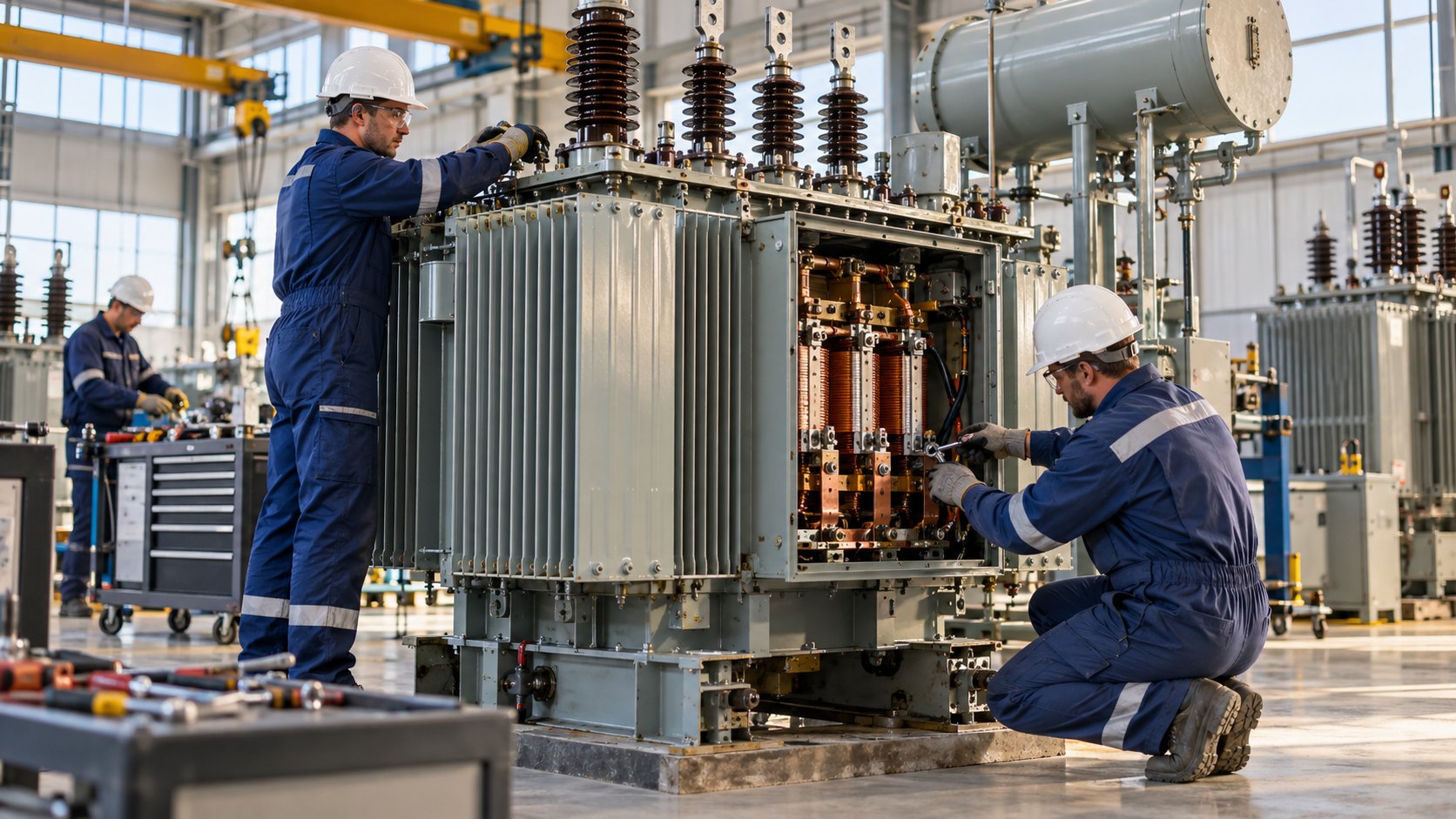
Gaskets and seals, bushings, oil leaks, cooling fans and radiators, tap-changer servicing, oil filtration and topping up, terminal and cable-box work. It is done on the customer's site, usually inside a window the customer dictates, and it requires a crew and a vehicle rather than a factory.
Work that requires the unit to come to you
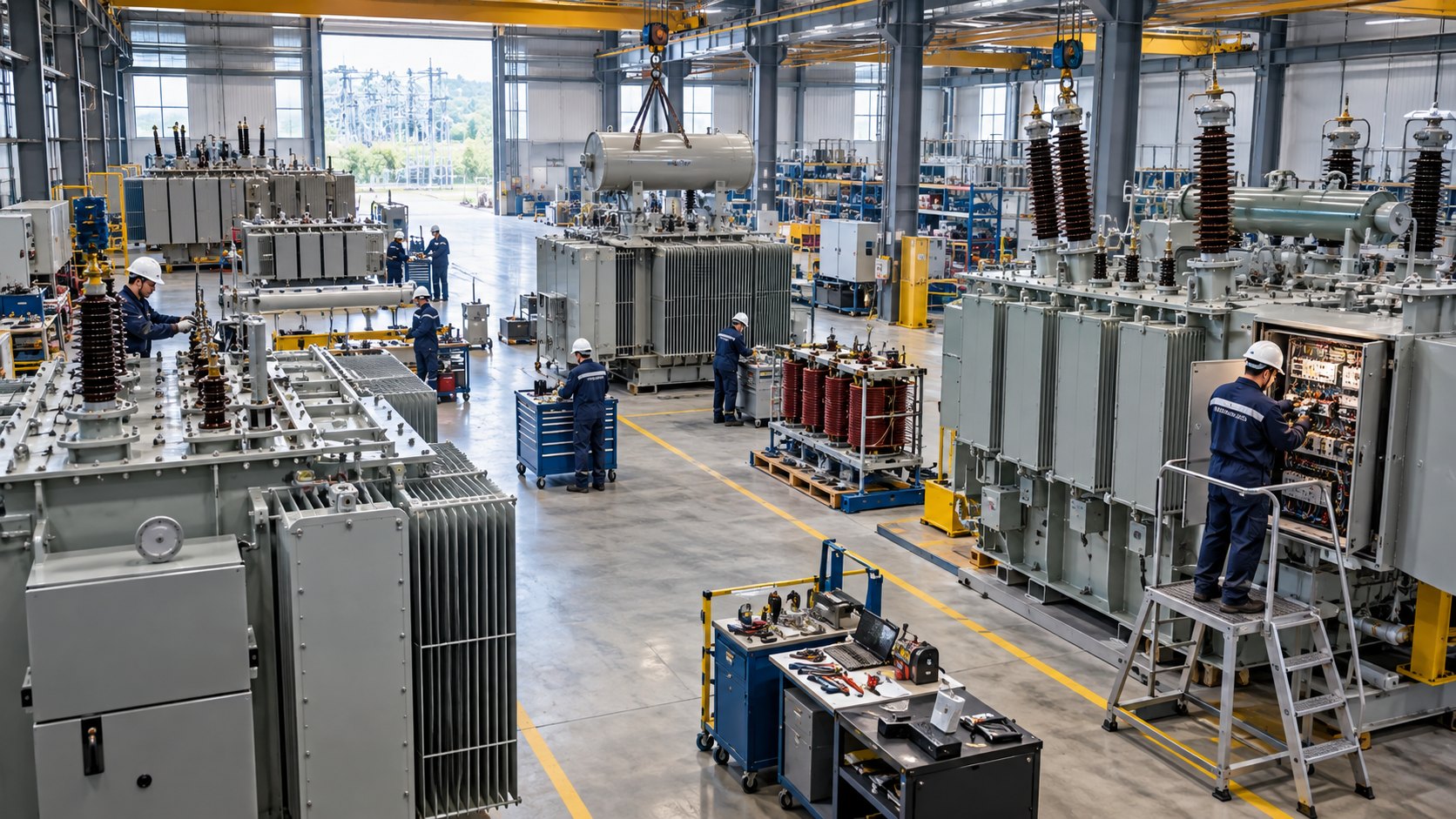
Untanking, rewinding, core work, re-insulating and retanking, followed by oil processing and a full test before the unit goes back. This is a workshop with lifting capacity, a drying and vacuum capability, clean space for winding, and tanks and handling for a great deal of oil. It is a materially larger capital undertaking than site service, and a business can be built on the first tier without ever entering the second.
Specialty transformers are worth naming separately because they change the customer rather than the technique — furnace and rectifier units, traction and drive transformers, instrument and isolation transformers, and the dry-type units common inside buildings where oil is unwelcome. A dry-type unit has no oil to test, which removes half the diagnostic toolkit and replaces it with a different one.
The buyer is whoever owns a substation
The obvious customer is the electricity utility, and it is the largest one. It is also the hardest to reach, and reaching it is a qualification exercise long before it is a sales exercise: organisations that own critical assets buy repair through approved-supplier arrangements and pre-qualification, which means the first year of the business is often spent proving capability to people who are not yet buying anything. Plan for that, because it is a cost with no revenue against it.
The accessible market is everybody else who owns transformers without being in the electricity business. Large developments, malls, hotels and hospitals hold private substations. Industrial plants hold their own, frequently older than the building. Data centres hold a great many and are the least tolerant of downtime of any customer you will ever have. Oil, gas and marine operators hold units in conditions that shorten their lives. Contractors and facilities managers sit in front of all of them, which makes the contractor both your route to market and your competitor for the margin.
The honest observation about this customer list is that none of them buys on price alone, and most of them cannot. They buy on whether they believe your test results. That is an unusual market position and it is the reason capability — the laboratory relationship, the test equipment, the documented method — is a commercial asset here rather than an overhead.
The oil is the condition that attaches to everything
The technical work is between you and the machine. The conditions on the licence are almost entirely about the fluid the machine is full of, and they sit with several different bodies rather than one.
Insulating oil in quantity is a fire-safety question before it is an engineering one, and the store on your premises is approved on that basis by Civil Defence, which handles fire safety and the approval of premises holding flammable and hazardous materials.¹ Oil drained out of a unit is then a waste question, handled by the municipality in Dubai and by the environmental authority in Abu Dhabi.² And oil drained from an old unit is not necessarily the same waste as oil drained from a new one: insulating fluids manufactured decades ago sometimes contained polychlorinated biphenyls, so the disposal route for an unknown legacy unit should be settled with the environmental authority before the drain plug comes out rather than after.³
Two more gates have nothing to do with the workshop. Moving an assembled transformer along a public road is a transport matter, and abnormal loads in Dubai are the business of the Roads and Transport Authority.⁴ Getting onto a live site to work is not a government permission at all — it is the asset owner's own permit-to-work system, and it is the gate that most often delays a job.
the six gates named on this page
The emirate's economic department
- The trade licence carrying the repair activityFirst, and everything behind it waits
- Whether the unit you take counts as industrial premisesWith the tenancy, because it sets the conditions
Civil Defence
- A store of insulating oil on the siteBefore the first drum arrives, not after
The municipality or the emirate's environment authority
- The route out for oil drained from a unitBefore the first unit is opened
The roads and transport authority
- Moving an assembled transformer on a public roadEvery time a large unit travels
The asset owner, under its own permit to work
- Access to work inside a live substationEvery visit, and it is not a government gate
Read the shape rather than the list. The licensing counter holds the most gates, but what makes this activity administratively heavier than bench repair is that four other bodies each hold exactly one thing, and each of those four can stop a job on its own. A shop that treats the trade licence as the finish line will meet the other four in the wrong order.
There is a customs dimension too, which surprises people. A customer's unit arriving from another country for repair, and leaving again afterwards, is a movement of goods as much as a piece of engineering, and the route for it should be agreed with Dubai Customs before the transformer is loaded rather than while it is standing at a border.⁵ The same applies to cores, windings and specialist consumables brought in as parts.
What any of this costs to hold is set by the emirate, the licensing authority, the premises you take and the activity mix on the licence, and it is not a number that can be quoted honestly in the abstract. ConsultZone establishes it for the specific case — including which of the six gates above your particular version of this business actually has to pass.
References
- Civil Defence — fire safety and the approval of premises storing flammable and hazardous materials, including insulating oil. Dubai Civil Defence
- Municipal waste handling and premises suitability in Dubai. Dubai Municipality
- Environmental permits and controlled-waste routes in Abu Dhabi. Environment Agency Abu Dhabi
- Vehicle and transport permits, including abnormal loads, in Dubai. Roads and Transport Authority
- Import and export of goods, customs codes and restricted goods. Dubai Customs
- National standards and conformity marks against which industrial work is measured. Ministry of Industry and Advanced Technology
Elsewhere in Manufacturing
Activities that sit beside this one
Most licences carry more than one activity. Adding a neighbouring line at the application stage costs a fraction of amending the licence afterwards.
Begin with a clear conversation
Tell us what you intend to build.
A consultant will map the structure, jurisdiction, approvals and likely cost against what you actually described — not against a package.
