

Activity CZ 31
How to Start a Protection Relay and Industrial Control Servicing Business in Dubai
A protection relay spends twenty years doing nothing and matters for one quarter of a second. Servicing relays and industrial controls sells a tested settings record, not a repaired part.
ConsultZone licensing desk
- Activity code
- CZ 31
- Category
- Manufacturing
- Reviewed
- Read
- 7 min
Listen instead
54 seconds
An audio summary of this guide.
Topic summary
How to Start a Protection Relay and Industrial Control Servicing Business in Dubai
Nothing on a protection relay wears out in a way a customer can see. It sits in a panel for two decades with no moving load on it, and the only moment it earns its place is the quarter-second after a cable faults — when it either opens the right breaker and leaves the rest of the plant running, or it does not, and one feeder takes a whole substation down with it. A relay that is physically perfect and wrongly set is worse than one that is visibly broken, because the broken one gets replaced.
That is the reason this line is closer to engineering than to fitting, and the reason its product is a document. What a client keeps at the end of a visit is a test record: the values injected, the times measured, the settings as found and as left, and the signature of the engineer who proved it. The hardware is incidental. Anyone can change a card; the chargeable skill is knowing what the card should be doing and being able to demonstrate that it does.
The equipment under this heading is wider than protection alone. Electromechanical and numerical relays for over-current, earth fault, differential, distance and under-voltage duties; trip-circuit supervision and lockout relays; programmable logic controllers and their input and output racks; human-machine interfaces and the supervisory and telemetry nodes behind them; variable-speed drives and soft starters; field instrumentation, transmitters and final control elements; safety relays, light curtains and interlock chains; and the control panels that house the lot. Repair and maintenance across that range means secondary injection testing, verifying settings against a coordination study, loop checking and calibration, firmware and configuration work, program backup and recovery, downloading and reading fault records, and swapping an obsolete electromechanical relay for a numerical one without disturbing the scheme around it.
The commercial case
Obsolescence is the engine of the business. Industrial control platforms reliably outlive the support windows of the companies that made them. A water plant, a cement works or a hotel chiller hall running a control system installed twenty years ago cannot buy a spare card from the manufacturer, cannot always get the programming software to run on a current laptop, and cannot find a graduate who has seen the platform before. Whoever holds legacy stock, the old tooling and an engineer who remembers the syntax is not selling hours — they are selling availability, and availability prices very differently.
The balance sheet is a payroll. This is one of the lighter licence lines to open and one of the harder ones to staff. There is no inventory to finance and no production line to fill; a competent engineer, a test set and a vehicle constitute the delivery capacity. That cuts both ways. Start-up capital is modest, but the business cannot grow faster than it can recruit, and a single engineer leaving takes a platform capability out of the door with them.
Demand recurs because somebody else's standard requires it. Protection and safety functions get proved periodically, not because the plant owner is curious but because their own maintenance regime, a handover certificate on a new plant, or a condition attached to their insurance says the proving has to happen. Recurring obligations produce renewable contracts, which is why the sensible shape here is a maintenance agreement across a site rather than a series of visits.
Where the money is lost is worth naming. A coordination error made on your settings sheet is a liability you carry afterwards. So documentation discipline, version control on configuration files and professional indemnity cover are costs of doing this work properly rather than overheads that can be trimmed. The firms that get into trouble are the ones that treated the test record as paperwork.
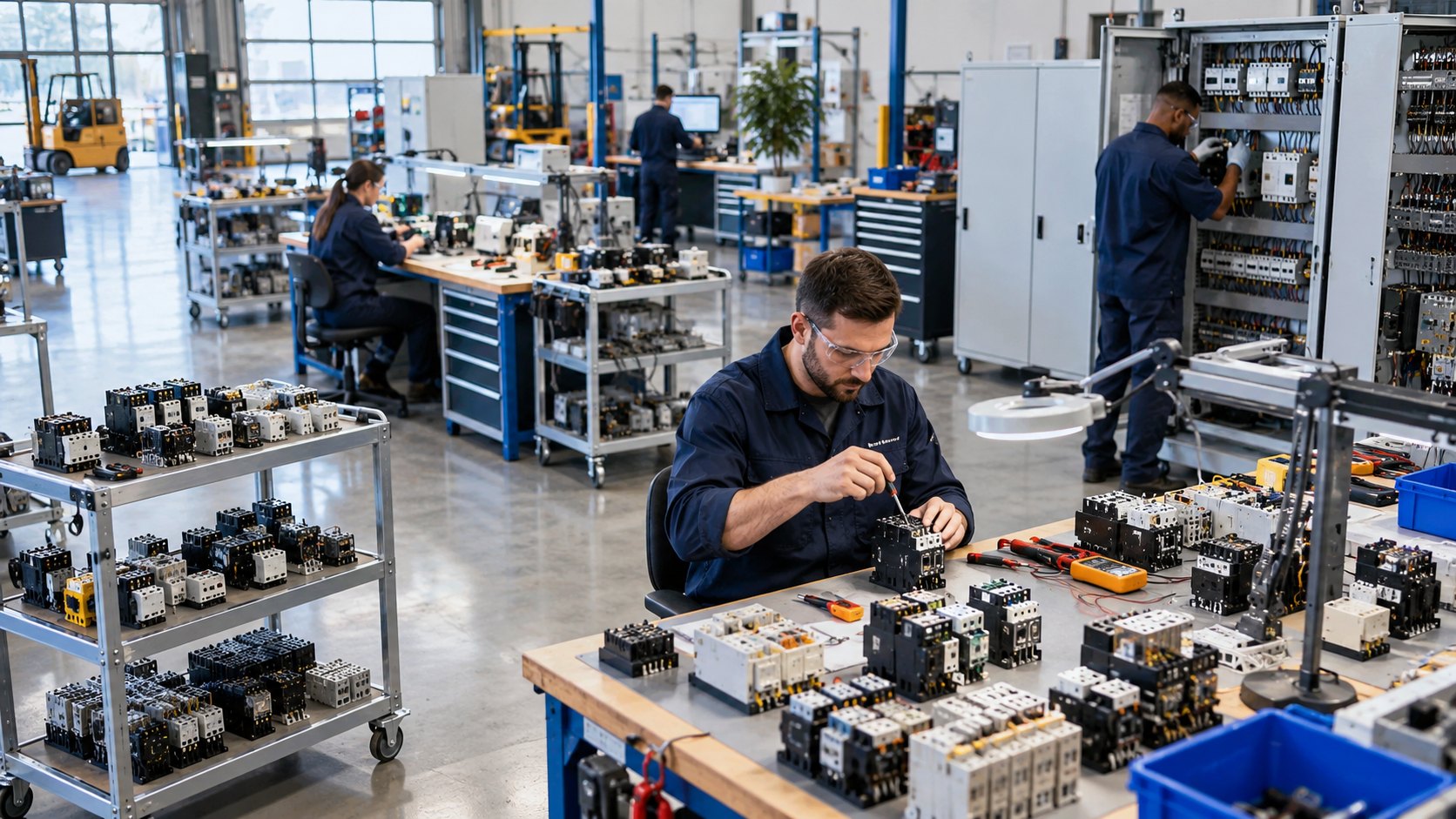
CZ 31 — Relays and industrial controls
Protection relays
The narrowest and most technical family, and the one clients pay most for. Setting, testing and coordinating the devices that decide which breaker opens and in what order. Retrofit work is a growing share of it, because numerical relays offer fault records and communications that an electromechanical device never could, and the retrofit has to leave the grading intact.
Control systems
Logic controllers, supervisory nodes and the software that runs them. The work is diagnosis, program recovery, configuration change, backup regimes and migration off platforms nobody supports. Frequently the most valuable thing delivered is an up-to-date copy of a program the client had lost.
Drives and instrumentation
Variable-speed drives, soft starters, transmitters, analysers and loops. Calibration and loop checking sit here, and so does the routine diagnostic work that keeps a process measuring what it thinks it is measuring.
Safety and interlock systems
Emergency stops, interlock chains, safety relays and guarding circuits. Proving these is a different discipline from protection testing, because the question is not selectivity but whether the chain fails to a safe state.
What this line does not cover
Manufacturing relays or assembling control panels for sale is a production activity. Designing a protection scheme or a control philosophy from scratch is engineering consultancy. Selling relays, controllers and drives as goods is trading. Installing cable and panels in new construction is electrical contracting. And the neighbouring maintenance lines are genuinely separate: the switchboard, the breaker and the busbar that a relay operates belong to the switchgear activity, while the battery bank that gives the trip circuit its power belongs to the battery activity. One substation room, three licence lines, and a service company that wants all three has to hold all three.
The conditions attach to the engineer, not to the equipment
A trade licence lets the company contract for this work. It is not what gets anyone through the door. The asset owner decides that, through their permit-to-work system and their own view of an engineer's qualifications and experience on the platform in question, and a serious client will ask for evidence before a panel door is opened. Building a business here means being able to produce that evidence on request for every person on the team.
- Settle the activity wording against the work you will really sellLets the trade name and the initial approval go forward
- Trade licence carrying this activityAllows the company to contract for the work
- Work permits and labour contracts for the engineersLets the team work lawfully on a client's site
- Engineer competence, evidenced to the client rather than to usDecides whether you reach the panel at all
- Type approval where a control carries a radio linkAllows wireless instrumentation and telemetry to be used
- Permit to work, taken again for every visitDecides when the circuit can be taken out of service
Read the handoffs rather than the sequence. Only the first two gates belong to a licensing authority; everything after that is decided by a labour authority, a telecoms regulator, the client and the client's safety organisation. A company that treats the licence as the finish line stalls at gate four.
Two of those gates deserve a note. Wireless instrumentation, telemetry radios and anything else in a control system that transmits are radio equipment, and type approval for radio and telecoms equipment in the UAE is a federal matter handled by the Telecommunications and Digital Government Regulatory Authority — worth checking before a customer's retrofit depends on a device arriving. Separately, replacement relays, controllers and drives are electrical and electronic goods, so the national standards and conformity marks that apply to such equipment on the UAE market apply to what you put back into a panel, and imported test sets and legacy spares clear customs like any other goods.
The specific conditions your licensing authority attaches — the wording of the activity, the qualifications it expects to see, whether a technical manager is named on the licence and what the premises must look like — differ by emirate and by zone, and they are not readable from the activity name. Confirm them for the actual case before committing to a jurisdiction or a lease.
References
- Telecommunications and Digital Government Regulatory Authority — type approval for radio-equipped instrumentation, telemetry and communications modules. Telecommunications and Digital Government Regulatory Authority
- Ministry of Human Resources and Emiratisation — work permits and labour contracts for field engineers. Ministry of Human Resources and Emiratisation
- Ministry of Industry and Advanced Technology — national standards and conformity marks for electrical and electronic equipment. Ministry of Industry and Advanced Technology
- Dubai Customs — import of test equipment, legacy spares and replacement control devices. Dubai Customs
Elsewhere in Manufacturing
Activities that sit beside this one
Most licences carry more than one activity. Adding a neighbouring line at the application stage costs a fraction of amending the licence afterwards.
Begin with a clear conversation
Tell us what you intend to build.
A consultant will map the structure, jurisdiction, approvals and likely cost against what you actually described — not against a package.
