

Activity CZ 30
How to Start a Switchgear and Switchboard Maintenance Business in Dubai
A switchboard is the one asset in a building that has to be switched off before anyone can look after it. That constraint, not the labour rate, is what a switchgear maintenance business is built around.
ConsultZone licensing desk
- Activity code
- CZ 30
- Category
- Manufacturing
- Reviewed
- Read
- 7 min
Listen instead
43 seconds
An audio summary of this guide.
Topic summary
How to Start a Switchgear and Switchboard Maintenance Business in Dubai
Almost everything else in a building can be serviced while it is working. A chiller can be nursed along, a lift can be tuned between journeys, a pump can be swapped out of a duty-standby pair without anyone upstairs noticing. A switchboard cannot. To open it, inspect it, test it or repair it, somebody has to take the load off it first — and that single physical fact is what this business is actually organised around.
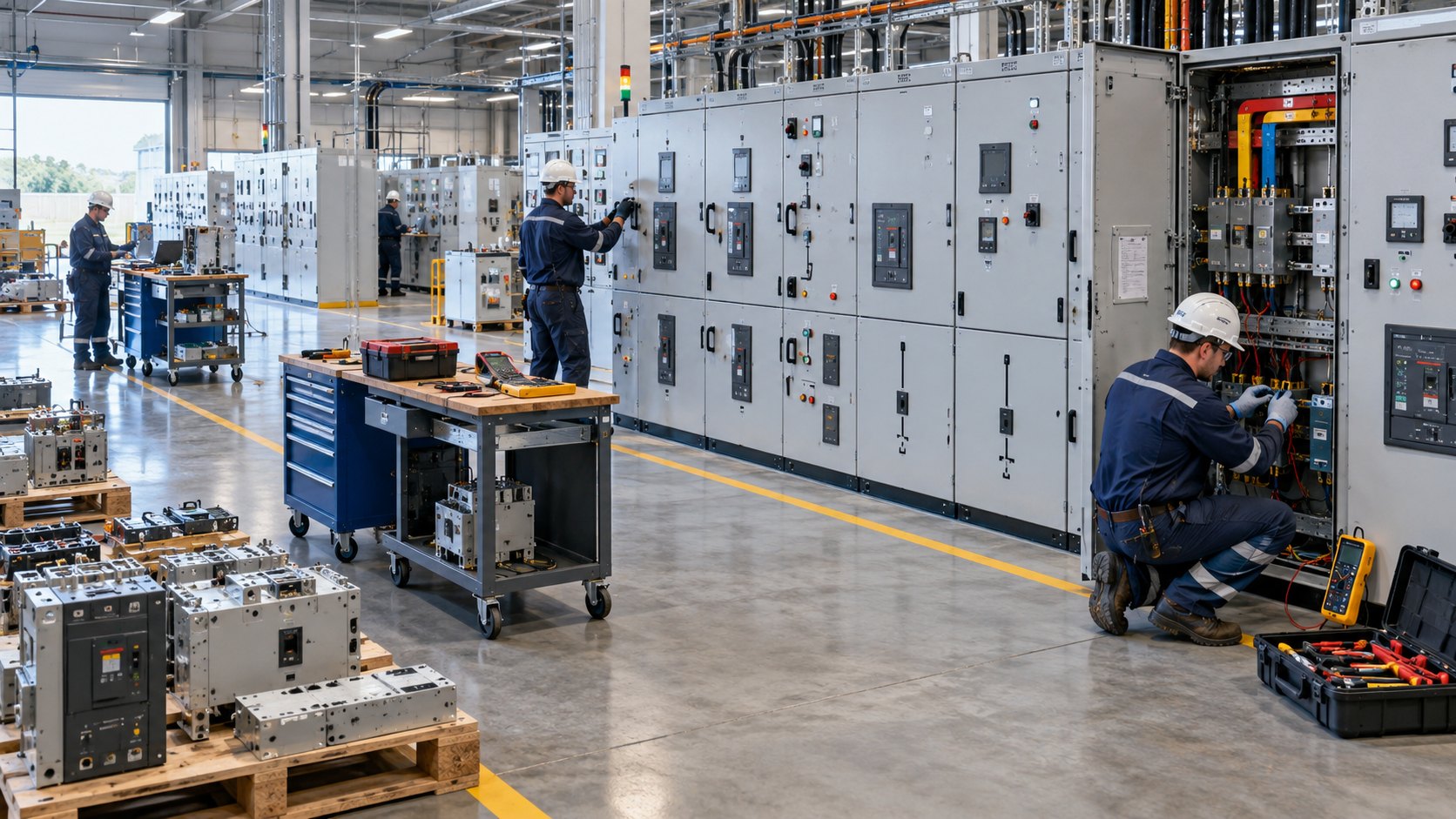
The assets themselves are unglamorous and everywhere: low-voltage distribution boards, motor control centres, medium-voltage panels, air and vacuum circuit breakers, moulded-case and miniature breakers, busbar systems and risers, ring main units, automatic changeover panels, capacitor banks and the protection enclosures around all of them. Every hotel, hospital, mall, cold store, data hall, port, water plant and factory in the country has at least one room full of this equipment, and almost none of them employ the people who look after it. That gap is the market, and it does not shrink, because the installed base only grows and switchgear ages whether it is worked hard or left alone.
The work is measurement before it is mechanics. A competent visit produces a thermographic survey of joints and terminations under load, insulation and contact-resistance readings taken cold, timing and injection tests on the breakers, torque checks on busbar connections, cleaning and re-lubrication of operating mechanisms, and the replacement of contacts, coils and auxiliary switches that have reached the end of their operation count. Beyond servicing, the same licence line covers overhaul and refurbishment of an existing assembly — stripping a panel back, rebuilding it and returning it to its own cubicle — and the retrofit that keeps an obsolete board alive when the original breaker has not been made for fifteen years.
Understand the economics of the outage and you understand how the service is sold. The invoice is small compared with the value of the window it sits inside. A shopping centre that shuts a board on a Sunday morning is spending far more on the closure than on the engineer, so nobody is really buying hours; they are buying the certainty that the board comes back on at the promised time. The consequence runs both ways. It is why planned shutdown maintenance can be priced properly, and it is why a job that overruns, or a second visit for a part that should have been on the van, costs more than the margin on the original order.
Who is this for?
Electrical contractors already on the site
The most natural entry. A firm that installs and terminates already knows the buildings, the consultants and the facilities managers. What it usually lacks is test equipment and the discipline of a written result, which is precisely what separates a maintenance contract from a call-out.
Service engineers from the manufacturers
People who have spent years on one maker's platform and know its mechanisms, its spares and its failure history. That knowledge is the scarce input in this trade, and it earns more inside a small independent business than it does on a salary.
Facilities management companies
Operators who currently subcontract this work and would rather hold it. The question to settle before applying is whether the intention is to serve your own portfolio or to sell into other people's, because the second needs a different sales organisation entirely.
What you can and cannot do under this line
Everything inside the line has one thing in common: an existing assembly, owned by somebody else, that you are returning to service. Testing it, cleaning it, overhauling it, rebuilding it, replacing components within it and retrofitting a modern device into an old enclosure all sit comfortably here.
Four neighbouring activities do not, and mistaking any of them for this one means amending a licence rather than trading on it. Building a new switchboard from components is manufacture and assembly. Designing a distribution system, sizing the protection or producing the drawings is engineering consultancy. Installing new boards into a new building is electrical contracting under a construction licence. Selling breakers, relays or panels as goods is a trading line. The boundary in the other direction is just as firm: work on the supply side of the metering point belongs to the utility that owns the network, whatever the customer would prefer.
Where this is the wrong purchase. If the plan is to assemble and sell panels, or to win first-fix electrical packages on new construction, this activity is the wrong one and will hold you back at the tender stage. Take the line that matches the work.
Which jurisdiction suits the company follows from who the customers are rather than from the licence itself, and the pattern is consistent enough to draw.
five kinds of work, two destinations
- Servicing a hotel's or a hospital's own distribution boardsThe work is performed on a client's premises inside the UAE market
- Planned shutdown maintenance for a mall or a district cooling plantA UAE building owner contracting a UAE supplier
- Framework and tender work for utilities and public bodiesMost tenders ask for a mainland licence
Mainland licence
- Overhaul and retrofit inside a free zone tenant's own plantCustomer and work both sit inside the zone
- Workshop refurbishment of panels that are then re-exportedThe assemblies never clear into the UAE market
Free zone licence
The reading is the concentration, not the list. Three of those five land in the same place, and they are the three that describe an ordinary service business selling to UAE buildings. A free zone licence is the better instrument only where the work or the goods genuinely stay inside a zone or leave the country again.
Premises and practical conditions
Because the work happens at the customer's site, the premises this company needs are a store and a workshop rather than a shop front: racking for spares, a secure cabinet for test sets, a bay large enough to take a panel brought in for rebuild, and somewhere to keep protective clothing clean and accounted for. A store that also holds insulating oil, solvents or gas cylinders is a fire-safety question about the building before it is a licensing one, and it is worth answering before a lease is signed rather than afterwards.
Test equipment is the real capital cost, and it has a recurring one attached. Primary and secondary injection sets, insulation and contact-resistance testers, breaker timing analysers, thermal cameras and calibrated torque tools are only as useful as their calibration certificates, because those certificates travel with the report and a client's consultant will ask for them.
The people are the licence's real condition. No competent asset owner lets anyone near a board on the strength of a trade licence: access is controlled by their own permit-to-work system, their isolation and lock-off procedure and their view of your engineers' qualifications and arc-flash protection. Components going back into an assembly are electrical goods in their own right, so the national standards and conformity marks that apply to electrical equipment placed on the UAE market apply to them too, and a client buying a refurbishment will expect to see what went in.
Two ordinary obligations complete the picture. Engineers brought into the country for this work need labour contracts and work permits from the federal labour authority before they are on a site. And the service invoices this company issues carry value added tax at the standard rate of five per cent once it is enrolled, which the Federal Tax Authority requires above the compulsory turnover threshold it publishes.
What none of this can tell you is the exact wording, the conditions and the qualifications your chosen authority will attach to the licence, because those differ between the emirates and between the mainland and each zone. They are worth confirming against the specific case — the emirate, the premises and the mix of work — before any commitment is made.
References
- Ministry of Human Resources and Emiratisation — work permits and labour contracts for engineers placed on a client's site. Ministry of Human Resources and Emiratisation
- Ministry of Industry and Advanced Technology — national standards and conformity marks applying to electrical equipment placed on the UAE market. Ministry of Industry and Advanced Technology
- Dubai Civil Defence — fire-safety conditions on premises holding insulating oil, solvents or gas cylinders. Dubai Civil Defence
- Dubai Municipality — premises suitability and public-health conditions for a workshop and store in Dubai. Dubai Municipality
- Federal Tax Authority — value added tax enrolment and filing for a UAE service business. Federal Tax Authority
Elsewhere in Manufacturing
Activities that sit beside this one
Most licences carry more than one activity. Adding a neighbouring line at the application stage costs a fraction of amending the licence afterwards.
Begin with a clear conversation
Tell us what you intend to build.
A consultant will map the structure, jurisdiction, approvals and likely cost against what you actually described — not against a package.
