
Activity CZ 34
How to Start a Wiring Devices Repair Business in Dubai
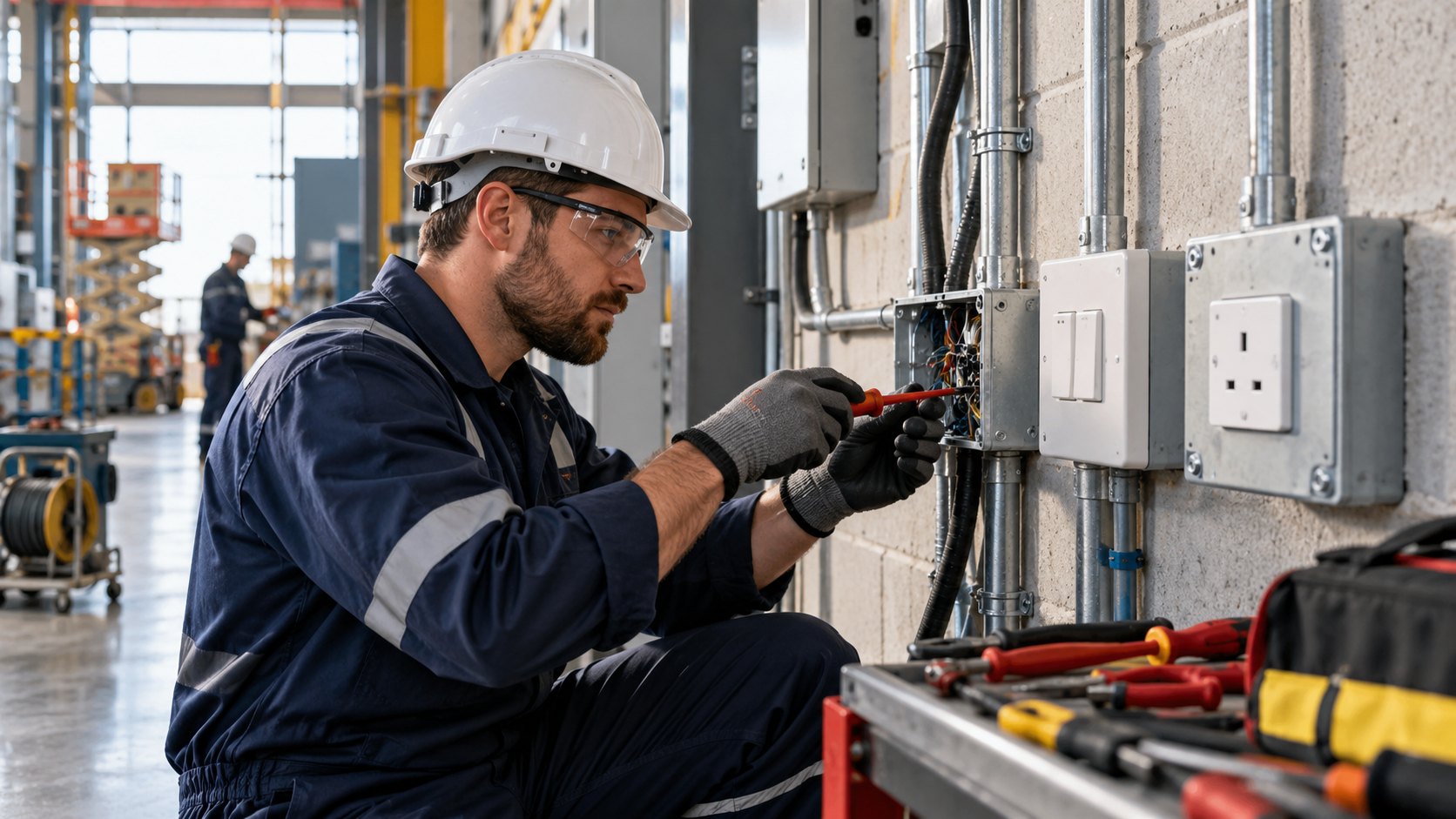
A socket outlet costs less than the visit that changes it, so this is rarely a shop of its own. Wiring devices repair earns money as a line inside a bigger maintenance or fit-out contract.
ConsultZone licensing desk
- Activity code
- CZ 34
- Category
- Manufacturing
- Reviewed
- Read
- 8 min
Listen instead
46 seconds
An audio summary of this guide.
Topic summary
How to Start a Wiring Devices Repair Business in Dubai
The catalogue entry for this activity runs to a hundred and thirty characters and manages to say one thing twice. Underneath the wording there is a single, useful distinction: a wiring device either carries current or it does not.
Socket outlets, switches, plugs, industrial connectors, terminal blocks, isolators and lamp holders carry it. The conductor runs through them and they are part of the circuit. Conduit, trunking, cable tray, back boxes, glands, cleats and insulators do not. They hold the conductor in place, keep it away from everything it should not touch, and let somebody get at it again later. One group is live when the circuit is on. The other is what stops anything else being live.
Both halves are componentry, and componentry is why the honest answer to the first question a founder asks is usually no.
CZ 34 — what the line covers, and why it is rarely a shop
A socket outlet is worth a few dirhams to a few tens of dirhams. A technician's visit is worth considerably more than that, and always will be. So nobody brings a broken socket anywhere to be mended: they take a new one out of a box and throw the old one away. The same is true of a back box, a length of conduit and most switches. Repair economics on componentry only work at three points, and knowing which of the three you are selling into is the difference between a business and a hobby.
Scale. A hotel refit, a tower's common areas, a school or a labour accommodation block, where several thousand accessories are changed inside a shutdown window. The money is in access, sequencing and labour productivity, not in the device — a job like that is won on programme and priced by the floor, not by the socket.
Value. Industrial plug-and-socket assemblies, interlocked switched sockets, distribution-board accessories and busbar connections. These cost enough, and take enough abuse on a site or in a port, that rebuilding one is genuinely cheaper than buying another. Burnt pins, cracked shrouds, jammed interlocks and heat-damaged terminations are all repairable faults on equipment worth repairing.
Certification. In a hazardous area the gland and the enclosure are part of the protection concept rather than accessories to it. A replacement has to be a like-for-like certified part, fitted the way the certificate describes, and the person doing it has to be able to show that it was. That work cannot be improvised, and it is paid accordingly.
What actually fails, in order of how often you will see it
Heat at a loose termination is the classic. A screw that was never torqued properly, or that relaxed under thermal cycling, raises the resistance at the joint until the terminal discolours, the insulation hardens and the accessory is cooked. It is the single commonest finding on a thermographic survey of a distribution board, and it is why retightening and re-terminating is real maintenance work rather than housekeeping. After that: burnt busbar and neutral-bar connectors, damaged industrial connectors on site power, corroded cable tray in plantrooms and car parks, trunking flattened by somebody else's trade, back boxes destroyed during a strip-out, and glands that have failed and taken an enclosure's ingress rating with them.
| Current-carrying devices | Non current-carrying devices | Fixed wiring | |
|---|---|---|---|
| What it is | Sockets, switches, connectors, isolators | Conduit, trunking, tray, boxes, glands | The cable and the circuit itself |
| What fails | Heat at a loose termination, burnt pins | Corrosion, impact, a lost seal | Insulation, ageing, mechanical damage |
| Who pays for the work | Plant and facilities maintenance | Fit-out and refurbishment contracts | The building owner, under contract |
| Where it sits on a licence | This activity line | This activity line | Electrical contracting, not this line |
| What you hand over | A conforming replacement part, fitted | A conforming replacement part, fitted | Design, cable, labour and a test result |
The last row is the one to read twice. Two of those columns are this activity. The third is not, and confusing them is the commonest reason a file on this line has to be amended after the licence has already been cut.
The buyer is a contract, not somebody at a counter
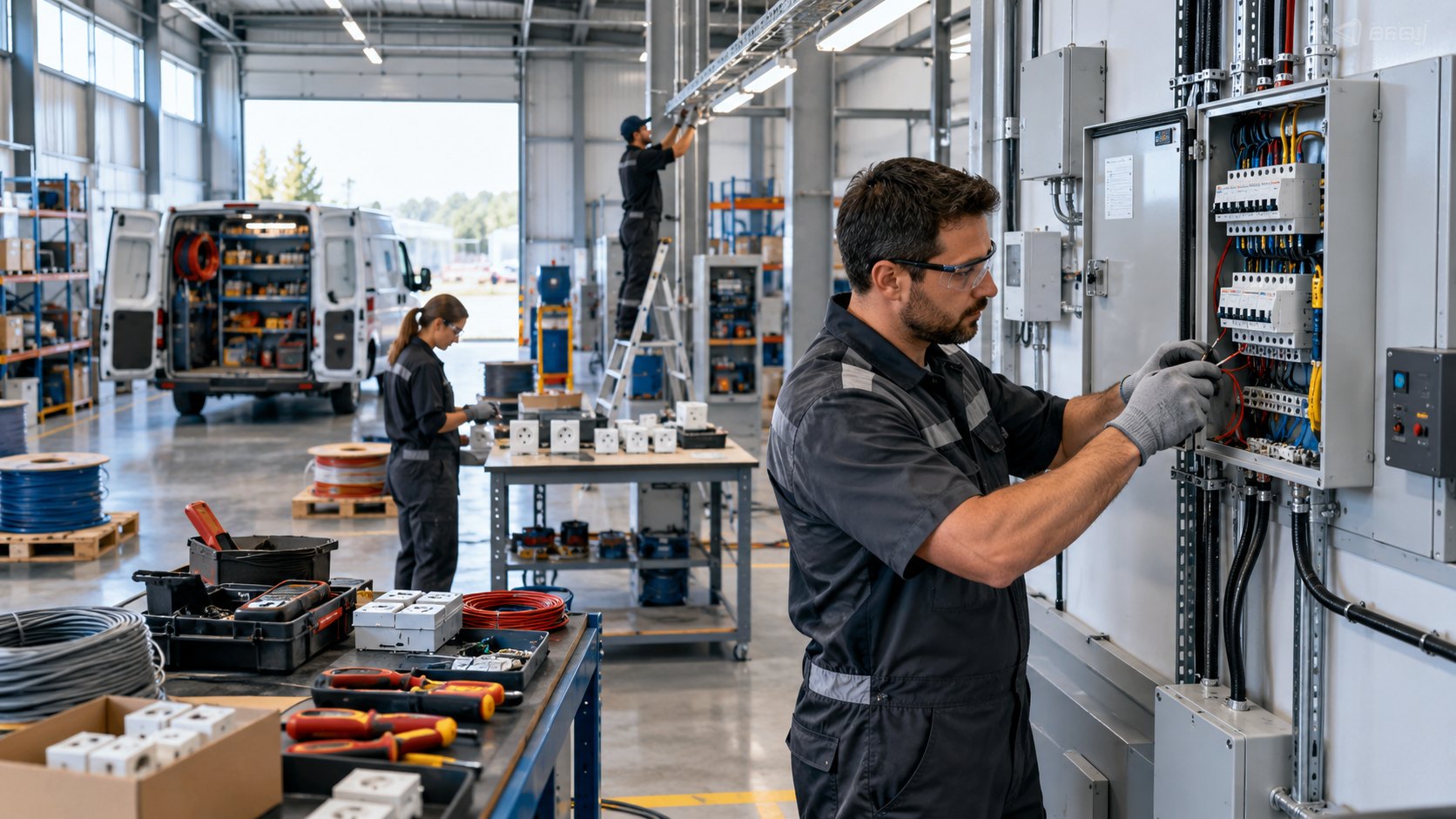
Nobody walks in. The demand for this work exists almost entirely inside somebody else's commercial arrangement, and that shapes everything about how the company is built.
The buyers are facilities management firms holding hard-services contracts; hotel, mall and hospital engineering departments; main contractors and the electrical subcontractors working under them during fit-out; industrial plants, ports, logistics yards and workshops with their own maintenance budgets; and owners' associations running towers where the common areas are nobody's private property. Each of them buys through a supplier pre-qualification process — a vendor list, a trade licence copy, insurance, a safety record, sometimes a trial job — and not one of them buys because a sign outside says the work is available.
That has two consequences worth planning for. The first is time: months can pass between a first meeting and a first purchase order, and none of that period produces revenue while the technicians are already on payroll. The second is cash shape. You invoice against certified work, payment terms are set by the contract rather than by you, and on a construction contract a slice can sit in retention until the project completes. Labour is paid weekly or monthly regardless. Work permits, contracts and wage protection for the people doing the work sit with the Ministry of Human Resources and Emiratisation, and on a labour-led trade that is not administrative detail — it is most of the cost base.¹
The jurisdiction question follows from the same fact. Work of this kind is performed on UAE soil, in a client's own building, which is what a mainland licence is for. A free zone company sells within its zone or outward from it, and a workshop inside a zone servicing equipment that arrives and leaves is a coherent plan — but it is not the same plan as maintaining accessories in an occupied tower in the middle of the city. Settle which of those two you are actually selling before choosing where to incorporate, because that decision is very difficult to reverse cheaply.
What attaches to the parts you fit
The conditions on this activity follow the component, not the office.
Electrical accessories placed on the UAE market are subject to national standards and conformity assessment, which sit federally with the Ministry of Industry and Advanced Technology.² A contractor who supplies the replacement part as well as fitting it is putting product into service, and a non-conforming socket in a client's wall is the supplier's problem long after the invoice is paid. If the parts are bought abroad, the licensed company needs a customs code in its own name and the goods clear through the emirate's customs authority, which for Dubai is Dubai Customs.³
Fire-rated construction is the condition most often missed. Where conduit, trunking or a cable tray passes through a fire-rated wall or floor, the penetration has to be sealed so the barrier still does its job, and that is a fire-safety matter rather than an electrical one — which is why the civil defence authority has an interest in containment work that looks purely mechanical.⁴
On tax, this activity is treated as any other UAE business is. Corporate tax runs at nine per cent on taxable income above AED 375,000 and at zero below it, under the federal corporate tax law,⁵ and value added tax enrolment and filing sit with the Federal Tax Authority once the relevant threshold is crossed.⁶ Neither is specific to wiring devices, and neither is a reason to choose or avoid this line.
Where this is the wrong purchase. If the intention is to import accessories and sell them on, this is the wrong activity and a trading line does the job better. If the intention is to wire circuits, alter boards and hand over test results, that is electrical contracting and it carries competence requirements this line does not. This activity is for the company that maintains, repairs and replaces the devices themselves — most often as one line among several on a maintenance or contracting licence rather than as the whole of it. Which combination of lines your plan actually needs, and what each one brings with it in your chosen emirate, is what we establish before a licence application is made.
References
- Ministry of Human Resources and Emiratisation — work permits, labour contracts, wage protection and Emiratisation for a labour-led trade. Ministry of Human Resources and Emiratisation
- Ministry of Industry and Advanced Technology — national standards and conformity assessment for electrical accessories placed on the UAE market. Ministry of Industry and Advanced Technology
- Dubai Customs — customs codes, import clearance and restricted goods where accessories are brought in. Dubai Customs
- Dubai Civil Defence — fire safety, including the sealing of containment passing through fire-rated construction. Dubai Civil Defence
- Federal Decree-Law No. 47 of 2022 on the Taxation of Corporations and Businesses — the rate and the threshold. Ministry of Finance
- Federal Tax Authority — value added tax and corporate tax enrolment, filing and thresholds. Federal Tax Authority
Elsewhere in Manufacturing
Activities that sit beside this one
Most licences carry more than one activity. Adding a neighbouring line at the application stage costs a fraction of amending the licence afterwards.
Begin with a clear conversation
Tell us what you intend to build.
A consultant will map the structure, jurisdiction, approvals and likely cost against what you actually described — not against a package.
