
Activity CZ 32
How to Start a Storage Battery Repair and Maintenance Business in Dubai
A primary battery cannot be repaired at all, so the repairable half of this line is storage batteries — the banks behind every UPS, trip supply and forklift fleet. The goods are hazardous, and that follows you.
ConsultZone licensing desk
- Activity code
- CZ 32
- Category
- Manufacturing
- Reviewed
- Read
- 7 min
Listen instead
53 seconds
An audio summary of this guide.
Topic summary
How to Start a Storage Battery Repair and Maintenance Business in Dubai
Read the activity name closely and it contains a contradiction worth resolving before anything else. A primary battery is a single-use cell: once it is flat it is finished, and there is nothing inside it to repair. So the repair half of this line belongs almost entirely to storage batteries — the rechargeable banks standing behind every uninterruptible power supply, every substation trip circuit, every emergency light and every forklift in the country — while the primary half is a question about handling, testing and what lawfully happens to a cell that is dead.
That resolution matters commercially, because it tells you where the recurring revenue is. A standby battery bank exists to work on one bad day and to be invisible on every other. Nobody can tell by looking whether it will hold its rated duty. The only way anyone knows is a discharge test with a curve attached to it, which is why in practice this business sells evidence: a report that says this bank will carry this load for this long, signed and dated. The battery work is the means; the certainty is the product.
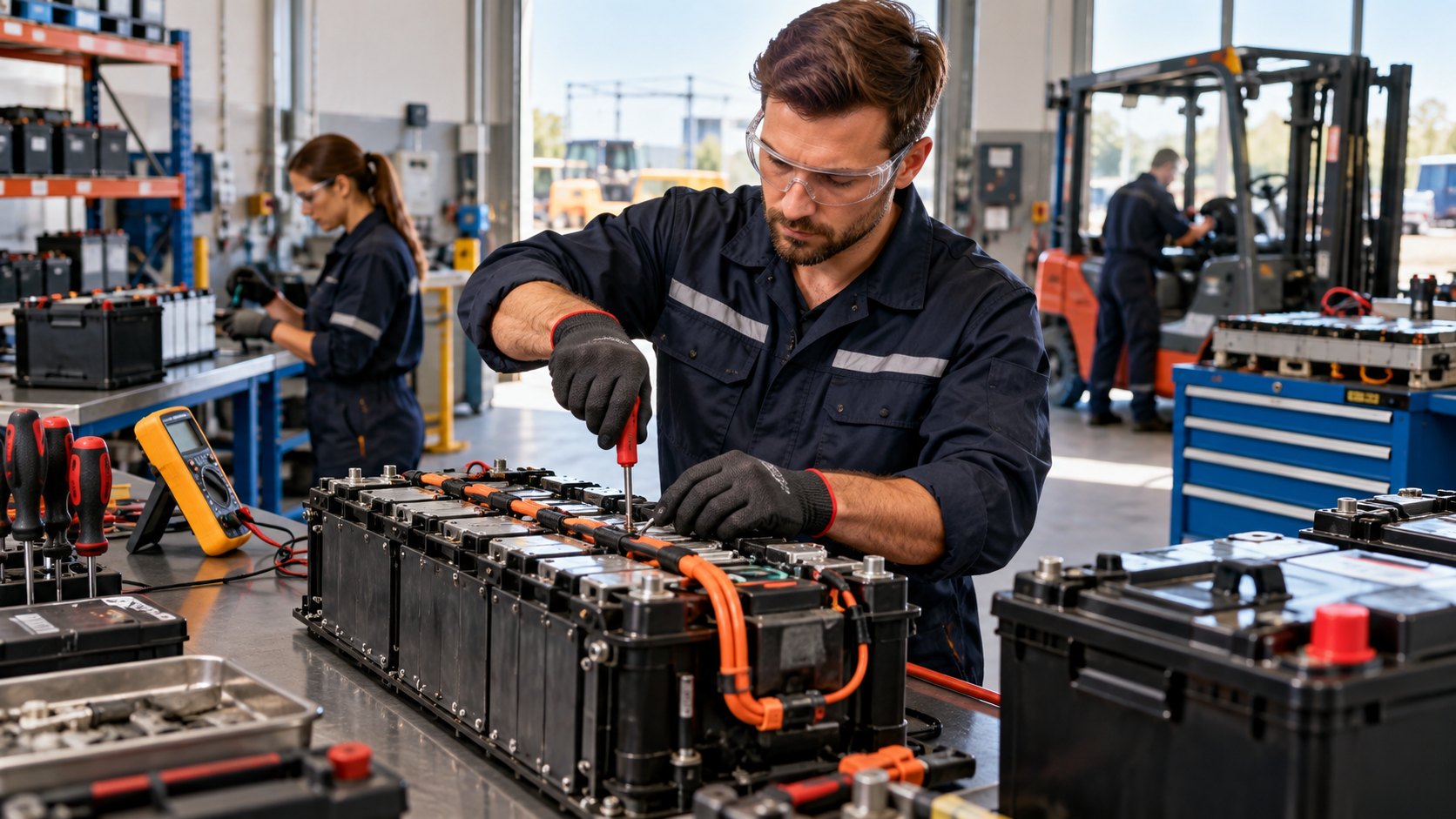
The techniques follow from that. Capacity and discharge testing against the duty the bank was specified for; impedance and conductance measurement to find the weak cell before it takes the string with it; specific-gravity and electrolyte checks on flooded cells; terminal cleaning, greasing and torque to a figure; thermal survey of connections and cases; equalising and boost charging; matching and replacing individual cells inside a string; commissioning a new bank and decommissioning an old one. On the primary side there is no repair, only condition checking, safe storage, safe transport and disposal through the right channel.
The rechargeable bank is the whole of the repairable work
Standby and UPS strings
The largest family. Data halls, hospitals, broadcast sites and commercial buildings run valve-regulated or flooded lead-acid strings, and increasingly lithium, behind their uninterruptible supplies. Testing is scheduled and contractual, and the client is usually a facilities team that has been asked to prove the plant works.
Substation and switchgear trip supplies
The smallest banks and the least forgiving. A DC battery gives a circuit breaker the energy to open. The bank is physically modest, the consequence of its failure is not, and the customer is a utility or an industrial asset owner rather than a building manager.
Telecom and rectifier banks
Cabinets and shelters holding strings on continuous float charge, spread across many sites. The work is volume, routine and logistics — the value is in covering a network on a schedule rather than in any single visit.
Traction batteries in warehouse fleets
Forklift and pallet-truck batteries worked hard, charged daily and abused routinely. Watering, equalising, cell replacement and charger matching keep a fleet running, and the customer feels the downtime immediately.
Life-safety and storage systems
Emergency lighting and fire-system standby batteries, where a working battery is an obligation and not a preference; and the newer solar and battery-storage installations, where the asset owner has a commercial performance figure to defend.
Where this line meets the two beside it
A single substation room contains the switchboard and its breakers, the protection relays that decide when to trip, and the battery bank that supplies the tripping energy. Those are three separate licence lines, and the battery is the one the other two depend on: a relay that decides correctly cannot act on the decision, and a breaker cannot open, without DC behind them. A battery service company therefore sells into the same room as a switchgear company without competing with it, and the two make natural referral partners.
What this activity does not cover
Manufacturing or assembling cells, modules and packs is a production line. Recycling, smelting or otherwise treating spent batteries to recover material is a waste-treatment activity with its own licence and its own conditions. Selling batteries as goods over a counter or into a trade channel is a trading line. Designing an uninterruptible supply or sizing a bank is engineering consultancy. The working test is short: is there an existing bank, owned by somebody else, that you are returning to a state where it holds its rated duty?
The buyers are the people who cannot afford the bank to fail
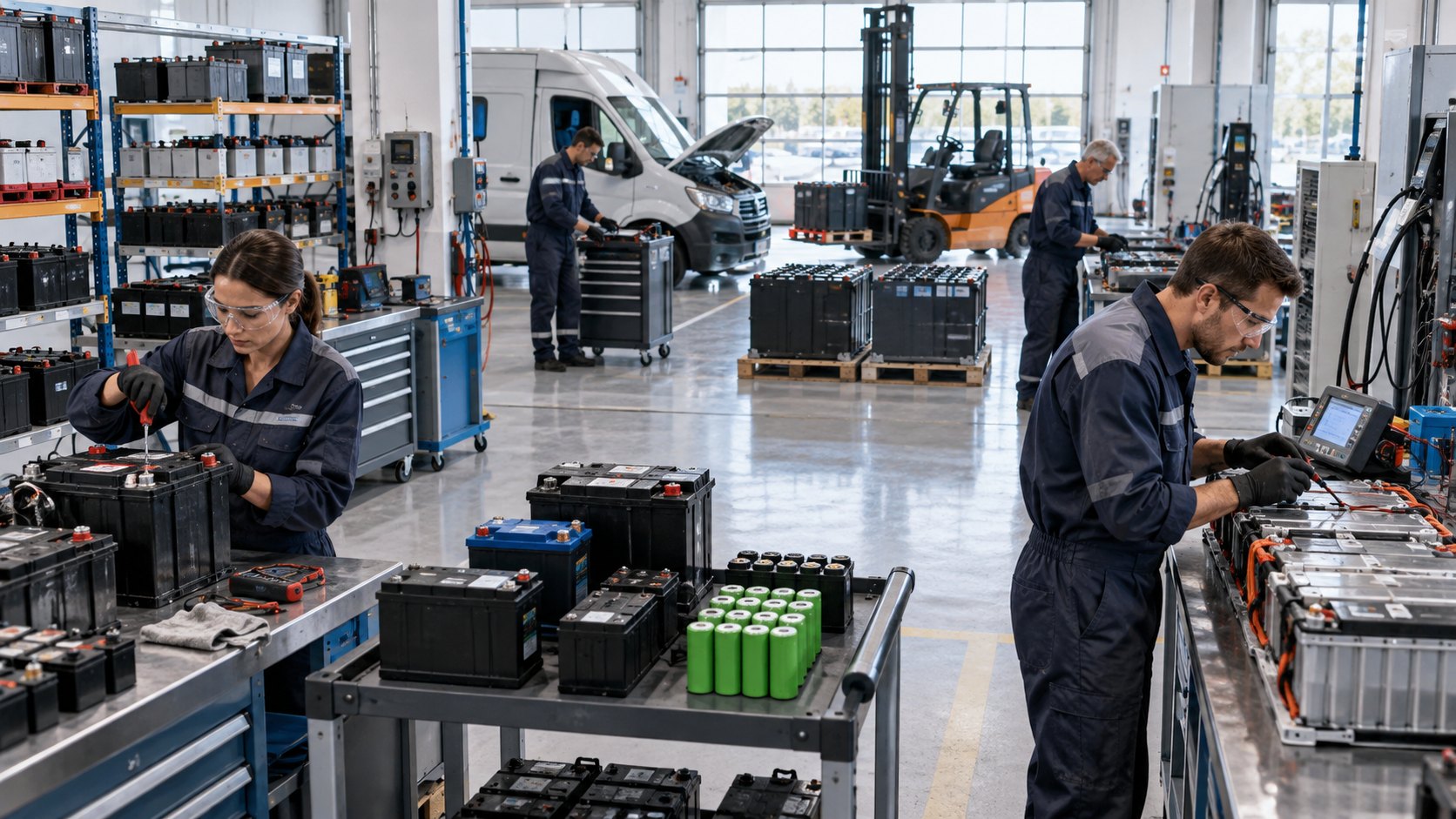
Every customer in this trade has the same profile from a different direction — an obligation they cannot discharge without a battery working. Data centre and telecom operators carry uptime commitments to their own customers. Hospitals and anyone holding life-safety standby carry a duty of care and a facility inspection behind it. Utilities and industrial asset owners carry the cost of an unplanned outage, which is the largest number in the conversation. Logistics and warehouse operators simply lose shifts. Solar and storage asset owners have a contracted output figure and a battery that quietly degrades against it.
That is a healthier customer base than it first appears, because none of those buyers is choosing whether to maintain the battery. They are choosing who does it and whether the paperwork will stand up.
Where it sits between the mainland and a free zone
The service is performed wherever the battery is, and the battery is almost always in somebody else's building. So the jurisdiction question is not which licence reads best; it is whether your revenue comes from UAE premises or from goods passing through.
judged on the same five rows
| Judged on | Mainland | Free zone |
|---|---|---|
| Service a customer's bank at their own premises on the mainland | Yes | Indirect |
| Bid for utility, hospital and public framework work | Yes | Generally not |
| Supply replacement cells to UAE customers as part of the job | Yes | Indirect |
| Hold imported cells in bond and send them out again | No | Yes |
| Take premises approved for hazardous storage | Conditional | Conditional |
Four of those five rows separate the two routes and point the same way for an ordinary service business. The fifth does not separate them at all, and that is the row worth dwelling on: the hazard follows the goods into whichever jurisdiction you choose, so a free zone address buys nothing on the condition most likely to constrain the premises.
The goods are what makes this line different from the other maintenance activities around it. Sulphuric acid, lead, alkali electrolyte and lithium cells are treated as hazardous material for storage, handling, transport and disposal. In practice that means flooded lead-acid gives off hydrogen and needs real ventilation rather than a vent; acid needs bunded flooring and spill containment; lithium cells are a fire-loading question about the room they sit in. Fire safety therefore has a view on the premises before licensing does, and municipal environmental control has a view on what leaves the site. None of the specific conditions can be read off the activity name, because they turn on the emirate, the quantity and the chemistry — which is why the premises should be cleared for what you intend to keep in them before a lease is signed, not after.
End of life is the second distinctive feature, and it is a boundary as much as an opportunity. A battery coming off a customer's site is controlled material rather than scrap, and it has to move through a channel that will account for it. The recovered lead in a flooded cell carries genuine value, which is why the collection side of this trade has an economics of its own — but recovering it is a treatment activity and not this one. You can take the old bank away as part of the job; turning it back into metal is somebody else's licence.
The direction of travel is favourable and can be stated without a forecast attached: every new data hall, hospital wing, substation and solar plant adds standby capacity to the installed base, and every bank in that base has to be proved to somebody. What the licence costs to hold, which approvals attach to your premises and what the storage conditions will be depend on the emirate, the site and the chemistry you handle. Those are confirmed for the specific case rather than assumed.
References
- Dubai Civil Defence — fire-safety and hazardous-storage conditions on premises holding acid, alkali or lithium cells. Dubai Civil Defence
- Dubai Municipality — premises suitability and the handling of controlled material leaving a customer's site in Dubai. Dubai Municipality
- Environment Agency Abu Dhabi — environmental permits where the work and the storage sit in Abu Dhabi. Environment Agency Abu Dhabi
- Ministry of Industry and Advanced Technology — national standards and conformity marks for batteries placed on the UAE market. Ministry of Industry and Advanced Technology
- Dubai Customs — import and export of cells, and the treatment of restricted and controlled goods. Dubai Customs
Elsewhere in Manufacturing
Activities that sit beside this one
Most licences carry more than one activity. Adding a neighbouring line at the application stage costs a fraction of amending the licence afterwards.
Begin with a clear conversation
Tell us what you intend to build.
A consultant will map the structure, jurisdiction, approvals and likely cost against what you actually described — not against a package.
