
Activity CZ 33
How to Start an Electric Lighting Repair Business in Dubai
LED sealed the cheap end of lighting repair shut. What survives is architectural, stage, street and industrial work, where the fitting is worth more than the labour that saves it.
ConsultZone licensing desk
- Activity code
- CZ 33
- Category
- Manufacturing
- Reviewed
- Read
- 8 min
Listen instead
47 seconds
An audio summary of this guide.
Topic summary
How to Start an Electric Lighting Repair Business in Dubai
A fluorescent batten had four repairable parts. The tube, the starter, the ballast and the lamp holders were each a stock item, each came out with a screwdriver, and a building with a thousand fittings kept somebody in work all year. An integrated LED panel has none of them. The diodes are soldered to a board, the board is bolted to a heatsink, the driver sits sealed inside a gasketed housing, and the finished fitting landed in the UAE for less than an hour of a technician's time. Nobody mends it. It goes in a skip and another one goes up.
That is the first thing to know about this line, and most plans for it miss it. Lighting repair did not grow as the lighting market grew. It was hollowed out from the bottom while the market above it expanded, and what is left sits at the expensive end — where fittings are bespoke, worked hard, or no longer available. That is a real business, and a different one from what the activity name suggests.
The five places the work actually is
Architectural and facade lighting. Bespoke fittings, custom optics, colour mixing driven over a control protocol, specified by a lighting designer and frequently out of production within a few years of the building opening. Matching one failed unit means matching a beam angle and a colour temperature that may no longer exist, so the owner pays to keep the ones already on the building alive.
Stage, studio and event fixtures. Moving heads, profiles and followspots are mechanical as well as electrical — motors, colour and pattern wheels, shutters, fans and a great deal of heat. They are used hard, they are expensive, and a rental fleet earns nothing while a unit sits on a bench. Turnaround time, not price, is what wins this work.
Street, tunnel and area lighting. Fleet-scale rather than fitting-scale, and almost always a maintenance contract with a public authority or a facilities operator rather than a job taken over a counter. The failures are drivers, control gear, surge damage and photocells; the constraints are access equipment and night working.
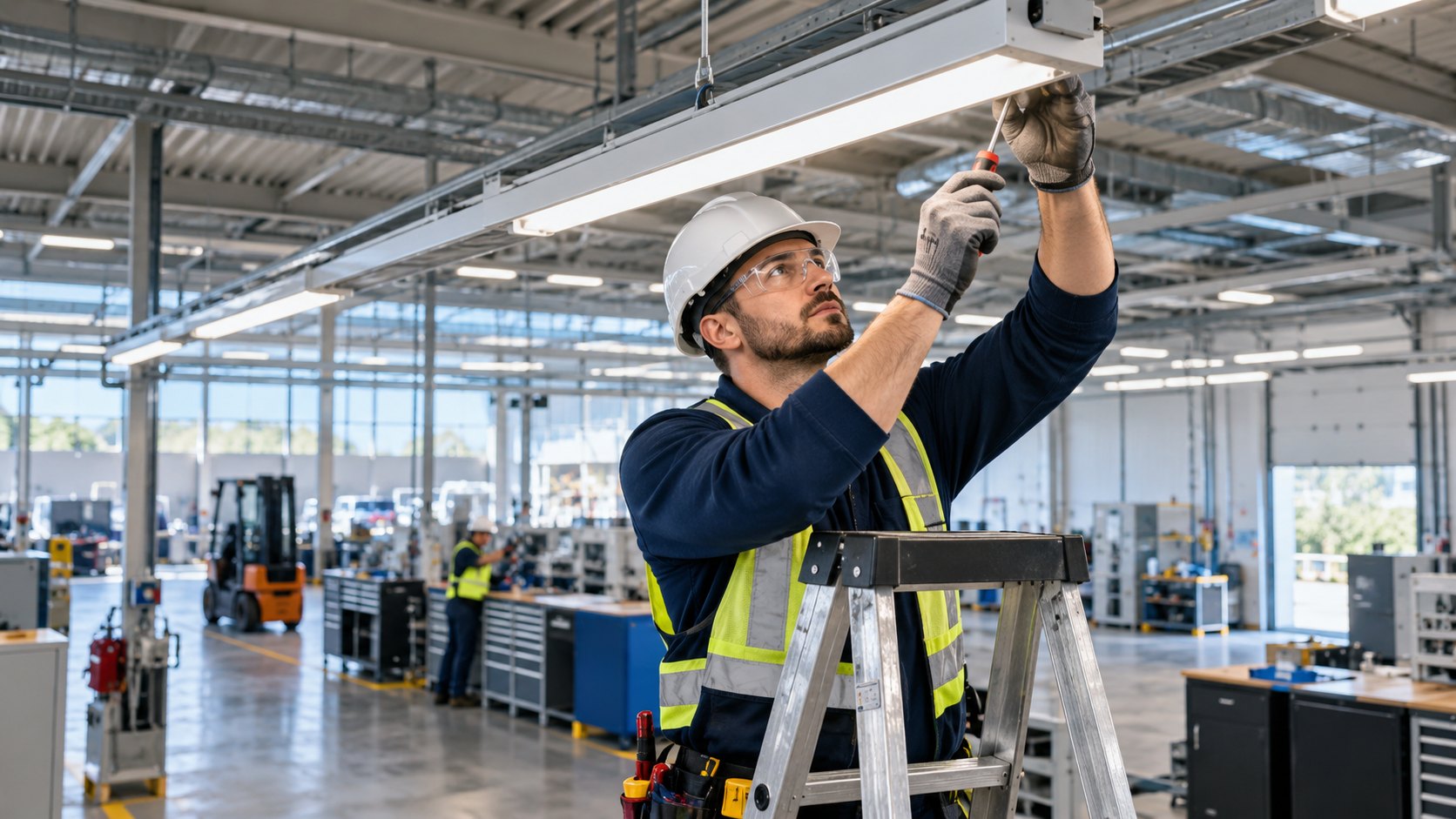
Industrial and hazardous-area fittings. High-bay, plantroom and explosion-protected luminaires, where the enclosure is part of the protection and the unit costs enough that overhaul beats replacement. Work on certified equipment is the opposite of improvisation: a part goes back exactly as its certificate describes, or the protection it was bought for is gone.
Decorative and chandelier work. Hotel atriums, mosques, malls and villas, where the fitting is a commissioned object rather than a product. Cleaning, rewiring, lamp holder replacement and crystal matching, usually at height, usually against a deadline set by somebody else's event calendar.
Who is this for?
Lighting and controls specialists
People who already commission dimming and control systems and understand what a driver has to do besides light a diode. The diagnosis is the skill here, and it is scarce enough to charge properly for.
Event and rental technicians
Operators servicing their own fixtures who realise they are already running a workshop and could be servicing everybody else's. The step up is stock and premises, not competence.
Facilities maintenance contractors
Firms with buildings already under contract who lose margin every time a fitting is thrown away instead of mended. Bringing the capability in-house keeps a spend that is currently leaving the company.
Brand agents and importers
A distributor who has given a five-year warranty on a luminaire needs somewhere to honour it, and a service bench turns that liability into a billable line. Worth testing first whether the plan is repair at all, or a trading line with a workshop behind it — those are different activities.
CZ 33 — Repair And Maintenance Of Electric Lighting Equipment
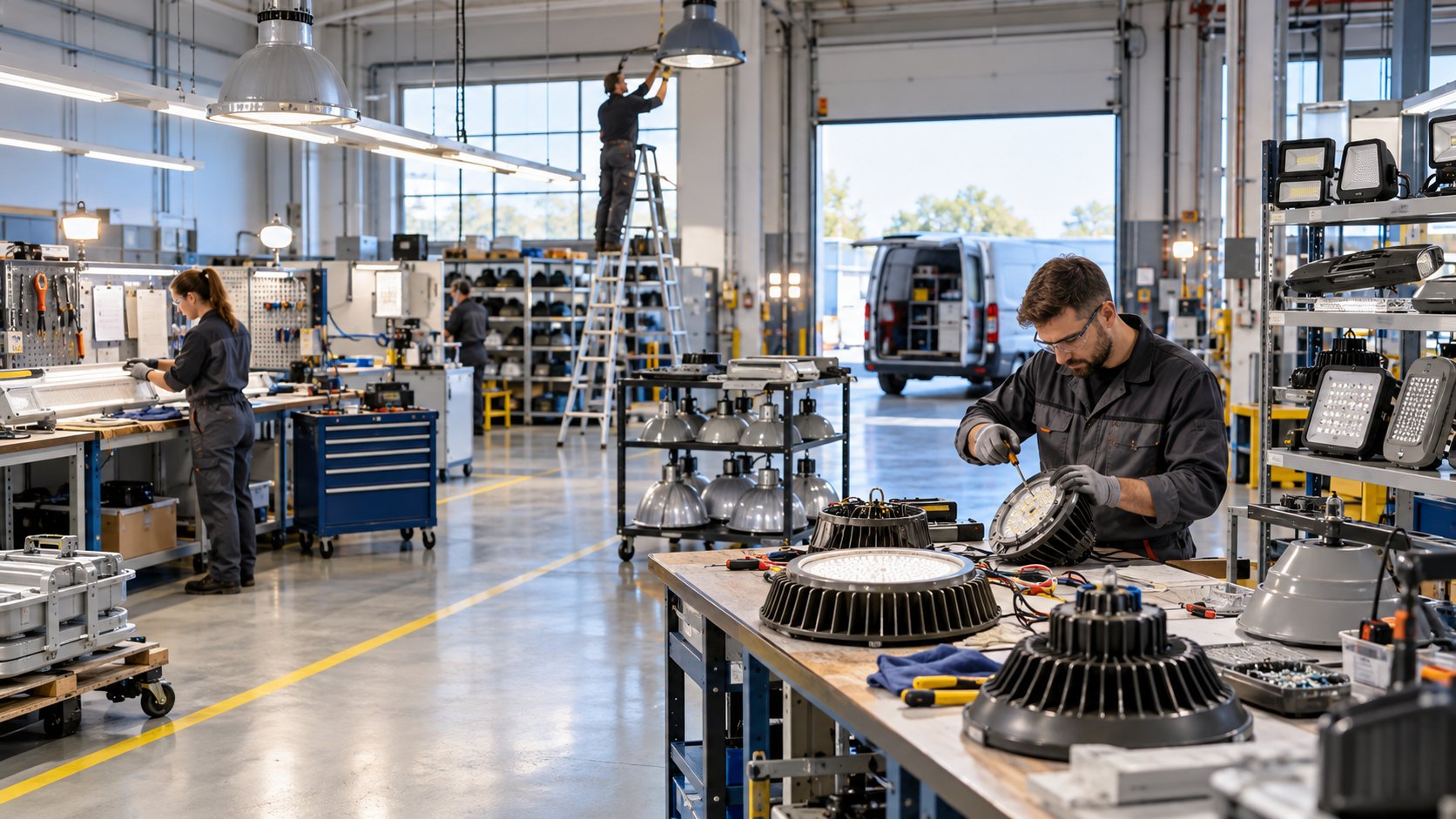
Under this line you diagnose, dismantle, mend, overhaul, test and maintain lighting equipment: interior and exterior luminaires, lamps and lamp holders, drivers and control gear, emergency and exit fittings, and the control devices sitting between a switch and a light. The catalogue files it under manufacturing rather than services, which is how repair of equipment is normally classified — and that classification is worth confirming for your own file, because it can change which authority takes an interest and what the premises are expected to be.
The repair-or-replace decision is the whole business
Every job runs the same sequence, and a workshop that gets it wrong loses money on quotations rather than on work. Identify the fitting and isolate what has actually failed: driver, LED board, optic, control gear or the housing itself. Then price the equivalent new fitting before pricing the repair, because the new fitting is the number the client is measuring you against. The question that decides the job is whether the same fitting can still be bought. If it can, a commodity panel or downlight is simply replaced, the labour to open it costs more than the part, and declining that quotation is the right answer. If it cannot, mending is the only way to hold a lighting scheme together instead of re-specifying a facade or a ceiling grid one unit at a time, and the job is worth taking. What follows is sourcing — the original driver, or an equivalent cross-referenced against the current, the dimming protocol and the space it has to occupy. What the client buys at the end is either a fitting back in service or a written case for replacing it.
- Identify the fitting and isolate what failedDriver, LED board, optic, control gear or the housing
- Price the equivalent new fitting firstIt is the number the client measures the quotation against
- Can the same fitting still be bought
- YesA commodity panel is replaced — opening it costs more than the part
- NoMending holds the scheme together, and the job is worth taking
- Source the driver, or cross-reference an equivalentMatched on current, dimming protocol and the space available
- The fitting goes back in service, or the client gets a written case for replacing it
Obsolescence is the trade's real difficulty
Parts availability, not technical difficulty, is what closes files on this activity. A driver out of a five-year-old luminaire may not exist any more, and a substitute has to satisfy the output current, the voltage window, the dimming protocol and the physical space it must fit inside. A workshop that can cross-reference gear and hold a sensible stock of common drivers converts jobs a competitor turns away — and that stock is where the working capital goes. This is a labour and diagnosis business with a parts drawer attached, not a parts business.
Where this line stops, and the boundaries that cost money
The line covers the fitting. It does not cover the circuit the fitting hangs on. Installing luminaires into a building's fixed wiring, altering a distribution board or running new circuits is electrical contracting: a different licence line, with its own competence requirements and its own approvals. Assembling or making luminaires is manufacturing. Importing and selling fittings is a trading line. Mending the accessories around the fitting — the socket outlets, switches, conduit, trunking and back boxes — is the next activity along in this catalogue, CZ 34, and the boundary between the two is clean. CZ 33 is the luminaire. CZ 34 is everything the luminaire is fed through.
Where this is the wrong purchase. If the plan is to import, stock and sell lighting, this is the wrong activity. A trading line does that job directly, and a repair activity only adds conditions you have no use for.
What attaches to the equipment rather than to the company
Three things reach past the authority that cuts your licence, and none of them is about the workshop.
Lighting product placed on the UAE market is subject to national standards and conformity assessment, which sit federally with the Ministry of Industry and Advanced Technology.¹ A repairer who supplies the replacement part as well as fitting it is putting product into service and inherits that question along with the job.
Emergency and exit luminaires are life-safety equipment. Their condition in an occupied building is a fire-safety matter rather than a lighting one, which is why the civil defence authority has an interest in how they are maintained and in what evidence exists that they still work.²
A fitting with a wireless control module inside it is radio equipment as well as a light. Type approval for radio and telecommunications equipment sits with the Telecommunications and Digital Government Regulatory Authority, and it is an entirely separate question from anything to do with illumination.³
Beyond those, the workshop is premises like any other. The municipality covers suitability, public health and waste, and what leaves the bench as scrap — spent lamps and dead control gear included — is a disposal question rather than a housekeeping one.⁴ The approvals and conditions that apply in practice differ between the emirates and between the licensing authorities inside them, and we confirm what they are for your activity mix, premises and emirate before anything is committed.
References
- Ministry of Industry and Advanced Technology — national standards and conformity assessment for lighting products placed on the UAE market. Ministry of Industry and Advanced Technology
- Dubai Civil Defence — fire and life-safety requirements in occupied buildings, which is what brings emergency and exit luminaires into scope. Dubai Civil Defence
- Telecommunications and Digital Government Regulatory Authority — type approval for radio and telecommunications equipment, including wireless lighting control modules. Telecommunications and Digital Government Regulatory Authority
- Dubai Municipality — workshop premises suitability, public health and the handling of waste in Dubai. Dubai Municipality
Elsewhere in Manufacturing
Activities that sit beside this one
Most licences carry more than one activity. Adding a neighbouring line at the application stage costs a fraction of amending the licence afterwards.
Begin with a clear conversation
Tell us what you intend to build.
A consultant will map the structure, jurisdiction, approvals and likely cost against what you actually described — not against a package.
