
Activity CZ 25
How to Start a Ship and Rail Engine Repair Business in Dubai
Ship and rail engine repair happens where the asset is, not where the workshop is. What this line covers, who the customer is, and why class and port permissions decide how the job runs.
ConsultZone licensing desk
- Activity code
- CZ 25
- Category
- Manufacturing
- Reviewed
- Read
- 8 min
Listen instead
41 seconds
An audio summary of this guide.
Topic summary
How to Start a Ship and Rail Engine Repair Business in Dubai
An engine of this kind is almost never brought to the repairer. A ship's main engine is bolted into a hull and a locomotive's prime mover is built into a frame, so the repairer travels — with tools, parts, a lifting plan and a crew — to a berth, an anchorage or a depot where somebody else owns the floor and somebody else writes the safety rules. Every commercial feature of this activity follows from that single fact.
It separates the line cleanly from the general machinery workshop. A workshop repairer can decide what jobs to take and when to take them. A marine or rail engine specialist works to the asset's window: a vessel sails on a tide, a locomotive has a depot slot, and both were scheduled by someone whose interest is getting the asset back into service rather than giving you a comfortable shift.
The UAE is a genuinely good place to do it, for reasons of geography rather than policy. The country sits on both sides of the Strait of Hormuz, with commercial ports at Jebel Ali, Khalifa Port, Hamriyah and Sharjah, and an anchorage off Fujairah where ships take fuel and stores without entering a port at all. Traffic between Asia and Europe passes within reach. On the land side, the national railway, Etihad Rail, has put a fleet of heavy diesel-electric traction into the country, which is a class of engine that had almost no domestic service market a decade ago.
The customer is a fleet, and the asset only earns while it moves
Nobody on this customer list is an individual. They are shipowners and their managers, tug and workboat operators, dredging and marine contractors, offshore support fleets, port operators with their own craft, and rail operators and their depot contractors. All of them run the same arithmetic: the asset is a capital item that produces nothing whatsoever while it is stationary, so the cost of the downtime usually dwarfs the cost of the repair.
That does three things to the commercial shape of the business, and each of them is worth pricing for.
First, it makes speed worth more than rate. A quotation that is cheaper but slower frequently loses, which is the opposite of how the general repair market behaves.
Second, it makes the work lumpy and sometimes nocturnal. Engine work clusters around dry-dockings, surveys, voyage windows and depot availability. Utilisation is the hard problem, and it is why firms in this trade take on planned overhaul work at predictable dates to fill the gaps between unplanned failures.
Third, it puts a third party in the room. On the marine side, an owner's insurer, the vessel's flag administration and its classification society all have an interest in who performed the work and to what standard. The customer is not simply buying a repair. They are buying a repair that will survive being inspected by somebody else, which is a higher bar than a factory gearbox has to clear and the main reason this line commands the rates it does.
Where this is the wrong purchase. If the plan is to sell engines, spares or reconditioned units, that is a trading activity, not this one. If the plan is to work on cars, vans, trucks or buses, the name of this line excludes it by design and a garage activity is the correct one. And a general engineering workshop hoping to take marine work occasionally should be honest about the third parties above before assuming the licence alone is enough.
CZ 25 — Repair and maintenance of non-automotive engines
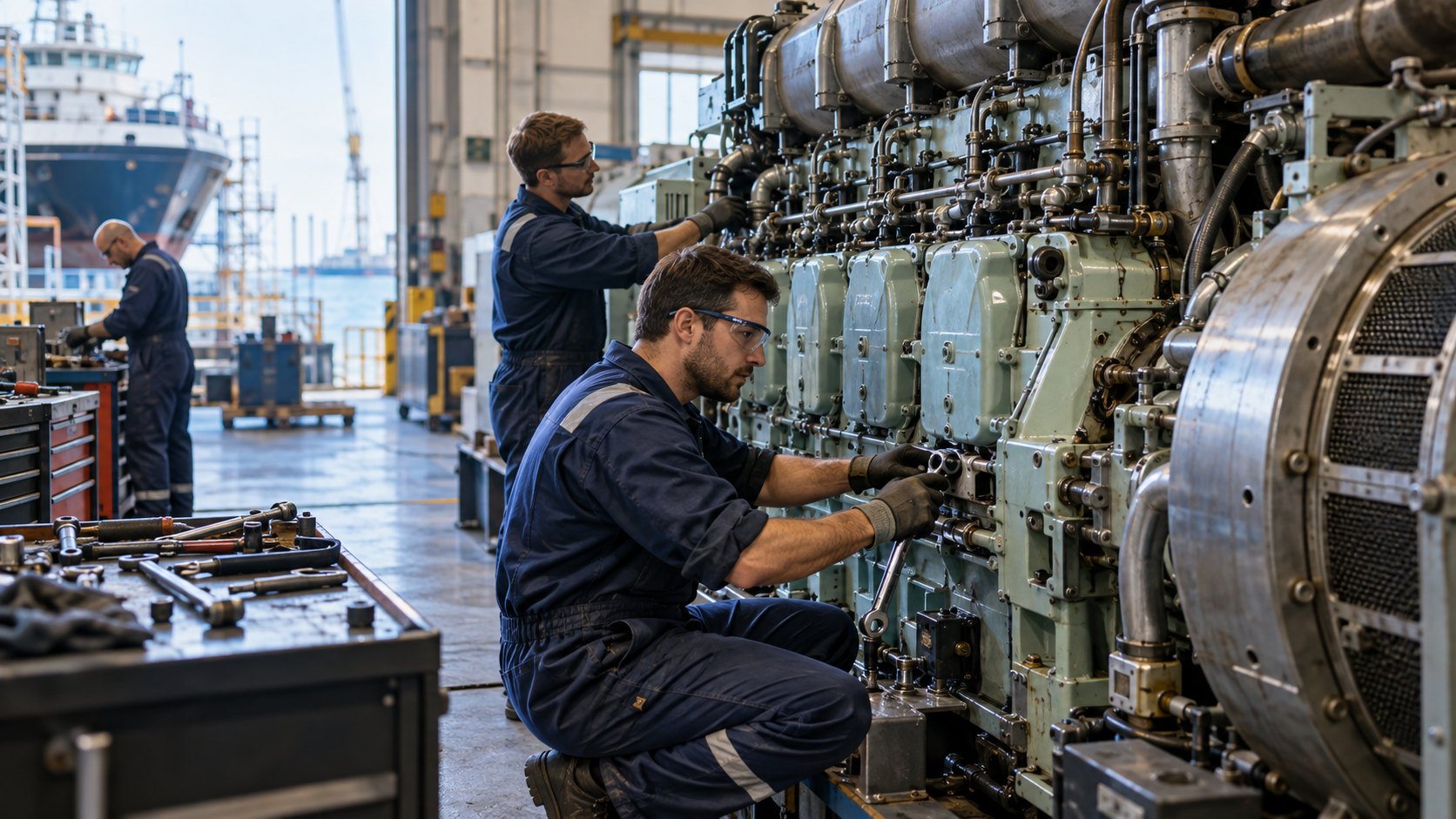
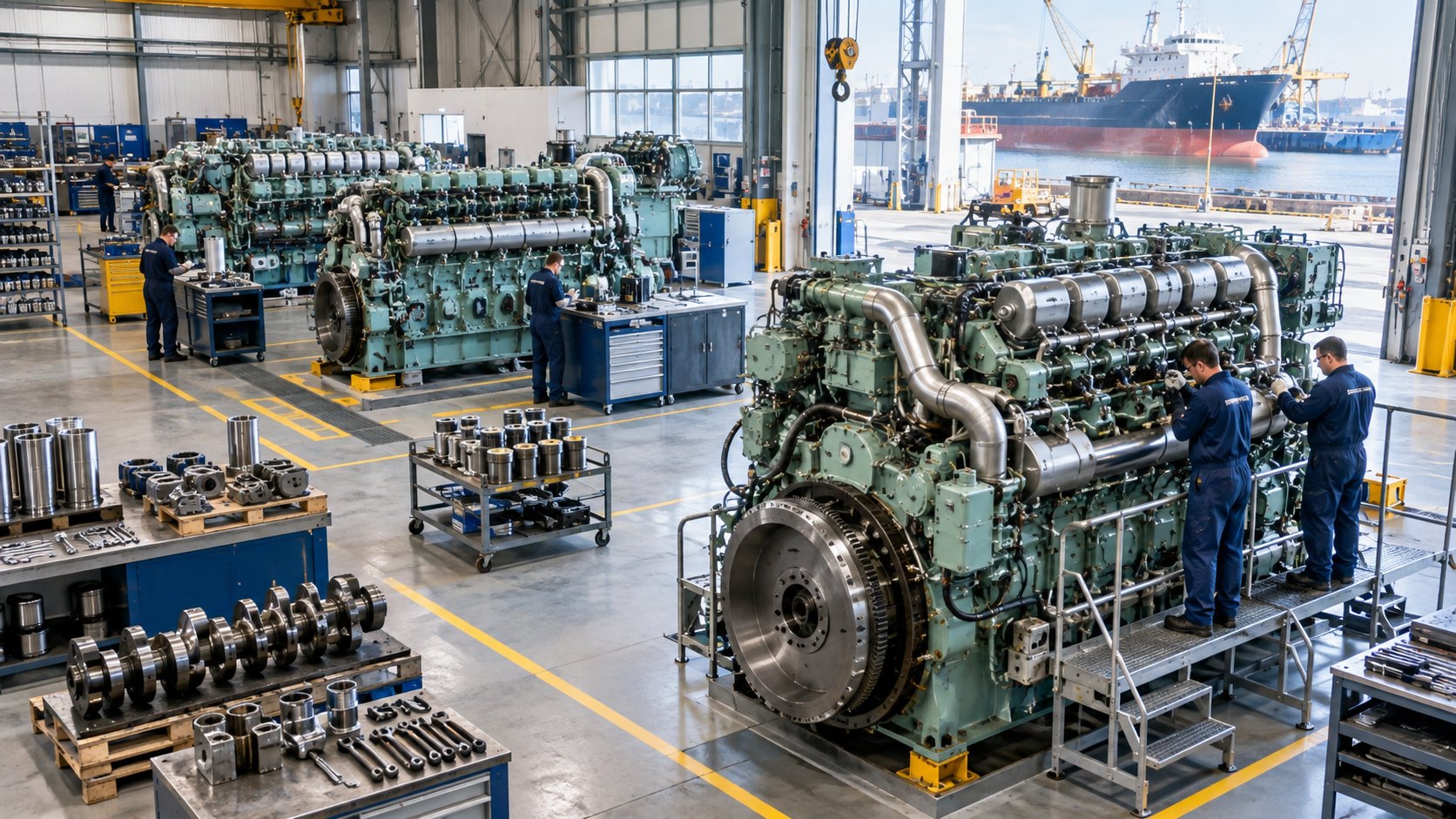
The line covers propulsion and power engines outside road transport, and the systems hung off them. In practice that means the main engines and auxiliary generating sets of ships, tugs, barges, workboats, dredgers and offshore support craft, and the prime movers and traction sets of locomotives and depot plant. The mechanical work is heavy and specific: cylinder liners, pistons and rings, bearings and journals, crankshaft measurement and alignment, valve seats and heads, turbochargers, fuel injection equipment, cooling and lubricating systems, starting air, and governors and their controls.
What the name deliberately keeps out
Non-automotive is doing real work in that activity name. Road vehicles are excluded outright. Aircraft engines are excluded too, and far more firmly than most people expect: aviation maintenance runs under a separate approval regime administered by the General Civil Aviation Authority, and an organisation without that approval cannot work on an aircraft engine whatever its trade licence says. Building new engines is manufacturing. Selling engines and parts is trading. Hull plating, structural steel and tank work belong with fabricated metalwork rather than here. Bridge electronics, automation and power management are an electrical specialism.
Three places the work happens, and each one changes the job
An engine job in this trade is done in one of three settings, and the setting decides who controls the site, whose permit governs the work, what happens when a part is late and what premises you actually have to hold. It is worth deciding which of the three the company is built around before taking a unit, because a business equipped for one is poorly equipped for the others.
judged on the same six rows
| Judged on | Your workshop | Alongside the asset | The operator's depot |
|---|---|---|---|
| Who controls the lifting gear and the power | You | The vessel and the port | The operator |
| Whose safety permit the job runs under | Yours | The port's and the ship's | The operator's |
| What a late part costs | Your schedule slips | The asset earns nothing | The depot slot is lost |
| Whether a class surveyor can attend easily | Yes | Depends on the berth | Not usually relevant |
| Premises you must actually hold | A bay with lifting height | A store and a van | A store and a van |
| Who you are competing against | Every machine shop | Few, and they travel | The operator's own fitters |
The middle column is where most of this trade's revenue sits and where its hardest constraints are. Working alongside a vessel means the crew, the tools and the components all have to reach a berth or be boated out to an anchored ship, under the port's rules and the master's authority, in a window that was not set by you.
The approvals attach to the job, not only to the company
This is the part that catches general engineers moving into marine and rail work. A trade licence lets the company exist and trade. It does not by itself open a berth, satisfy a surveyor or permit hot work next to a fuel tank. Several of the permissions on this activity are per job and per site.
Classification and flag. Where a repair touches an item covered by the vessel's classification, the work is done to the class society's rules and witnessed by its surveyor, and the flag administration has its own interest. These are not UAE approvals — they follow the ship — but they govern how the job is performed and documented, and they are frequently what an owner is really selecting a contractor on.
Port and terminal permissions. Work on a vessel alongside or at anchor runs under the port or terminal's own contractor arrangements: site access for the crew, a permit for the berth, and a means of reaching a ship lying off. Confirm these with the port concerned as well as with the licensing authority, because they differ port to port.
Hot work and flammable materials. Cutting and welding near fuel tanks and machinery spaces is among the most tightly controlled operations in ship repair, and a workshop holding fuels, oils, solvents and gas cylinders carries fire-safety conditions on its own premises. In Dubai those approvals come from Dubai Civil Defence.
Waste. Used lubricating oil, oily water, sludge, spent coolant and contaminated absorbents are controlled streams with approved disposal routes rather than ordinary refuse. In Abu Dhabi environmental permits are handled by the Environment Agency Abu Dhabi; in Dubai the municipality covers it.
People. Technicians who sail with a vessel or travel to an asset need work permits issued against the licence through the Ministry of Human Resources and Emiratisation, and a riding crew raises questions about hours and travel that a workshop-only company never has to answer.
Parts across a border. Components imported for a vessel, or sent out for machining and brought back, move under customs arrangements including temporary import and re-export, handled through Dubai Customs in Dubai.
What each of those requires, and which of them applies to a given job, depends on the emirate, the port, the asset's flag and its class. Those are the points ConsultZone confirms against a specific plan before a licence is committed to, because the wrong activity wording on an engine business is expensive to correct once a contract is signed against it.
References
- UAE Government portal — federal government information on maritime and rail transport and the instruments behind them. UAE Government portal
- General Civil Aviation Authority — aircraft and aircraft-engine maintenance approvals, which sit outside this activity entirely. General Civil Aviation Authority
- Dubai Civil Defence — fire-safety approvals for hot work and for premises holding fuels, oils and gas cylinders. Dubai Civil Defence
- Environment Agency Abu Dhabi — environmental permits and controlled waste streams for engine work in Abu Dhabi. Environment Agency Abu Dhabi
- Ministry of Human Resources and Emiratisation — work permits for technicians travelling to an asset or sailing with a vessel. Ministry of Human Resources and Emiratisation
- Dubai Customs — import, temporary import and re-export of engine components and spares. Dubai Customs
Elsewhere in Manufacturing
Activities that sit beside this one
Most licences carry more than one activity. Adding a neighbouring line at the application stage costs a fraction of amending the licence afterwards.
Begin with a clear conversation
Tell us what you intend to build.
A consultant will map the structure, jurisdiction, approvals and likely cost against what you actually described — not against a package.
