

Activity CZ 39
How to Start a Passenger & Cargo Aircraft Repair Business in Dubai
Nobody buys aircraft repair. They buy the aircraft back. That is why a passenger and cargo repair business is sold on turnaround and on the certainty of the release, not on an hourly rate.
ConsultZone licensing desk
- Activity code
- CZ 39
- Category
- Manufacturing
- Reviewed
- Read
- 8 min
Listen instead
52 seconds
An audio summary of this guide.
Topic summary
How to Start a Passenger & Cargo Aircraft Repair Business in Dubai
An aircraft in a hangar is an asset earning nothing. Whoever owns it is paying for crew, for finance, for parking and for a schedule it is not flying, and every one of those costs runs whether the aircraft is being worked on or waiting for a part. That is the number your customer is managing, and it is far larger than your invoice. It is also the reason this trade is not priced like a workshop: what a repair business sells is a date, and the confidence that the aircraft will actually leave on it.
There are two kinds of customer and they read the same job differently. An operator wants the aircraft flying and will judge you on the calendar. A lessor wants the aircraft and its maintenance records in defensible condition at the end of a lease, because the records are a substantial part of what the asset is worth when it changes hands — a gap in them is a commercial problem long after the metal is sound. Work for operators is measured in downtime. Work for lessors is measured in documentation. A business that quotes both the same way will lose money on one of them.
The margin is in capacity, and capacity is slow to build
Heavy airframe work is capacity-bound in a way that few service businesses are. It needs a hangar bay large enough for the type, docking to reach the airframe, calibrated tooling, and licensed engineers who can sign for what they have done. None of that can be added in a quarter. A bay either exists or it does not, so the price of the work tracks availability rather than the cost of the labour inside it — which is why the good years in this sector are the ones where somebody else has no room.
The UAE's position helps on both sides of the ledger. The Gulf sits on the long-haul routes between Europe, Asia and Africa, the fleets based here are weighted towards larger aircraft, and freighter traffic through the region is dense. So there is a resident fleet to serve and transit traffic that can be persuaded to plan a check where it already flies. Cargo is the part most people underestimate: freighters are generally older airframes worked harder, which makes them heavier maintenance customers than an equivalent passenger fleet, and the growing practice of converting passenger aircraft into freighters is structural work of exactly the kind a base maintenance facility is built for. Worth being precise about that one, though — a conversion is a design change to the aircraft rather than a repair, so it is normally carried out under design approval data held by somebody else, and the facility's role is to install it correctly and record it properly.
Working capital in this business is parts. A check opens an airframe and finds things nobody quoted for, and from that moment the customer's date depends on whether the component is on your shelf, on a pool you can draw from, or on a lead time. You either carry inventory, buy access to somebody else's, or explain delays — and explaining delays is precisely the thing the customer came to you to avoid. Licensed engineers are the other scarce input, and they are internationally mobile, so payroll here competes with every other facility in the world rather than with the local labour market.
Two things are worth knowing before the plan is written. Line maintenance — the between-flights work at a gate or on a stand — looks like the same industry and is a much thinner one: high responsiveness, low hours, little of the structural work where the value is. And a facility with a narrow type capability is exposed to one fleet's renewal decisions, so breadth is a risk position as much as a marketing one.
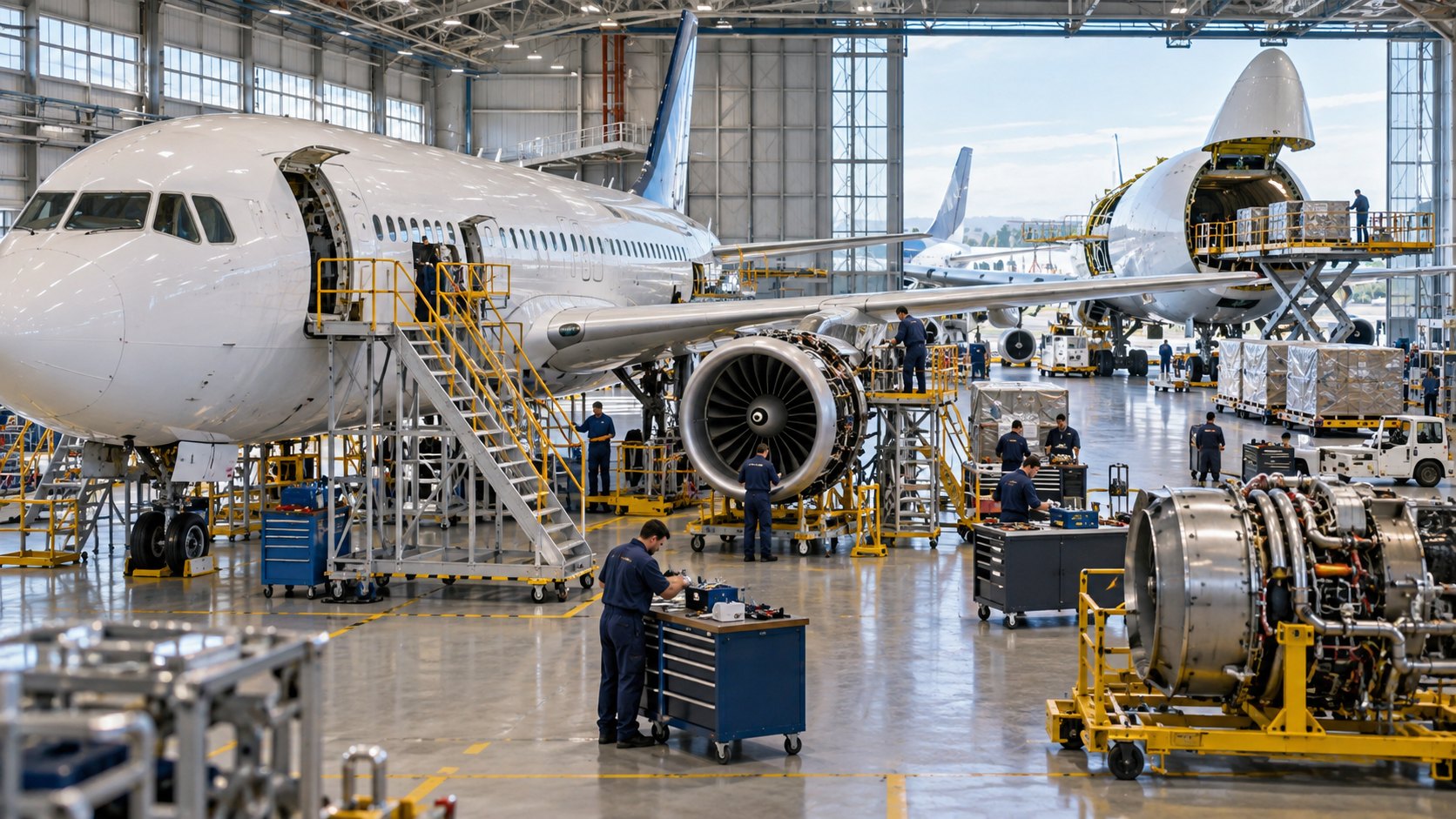
CZ 39 — Passengers & Cargo Aircrafts Repair
This line covers work on the aircraft itself, as a whole machine: scheduled inspections and checks, structural repair, corrosion treatment, the removal and fitting of components and systems, defect rectification, and modifications carried out under approved data. It reads across passenger and cargo transport aircraft alike, and in practice cargo is the more demanding half of it.
What it is not is every trade that happens near an aircraft. Engine and auxiliary power unit overhaul is shop work with its own tooling, test cells and approvals. Repairing an avionics or hydraulic unit is component work, done to the unit rather than to the aircraft. Cabin interiors are a separate capability, and the soft trim of seating in particular has its own activity line — CZ 38, where the controlling question is material qualification rather than airframe access. Rotary-wing aircraft are the clearest boundary of all: helicopters sit on the next line of the same sheet, CZ 40, and a capability written for transport aeroplanes does not reach them, because an approval's scope is written by aircraft type and a helicopter is a different type with a different maintenance logic.
Within the line there are three business shapes, and choosing between them is a bigger decision than choosing an emirate.
judged on the same five rows
| Judged on | Base maintenance | Line maintenance | Component shop |
|---|---|---|---|
| Needs a hangar bay of its own | Yes | No | No |
| The aircraft is out of service while you work | Yes | Rarely, between flights | No, the part travels instead |
| Where the capital sits | Docking, hangar and tooling | People, vehicles and response | Test benches and shelf stock |
| What the customer is buying | A date, and certainty of the release | Response time on the stand | Availability and documentation |
| Realistic for a first facility | Generally not | Yes | Yes, in a narrow capability |
Nothing you do is saleable until the organisation is approved
The approval in aircraft maintenance belongs to the organisation, not to the individual, and its value is entirely in its scope: which aircraft it covers and which classes of work. Hiring an experienced engineer does not extend it. The General Civil Aviation Authority approves maintenance organisations and sets the airworthiness framework that applies here, and the conditions attaching to an approval — a quality system, a capability list, controlled procedures, calibrated tooling and appropriately licensed staff — are the real content of the business plan rather than an appendix to it.¹
One question in this area decides your customer list and is routinely discovered too late. An approval is issued by the authority that oversees the aircraft. A UAE approval answers for aircraft the UAE oversees; taking work on an aircraft overseen by another state generally means holding a matching approval from that state's authority as well. That is a commercial choice about which fleets you can quote for, and it should be made when the facility is designed, not when the first foreign operator asks for a slot.
Parts carry the same logic. A component is an aircraft part because of the documentation that releases it, and a part whose paper trail is broken is scrap however new it looks. Goods inward, quarantine of unproven material, and a record that ties every fitted item back to its release is not administration around the engineering — for an auditor and for a lessor it is the engineering.
The physical conditions are what they sound like. A hangar holds fuel, oxygen, solvents, paint and compressed gases, which makes fire safety a matter for the premises and the way those materials are stored rather than a workshop detail.² Effluent, spent chemicals and scrapped material are waste streams with their own municipal conditions.³ Airside access and a stand or a taxi route to your door come from whoever runs the aerodrome and are not granted by the body that issues the licence — a distinction that has surprised more than one investor who secured a licence and then discovered the aircraft could not reach the building. Work permits and contracts for engineers and technicians run through the Ministry of Human Resources and Emiratisation.⁴
On the mainland and free zone question, the honest general answer is that the premises decide it here, because hangar-capable land adjacent to an airport is not evenly available and the site narrows the list before ownership or tax does. A free zone suits a facility whose customers are largely foreign operators and whose parts are held in bond and re-exported. The mainland suits a facility serving UAE-based operators and government fleets. Two tax points are worth raising early rather than late: corporate tax applies at nine per cent on taxable income above AED 375,000, with a zero rate available to a qualifying free zone person on qualifying income where the substance conditions are met,⁵ and the value-added tax treatment of a repair invoiced to a foreign operator is a question to settle with the Federal Tax Authority's own rules before the first invoice rather than after it.⁶ ConsultZone confirms the licensing route, the approval path and the tax position against your intended scope and customer mix.
References
- General Civil Aviation Authority — approval of maintenance organisations, scope of approval and the airworthiness requirements applying to aircraft maintenance in the UAE. General Civil Aviation Authority
- Dubai Civil Defence — fire-safety requirements for hangars and for the storage of fuel, solvents, paint and compressed gases. Dubai Civil Defence
- Dubai Municipality — premises conditions and industrial waste streams. Dubai Municipality
- Ministry of Human Resources and Emiratisation — work permits and labour contracts for licensed engineers and technicians. Ministry of Human Resources and Emiratisation
- Federal Decree-Law No. 47 of 2022 on the Taxation of Corporations and Businesses. Ministry of Finance
- Federal Tax Authority — value-added tax treatment of services supplied to non-resident customers, and corporate tax enrolment and filing. Federal Tax Authority
Elsewhere in Manufacturing
Activities that sit beside this one
Most licences carry more than one activity. Adding a neighbouring line at the application stage costs a fraction of amending the licence afterwards.
Begin with a clear conversation
Tell us what you intend to build.
A consultant will map the structure, jurisdiction, approvals and likely cost against what you actually described — not against a package.
