
Activity CZ 43
How to Start a Medical & Laboratory Equipment Repair Business in Dubai
An analyser drifting out of calibration does not fail loudly. That is why medical and laboratory equipment servicing is contracted work rather than call-out work, and why the hardest gate belongs to the maker.
ConsultZone licensing desk
- Activity code
- CZ 43
- Category
- Manufacturing
- Reviewed
- Read
- 8 min
Listen instead
1 min 2 sec
An audio summary of this guide.
Topic summary
How to Start a Medical & Laboratory Equipment Repair Business in Dubai
A broken machine is the easy case. The expensive failure in a hospital or a diagnostic laboratory is the machine that still switches on: an analyser a few per cent out of calibration, an infusion pump delivering slightly less than the number on its screen, a steriliser running a cycle that looks complete and is not. Nothing alarms. Results come out looking normal and are wrong, and the facility discovers the problem in a patient rather than on a screen.
That is the whole commercial argument for this activity, and it is a stronger one than either of the neighbouring equipment-servicing lines can make. A clinic cannot defer this work in the way a boat owner defers a winch or an aircraft owner defers a paint job, because the facility's ability to demonstrate that its equipment is fit to use is bound up with its own standing as a licensed provider. The order book is filled by an obligation, not by a marketing budget.
Of the three repair lines a reader usually compares — aircraft, marine and medical — this one has the best customer, the highest barrier to entry and the longest contracts. That barrier is worth understanding first, because no government body holds it.
CZ 43 — Medical & Laboratory Equipment Repair
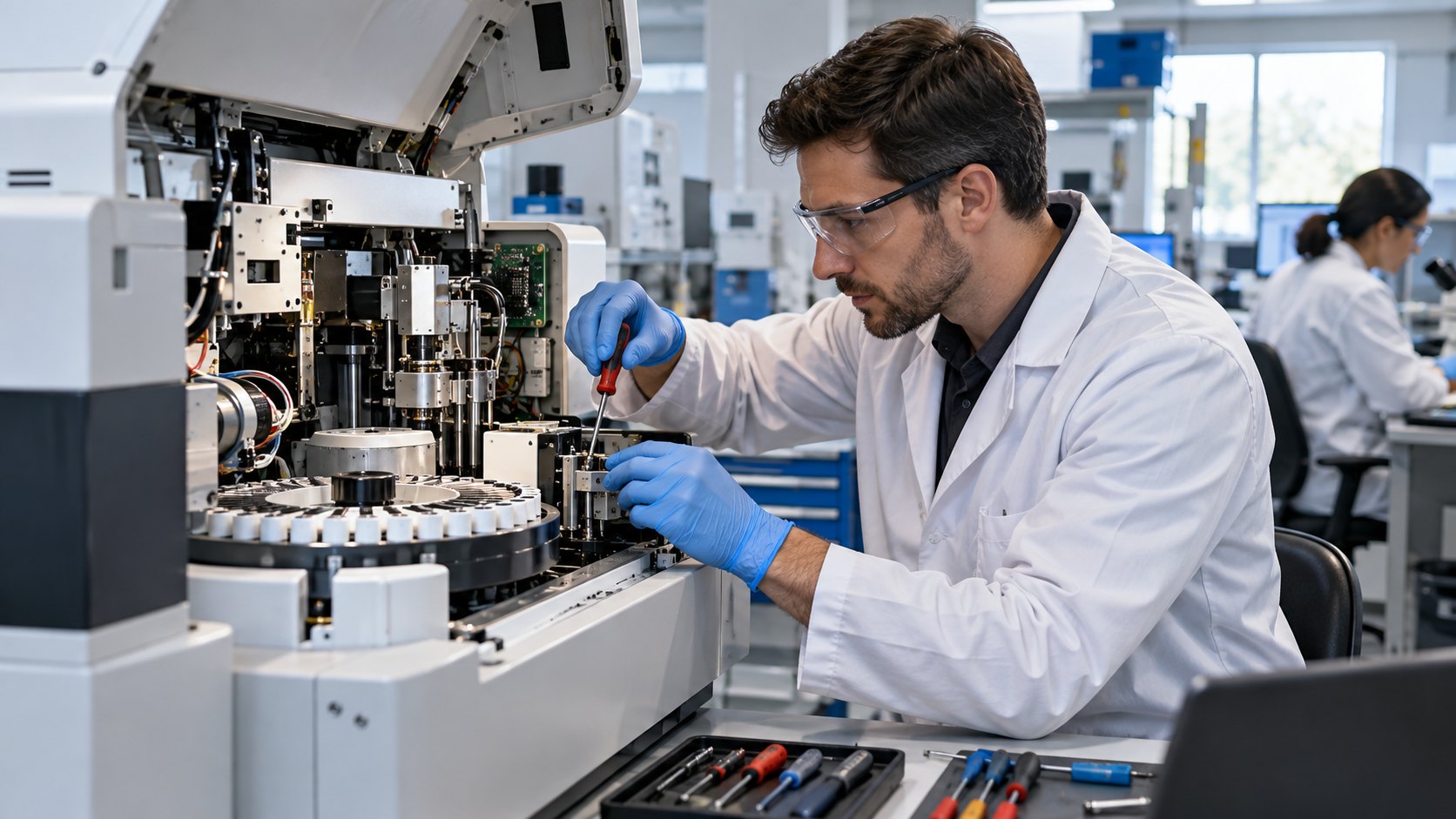
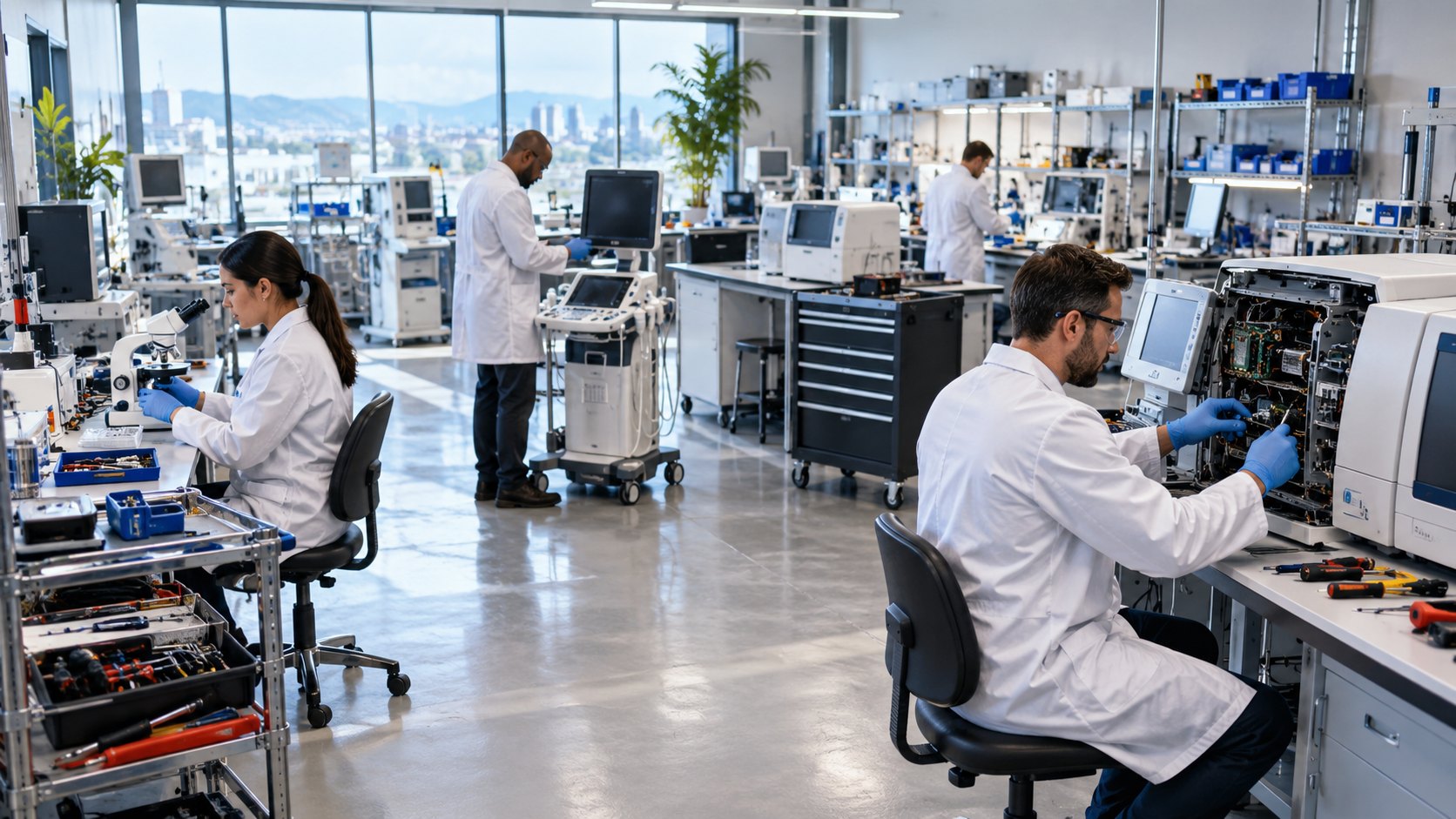
Under this line sits the servicing, calibration, performance testing and repair of clinical and laboratory equipment: patient monitors, infusion and syringe pumps, ventilators and anaesthesia machines, defibrillators, dialysis units, surgical and dental equipment, sterilisers and autoclaves, imaging equipment, and on the laboratory side analysers, centrifuges, microscopes, incubators, water baths, fume cupboards, pipettes, balances and the cold storage that holds samples and reagents.
Note the proportions, because they are the opposite of what the activity name suggests. Most of the revenue is planned: commissioning checks on installation, scheduled preventive maintenance to the manufacturer's own interval, calibration and performance verification, electrical safety testing, and decommissioning at end of life. Repair is the smaller and spikier part. A shop that sells itself as a repairer is pricing the minority of its own work.
The hardest gate is held by the manufacturer
This is the finding that decides whether the business is viable, and no authority controls it. Service manuals, calibration and diagnostic software, service-mode access, firmware, genuine spare parts, consumable kits and factory training are all controlled by the equipment maker, released to organisations it authorises and withheld from those it does not. An engineer can be excellent and still be locked out of a machine he understands perfectly.
Two consequences follow, and they pull in opposite directions. The authorisation is the barrier — it is why a hospital's equipment is not serviced by whoever is cheapest. It is also the moat, because once you hold it for a brand that is already installed across a city's clinics, the competitive field narrows to whoever else holds the same letter.
Regulation sits on the goods and on your customer
Medical devices are health-regulated products in the UAE, and the control is federal: the Ministry of Health and Prevention is the authority for medicines, medical devices and health products, and what may be supplied and by whom sits with it.¹ Where the facility is in Dubai, the Dubai Health Authority licenses the facility itself and governs the trade in health products there.² A servicing company meets both of those obliquely rather than head-on — but it does meet them, because the hospital passes its own obligations down the chain to its suppliers. Expect to be asked for traceable calibration documentation, technician competence records, evidence of where your parts came from, and an audit trail per asset.
That is not a burden to minimise in the plan. It is the product: a facility is buying a defensible answer to a question an inspector may ask, not an hour of engineer time.
Five ways in, and they are not equally good
The activity permits several business models and they have genuinely different economics. Sole authorisation for a maker gives you their parts channel and their name in your quotation, at the price of a territory you do not own. Independent multi-vendor work makes every brand in a building a prospect, and leaves you buying access at somebody else's price or working around it. Calibration and safety testing alone is the fastest start and the thinnest invoice. A planned maintenance contract pays whether anything breaks or not, and obliges you to hold engineer capacity in reserve. Pure break-fix looks free of commitment until you notice the customer calls his contract holder first.
What it givesWhat it costs
- Authorised service for one makerParts, software access and the maker's name on your quotationA territory you do not own and targets somebody else sets
- Independent multi-vendor servicingEvery brand in the building becomes a customerParts and software bought at someone else's price, or not at all
- Calibration and safety testing onlyA small toolkit, a fast start, work every facility needsThin invoices, and you leave before the profitable repair is quoted
- Planned maintenance under contractRevenue that arrives whether anything fails or notEngineer time held in reserve for a fixed fee
- Break-fix call-outs onlyNo commitment, and the highest hourly rateThe contract holder is called first and you get what is left
Most shops that last start on the third row and work upward. The marked row is marked because it is the only route where the customer relationship belongs to you rather than to a manufacturer.
Adjacent lines people confuse with it
Several activities look like this one on a spreadsheet and are not, and choosing the wrong one means amending a licence rather than using it.
Selling equipment is not servicing it. Supplying medical devices or laboratory instruments is a trading line with its own health-product control, and a company that intends to do both needs both — the fact that the same engineer installs the machine he sold does not merge the two activities.
Running the tests is not fixing the machine. A laboratory that performs diagnostic testing is a health facility answering to health-facility licensing, which is a different order of obligation entirely.
Instrument calibration for industry is the closest genuine neighbour: pressure gauges, torque tools, thermometers, weighing equipment. The skill overlaps almost completely, the customer does not, and the standards and conformity route runs through the Ministry of Industry and Advanced Technology rather than through health regulation.³
Making or assembling devices is production rather than service. Support for imaging software and clinical systems is usually an information-technology line.
The two activities nearest this one in the catalogue are worth naming, because the three are complementary rather than alternatives. Light aircraft maintenance and marine equipment servicing rest on the same discipline — scheduled work, traceable parts, documented sign-off. What separates them is who signs the work off and who controls the parts channel: an aviation authority and the airframe maker in one, a fire authority and the equipment maker in another, and a health regulator and the device maker here.
Who is this for?
Biomedical engineers
The natural founders. Hospital-trained engineers with factory certificates for brands already installed locally start with the one asset that cannot be bought: a maker's authorisation and a reputation with the people who sign the purchase order.
Distributors already holding an agency
A company supplying equipment into the market usually has to service what it sells. Setting that up as a properly licensed and staffed activity, rather than as an obligation absorbed by the sales team, is what turns an after-sales cost centre into contracted revenue.
Independent multi-vendor operators
Harder, slower and more durable. The pitch is that a facility with eleven brands would rather deal with one shop, and the work is winning access brand by brand.
Laboratory and calibration specialists
Metrology people who lean toward the laboratory half of the line: analysers, balances, pipettes, temperature-controlled storage. Small equipment, frequent intervals, and a customer whose entire output depends on the numbers being right.
Where this is the wrong purchase. If the intention is to import and sell devices, instruments or consumables, this activity is the wrong instrument and a trading line with the appropriate health-product permissions is what the business needs. If the intention is to run diagnostic or clinical services, the facility licence is the thing, and equipment servicing is something you will buy rather than sell.
On jurisdiction, the work decides it. Engineers attending hospitals, clinics and laboratories on UAE soil, for UAE-licensed facilities, point to a mainland licence. A free zone case exists where equipment is brought in, worked on and sent out again without entering the local market — a refurbishment centre rather than a service company. The permissions, conditions and costs differ between emirates and change with the equipment classes you intend to handle, so they are confirmed for the specific case before anything is committed. Spare parts and diagnostic consumables are imported goods with their own controls at the border, and that belongs in the plan from the start.⁴
References
- Ministry of Health and Prevention — medical devices, health products and the federal control over what may be supplied and by whom. Ministry of Health and Prevention
- Dubai Health Authority — licensing of health facilities in Dubai and the trade in health products there. Dubai Health Authority
- Ministry of Industry and Advanced Technology — national standards and conformity marks, which is the route for industrial instrument calibration. Ministry of Industry and Advanced Technology
- Dubai Customs — importing spare parts, diagnostic consumables and instruments, and goods subject to control at the border. Dubai Customs
Elsewhere in Manufacturing
Activities that sit beside this one
Most licences carry more than one activity. Adding a neighbouring line at the application stage costs a fraction of amending the licence afterwards.
Begin with a clear conversation
Tell us what you intend to build.
A consultant will map the structure, jurisdiction, approvals and likely cost against what you actually described — not against a package.
