
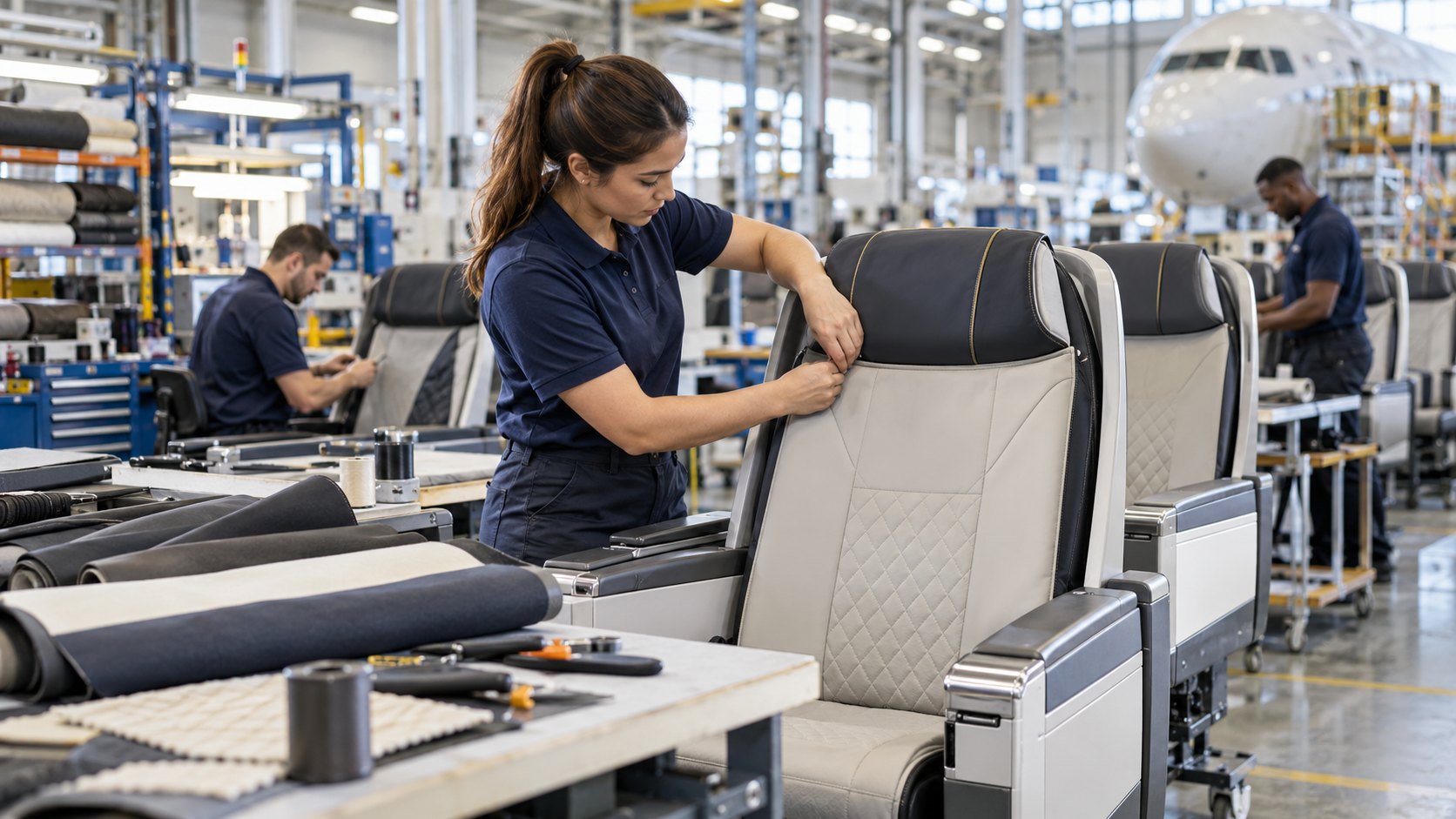
Activity CZ 38
How to Start an Aircraft Seats Upholstery Business in Dubai
Aircraft seats upholstery is the same craft as furniture trim and a completely different business. The barrier is certified materials and traceability, not the stitching.
ConsultZone licensing desk
- Activity code
- CZ 38
- Category
- Manufacturing
- Reviewed
- Read
- 8 min
Listen instead
46 seconds
An audio summary of this guide.
Topic summary
How to Start an Aircraft Seats Upholstery Business in Dubai
Two workshops on the same industrial street can hold the same sewing machines, the same cutting tables and the same trimmers. One recovers hotel furniture. The other recovers aircraft seats. Only the second is a controlled business, and the difference has almost nothing to do with the quality of the stitching.
A seat in a passenger cabin is part of the aircraft. Everything soft that goes onto it — the face leather or fabric, the foam under it, the backing, the thread, the adhesive, the fire-blocking layer — has to satisfy the requirements that apply to any material installed in an occupied cabin, and those requirements are about how a material behaves in a fire rather than about how it wears. Flammability, the way flame travels across a surface, and the smoke and heat a material gives off under test are the properties that decide whether a roll may be used at all. A leather that is faultless in a hotel lobby is not thereby acceptable in row 14.
That one fact reorganises the whole business. The scarce input is not skill; it is qualified material with test evidence behind it and an unbroken paper trail from the mill to the finished cover. The scarce capability is not upholstery; it is being able to hand a customer a completed cover with documentation that lets the organisation responsible for the aircraft put the seat back in service. Without that documentation the work is furniture, however good it looks — and a furniture price is not what pays for the compliance behind it.
Aircraft work is an approved-organisation trade. The General Civil Aviation Authority approves maintenance organisations and sets the airworthiness framework that applies in the UAE, and what a workshop may sell as aircraft work is bounded by the scope of the approval it works under — by the class of work and by the aircraft that approval covers.¹ Whether a trim shop needs an approval in its own name or operates as a supplier inside somebody else's is therefore the first commercial question on the file rather than a formality. It settles who the customer is, what the shop may sign for, and how much of the compliance burden sits on your side of the invoice. Which approval fits your intended scope, and what conditions attach to it, is a question for the authority and for the specific case.
The likeliest owner already has the sewing machines
Furniture and marine trim shops
The most realistic entrant is an established upholsterer, because the craft transfers whole and only the compliance is new. That is also the trap: the skill arrives on day one and the materials file, the traceability and the quality system arrive over months, so the first serious quote is further away than the workshop looks.
Maintenance organisations adding cabin capability
A business already inside the approval system is adding a line rather than starting one. Interiors are attractive to them because the work recurs on a predictable cycle, is labour-heavy rather than tooling-heavy, and keeps an aircraft's own downtime shorter when it is done alongside other work.
Completion and private-cabin specialists
Private, corporate and head-of-state aircraft are where trim is judged as finish work and paid for accordingly. The hides, the stitch detail and the colour matching are the product, the volumes are small, and the customer is an owner's representative rather than an airline procurement desk.
Seat manufacturers' service partners
A narrower route, where the seat maker's own data and material specifications arrive with the appointment. Less design freedom, steadier volume.
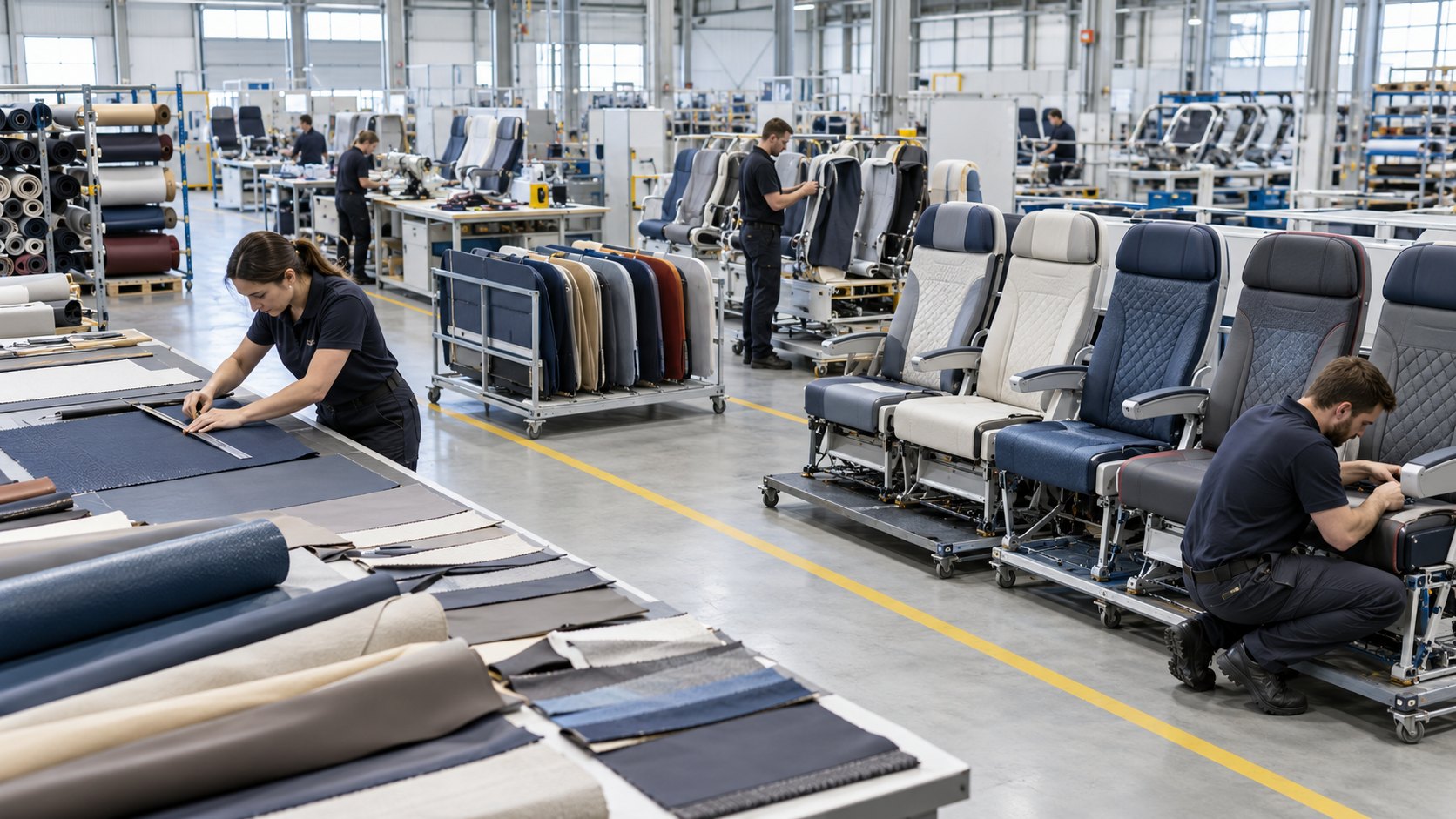
The line covers the soft trim and stops at the mechanism
Read on its own terms, this activity is the soft trim of aircraft seating: recovering and re-trimming seats, cutting and replacing cushion foam, making dress covers, headrest and armrest covers, and the sewn assemblies that go over a seat frame. It is the part of a seat that wears out fastest and is replaced most often, which is exactly why it is a business rather than an occasional job.
What it does not cover is everything the cover is stretched over. The seat's structure, its recline and tracking mechanism, its belts, its in-seat power and its entertainment hardware are work on a certified assembly and on aircraft wiring, and they belong to different capabilities and different approvals. Changing a cabin's seat layout is a design change to the aircraft rather than a re-trim. Full cabin refurbishment — sidewalls, ceilings, galleys, lavatories, carpets, curtains — is a wider scope than seating. And the act of returning the aircraft to service after the seats go back in belongs to the organisation whose approval covers that, which may or may not be you.
Where this is the wrong purchase. If the intention is to build seats rather than re-trim them, this is the wrong line and a manufacturing activity written against seat assemblies will serve better. If the intention is to sell seat covers as accessories or merchandise, this is also the wrong line, and a trading activity costs considerably less to hold.
Getting that classification right is the first of five gates, and they do not arrive in the order most people expect. The material qualification comes before the first quote, not after the first order. The approval position comes before the first customer. The traceability system is what an auditor reads, and it has to have been running from the beginning because it cannot be reconstructed afterwards. Only then do the licence and the premises matter, and those are the two most people start with.
- Fix the exact class of work the shop will sellDecides which approval is needed and which is not
- Qualify every fabric, leather, foam, thread and adhesiveNothing can be quoted until the materials are qualified
- Hold, or work under, the airworthiness approval covering the workTurns a trimmed cushion into something an operator may fit
- Prove traceability from the roll to the finished coverIs what a customer's auditor actually reads
- Take the trade licence and the premises the activity requiresAllows the shop to operate and to be inspected
A trim shop is judged on what it stores as much as on what it sews
The physical requirements follow from the paperwork rather than from the craft. Cutting, sewing and assembly want clean, dust-controlled space and enough of it to lay out hides and foam without improvising. Material storage wants more than most owners plan for, because foam, rolls and finished covers are bulky and because qualified stock cannot be stacked wherever there is room.
That last point is the one that catches people. Qualified aviation material has to be kept apart from anything uncertified, and the reason is not tidiness. A single unqualified bolt on the same rack puts the traceability of everything around it in doubt, and a customer who cannot tell from your records which roll a cover came off has to treat the cover as unproven. Physical separation, clear identification and a record that ties each finished item to its material is the cheapest insurance in the business.
Adhesives, solvents, cleaners and foam are flammable, and storing them is a fire-safety matter for the premises rather than a detail of workshop layout. In Dubai that means the civil defence requirements for handling flammable materials, which bear on the building, the quantities held and the way they are kept.² Offcuts, spent solvent and solvent-soaked rags are a waste stream with its own municipal conditions, and both questions are cheaper to answer before a lease is signed than after.³
Two practical constraints decide where the workshop goes. Seats travel badly and the cost a customer is really managing is cabin downtime, so proximity to a maintenance base is worth rent — which points at industrial space near the major airports rather than at the cheapest available unit. And almost every input is imported: hides, specialist fabrics, foam, fire-blocking layers and thread all arrive from abroad, so the company needs its own customs code and someone who understands how the material is described at the border.⁴ Trimmers of this standard are a scarce and internationally mobile skill, and their work permits run through the Ministry of Human Resources and Emiratisation.⁵
The mainland and free zone choice follows from all of that rather than driving it. A mainland licence is the straightforward answer where the customers are UAE-based operators and the workshop sits in a municipality's area. A free zone suits a shop working mostly on foreign-owned aircraft, with material held and re-exported without clearing into the local market. Neither of them gives you the approval, the material qualification or the traceability, and those are the three things the business actually runs on. ConsultZone confirms the licensing and approval position for your scope, emirate and customer mix before anything is committed.
References
- General Civil Aviation Authority — approval of maintenance organisations, airworthiness requirements and the scope within which aircraft work may be carried out in the UAE. General Civil Aviation Authority
- Dubai Civil Defence — fire-safety requirements for premises storing and handling flammable materials such as adhesives, solvents and foam. Dubai Civil Defence
- Dubai Municipality — premises suitability and the conditions attaching to industrial waste streams. Dubai Municipality
- Dubai Customs — importing hides, textiles, foam and aircraft materials, and holding a customs code in the company's own name. Dubai Customs
- Ministry of Human Resources and Emiratisation — work permits and labour contracts for skilled trim staff. Ministry of Human Resources and Emiratisation
Elsewhere in Manufacturing
Activities that sit beside this one
Most licences carry more than one activity. Adding a neighbouring line at the application stage costs a fraction of amending the licence afterwards.
Begin with a clear conversation
Tell us what you intend to build.
A consultant will map the structure, jurisdiction, approvals and likely cost against what you actually described — not against a package.
